Indemnification Agreement for Personal Property
Overview of this form
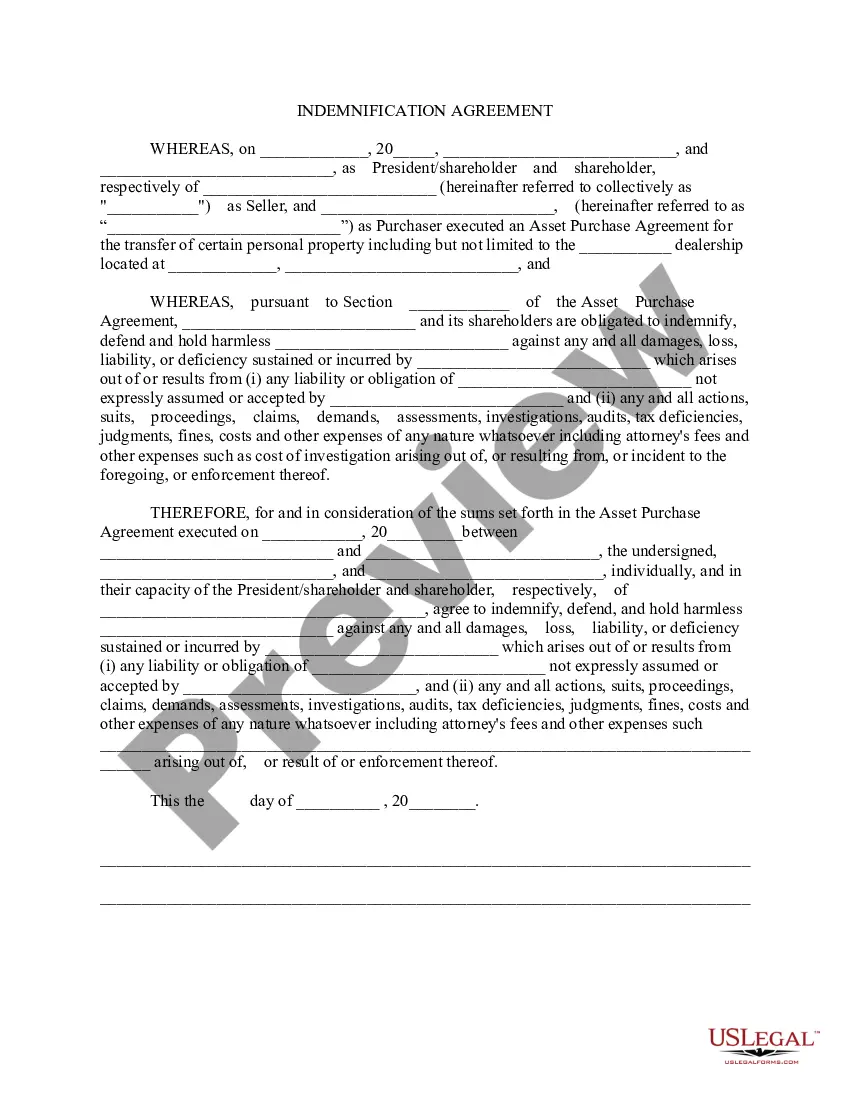
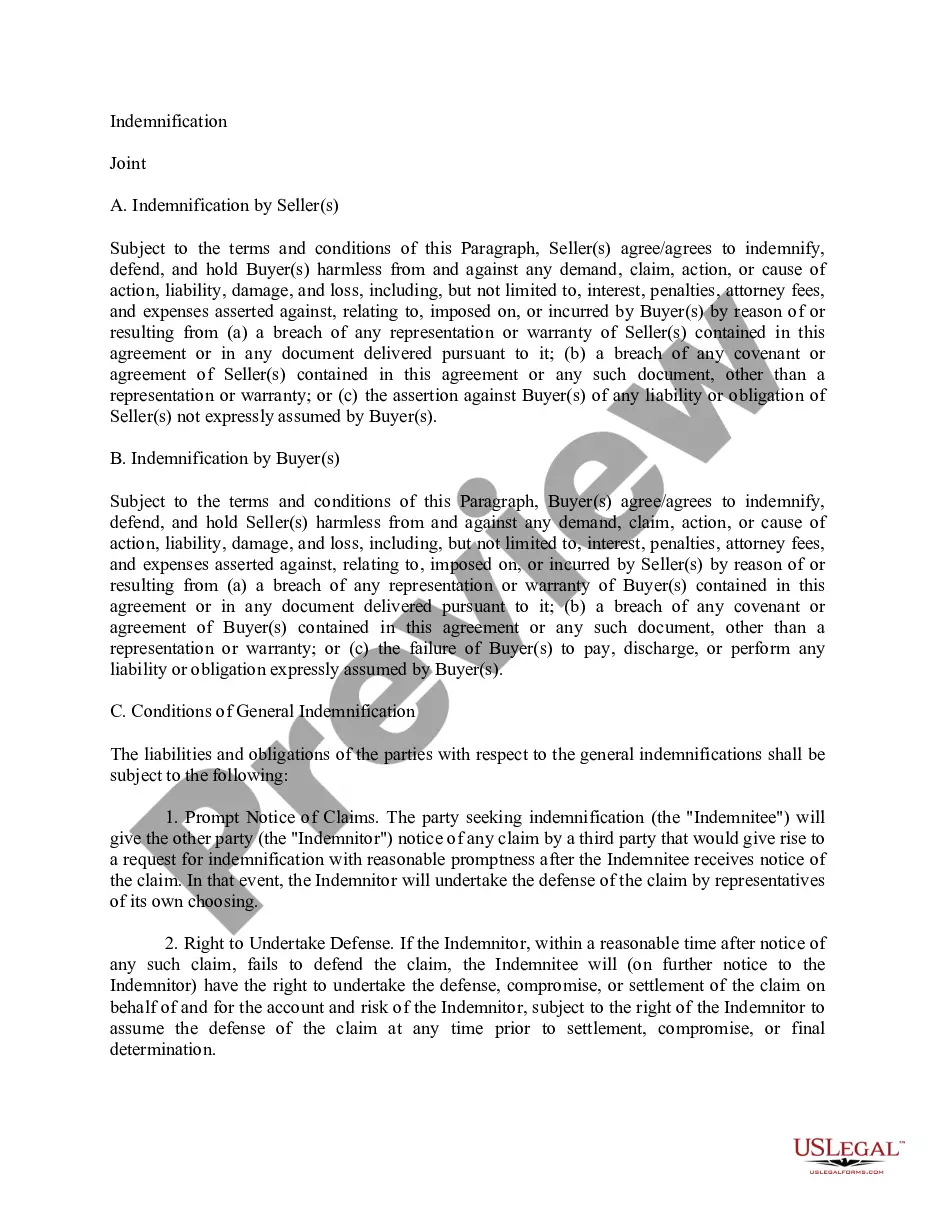
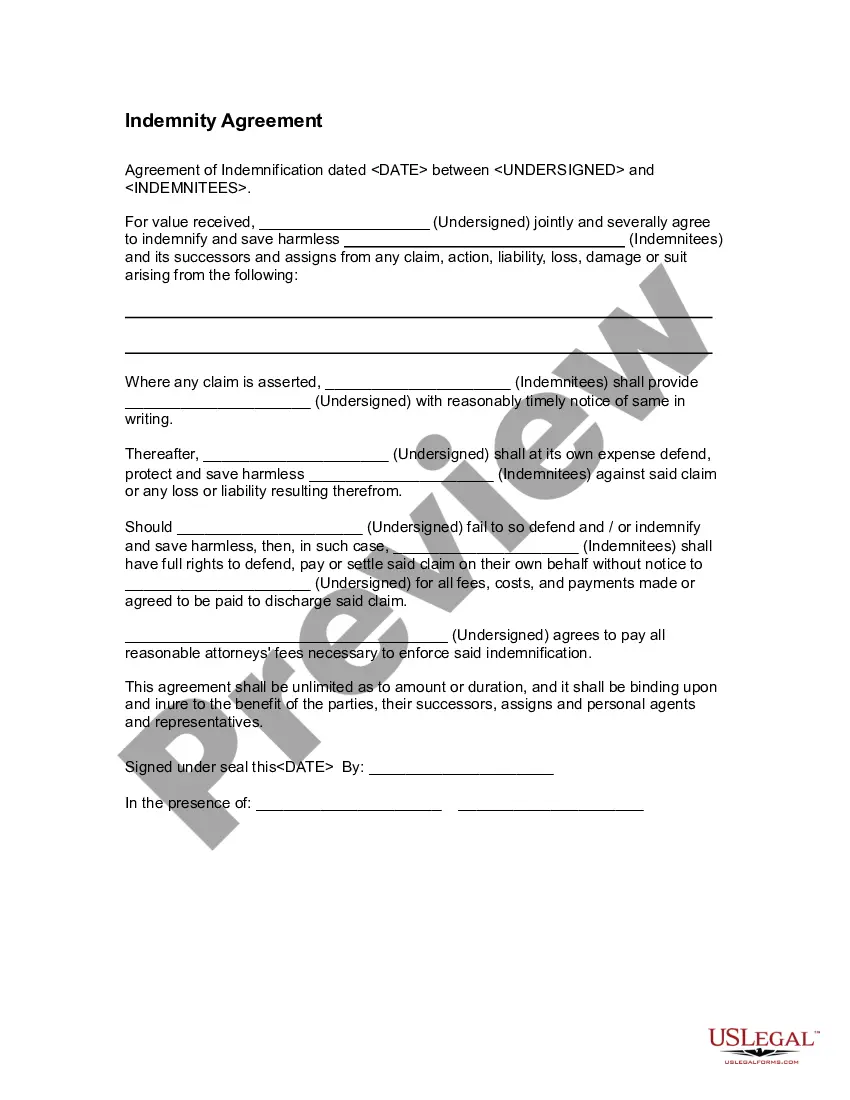
An indemnification agreement for personal property is a legal document that protects a purchaser from potential liabilities arising from the sale of personal property. This form is especially important when shareholders of a company transfer assets to a buyer, as it ensures that the buyer is held harmless from any unforeseen damages or claims relating to the property being purchased. It serves a distinct purpose compared to other agreements by emphasizing the indemnification obligations of the sellers.
Form components explained
- Identification of the parties involved in the agreement: sellers (shareholders) and the purchaser.
- Details of the Asset Purchase Agreement, including the date and property being transferred.
- Indemnification obligations describing the seller's responsibilities to defend and hold the purchaser harmless.
- Provisions regarding liabilities that are not assumed by the purchaser.
- Signatures of the individuals authorized to bind the sellers and the date of agreement.
Common use cases
This form should be used when shareholders of a company have entered into an Asset Purchase Agreement for transferring personal property. It is essential in situations where the purchaser wants to ensure protection against potential claims, liabilities, or losses that may arise due to obligations the seller has not assumed in the agreement. If there is a transfer of significant assets, utilizing this agreement can mitigate legal risks for the purchaser.
Who should use this form
- Shareholders of a company engaging in an asset purchase transaction.
- Purchasers acquiring personal property from a seller and seeking liability protection.
- Business attorneys drafting agreements for asset transfers to ensure compliance and legal protection.
Instructions for completing this form
- Identify the parties involved by entering the names of the shareholders and the purchaser.
- Specify the date of the Asset Purchase Agreement and the personal property being transferred.
- Clearly outline the indemnification obligations in the designated sections.
- Include the specific liabilities that are not assumed by the purchaser.
- Ensure all parties sign and date the agreement to make it legally binding.
Does this form need to be notarized?
In most cases, this form does not require notarization. However, some jurisdictions or signing circumstances might. US Legal Forms offers online notarization powered by Notarize, accessible 24/7 for a quick, remote process.
Get your form ready online
Our built-in tools help you complete, sign, share, and store your documents in one place.
Make edits, fill in missing information, and update formatting in US Legal Forms—just like you would in MS Word.
Download a copy, print it, send it by email, or mail it via USPS—whatever works best for your next step.
Sign and collect signatures with our SignNow integration. Send to multiple recipients, set reminders, and more. Go Premium to unlock E-Sign.
If this form requires notarization, complete it online through a secure video call—no need to meet a notary in person or wait for an appointment.
We protect your documents and personal data by following strict security and privacy standards.

Make edits, fill in missing information, and update formatting in US Legal Forms—just like you would in MS Word.

Download a copy, print it, send it by email, or mail it via USPS—whatever works best for your next step.

Sign and collect signatures with our SignNow integration. Send to multiple recipients, set reminders, and more. Go Premium to unlock E-Sign.

If this form requires notarization, complete it online through a secure video call—no need to meet a notary in person or wait for an appointment.

We protect your documents and personal data by following strict security and privacy standards.
Typical mistakes to avoid
- Failing to accurately identify all parties involved in the agreement.
- Leaving out key details about the personal property being sold.
- Not specifying the liabilities not assumed by the purchaser.
- Missing signatures or dates, which can invalidate the agreement.
Benefits of completing this form online
- Immediate access to a professionally drafted indemnification agreement.
- Easy customization to fit your specific transaction and needs.
- Downloadable format allows for easy printing and sharing.
Legal use & context
- This form establishes clear liability terms between parties in a personal property transaction.
- Enforceability may vary based on the specifics of the transaction and local legal standards.
Quick recap
- An indemnification agreement protects the purchaser from seller's past liabilities.
- This form is crucial in asset purchase transactions involving significant personal property.
- Clear identification and definitions are key to effective use of this form.
Looking for another form?


Form popularity
FAQ
It's still your business decision whether you sign them or not, but you should do so only where it is a critical contract that you have no way of modifying or negotiating changes. In contrast, the best kind of Indemnity Agreement is commonly called a Mutual Indemnity Agreement or a Mutual Hold Harmless Provision.
When the term indemnity is used in the legal sense, it may also refer to an exemption from liability for damages. Indemnity is a contractual agreement between two parties. In this arrangement, one party agrees to pay for potential losses or damages caused by another party.
With a real estate indemnity agreement, one party is pledging to protect another from any kind of financial loss or from a lawsuit of some kind.With a real estate indemnity agreement, one party, usually the buyer, agrees to take full responsibility for a mistake or a problem caused by the other.
Transitive verb. 1 : to secure against hurt, loss, or damage. 2 : to make compensation to for incurred hurt, loss, or damage. Other Words from indemnify Synonyms Choose the Right Synonym Example Sentences Learn More about indemnify.
Generally (but not always), California courts agree to provide indemnity for own negligence if the parties use sufficiently specific and explicit language that is strictly construed against the indemnitee.
Just as a limit of liability would not restrict an obligation to develop software or any other obligation to perform it does not restrict obligations to perform an indemnity. The indemnitor must spend whatever is necessary to defend the indemnified claim, to settle the case, and/or to cover judgments.
"Indemnify" and "hold harmless" both mean pretty much the same thing: to make the injured party whole again.In California, you have the option to choose if you are the indemnifying party to choose to defend yourself.
Indemnification provisions are generally enforceable. There are certain exceptions however. Indemnifications that require a party to indemnify another party for any claim irrespective of fault ('broad form' or 'no fault' indemnities) generally have been found to violate public policy.