General and Continuing Guaranty and Indemnification Agreement
Overview of this form
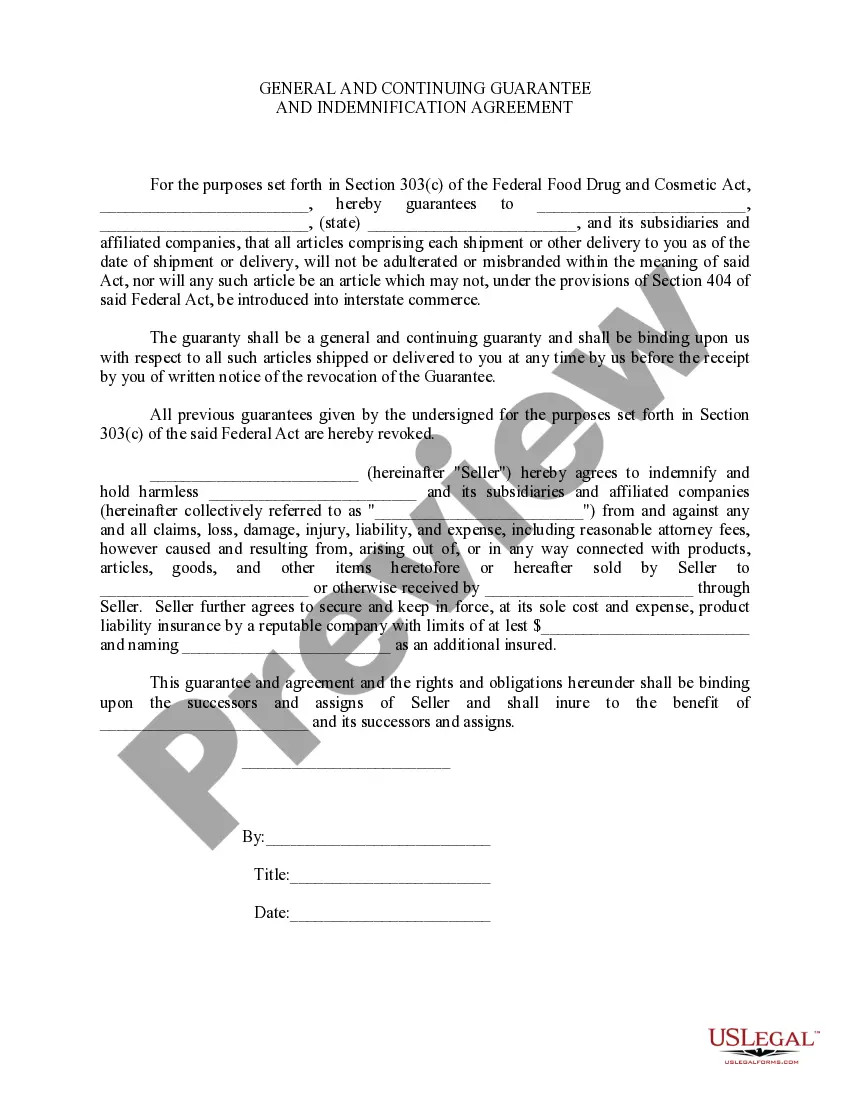
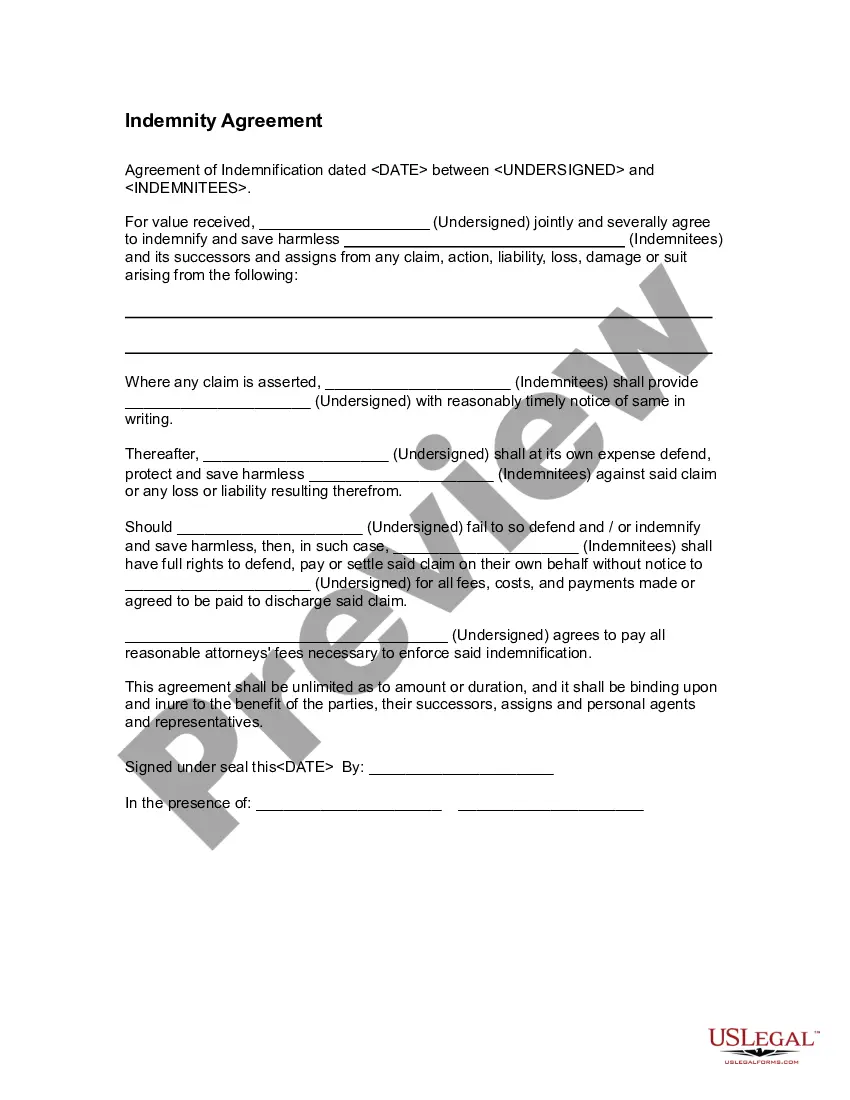
The General and Continuing Guaranty and Indemnification Agreement is a legally binding document that outlines a seller's commitment to guarantee that all articles shipped or delivered comply with specific regulations. This form not only serves as a guarantee of product integrity but also indemnifies the buyer against potential liabilities arising from the goods supplied. Unlike other guaranty agreements, this form emphasizes its ongoing nature until revoked in writing, making it essential for long-term business relationships.
What’s included in this form
- Guarantee Clause: Affirms that the seller's products meet legal standards and do not misbrand or adulterate.
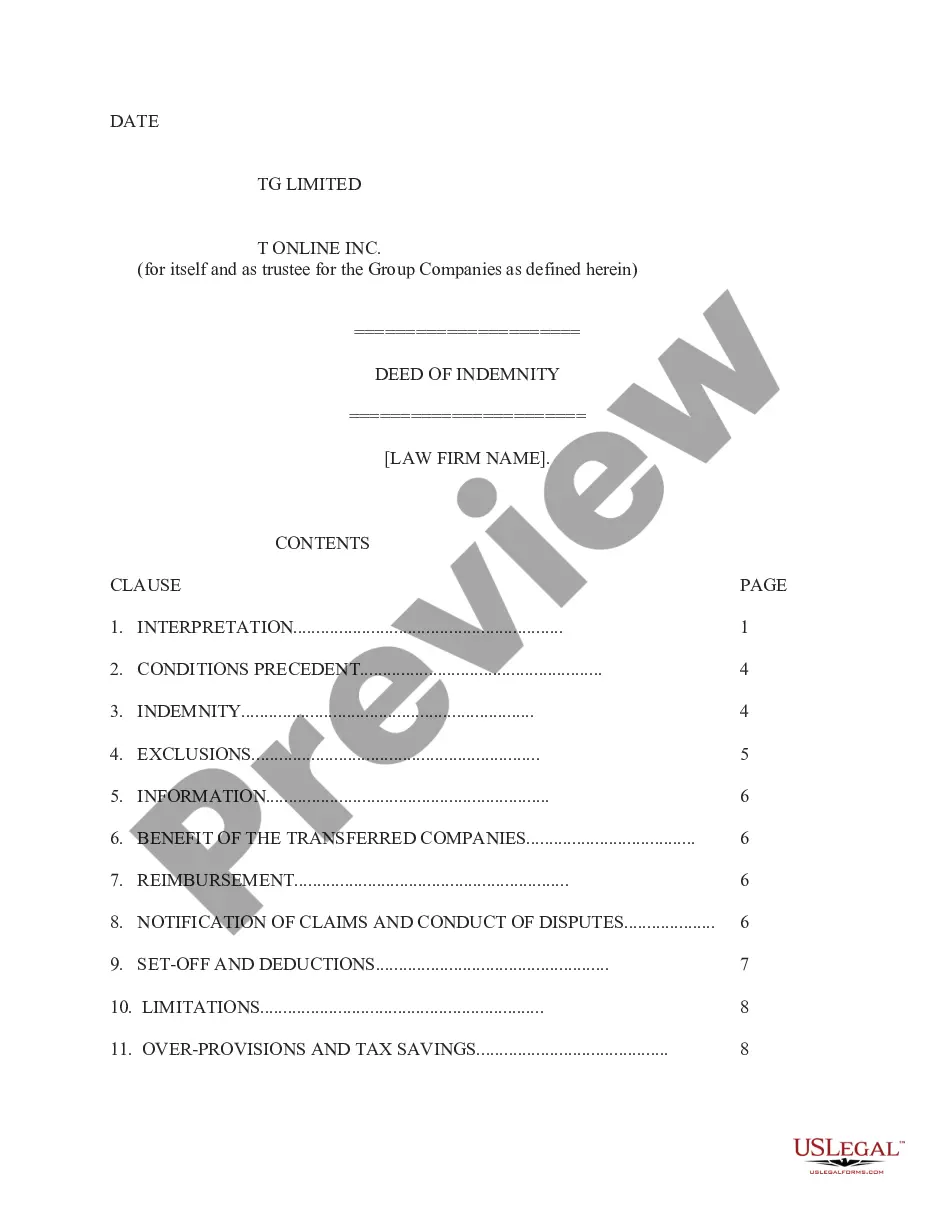
- Indemnification Clause: Protects the buyer from claims or losses related to products supplied by the seller.
- Revocation of Previous Guarantees: Clearly states that previous guarantees are revoked upon this agreement's execution.
- Insurance Requirement: The seller must maintain product liability insurance and name the buyer as an additional insured.
- Binding Effect: Details that the agreement is binding upon successors and assigns of the seller.
When to use this document
This form is used primarily in business transactions involving the sale of goods where a seller needs to guarantee the quality and compliance of products to a buyer. It is essential when establishing a long-term supplier relationship where ongoing shipments are involved and protects the buyer from potential liabilities associated with the delivered products.
Intended users of this form
This agreement is suitable for:
- Business owners who sell products requiring certification of non-adulteration.
- Buyers who wish to protect themselves from liability related to purchased goods.
- Manufacturers shipping products to distributors or retailers.
- Companies looking to establish formal agreements for ongoing supply.
Instructions for completing this form
- Identify the seller and buyer by entering their names and relevant details in the designated sections.
- State the products or articles being guaranteed in the agreement.
- Specify the limits of product liability insurance that the seller must maintain.
- Sign and date the form in the appropriate places to affirm its validity.
- Ensure that all parties retain copies of the signed agreement for their records.
Does this document require notarization?
This form does not typically require notarization to be legally valid. However, some jurisdictions or document types may still require it. US Legal Forms provides secure online notarization powered by Notarize, available 24/7 for added convenience.
Get your form ready online
Our built-in tools help you complete, sign, share, and store your documents in one place.
Make edits, fill in missing information, and update formatting in US Legal Forms—just like you would in MS Word.
Download a copy, print it, send it by email, or mail it via USPS—whatever works best for your next step.
Sign and collect signatures with our SignNow integration. Send to multiple recipients, set reminders, and more. Go Premium to unlock E-Sign.
If this form requires notarization, complete it online through a secure video call—no need to meet a notary in person or wait for an appointment.
We protect your documents and personal data by following strict security and privacy standards.

Make edits, fill in missing information, and update formatting in US Legal Forms—just like you would in MS Word.

Download a copy, print it, send it by email, or mail it via USPS—whatever works best for your next step.

Sign and collect signatures with our SignNow integration. Send to multiple recipients, set reminders, and more. Go Premium to unlock E-Sign.

If this form requires notarization, complete it online through a secure video call—no need to meet a notary in person or wait for an appointment.

We protect your documents and personal data by following strict security and privacy standards.
Typical mistakes to avoid
- Not providing a complete description of the products covered by the guaranty.
- Failing to specify the insurance requirements clearly.
- Not revoking prior guarantees in the agreement.
- Ignoring the need for all parties to sign and date the form to validate it.
Why complete this form online
- Convenience in accessing and completing the form from anywhere.
- Editability for customizing the content to fit specific needs.
- Reliable access to forms drafted by licensed attorneys.
Legal use & context
- This form is legally binding when properly completed and executed by both parties.
- It protects the buyer by transferring risks associated with the quality of goods to the seller.
- Failure to comply with federal standards can lead to significant legal repercussions, making this form essential for compliance.
Main things to remember
- The General and Continuing Guaranty and Indemnification Agreement establishes binding guarantees on product quality.
- This form protects buyers from potential legal liabilities linked to supplied articles.
- It is essential for ensuring ongoing business relationships in sales transactions.
Looking for another form?




Form popularity
FAQ
The key differences between guarantees and indemnities include: a guarantee is a secondary liability, which means that there will be another person who is primarily liable for the obligation; whereas, an indemnity imposes a primary liability.a guarantor's liability is limited by the extent of the debtor's liability.
Continuing guaranty refers to a guaranty in which the guarantor will not be liable unless a specified event occurs.A continuing guaranty may be revoked at any time by the guarantor in respect to future transactions, unless there is a continuing consideration as to the transactions that the guarantor does not give up.
Unlike a guarantee, an indemnity need not be in writing or signed by the indemnifier in order to be effective. More robust. Being a primary obligation, an indemnity will be valid even if the underlying transaction is set aside; unlike a guarantee, which is dependent on the underlying transaction.
Specific Guarantee: A specific guarantee is for a single debt or any specified transaction. It comes to an end when such debt has been paid.A continuing guarantee applies to all the transactions entered into by the principal debtor until it is revoked by the surety.
A continuing guaranty is an agreement by the guarantor to be liable for the obligations of someone else to the lender, even if there are several different obligations that are made, renewed or repaid over time. In contrast, a specific guaranty is limited only to one individual transaction.
A continuing guaranty is an agreement by the guarantor to be liable for the obligations of someone else to the lender, even if there are several different obligations that are made, renewed or repaid over time. In contrast, a specific guaranty is limited only to one individual transaction.
There are two types of Guarantee i.e. Specific Guarantee which is for a specific transaction and Continuing Guarantee which is for a series of transactions. Specific Guarantee: A guarantee which is given for only one transaction or debt, the guarantee is known as a Specific Guarantee.
Bid/Tender Guarantee. Issued in support of an exporter's bid to supply goods or services and, if successful, ensures compensation in the event that the contract is not signed. Performance Guarantee. Advance Payment Guarantee. Warranty Guarantee. Retention Guarantee.
A continuing guarantee is said to be revoked as regards to the future transactions to be entered between the debtor and the creditor, in the following ways: By notice of revocation by the surety (Section 130) By death of the surety (Section 131)