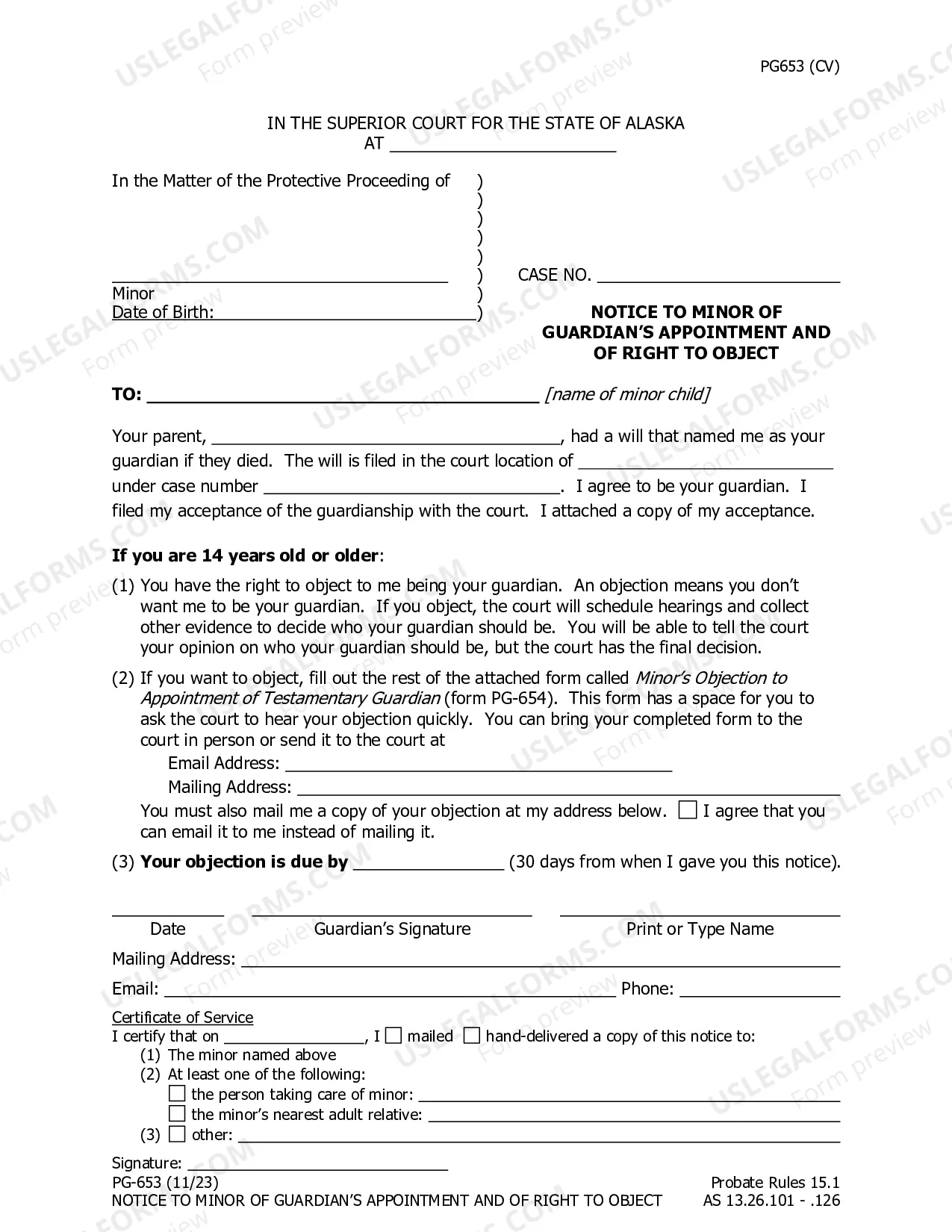
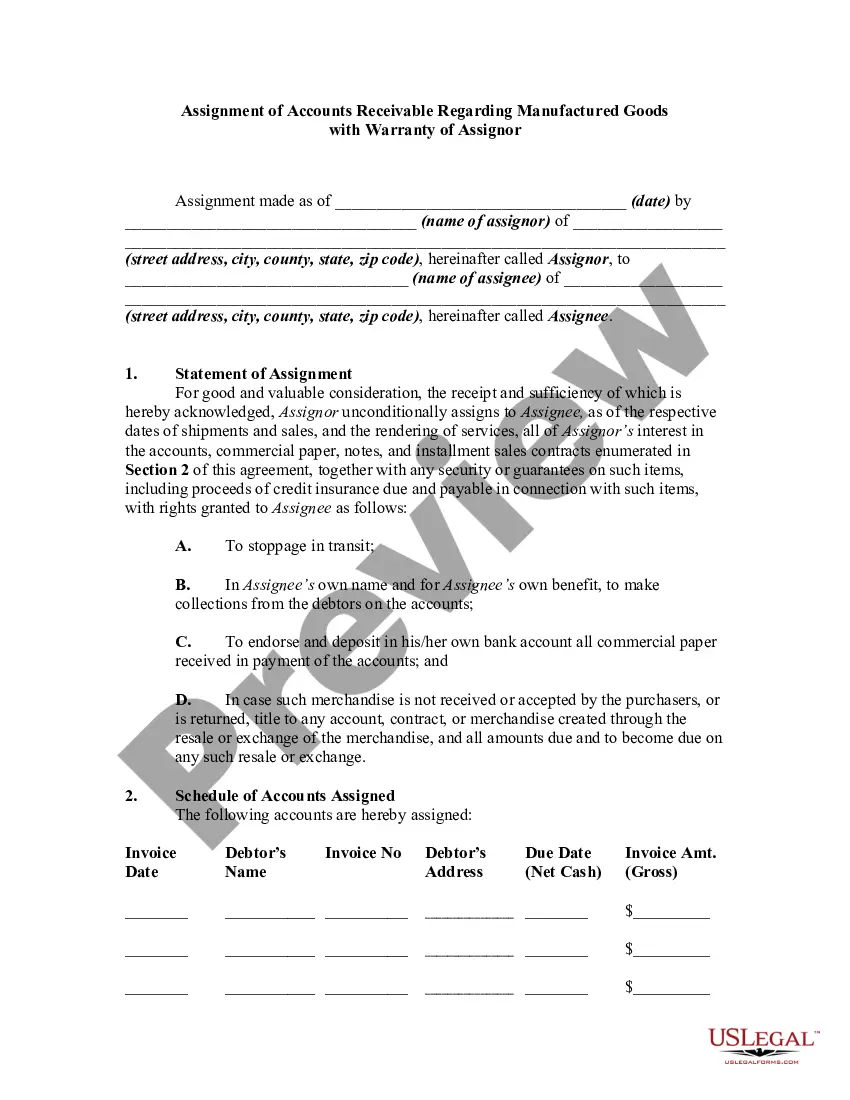
Assignment of Accounts Receivable Regarding Manufactured Goods with Warranty of Assignor
About this form
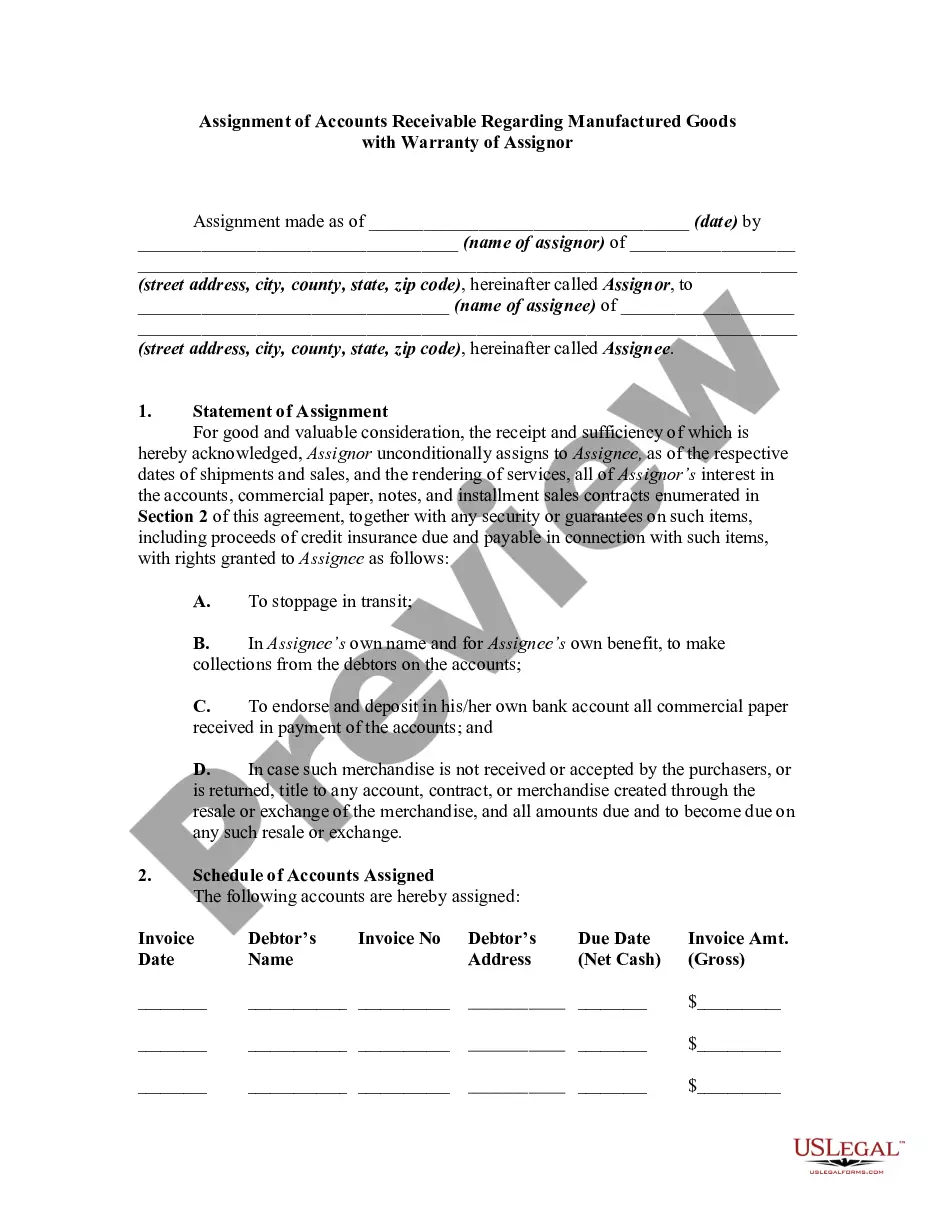
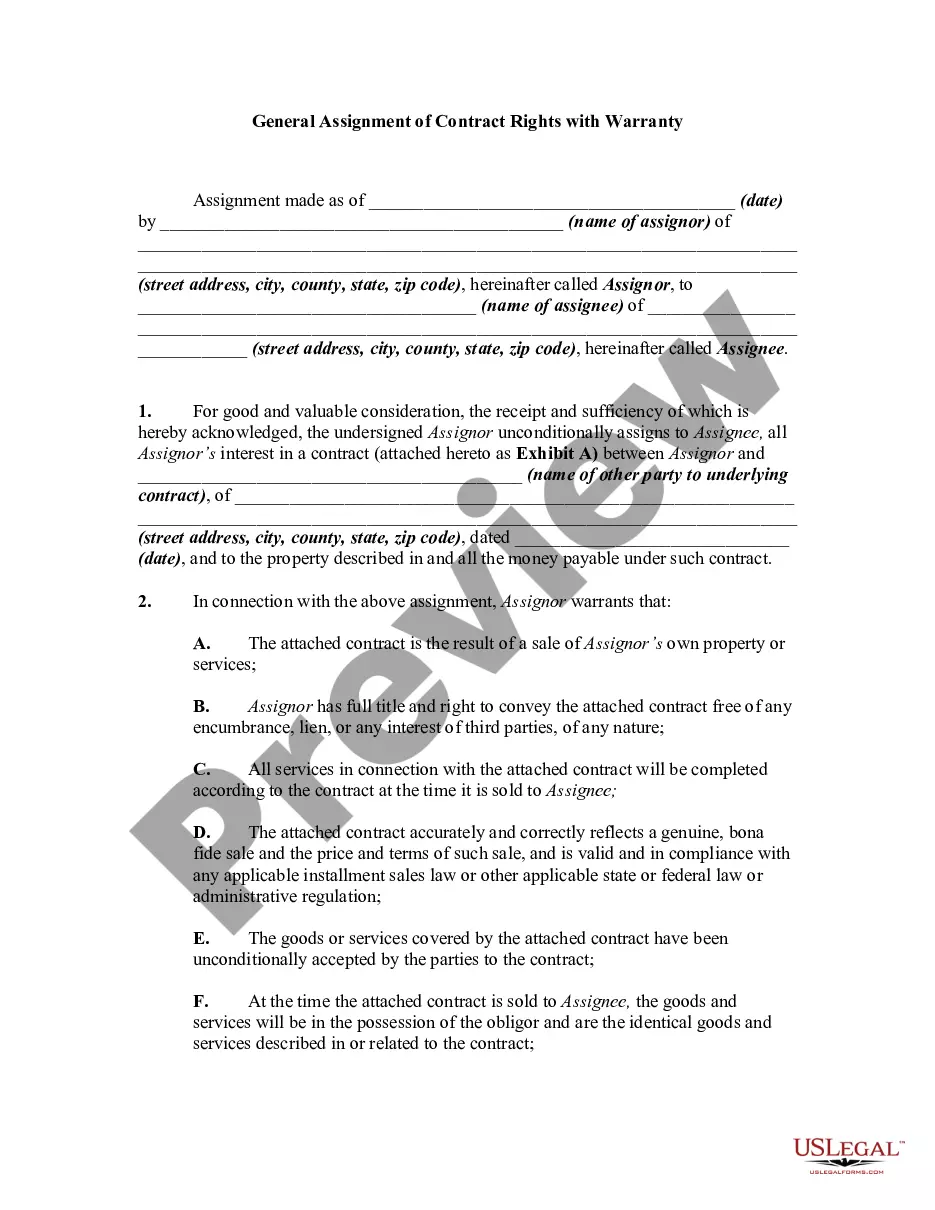
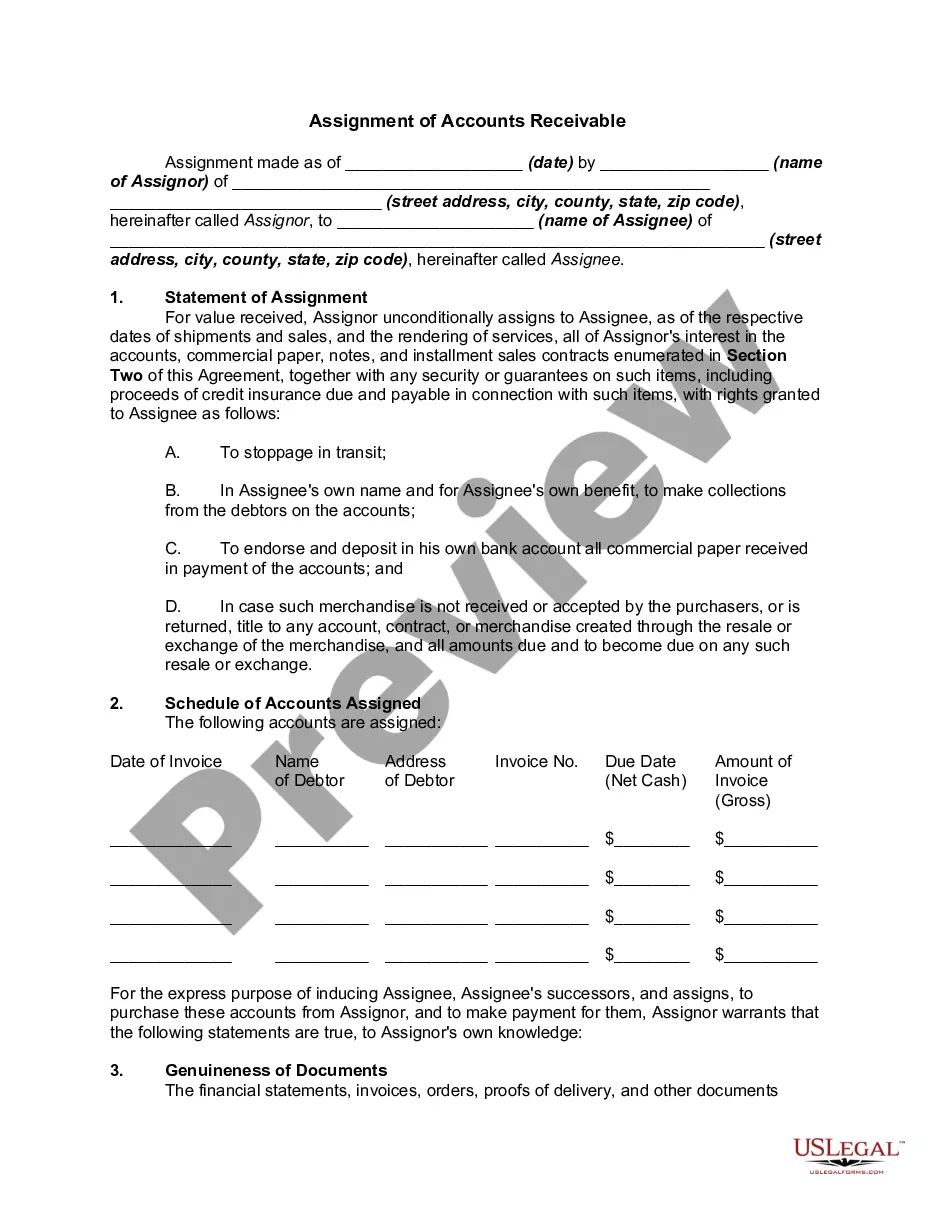
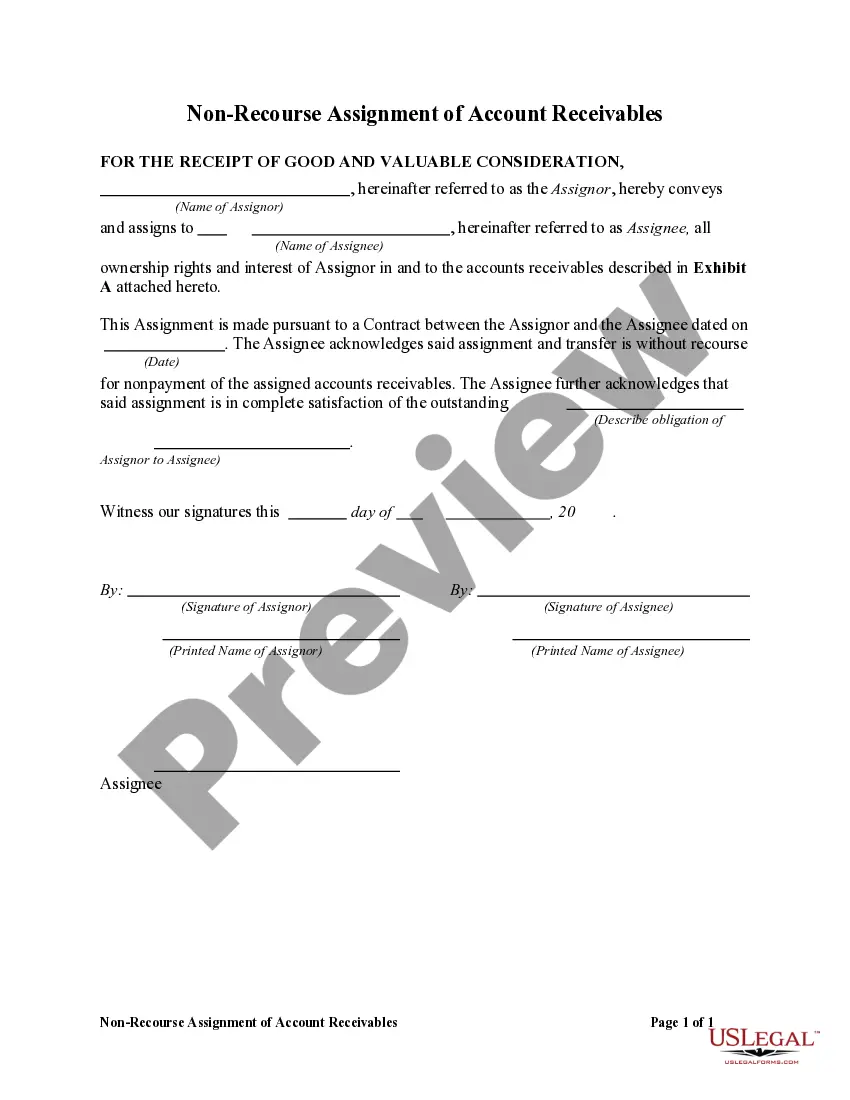
The Assignment of Accounts Receivable Regarding Manufactured Goods with Warranty of Assignor is a legal document that facilitates the transfer of accounts receivable from one party (the Assignor) to another (the Assignee). This form ensures that the Assignee receives the rights to collect on specified accounts, including any associated warranties. Unlike simpler assignment forms, this document includes detailed representations about the validity and condition of the assigned accounts, specifically related to manufactured goods. It protects both parties by clarifying their rights and obligations concerning the transferred accounts.
Form components explained
- Date of assignment and names of the Assignor and Assignee
- Statement of assignment, detailing the accounts receivable being transferred
- Schedule listing the specific accounts, invoices, and debtors
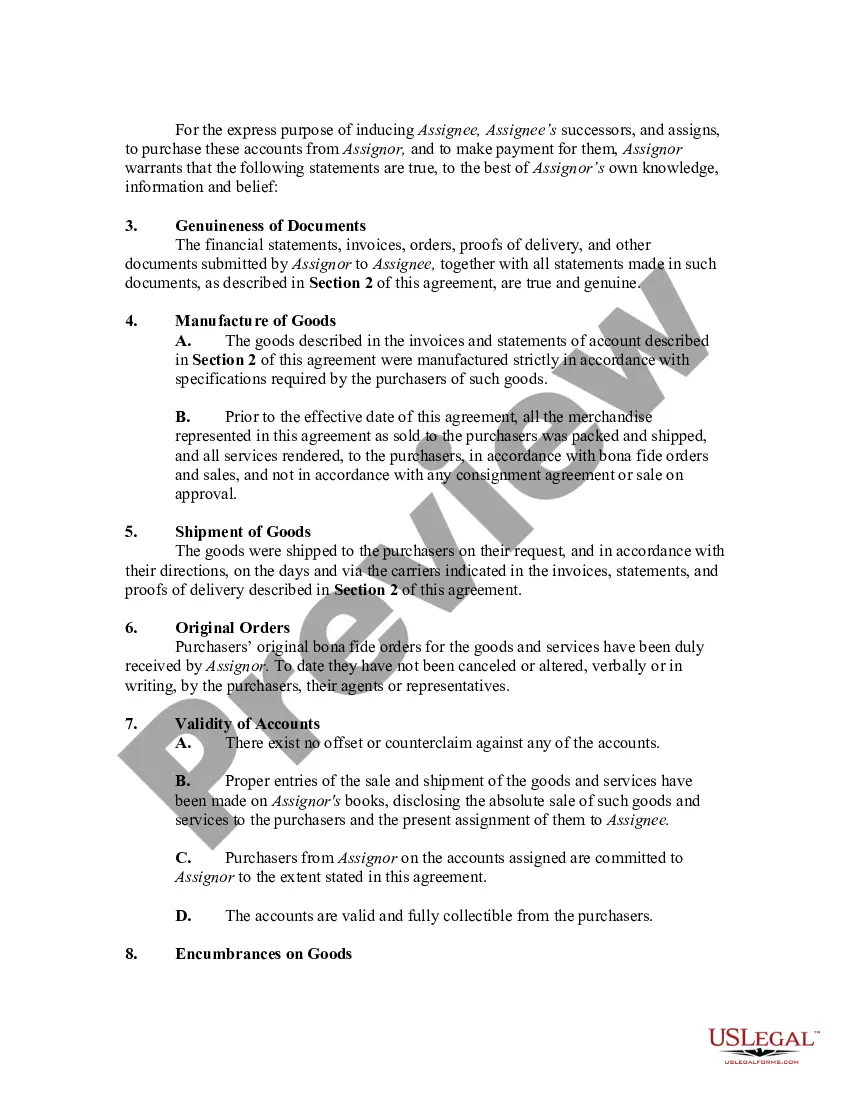
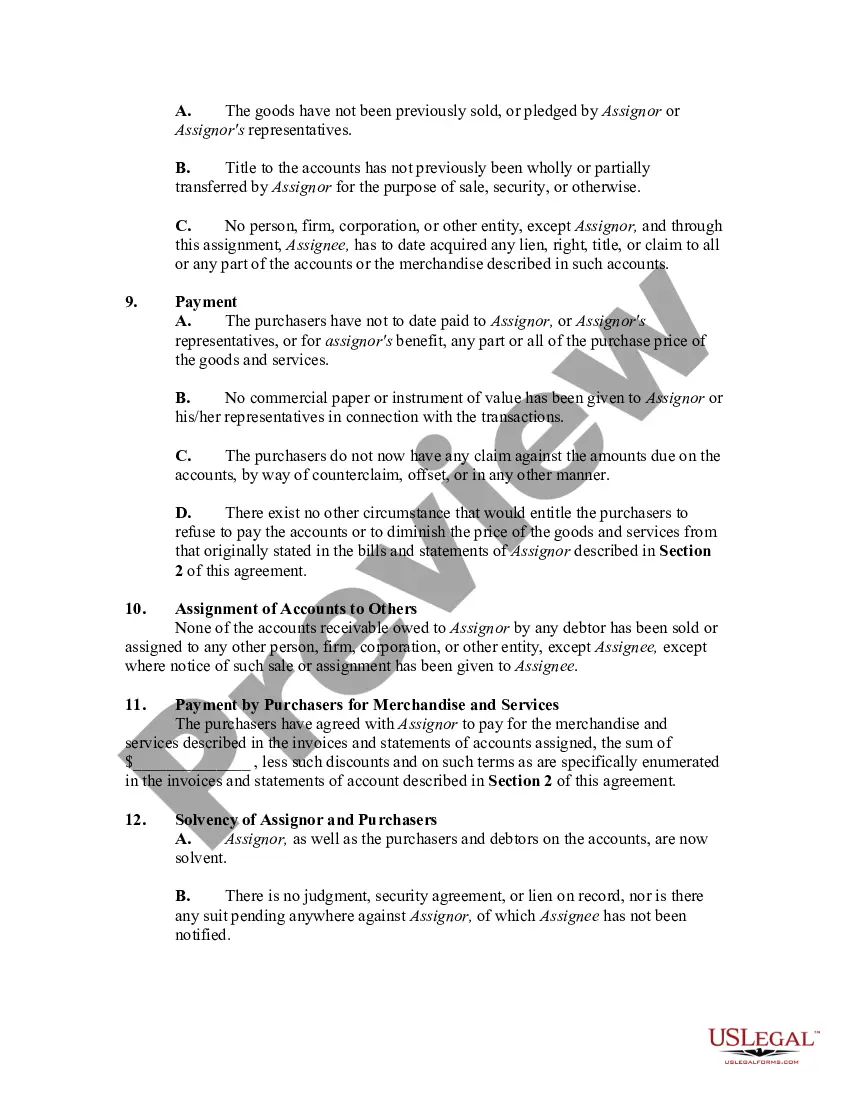
- Warranties made by the Assignor about the genuineness of documents and validity of accounts
- Confirmation of the manufactured goods and shipment arrangements
- Statement regarding the solvency of the Assignor and debtors


Common use cases
This form is essential when a business desires to transfer its rights to collect payments from customers for manufactured goods to another party. Situations may include selling accounts receivable to improve cash flow, financing operations, or consolidating debt. By using this assignment form, businesses can ensure they have documented proof of the transfer, which is crucial for legal and financial clarity.
Who can use this document
- Businesses selling manufactured goods that have outstanding invoices
- Companies needing to improve cash flow by selling accounts receivable
- Professionals acting on behalf of the Assignor or Assignee, such as lawyers or finance advisors
- Anyone looking to formalize the assignment of accounts for the collection of payments
How to complete this form
- Identify the parties involved by entering the names and addresses of both the Assignor and Assignee.
- Fill in the date of assignment at the top of the form.
- List all accounts receivable being assigned in the specified schedule, including details like invoice numbers and amounts.
- Provide warranties by the Assignor regarding the validity and condition of the assigned accounts.
- Ensure both parties sign the document to formalize the assignment.
Notarization requirements for this form
This form usually doesn’t need to be notarized. However, local laws or specific transactions may require it. Our online notarization service, powered by Notarize, lets you complete it remotely through a secure video session, available 24/7.
Get your form ready online
Our built-in tools help you complete, sign, share, and store your documents in one place.
Make edits, fill in missing information, and update formatting in US Legal Forms—just like you would in MS Word.
Download a copy, print it, send it by email, or mail it via USPS—whatever works best for your next step.
Sign and collect signatures with our SignNow integration. Send to multiple recipients, set reminders, and more. Go Premium to unlock E-Sign.
If this form requires notarization, complete it online through a secure video call—no need to meet a notary in person or wait for an appointment.
We protect your documents and personal data by following strict security and privacy standards.

Make edits, fill in missing information, and update formatting in US Legal Forms—just like you would in MS Word.

Download a copy, print it, send it by email, or mail it via USPS—whatever works best for your next step.

Sign and collect signatures with our SignNow integration. Send to multiple recipients, set reminders, and more. Go Premium to unlock E-Sign.

If this form requires notarization, complete it online through a secure video call—no need to meet a notary in person or wait for an appointment.

We protect your documents and personal data by following strict security and privacy standards.
Common mistakes to avoid
- Failing to list all relevant accounts receivable, leading to incomplete assignments.
- Not securing required signatures from both the Assignor and Assignee.
- Omitting critical details in the warranties section, which could lead to legal disputes.
- Neglecting to keep a copy of the executed assignment for record-keeping.
Advantages of online completion
- Convenience of downloading and filling out the form at your own pace.
- Easy access to legal templates prepared by licensed attorneys.
- Time-saving by avoiding the need to draft the form from scratch.
- Secure storage and retrieval options for completed documents.
Looking for another form?
Form popularity
FAQ
The assignee is the party that receives the rights and obligations under the contract, but wasn't an original party to the contract. The assignor was an original party to the contract and is the party that transfers its contractual rights to another party.
The purpose of assigning accounts receivable is to provide collateral in order to obtain a loan. To illustrate, let's assume that a corporation receives a special order from a new customer whose credit rating is superb.
It is not uncommon that companies with cash flow problems or those that have a desire to be paid on expedited terms assign their accounts receivables as collateral for a secured loan or they factor them.In the case of factoring, the contractor sells its accounts receivable to the financial institution or the factor.
Accounts Receivable (A/R) is the money owed to a business by its clients. The main objective in Accounts Receivable management is to minimise the Days Sales Outstanding (DSO) and processing costs whilst maintaining good customer relations.
Accounts receivable is a common account used by company accountants to track revenue earned but not yet collected. It is a balance of money owed to the business by buyers who make purchases on account and agree to pay later.
Assignment of accounts receivable is a lending agreement whereby the borrower assigns accounts receivable to the lending institution.The borrower pays interest and a service charge on the loan and the assigned receivables serve as collateral.
The assignor normally remains liable unless there is an agreement to the contrary by the other party to the contract.No specific language is required to create an assignment so long as the assignor makes clear his/her intent to assign identified contractual rights to the assignee.
The assignee won't be required to go through the assignor when asserting legal rights under the contract. This means that the assignee can generally sue the other party to the contract if that party doesn't fulfill the contract.