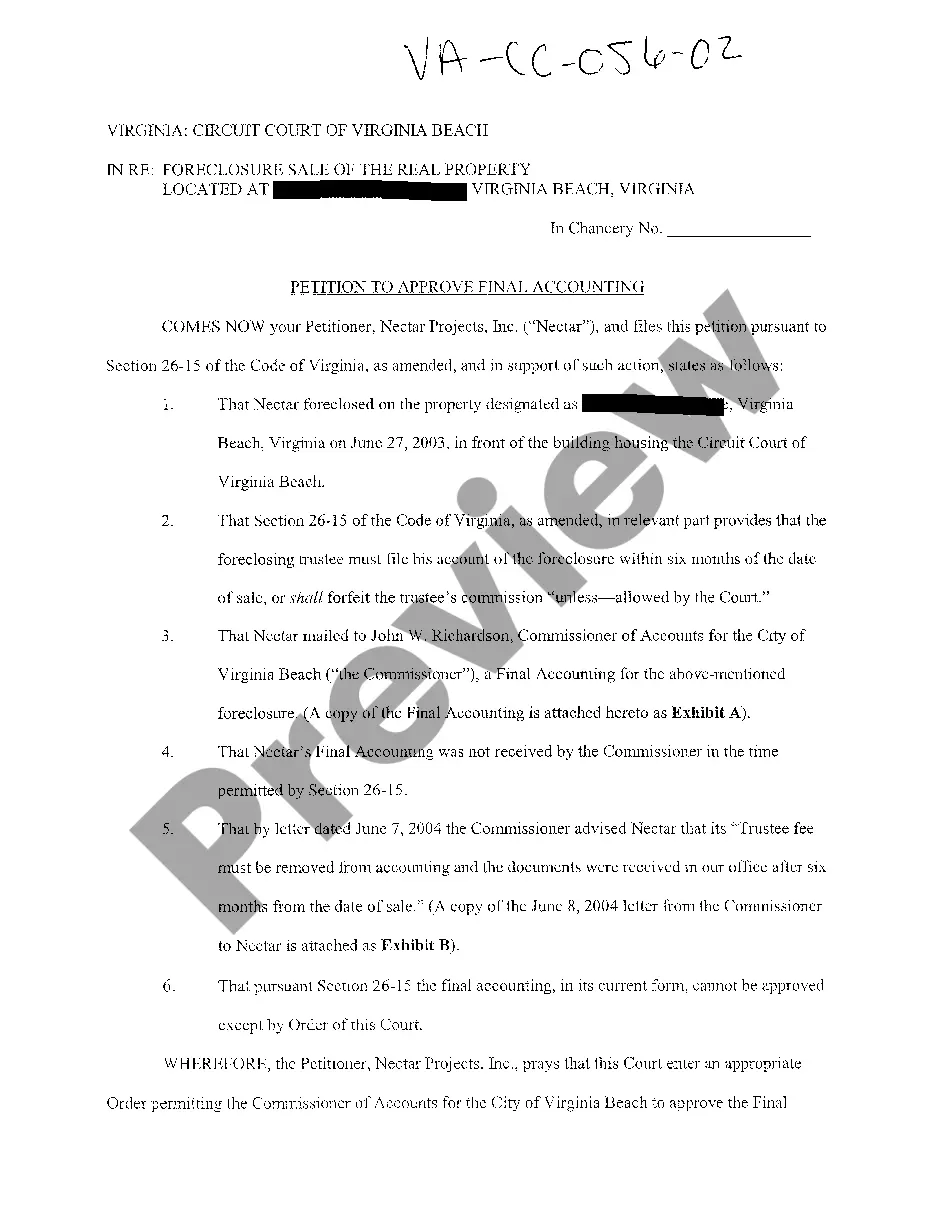
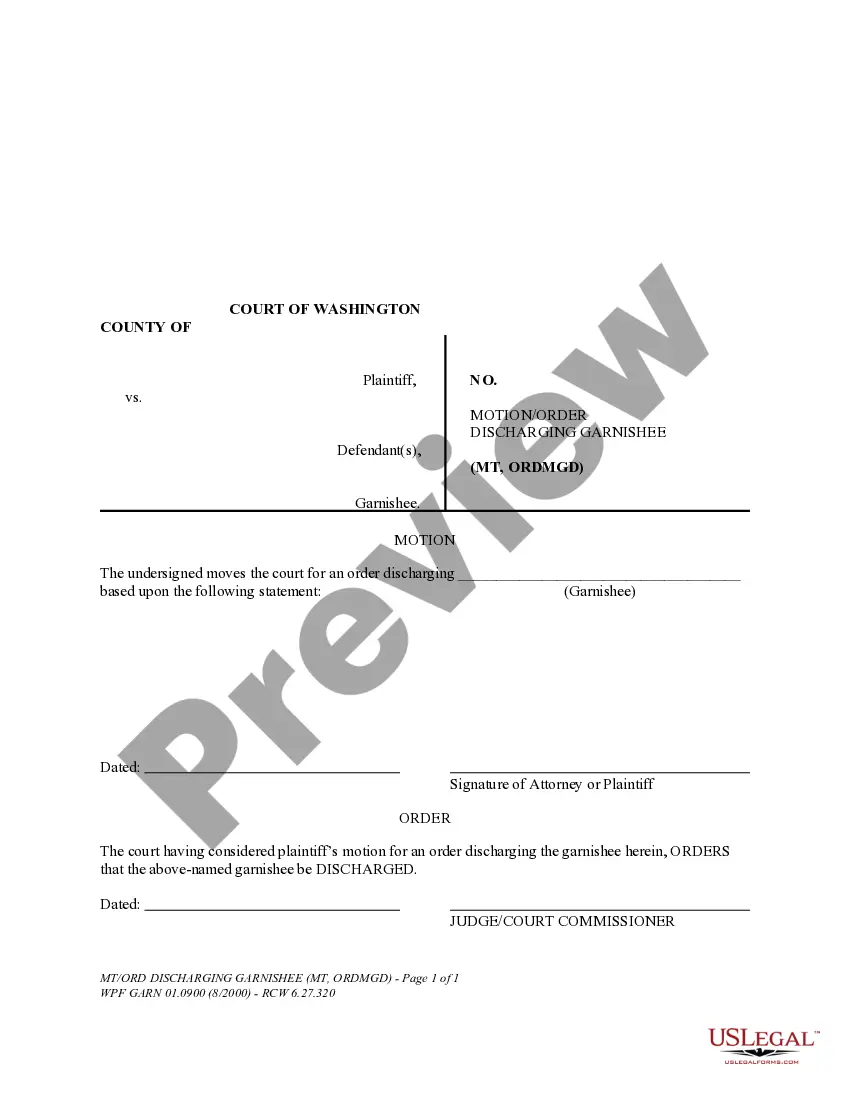
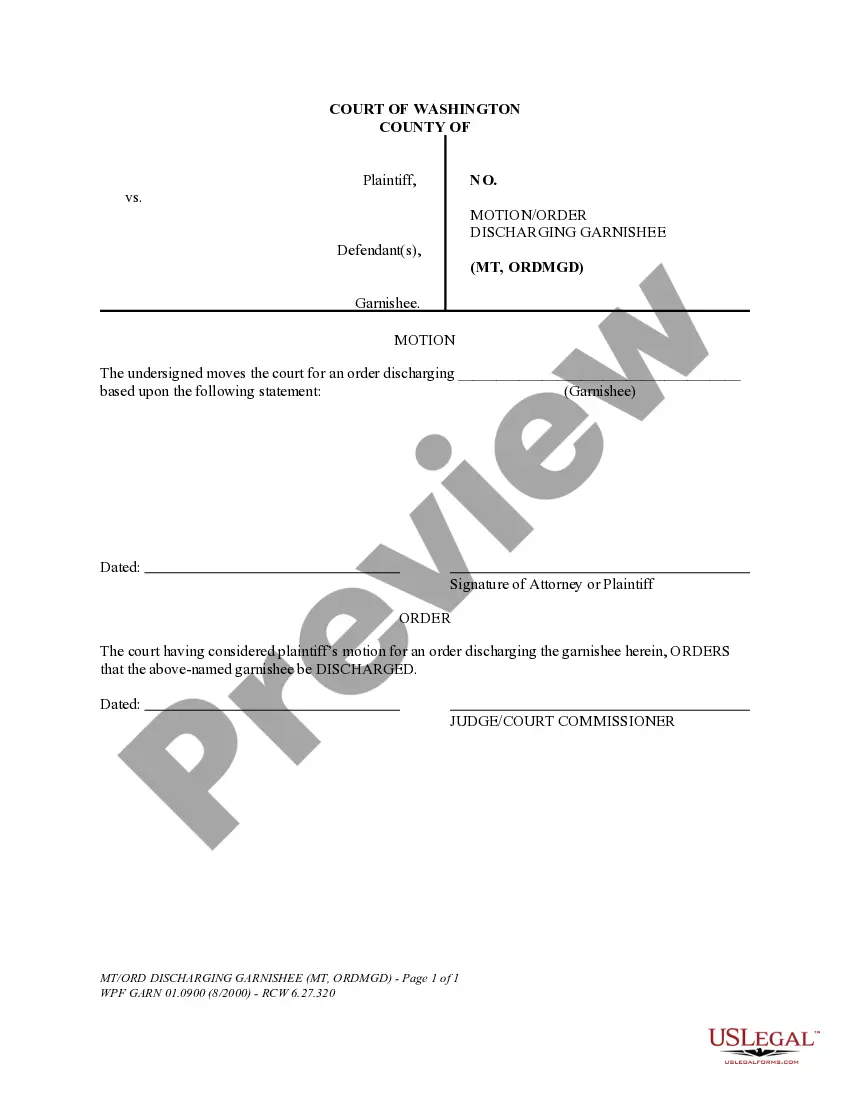
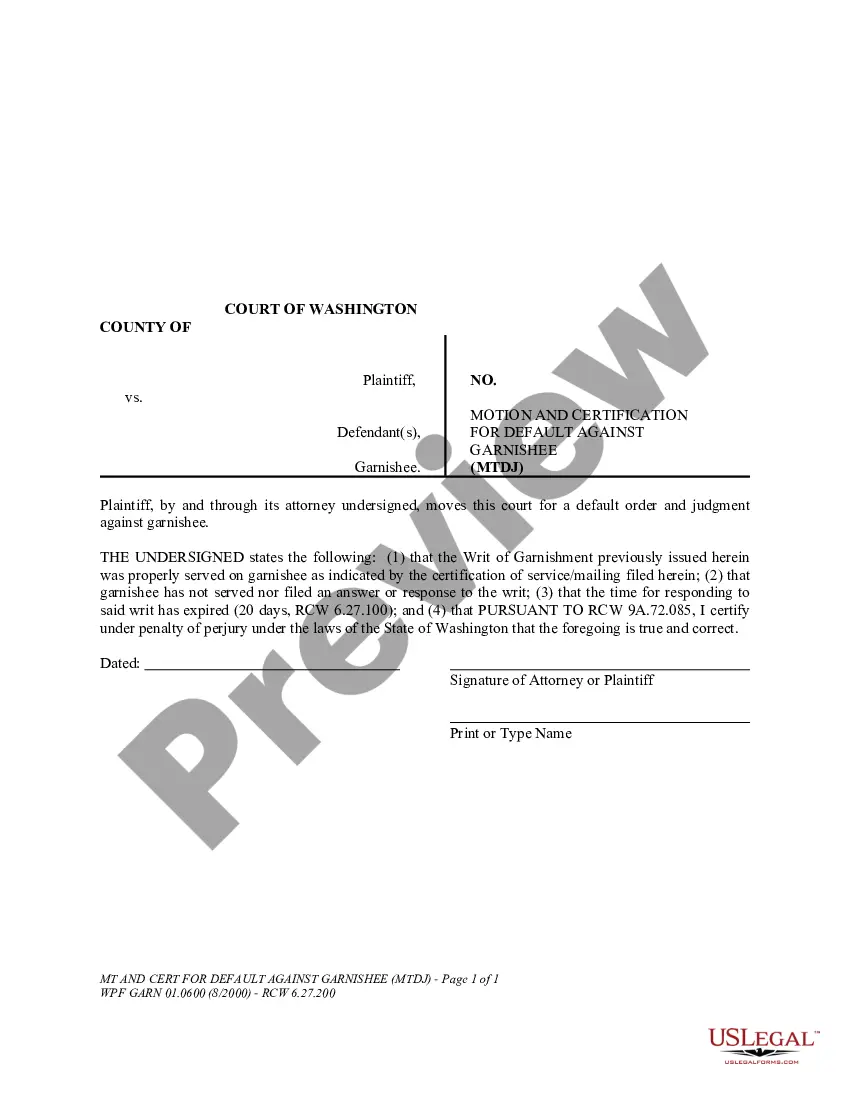
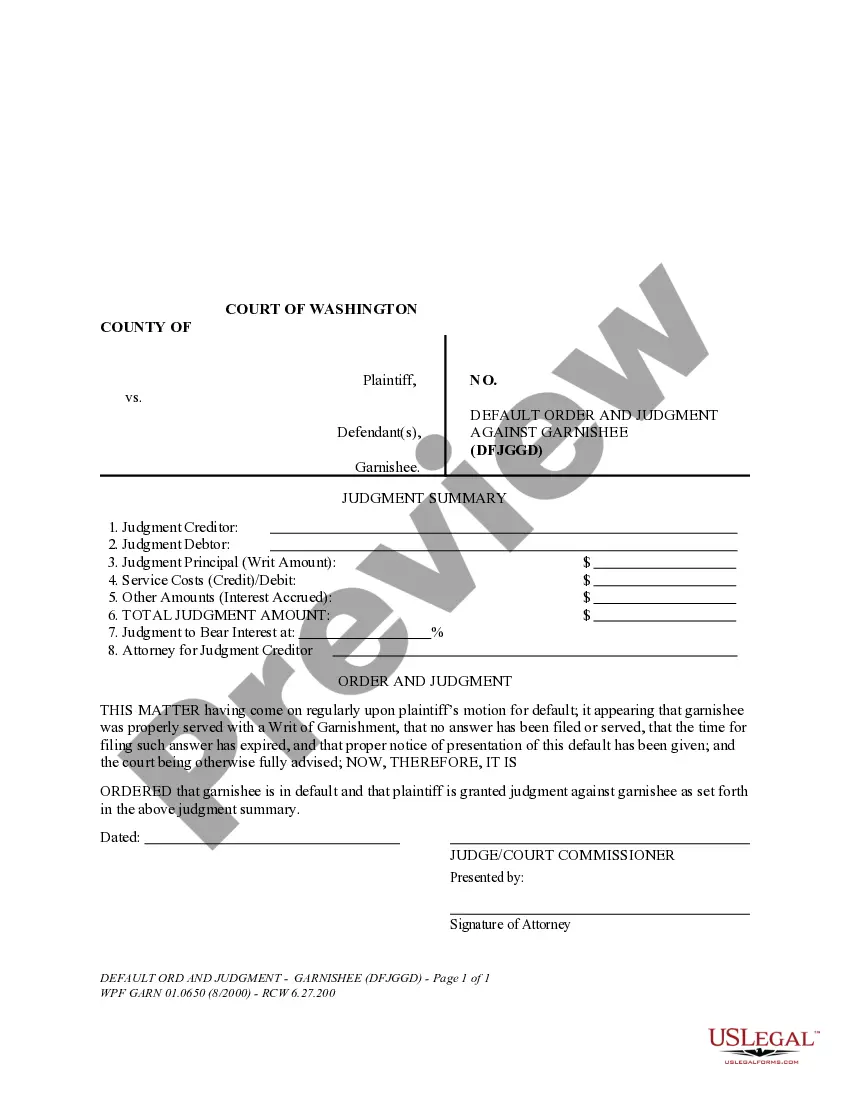
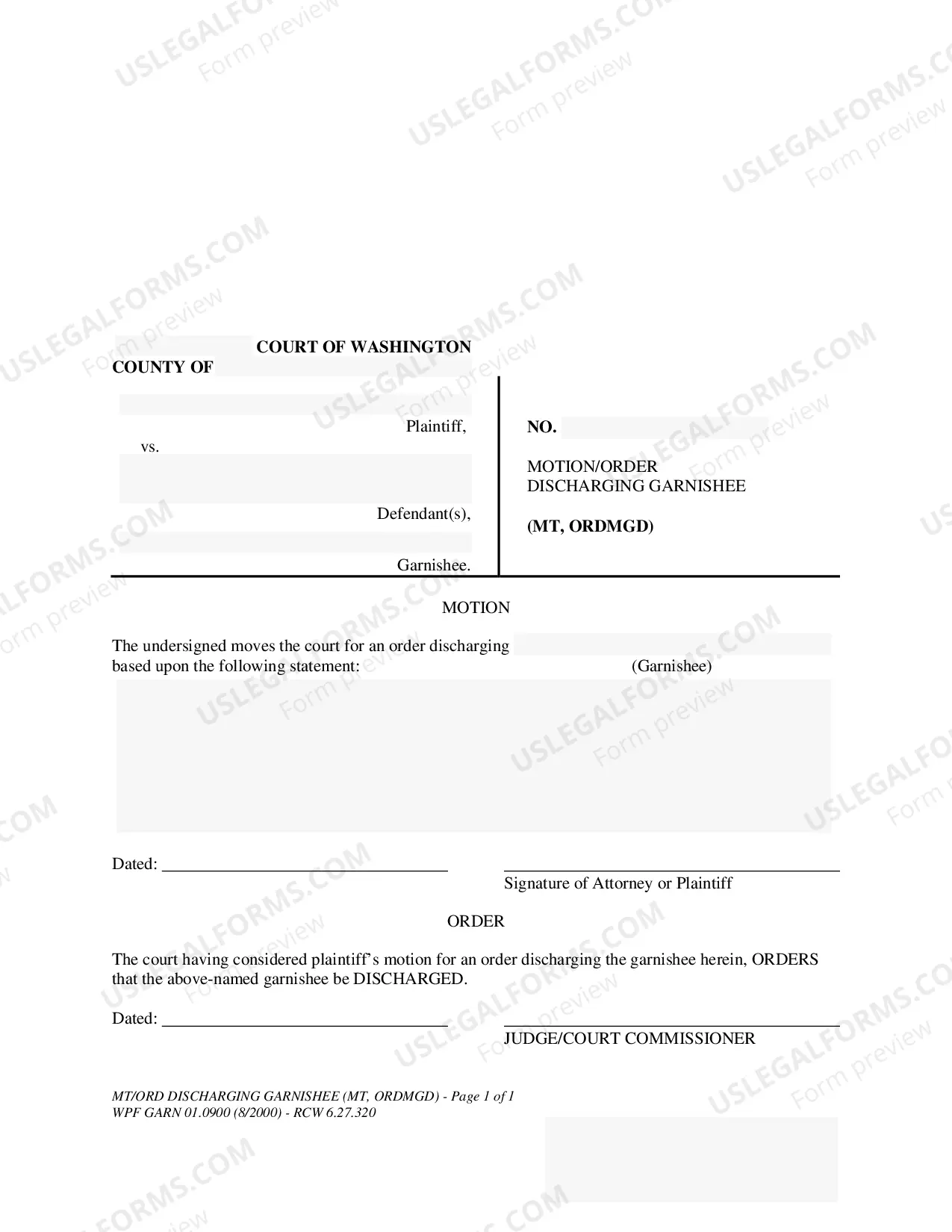
This is an official Washington court form for use in Garnishment cases, a Motion/Order Discharging Garnishee. Available in Word or rich text format.
Washington WPF GARN 01.0900 - Motion - Order Discharging Garnishee
State:
Washington
Category:
Control #:
WA-0985-08
Format:
Word;
PDF;
Rich Text
Instant download
This website is not affiliated with any governmental entity
Public form
Description
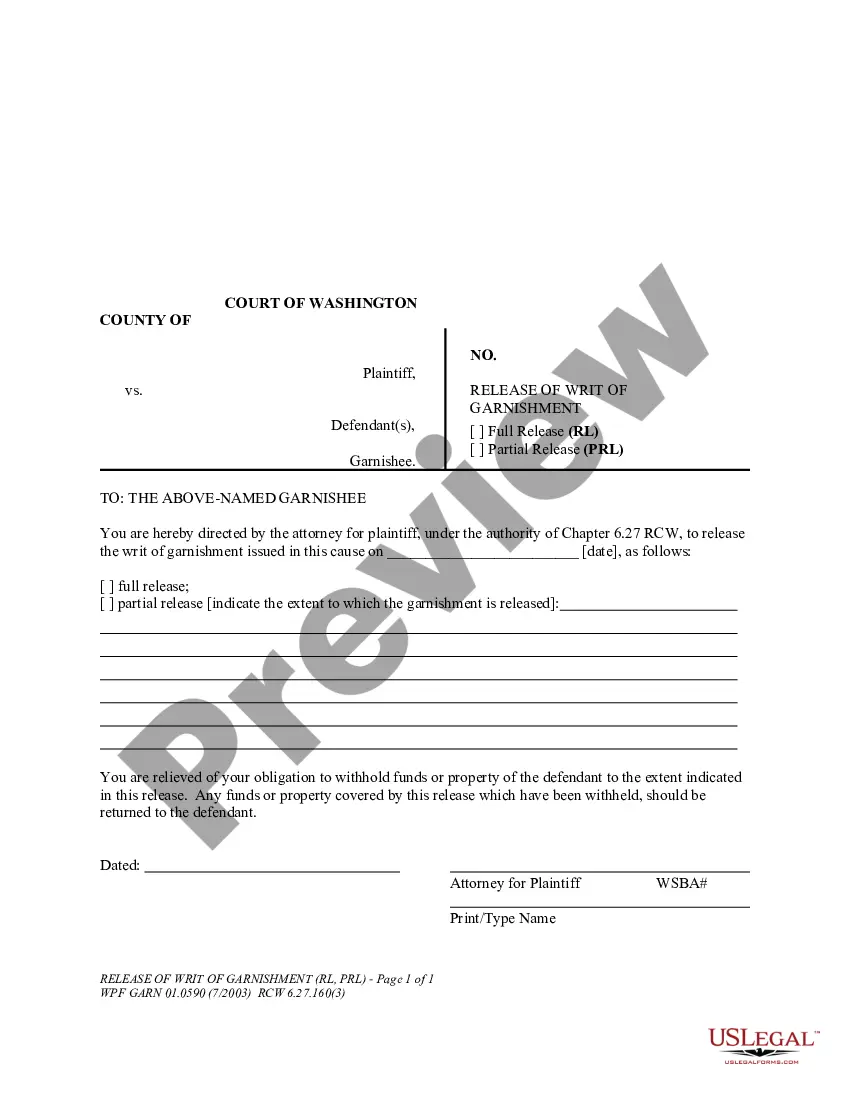
Get your form ready online
Our built-in tools help you complete, sign, share, and store your documents in one place.
Built-in online Word editor
Make edits, fill in missing information, and update formatting in US Legal Forms—just like you would in MS Word.
Export easily
Download a copy, print it, send it by email, or mail it via USPS—whatever works best for your next step.
E-sign your document
Sign and collect signatures with our SignNow integration. Send to multiple recipients, set reminders, and more. Go Premium to unlock E-Sign.
Notarize online 24/7
If this form requires notarization, complete it online through a secure video call—no need to meet a notary in person or wait for an appointment.
Store your document securely
We protect your documents and personal data by following strict security and privacy standards.

Make edits, fill in missing information, and update formatting in US Legal Forms—just like you would in MS Word.

Download a copy, print it, send it by email, or mail it via USPS—whatever works best for your next step.

Sign and collect signatures with our SignNow integration. Send to multiple recipients, set reminders, and more. Go Premium to unlock E-Sign.

If this form requires notarization, complete it online through a secure video call—no need to meet a notary in person or wait for an appointment.

We protect your documents and personal data by following strict security and privacy standards.
Looking for another form?



How to fill out Washington WPF GARN 01.0900 - Motion - Order Discharging Garnishee?
Out of the multitude of platforms that offer legal samples, US Legal Forms offers the most user-friendly experience and customer journey while previewing templates before purchasing them. Its comprehensive library of 85,000 samples is categorized by state and use for simplicity. All of the documents on the service have been drafted to meet individual state requirements by accredited legal professionals.
If you already have a US Legal Forms subscription, just log in, search for the template, hit Download and gain access to your Form name in the My Forms; the My Forms tab keeps all your saved documents.
Stick to the guidelines listed below to obtain the form:
- Once you discover a Form name, make certain it’s the one for the state you really need it to file in.
- Preview the template and read the document description before downloading the template.
- Look for a new template via the Search engine in case the one you have already found is not appropriate.
- Just click Buy Now and choose a subscription plan.
- Create your own account.
- Pay with a card or PayPal and download the template.
After you’ve downloaded your Form name, it is possible to edit it, fill it out and sign it in an web-based editor that you pick. Any form you add to your My Forms tab might be reused multiple times, or for as long as it continues to be the most up-to-date version in your state. Our service provides easy and fast access to samples that fit both attorneys as well as their clients.
Form popularity
FAQ
Unfortunately a garnishee order can only be stopped by bringing an application to court to have the order stopped, or, if the judgment creditor informs the employer or garnishee that he no longer needs to deduct money from your salary.
You can stop a garnishment by paying the debt in full. You can stop a wage garnishment by asking the court to order installment payments in your case. Read Getting an Installment Payment Plan to learn more. Objecting to a garnishment will stop it until the objection is decided.
Unfortunately a garnishee order can only be stopped by bringing an application to court to have the order stopped, or, if the judgment creditor informs the employer or garnishee that he no longer needs to deduct money from your salary.
If the garnishee owes a debt to the defendant and s/he pays the debt or an amount sufficient to cover the plaintiffs claim the garnishee shall be discharged of all liability for the amount paid. When the repayment obligation has been met, a notice of release will be filed with the court to remove the garnishment order.
If it's already started, you can try to challenge the judgment or negotiate with the creditor. But, they're in the driver's seat, and if they don't allow you to stop a garnishment by agreeing to make voluntary payments, you can't really force them to. You can, however, stop the garnishment by filing a bankruptcy case.
Garnishee Order is an order passed by an executing court directing or ordering a garnishee not to pay money to judgment debtor since the latter is indebted to the garnisher (decree holder). It is an Order of the court to attach money or Goods belonging to the judgment debtor in the hands of a third person.