Wisconsin Waiver of Lien - Individual
What is this form?
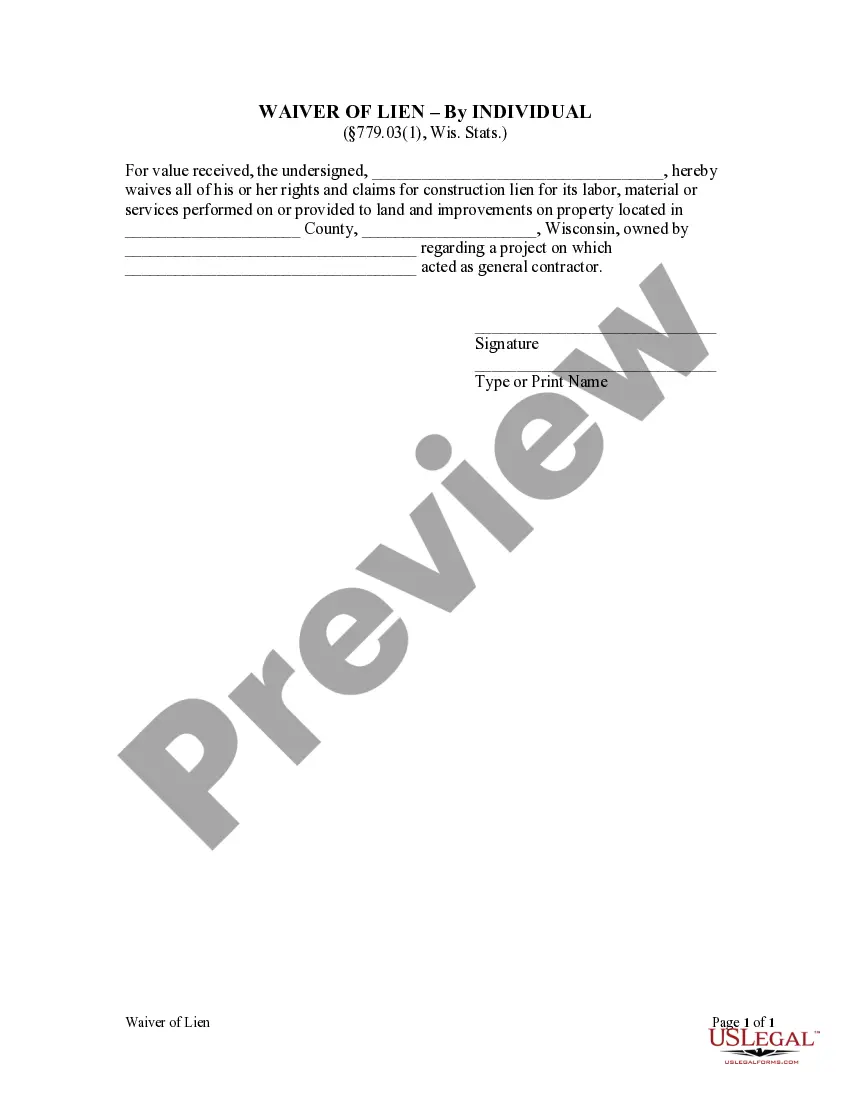
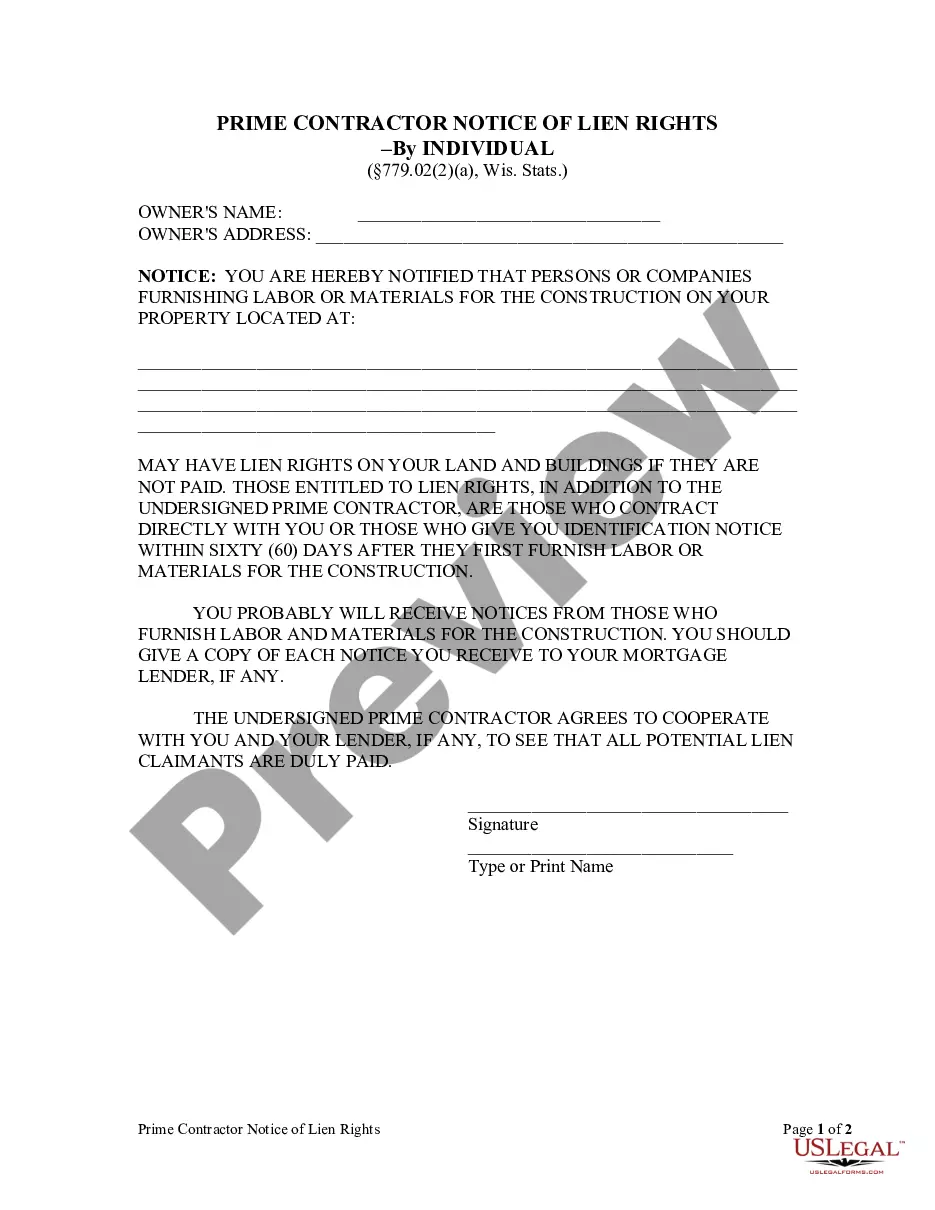
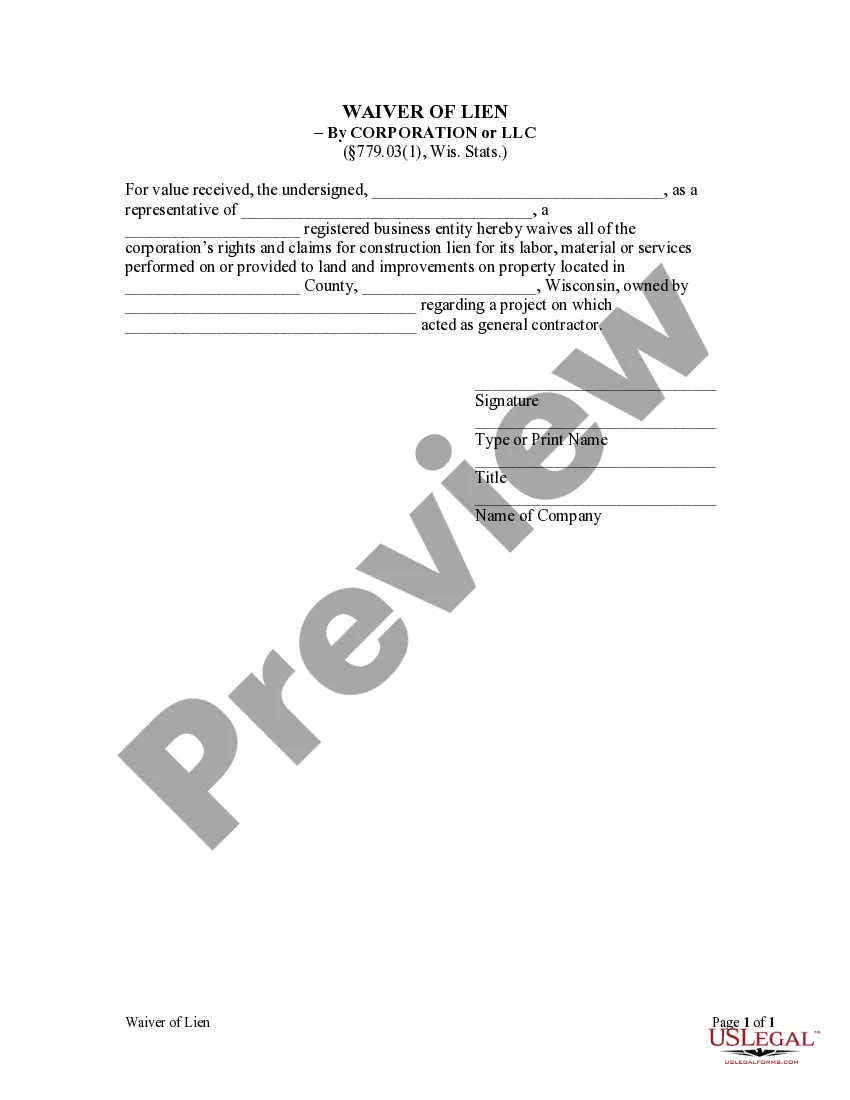
The Waiver of Lien - Individual is a legal document used by individuals to formally relinquish their rights to a construction lien for work completed on a property. By signing this form, the individual acknowledges that they have received payment and waives any future claims related to labor, materials, or services provided. It differs from other lien waivers by its focus on individual users instead of businesses or contractors.
Key parts of this document
- Identification of the individual waiving their lien rights.
- Details about the property and county where the work was performed.
- Information about the project and the general contractor involved.
- Signature of the individual to confirm the waiver.
- Typing or printing the name of the individual for clarity.
When to use this document
This form should be used when an individual has completed construction work or provided materials or services related to a property and has received payment. It is often utilized by subcontractors or laborers who want to ensure that they cannot later bring a lien claim against the property owner for unpaid work.
Who can use this document
This waiver is designed for:
- Individuals who provided labor, materials, or services for a construction project.
- Subcontractors or suppliers seeking to waive their lien rights after receiving payment.
- Anyone needing to release their claims to a property to avoid legal disputes.
Completing this form step by step
- Identify and fill in your name as the individual waiving the lien rights.
- Specify the location of the property, including the county and address.
- Enter the name of the property owner and the general contractor for the project.
- Sign the form to confirm your waiver of lien rights.
- Type or print your name for clarity alongside your signature.
Does this form need to be notarized?
In most cases, this form does not require notarization. However, some jurisdictions or signing circumstances might. US Legal Forms offers online notarization powered by Notarize, accessible 24/7 for a quick, remote process.
Get your form ready online
Our built-in tools help you complete, sign, share, and store your documents in one place.
Make edits, fill in missing information, and update formatting in US Legal Forms—just like you would in MS Word.
Download a copy, print it, send it by email, or mail it via USPS—whatever works best for your next step.
Sign and collect signatures with our SignNow integration. Send to multiple recipients, set reminders, and more. Go Premium to unlock E-Sign.
If this form requires notarization, complete it online through a secure video call—no need to meet a notary in person or wait for an appointment.
We protect your documents and personal data by following strict security and privacy standards.

Make edits, fill in missing information, and update formatting in US Legal Forms—just like you would in MS Word.

Download a copy, print it, send it by email, or mail it via USPS—whatever works best for your next step.

Sign and collect signatures with our SignNow integration. Send to multiple recipients, set reminders, and more. Go Premium to unlock E-Sign.

If this form requires notarization, complete it online through a secure video call—no need to meet a notary in person or wait for an appointment.

We protect your documents and personal data by following strict security and privacy standards.
Common mistakes
- Not indicating the correct property address or county.
- Failing to sign the document properly or omitting the printed name.
- Not verifying that payment has been received before signing.
- Using outdated forms that may not comply with current legal standards.
Why complete this form online
- Convenient access to the form at any time from your device.
- Easy to fill out and customize according to your specific project details.
- Reliable templates drafted by licensed attorneys to ensure legal compliance.
- Quick download process, allowing for immediate use without delays.
Key takeaways
- The Waiver of Lien - Individual is essential for individuals who have received payment for construction work.
- Ensure accurate completion of all fields to avoid future legal issues.
- Understand local laws regarding lien waivers to ensure compliance.
Looking for another form?
Form popularity
FAQ
The main purpose of a lien waiver is to provide protection to the paying party. In exchange for such payment, the lien waiver waives the payee's right to file a lien for the exact value of the payment they have received.
LIen waivers are not required to be notarized. The primary times that a document needs to be notarized is if it is going to be filed with the county recorder or it is an affidavit. There are some other documents that often use notarization, but lien waivers don't fall into any of those that "need to be notarized."
Bottom Line: Never Sign an Unconditional Lien Waiver Prior to Receiving Payment!If the lien waiver is the only proof the owner has as to whether a particular party has been paid, the owner must be able to rely on it in order for the lien waiver to accomplish its purpose.
A lien waiver is signed before a lien is actually filed. The party submitting the lien waiver states that they waive the right to lien against the project. In some instances, the property owner or general contractor may request that you sign and deliver a lien waiver before payment is disbursed.
Name of Claimant. This is the name the party to be paid, and the party who will be signing the lien waiver document. Name of Customer. Job Location. Owner. Exceptions. Claimant's Signature. Claimant's Title. Date of Signature.
The simplest way to prevent liens and ensure that subcontractors and suppliers are paid is to pay with joint checks. This is when both parties endorse the check. Compare the contractor's materials or labor bill to the schedule of payments in your contract and the Preliminary Notices.
It basically states that you've paid the subcontractor what is owed, they accept the payment in full, and they waive the right to put a lien on your property. Simply present this form to the subcontractor with your payment and ask them to sign it. Make sure you get their signature!
A lien waiver is quite common in the construction business. Essentially, it is a document from a contractor, subcontractor, supplier, or another party who holds a mechanic's lien that states they have been paid in full and waive future lien rights to the disputed property.
This is a legal document where a contractor waives his common law right to hold control and possession over a property or resists to hand over the keys to the Bank when requested to do so, if he is not paid in full. Legal FAQ Guide.