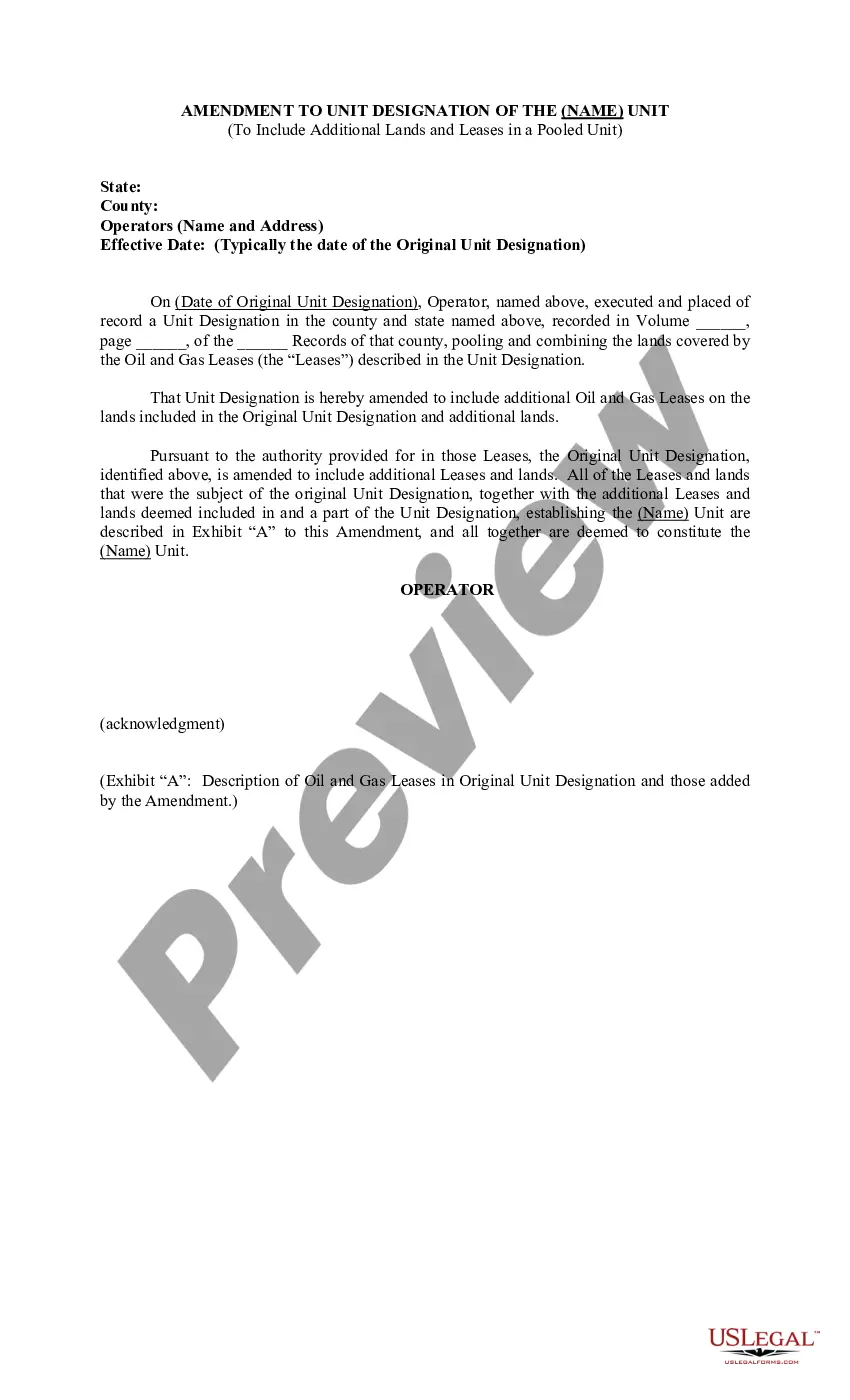
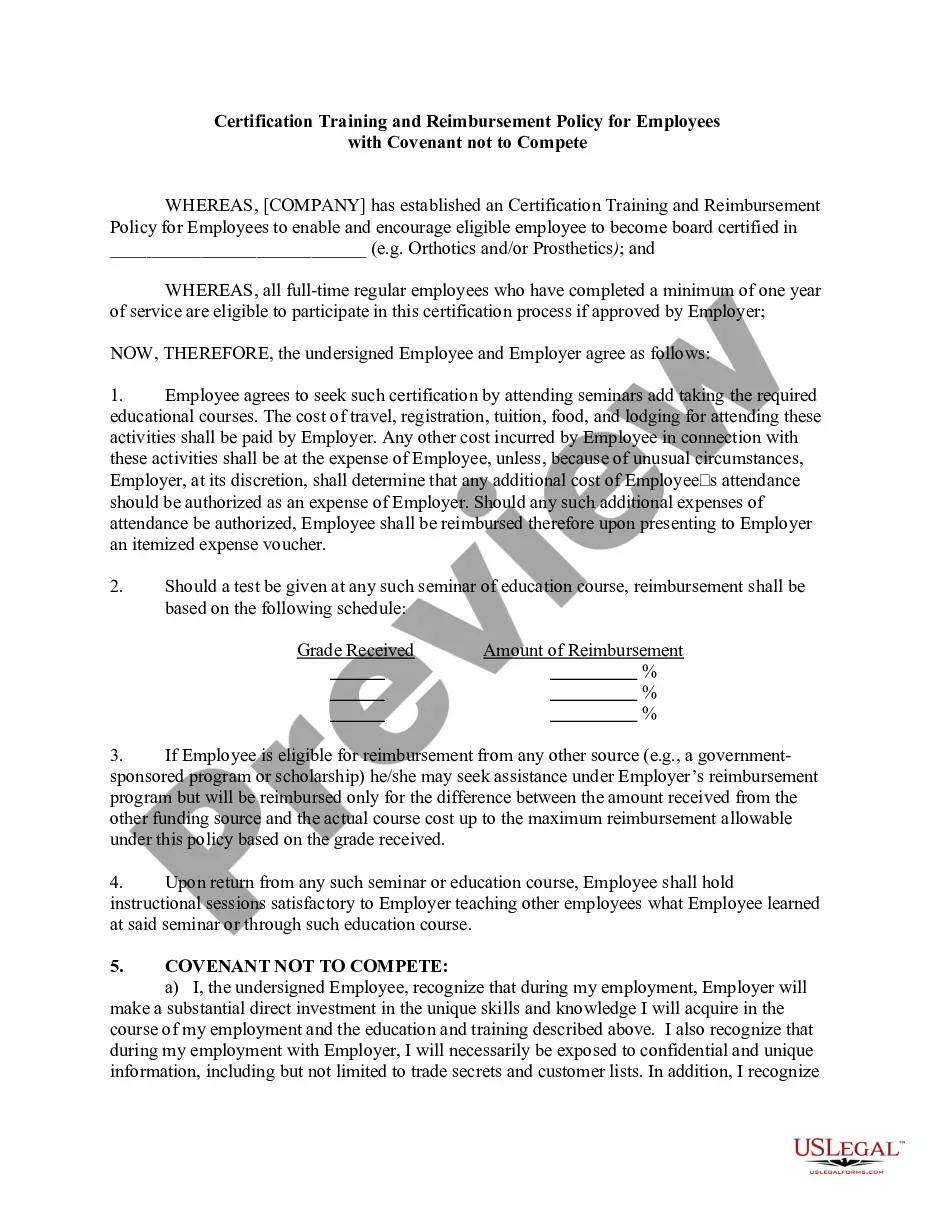
Certification Training and Reimbursement Policy for Employees with Covenant not to Compete
About this form
This Certification Training and Reimbursement Policy for Employees with Covenant not to Compete form provides a mechanism for employers to offer financial assistance for employee training costs while establishing a covenant not to compete. It helps employers protect their business interests by ensuring that employees do not engage in competitive practices after their employment ends. This form stands out by combining reimbursement guidelines for training expenses with enforceable competition restrictions, promoting both employee development and employer protection.
Main sections of this form
- Eligibility criteria for employees to receive training reimbursement after one year of service.
- Details on reimbursable expenses, including travel, registration, and tuition.
- Reimbursement schedule based on grades received in courses.
- Explanation of the requirement to hold instructional sessions for other employees after attending training.
- Clear covenant not to compete clauses outlining restrictions on post-employment competition.

When this form is needed
This form should be used when an employer wishes to implement a training reimbursement program that includes conditions to protect their business from competition by former employees. It is especially relevant in industries where proprietary knowledge, customer relationships, or specialized skills are critical for success. Employers may also use it to encourage employee growth and retention by offering financial support for certification processes.
Who should use this form
- Employers looking to establish a formal policy for training reimbursement.
- Human resources professionals managing employee certification programs.
- Employees in fields requiring certification who want to benefit from employer-sponsored training and reimbursement.
Instructions for completing this form
- Identify the parties involved by entering the names of the employer and employee.
- Specify the field in which the employee is seeking certification.
- Fill out the reimbursement sections, detailing covered expenses and conditions for reimbursement.
- Enter the periods covered by the covenant not to compete and specify the nature of the business.
- Have both parties sign and date the form to indicate agreement to the terms outlined.
Does this document require notarization?
This form usually doesn’t need to be notarized. However, local laws or specific transactions may require it. Our online notarization service, powered by Notarize, lets you complete it remotely through a secure video session, available 24/7.
Get your form ready online
Our built-in tools help you complete, sign, share, and store your documents in one place.
Make edits, fill in missing information, and update formatting in US Legal Forms—just like you would in MS Word.
Download a copy, print it, send it by email, or mail it via USPS—whatever works best for your next step.
Sign and collect signatures with our SignNow integration. Send to multiple recipients, set reminders, and more. Go Premium to unlock E-Sign.
If this form requires notarization, complete it online through a secure video call—no need to meet a notary in person or wait for an appointment.
We protect your documents and personal data by following strict security and privacy standards.

Make edits, fill in missing information, and update formatting in US Legal Forms—just like you would in MS Word.

Download a copy, print it, send it by email, or mail it via USPS—whatever works best for your next step.

Sign and collect signatures with our SignNow integration. Send to multiple recipients, set reminders, and more. Go Premium to unlock E-Sign.

If this form requires notarization, complete it online through a secure video call—no need to meet a notary in person or wait for an appointment.

We protect your documents and personal data by following strict security and privacy standards.
Mistakes to watch out for
- Failing to specify which courses are eligible for reimbursement.
- Not clearly defining the terms of the covenant not to compete.
- Neglecting to have both parties sign the form.
- Using vague language that could create ambiguity regarding reimbursements or competition limits.
Benefits of completing this form online
- Convenience of accessing and completing the form from anywhere at any time.
- Editable templates allow customization to fit specific employer needs.
- Reliable and up-to-date legal wording compiled by licensed attorneys.
Legal use & context
- The form serves to create enforceable agreements regarding employee training and post-employment competition.
- Both parties must understand their rights and obligations concerning the reimbursement and non-compete clauses.
- Employers should ensure compliance with state laws to avoid potential legal challenges to the covenant not to compete.
Quick recap
- This form combines training reimbursement policies with a covenant not to compete.
- Clear guidelines must be established for reimbursable expenses and training eligibility.
- Both employers and employees should fully understand the implications of the covenant to avoid conflicts post-employment.
Looking for another form?



Form popularity
FAQ
It is not that unusual for employers to require employees to repay their costs of training or other professional fees that the employer has incurred on their behalf if they leave their employment. Occasionally, an employee will argue that this type of clause is a penalty clause and therefore unenforceable.
Agreements to repay your employer for training costs are valid and enforceable.That means that if there is a contract to repay your employer any training costs they paid for you in the event you quit, then if you do quit, you must repay them.
Final pay when someone leaves a job Employers can only deduct money for training courses if it was agreed in the contract or in writing beforehand. For example, an employer could ask someone to agree in writing before a training course to pay back costs if they leave within 6 months.
Is it lawful for an employer to demand the repayment of training costs? The short answer is yes provided that there is a properly drafted agreement.
In the UK they are any bond is un-enforceable in law after the Bosman ruling in football. This made any employer unable to restrict the movement of employees to better and other employment or career changes.
California law requires all employers of 5 or more employees to provide 1 hour of sexual harassment and abusive conduct prevention training to nonsupervisory employees and 2 hours of sexual harassment and abusive conduct prevention training to supervisors and managers once every two years.
Not paying your new hires during their training is nearly always illegal. Employees must be paid for all time they spent working, which generally includes training time. The only time when training would not count as working time is when all four of these criteria are met: Attendance is outside normal hours.
Yes, according to a California Court of Appeal.
Repayment of training costs If there is no contractual right to allow the employer to demand repayment, the money cannot be recovered. Some employers will try to recoup the training costs by making deductions from the employee's salary during their notice period.