South Dakota Subcontractors Package
What this form package covers
The South Dakota Subcontractors Package is a comprehensive collection of essential legal documents designed specifically for subcontractors participating in construction projects in South Dakota. This package helps you manage your contractual obligations while protecting your legal rights. What sets this package apart is the inclusion of a subcontractor's agreement that meets state law requirements, ensuring compliance and clarity throughout the construction process.
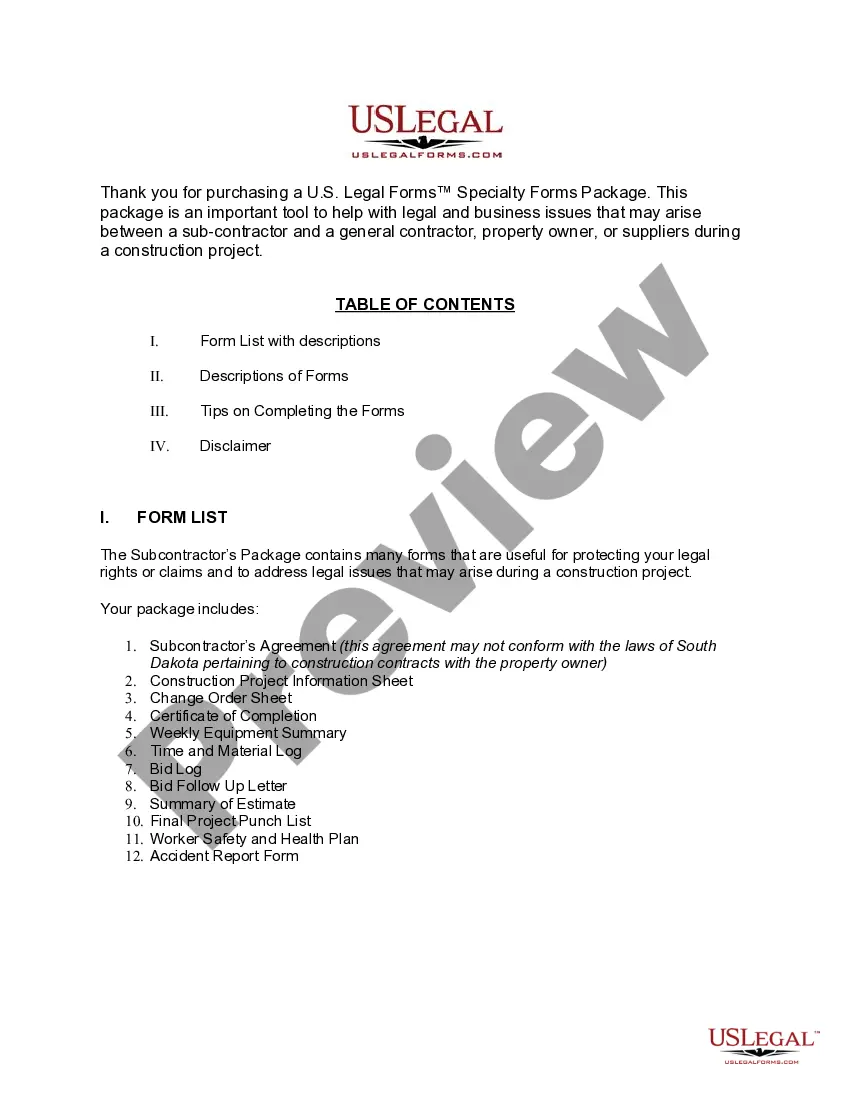
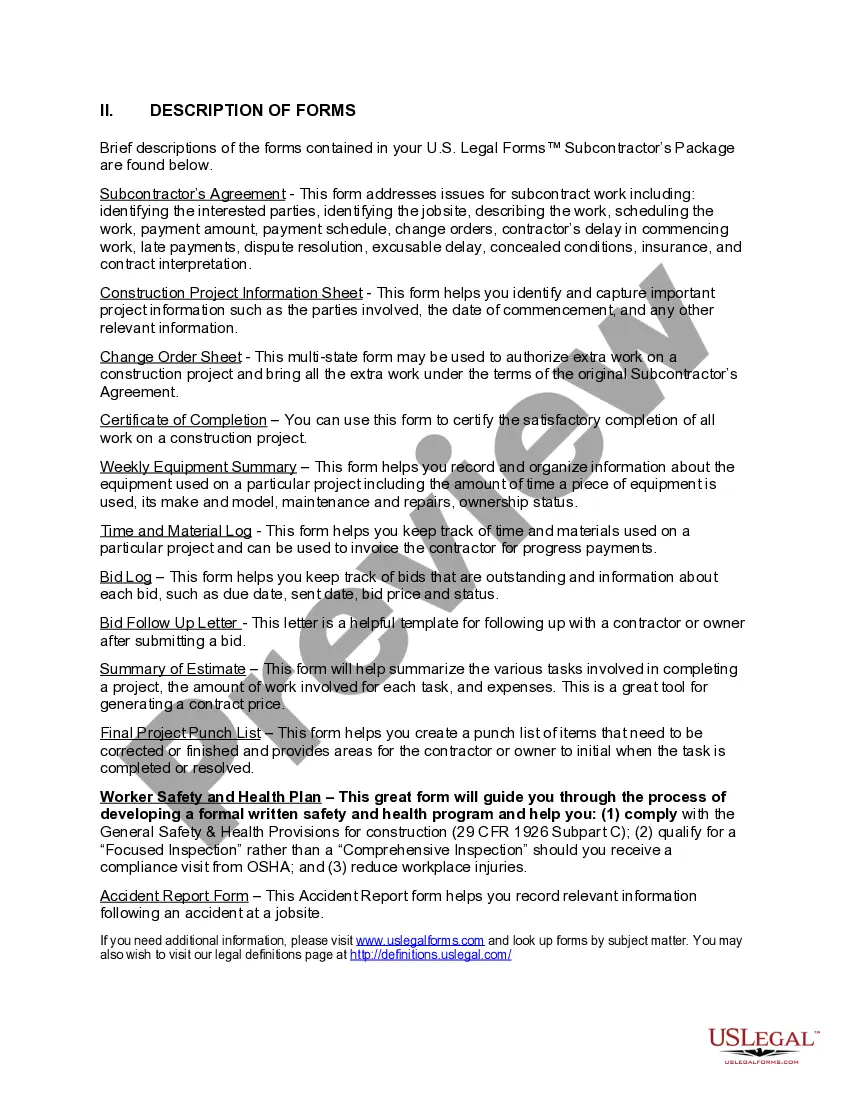
Forms provided in this package
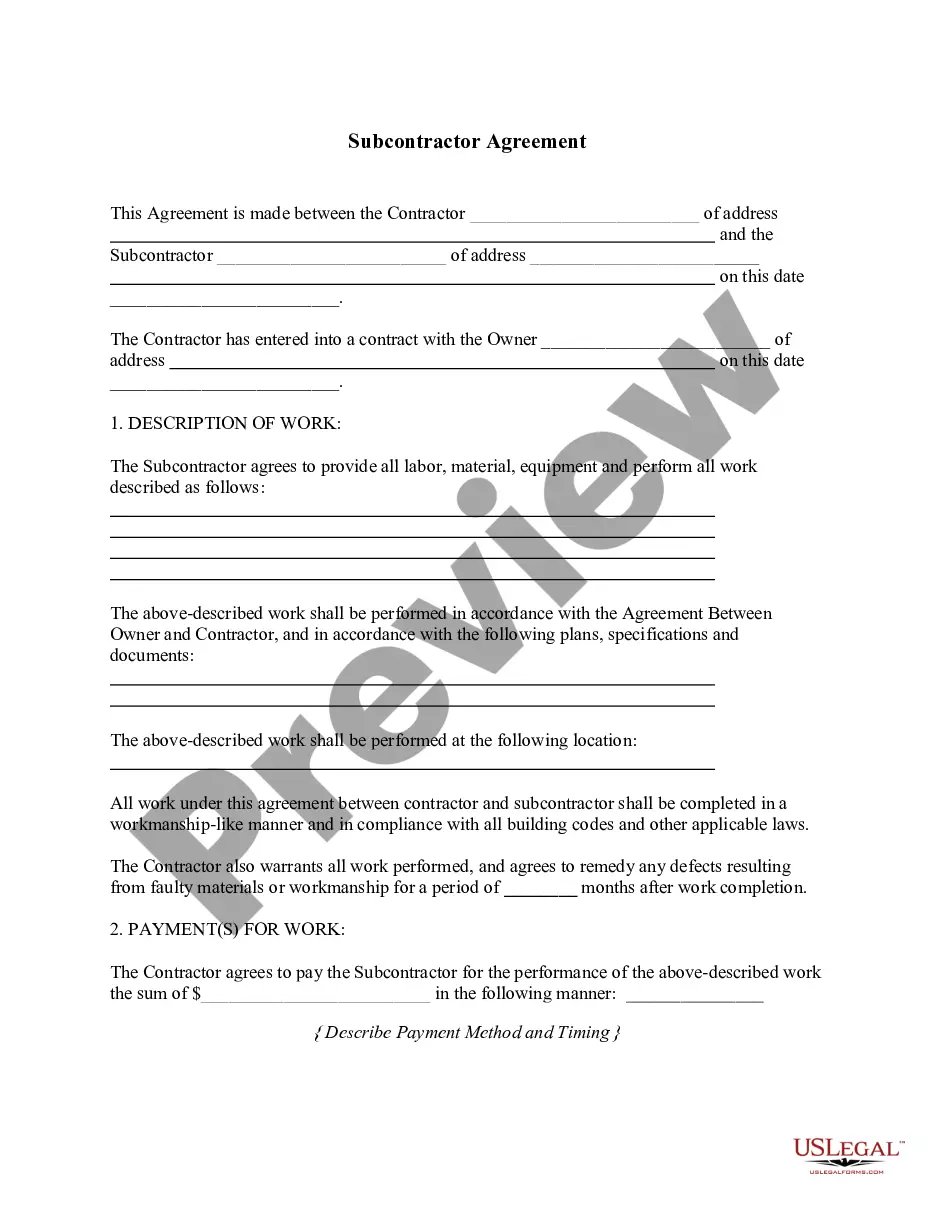
- Subcontractor's Agreement
- Contractor's Weekly Equipment Summary
- Contractor's Time and Materials Log
- Contractor's Bid Log
- Contractor's Bid Follow Up Letter
- Contractor's Summary of an Estimate
- Contractor's Final Punch List
- Construction Accident Report
- Construction Safety and Health Plan
- Change Order for Construction or Repairs by Contractor
- Certification of Completion by Contractor
- Construction Project Information Sheet

Common use cases
This package is useful in various situations, including:
- Starting a construction project and needing to outline subcontractor agreements.
- Handling changes to a project scope through change orders.
- Maintaining precise records of project equipment and materials used.
- Ensuring compliance with safety and health regulations on the job site.
- Documenting the completion of work and any accidents that may occur.
Who should use this form package
- Subcontractors working in South Dakota.
- Small construction businesses engaging in various projects.
- Independent contractors seeking to formalize their agreements.
- Anyone involved in project management who needs clear documentation.
How to prepare this document
- Review all included documents to understand their purposes.
- Identify the parties involved and enter their details in the appropriate sections.
- Fill in relevant project information, such as start dates and budgets.
- Complete the Change Order Sheet for any modifications during the project.
- Sign and date all forms where required, and provide copies to all parties involved.
Do documents in this package require notarization?
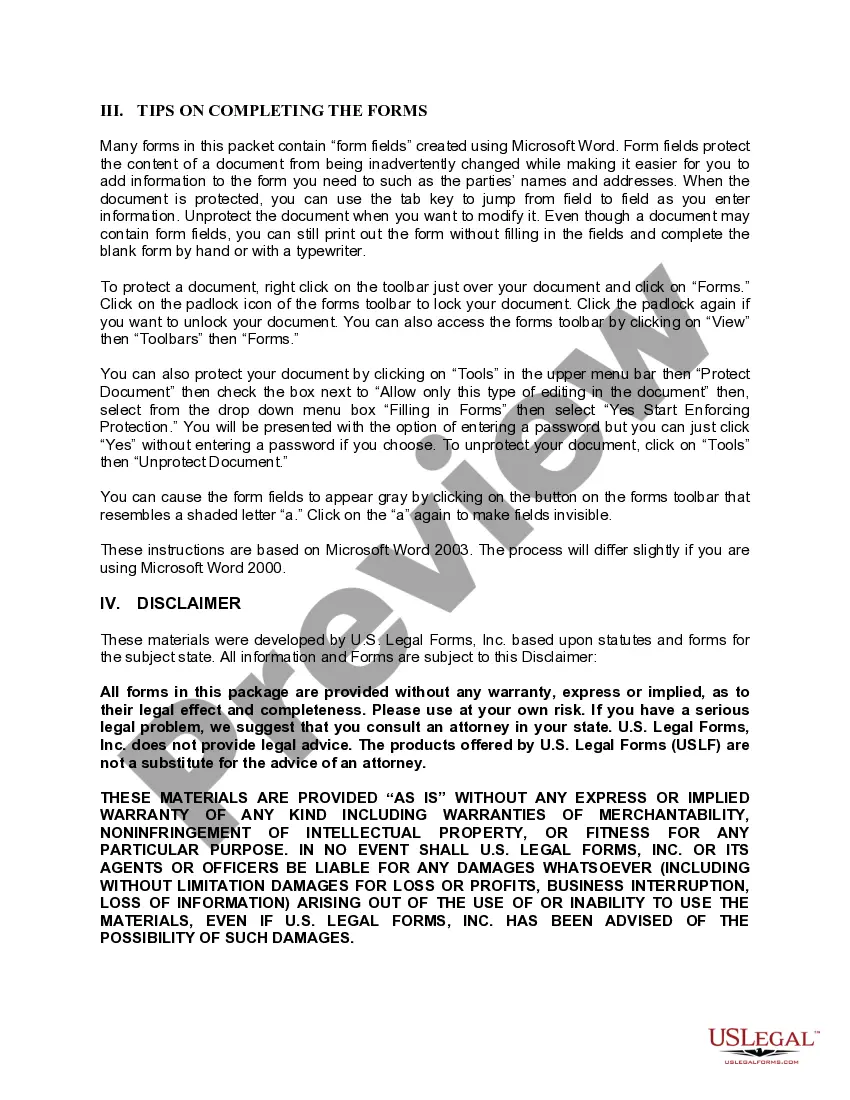
Notarization is not commonly needed for forms in this package. However, if your state’s laws require it, our notarization service, powered by Notarize, allows you to finalize documents online 24/7 without in-person visits.
Get your form ready online
Our built-in tools help you complete, sign, share, and store your documents in one place.
Make edits, fill in missing information, and update formatting in US Legal Forms—just like you would in MS Word.
Download a copy, print it, send it by email, or mail it via USPS—whatever works best for your next step.
Sign and collect signatures with our SignNow integration. Send to multiple recipients, set reminders, and more. Go Premium to unlock E-Sign.
If this form requires notarization, complete it online through a secure video call—no need to meet a notary in person or wait for an appointment.
We protect your documents and personal data by following strict security and privacy standards.

Make edits, fill in missing information, and update formatting in US Legal Forms—just like you would in MS Word.

Download a copy, print it, send it by email, or mail it via USPS—whatever works best for your next step.

Sign and collect signatures with our SignNow integration. Send to multiple recipients, set reminders, and more. Go Premium to unlock E-Sign.

If this form requires notarization, complete it online through a secure video call—no need to meet a notary in person or wait for an appointment.

We protect your documents and personal data by following strict security and privacy standards.
Common mistakes
- Failing to update the agreement after changes to the project scope.
- Neglecting to keep accurate records in the Weekly Equipment Summary.
- Not having all parties sign the documents, which can lead to disputes.
- Overlooking the safety and health protocol compliance required on job sites.
Why use this package online
- Convenience of downloading forms instantly, saving time and effort.
- Editability of documents allows for customization to fit specific project needs.
- Reliability of forms generated by licensed attorneys ensures legal soundness.
- Accessibility from anywhere, enabling quick updates as projects evolve.
Main things to remember
- The South Dakota Subcontractors Package is essential for subcontractors in construction.
- It contains various forms necessary for managing and documenting projects.
- Forms are compliant with state laws, ensuring legal protection and clarity.
- No notarization is generally required for the included documents.
Looking for another form?
Form popularity
FAQ
A rule of thumb for independent contractors is that the vendor should be allowed to mark up your pay rate by about 15 percent when billing the client. This allows the vendor a respectable profit without making the bill rate outrageous.
Start with procurement standards. Execute all subcontracts prior to starting your projects. Help those who help you. Award the job to the lowest fully qualified bidder. Use contract scope checklists. Make sure you have tight clauses. Meet to review the proposed subcontract.
Subcontracting in general is where one company will take a piece of work and give it to some other business organization to carry out that work.The more subcontracting, the more fissuring of the work, the greater the risk for health and safety at the bottom of those chains.
The disadvantages contractors doing this work lie in costs: The hourly expenses are high, and the professionals are independent in that they don't report to supervisors inside the company. These factors make it challenging to control the costs of these subcontracts.
Licensing. Scope of Work and Payment. Timing. Defense and Indemnification.
Some subcontractors are paid with a lump sum of money by their employers. For example, a technical writer contracts with a company to write a manual. The company agrees to pay that writer a certain amount of money to write the manual. The writer then writes the manual for the company and submits it.
The biggest drawback for workers is the lack of benefits provided. Most, if not all, companies that hire temporary workers do not offer health insurance, retirement plans, or vacation and sick days to them. Workers are responsible for funding these benefits, and they're expensive.
Lack of staff development. Contractors will use more time researching potential subcontractors. Contractors will lose their control over the timeliness and quality of work. Poor performance quality.
Even though subcontractors are typically cost more than self-performing in-house, it is still more cost-effective in most cases. Subcontractors do not get benefits, office space or equipment. Hiring contractors also relieves you of having to pay employee taxes and a full-time salary.