Aggressive Clause Dealing with Reentry and Continuing Access to the Demised Premises
Overview of this form
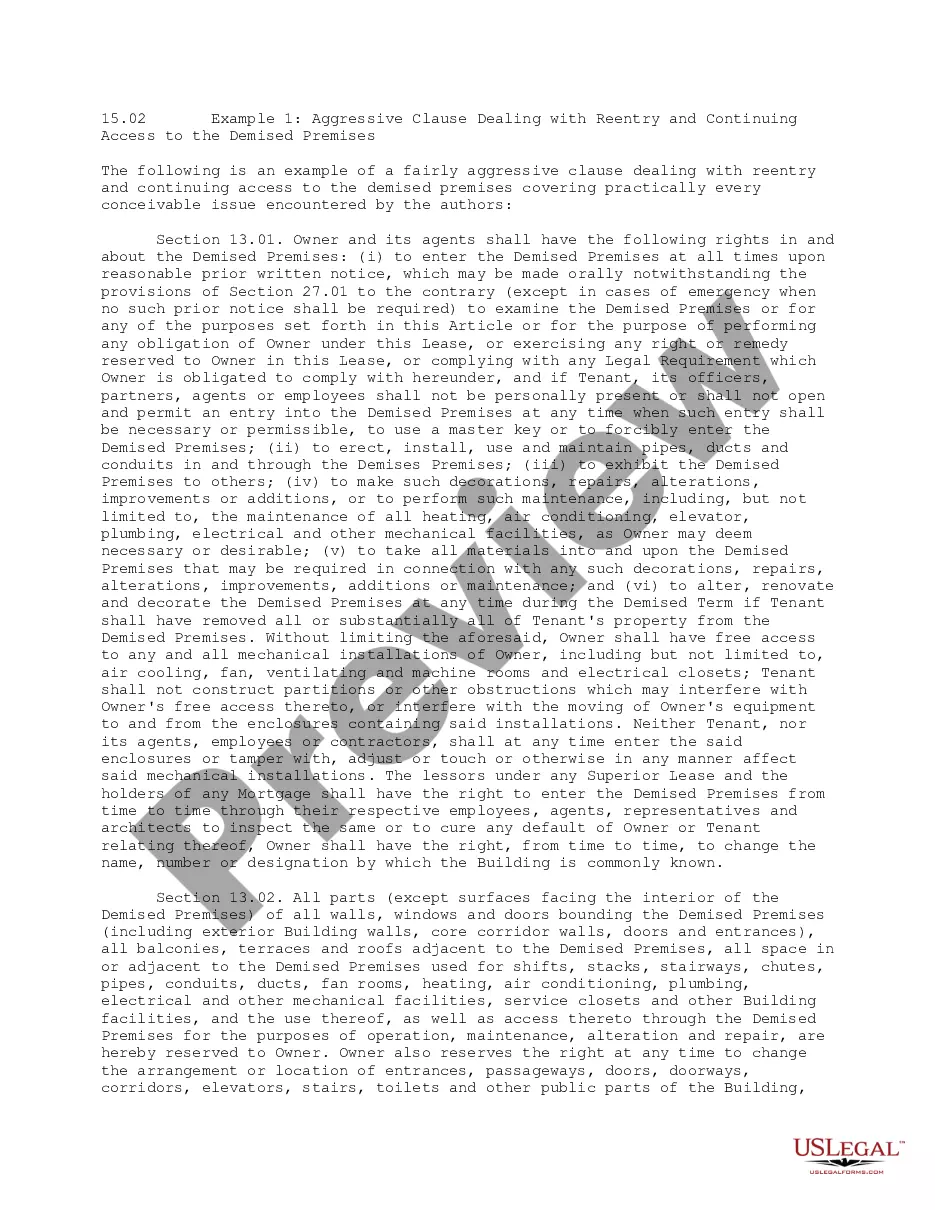
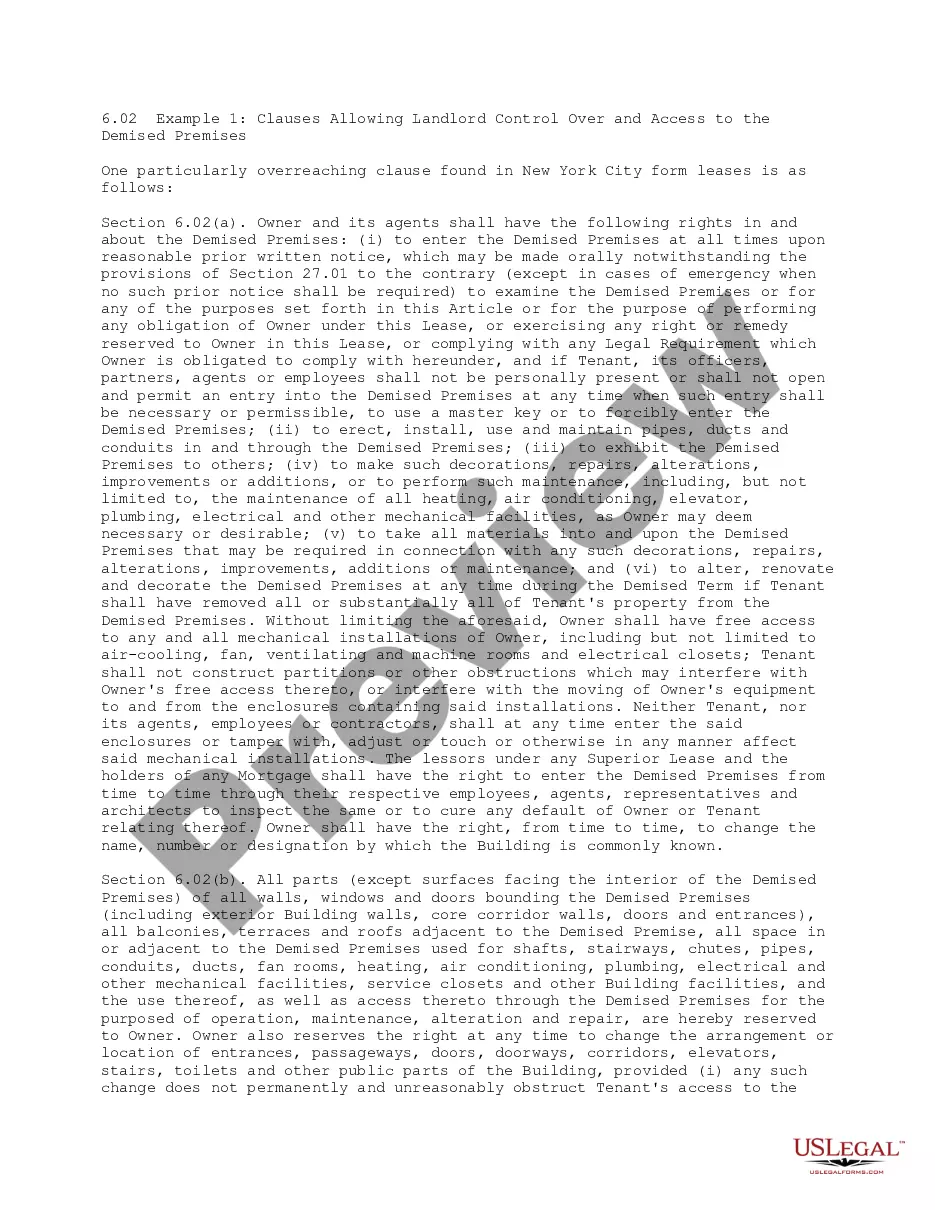
This form is an Aggressive Clause dealing with reentry and continuing access to the demised premises. It establishes the rights of the property owner regarding access to the leased property. This clause is more extensive and aggressive than typical lease clauses, covering a wide range of scenarios where an owner might need to enter the premises.
Form components explained
- Owner's rights to enter the premises with reasonable notice or in emergencies.
- Permits maintenance and alterations, including installation of necessary systems and equipment.
- Access to mechanical installations without tenant interference.
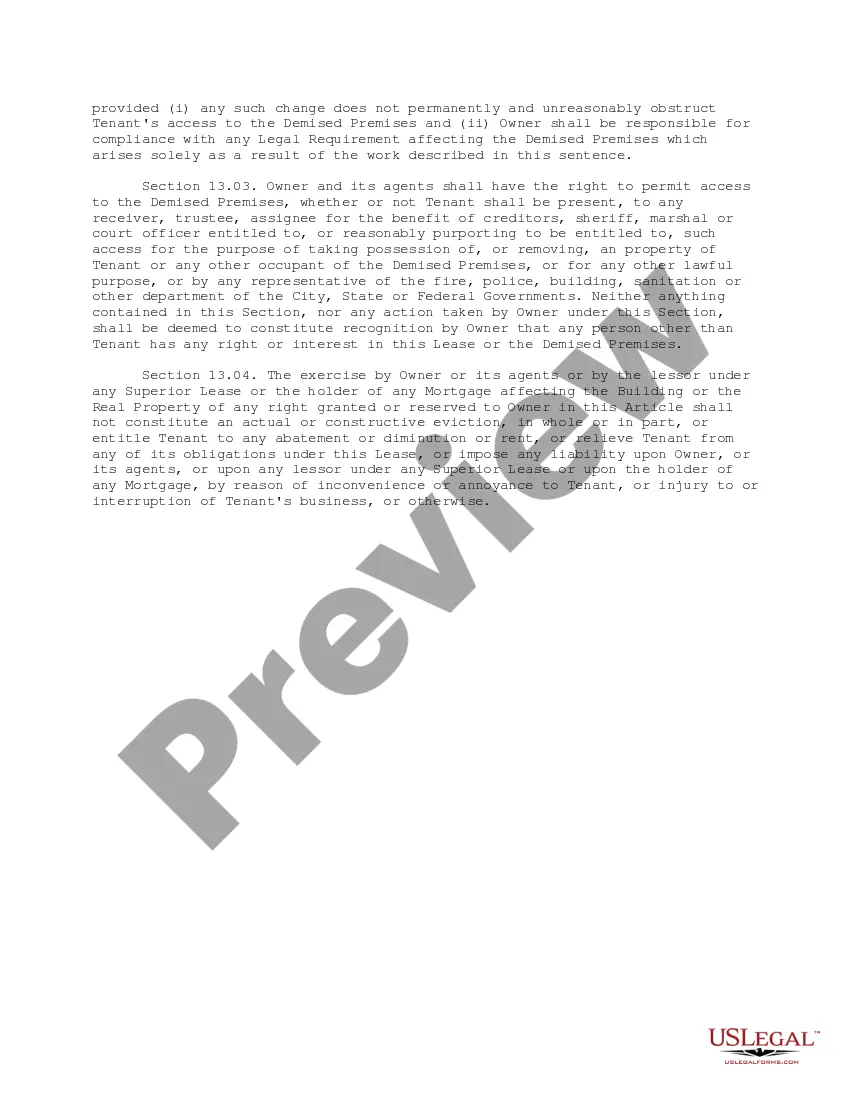
- Rights of third parties (e.g., receivers, government officials) to access the premises.
- Clarification that owner access does not equate to tenant eviction or rent reduction.
Common use cases
This form is useful when entering a lease agreement where the property owner requires significant rights to access and maintain the premises. It is particularly relevant in commercial leases or situations where the property may need frequent inspections or repairs. Landlords should consider using this form to ensure clear terms regarding access rights are established from the outset.
Intended users of this form
- Property owners or landlords looking to establish comprehensive access rights in a lease agreement.
- Commercial lease parties who anticipate ongoing maintenance or modifications are required.
- Legal professionals drafting lease clauses for clients in real estate transactions.
Steps to complete this form
- Identify the parties involved, including the owner and tenant.
- Clearly specify the demised premises and any relevant property descriptions.
- Outline the rights and responsibilities of both parties regarding access to the premises.
- Include any conditions under which access may be granted or limited.
- Ensure all parties sign and date the document to acknowledge agreement.
Does this form need to be notarized?
This form does not typically require notarization to be legally valid. However, some jurisdictions or document types may still require it. US Legal Forms provides secure online notarization powered by Notarize, available 24/7 for added convenience.
Get your form ready online
Our built-in tools help you complete, sign, share, and store your documents in one place.
Make edits, fill in missing information, and update formatting in US Legal Forms—just like you would in MS Word.
Download a copy, print it, send it by email, or mail it via USPS—whatever works best for your next step.
Sign and collect signatures with our SignNow integration. Send to multiple recipients, set reminders, and more. Go Premium to unlock E-Sign.
If this form requires notarization, complete it online through a secure video call—no need to meet a notary in person or wait for an appointment.
We protect your documents and personal data by following strict security and privacy standards.

Make edits, fill in missing information, and update formatting in US Legal Forms—just like you would in MS Word.

Download a copy, print it, send it by email, or mail it via USPS—whatever works best for your next step.

Sign and collect signatures with our SignNow integration. Send to multiple recipients, set reminders, and more. Go Premium to unlock E-Sign.

If this form requires notarization, complete it online through a secure video call—no need to meet a notary in person or wait for an appointment.

We protect your documents and personal data by following strict security and privacy standards.
Common mistakes
- Failing to provide specific examples of when and how access can occur.
- Not clearly defining the rights of third parties or external entities accessing the premises.
- Omitting to ensure both parties read and understand the implications of the access rights.
Advantages of online completion
- Convenient access to legal forms without the need for in-person consultations.
- Editable templates allow for customization to meet specific needs.
- Reliability from documents drafted by licensed attorneys.
Legal use & context
- This clause is enforceable in a lease agreement provided it complies with local laws.
- Landlords should ensure that rights given do not violate tenant rights under state laws.
- It's essential to balance landlord access rights with tenant privacy and use rights.
Key takeaways
- The form establishes clear access rights for landlords and includes various access scenarios.
- Understanding the implications of these rights is crucial for both tenants and landlords.
- Using this form online streamlines the process of drafting and accessing lease agreements.
Looking for another form?
Form popularity
FAQ
Following building and housing codes. Keeping the unit safe and sanitary. Disposing of garbage. Maintaining plumbing fixtures. Properly operating all plumbing and electric fixtures. Maintaining appliances supplied by the landlord. Not damaging the unit.
Approach The Court Of Law You will have to send a legal notice to your tenant asking him/her to pay the arrears of rent or else to vacate within a month. The tenant has to pay rent in the court once it is assessed by the court and in case he/she fails, it invites immediate eviction.
Tell Them The Problem & Consequences. Explain the reason that you want the tenant to go. Offer Them a Way Out. Let the tenant know that you are willing to give them a lump sum of cash in agreement for leaving the property. The Release.
File for eviction with your local courthouse. Gather evidence. Come to the court hearing to prove your case. Win a writ of possession and have the tenant removed by the sheriff.
Using County Court bailiffs (or sometimes High Court Sheriffs) acting under a court order for possession is the ONLY legal way you can physically evict tenants from a property if they refuse to go voluntarily.Sometimes tenants will try to get you to delay and they can be very persuasive.
Keep your rental unit as clean and safe as the condition of the premises permits. Dispose of garbage, rubbish, and other waste in a clean and safe manner. Keep plumbing fixtures as clean as their condition permits.
Demised Premise means all that portion of the Building which is leased or intended to be leased by the Landlord to the Tenant by this Lease, including any additions and improvements to the Building herein provided; Save.
No, a landlord cannot just kick you out. They need to follow the formal eviction process provided in your state. If a landlord uses illegal self-help measures, such as changing the locks or throwing out your belongings, you should be able to hold the landlord accountable and remain on the property.
If you haven't got a break clause Alternatively, you could sign a new six-month agreement if both you and your landlord are happy to do so. If you have signed a longer agreement at the start of the tenancy, say 12 months or two years, it is still possible to terminate the agreement early.