Clause Requiring Landlord Consent
Understanding this form
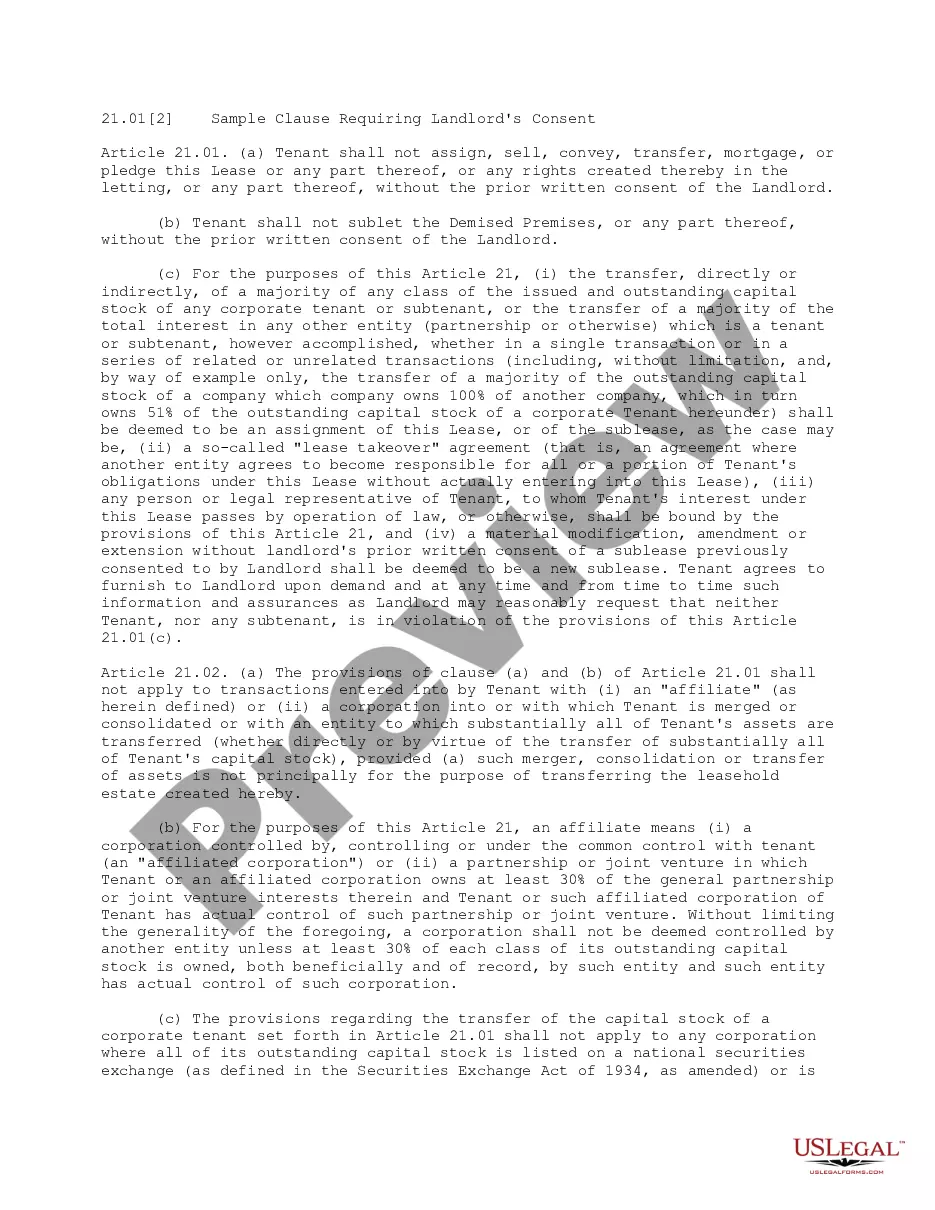
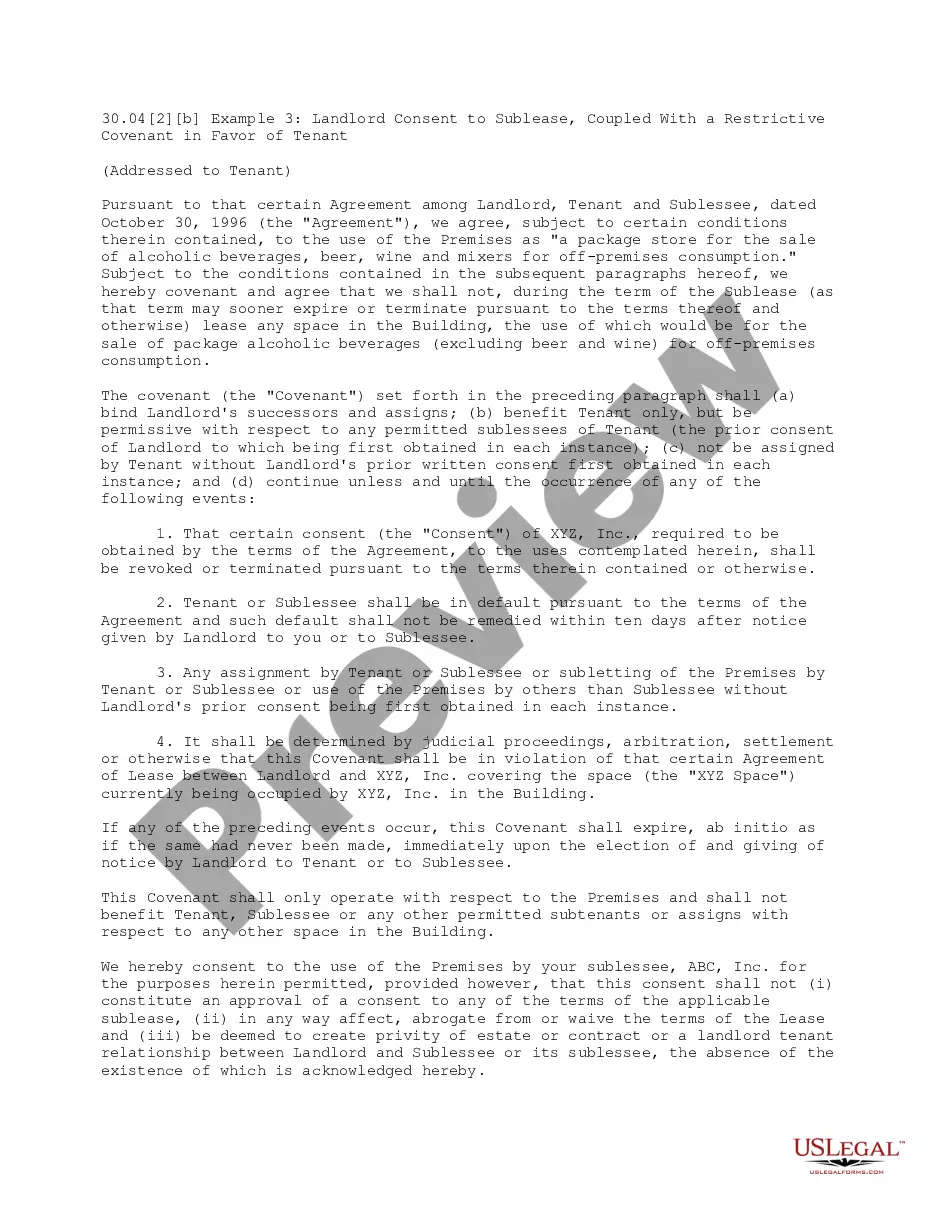
The Clause Requiring Landlord Consent is a legal document used in office leases to outline the circumstances under which a tenant must obtain written consent from the landlord before taking certain actions. This form provides clarity on what actions require approval and helps protect the interests of both the landlord and tenant. It differs from a standard lease agreement by specifically addressing transfer rights, subletting, and company control in relation to the lease.
Key components of this form
- Article 21.01: Prohibits the tenant from assigning or subletting the lease without landlord consent.
- Article 21.02: Defines exceptions for transfers of lease rights, such as mergers and affiliations.
- Detailed definitions of "affiliate" and conditions for acknowledgment of consent requirements.
- Tenant's obligation to provide information regarding compliance with the lease transfer provisions.

Common use cases
This form is necessary when a tenant wishes to assign, transfer, or sublet their leased premises. It ensures that the landlord is aware of and approves any changes in tenancy, thereby safeguarding the property and maintaining the integrity of the landlord-tenant relationship. This form is essential in scenarios where lease obligations may be complicated by changes in business structure, such as mergers or sales.
Intended users of this form
- Commercial tenants who plan to assign their rights or sublet their leased premises.
- Landlords who want to establish clear parameters for consent regarding their property.
- Businesses involved in mergers or acquisitions that may affect their lease agreements.
- Legal professionals assisting clients with commercial leasing transactions.
Steps to complete this form
- Identify the parties involved: Clearly state the names of the tenant and landlord.
- Specify the property: Include the address and any relevant details of the leased premises.
- Detail the actions requiring consent: List all actions that necessitate landlord approval, such as assignment and subletting.
- Include exceptions to the consent requirement: Mention any transactions involving affiliates or mergers as outlined in the document.
- Sign and date the form: Ensure both parties review and sign the document to confirm mutual understanding and agreement.
Is notarization required?
Notarization is not commonly needed for this form. However, certain documents or local rules may make it necessary. Our notarization service, powered by Notarize, allows you to finalize it securely online anytime, day or night.
Get your form ready online
Our built-in tools help you complete, sign, share, and store your documents in one place.
Make edits, fill in missing information, and update formatting in US Legal Forms—just like you would in MS Word.
Download a copy, print it, send it by email, or mail it via USPS—whatever works best for your next step.
Sign and collect signatures with our SignNow integration. Send to multiple recipients, set reminders, and more. Go Premium to unlock E-Sign.
If this form requires notarization, complete it online through a secure video call—no need to meet a notary in person or wait for an appointment.
We protect your documents and personal data by following strict security and privacy standards.

Make edits, fill in missing information, and update formatting in US Legal Forms—just like you would in MS Word.

Download a copy, print it, send it by email, or mail it via USPS—whatever works best for your next step.

Sign and collect signatures with our SignNow integration. Send to multiple recipients, set reminders, and more. Go Premium to unlock E-Sign.

If this form requires notarization, complete it online through a secure video call—no need to meet a notary in person or wait for an appointment.

We protect your documents and personal data by following strict security and privacy standards.
Common mistakes
- Failing to obtain written consent before assigning or subletting the lease.
- Not understanding the definitions of affiliates and transfer terms.
- Skipping the signature step, which may render the document unenforceable.
Benefits of using this form online
- Convenience of accessing and completing the form at any time.
- Editability allows users to tailor the document to their specific needs.
- Access to legally vetted templates ensures reliability and compliance with current laws.
Legal use & context
- Enforceability: The Clause Requiring Landlord Consent is enforceable in a court of law when properly included in a lease agreement.
- Limitations: Failure to follow the clause may result in legal disputes, including eviction or lease termination.
Key takeaways
- Always obtain landlord consent before assigning or subletting your lease.
- Be aware of defined terms and exceptions within the form.
- Using this form can help prevent misunderstandings and protect all parties involved in the lease.
Looking for another form?
Form popularity
FAQ
Amount of rent, security deposit, other payments. Duration of agreement and renewal criteria. List of fittings, fixtures. Registration of agreement. Restrictions.
If you're a tenant and your business fails, but you vacate your space and pay rent through the date you vacate, you're a good guy. A good guy clause limits the liability of the personal guarantor for a tenant when a lease is terminated early.
Residential tenancy laws require landlords to provide their name and telephone number or other contact details (e.g. an email address) to their tenant. These details must be given to the tenant even if the landlord uses an agent.
The lease becomes legally binding when all parties have signed: the landlord and all tenants living in the unit who are 18 and older. If you're worried about situations where a lease needs to end early, learn about breaking a lease and grounds for eviction.
If you're a tenant and your business fails, but you vacate your space and pay rent through the date you vacate, you're a good guy. A good guy clause limits the liability of the personal guarantor for a tenant when a lease is terminated early.
If an issue crops up after a lease has begun, you can still add a clause or addendum. You will just need to send your tenant written notice of the change, preferably with a lease amendment, and then get your tenant's signature on the new amendment.
Landlords need to collect confidential information from their tenants in order to determine whether or not they qualify for a lease. A tenant's employer, bank account numbers, credit history, social security number and previous addresses are all valuable to identity thieves.
Names of all tenants. Limits on occupancy. Term of the tenancy. Rent. Deposits and fees. Repairs and maintenance. Entry to rental property. Restrictions on tenant illegal activity.
10 Important Rental Lease Clauses. #1 Rent Liability. #2 Severability Clause. #3 Access to Premises. #4 Use of Premises. #5 Holding Over. #6 Sublet Rules. #7 Disturbance Clause.