Incentive Stock Option Agreement
Overview of this form
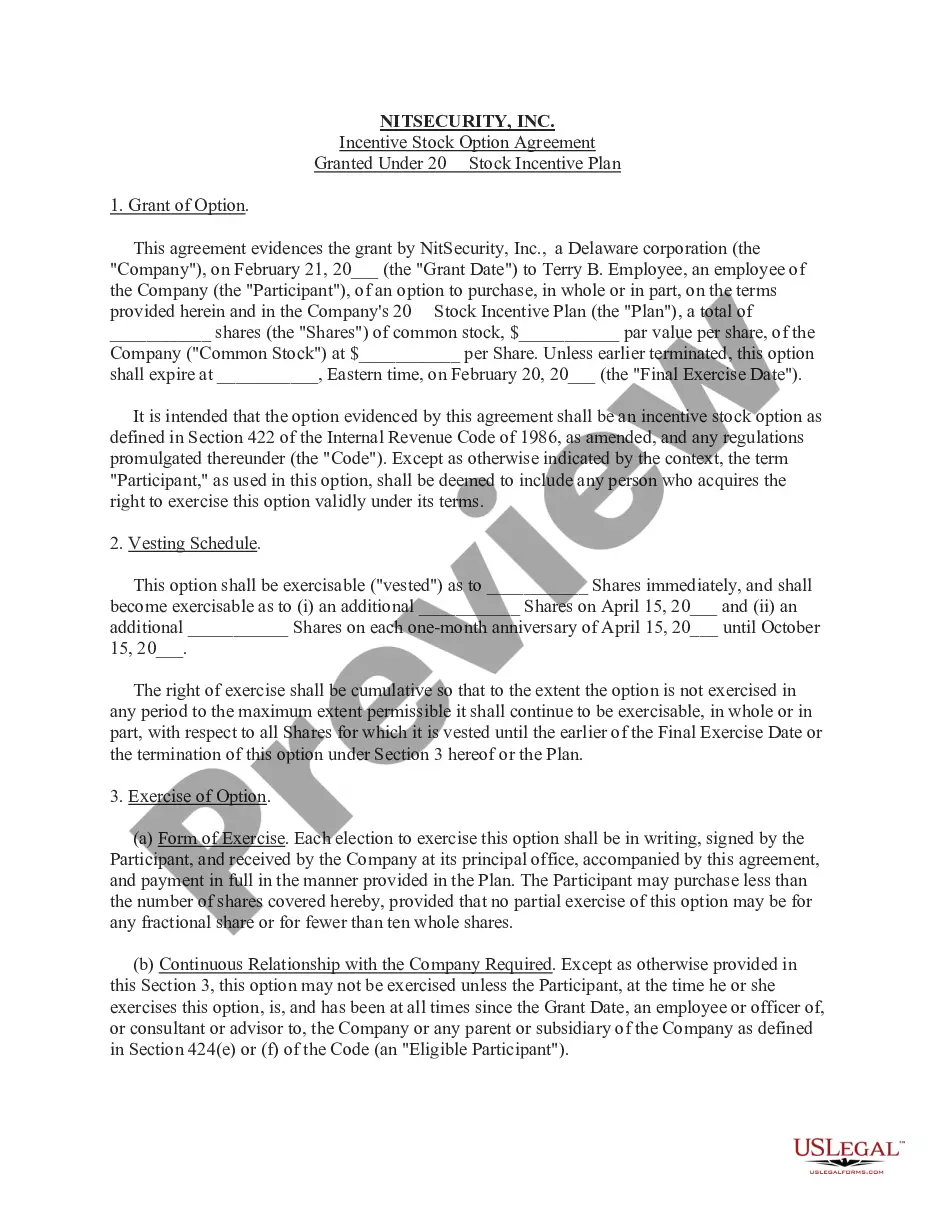
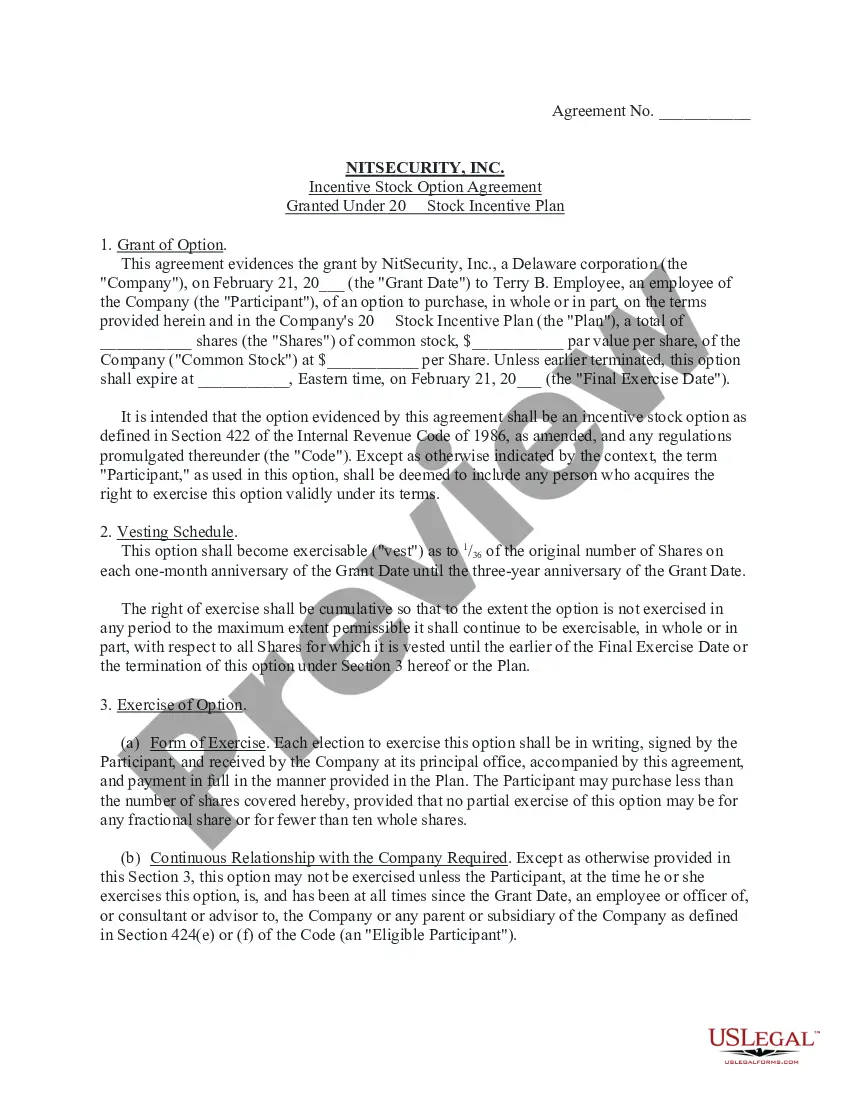
The Incentive Stock Option Agreement is a legal document that provides employees with the opportunity to purchase shares of a company's stock at a discounted price. This type of agreement is distinct from other stock option agreements due to its potential tax benefits under federal law, specifically Section 422 of the Internal Revenue Code. Incentive stock options can offer critical savings on taxes, as the profit from these stocks is generally taxed at the capital gains rate rather than as ordinary income.
Main sections of this form
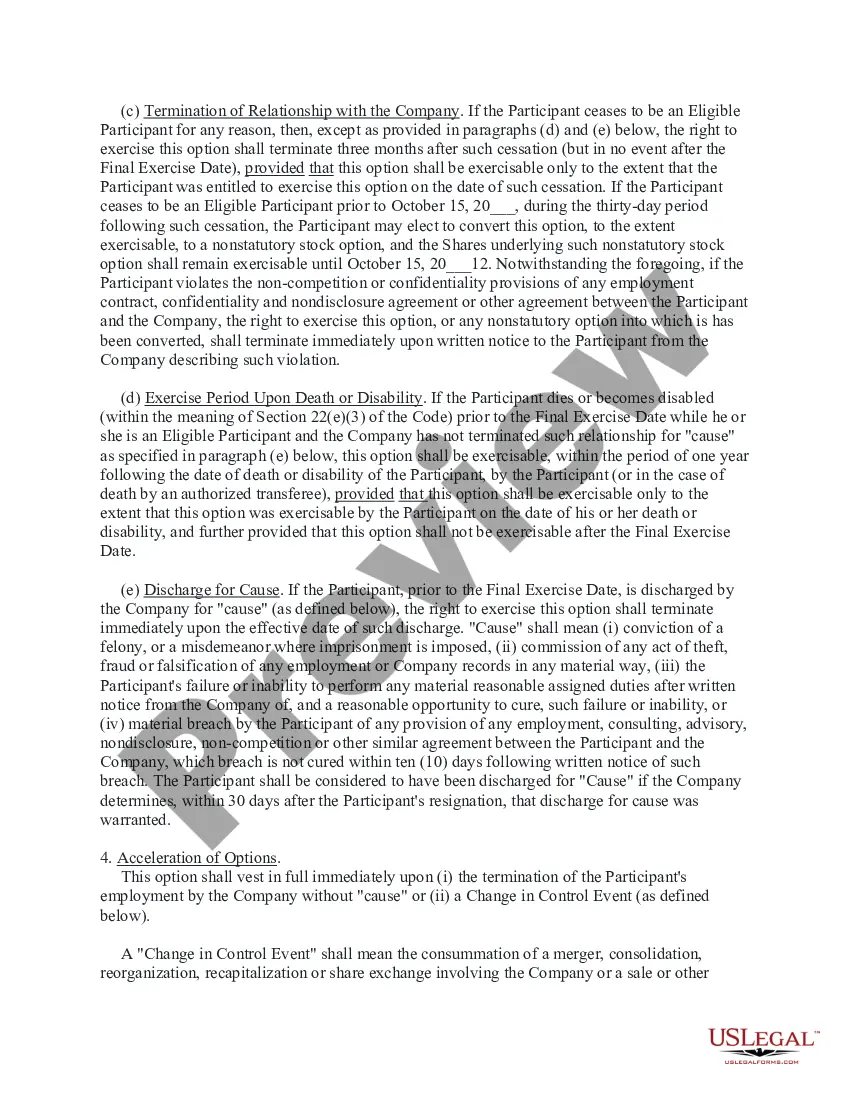
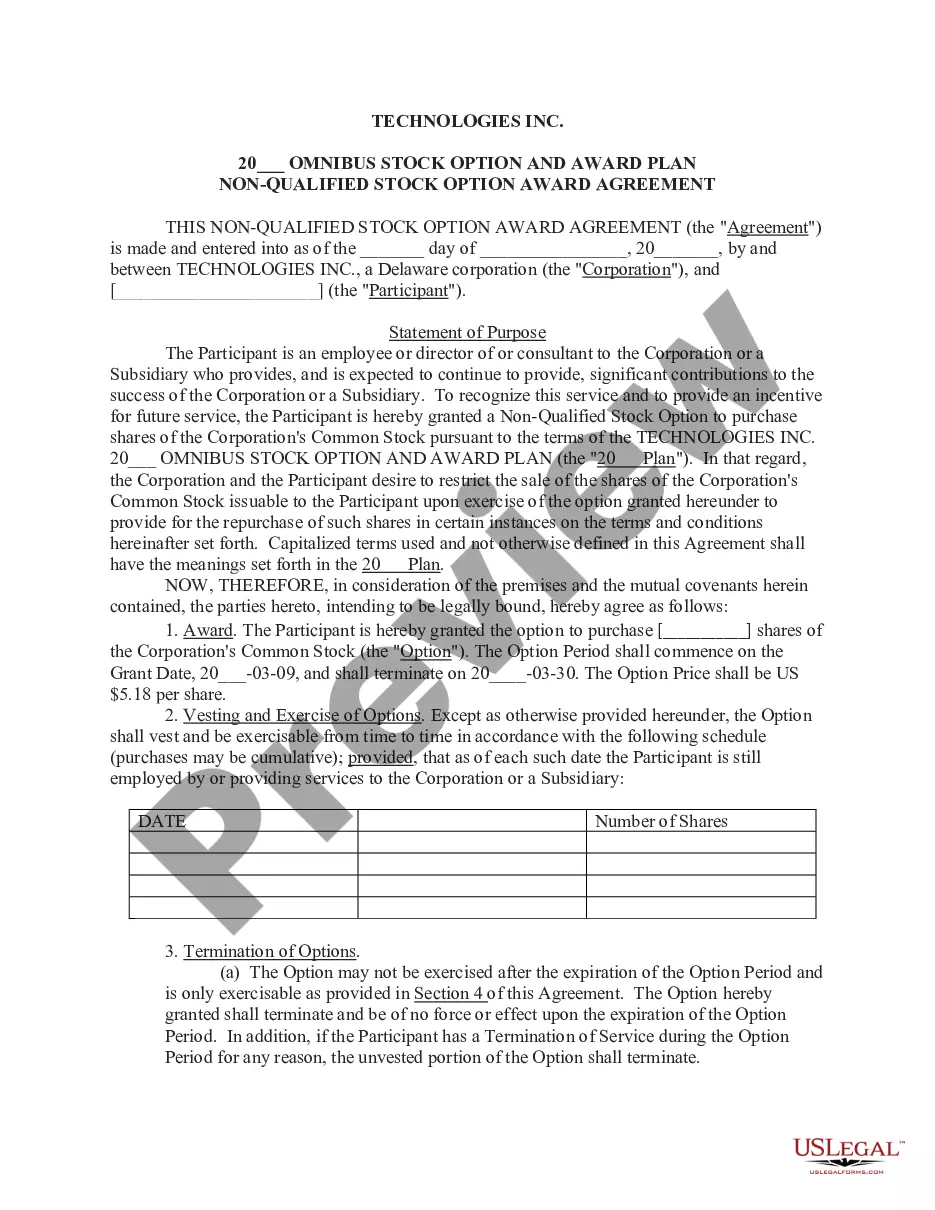
- The grant of an option to purchase a specified number of shares at a predetermined price.
- A detailed vesting schedule that specifies when the options can be exercised.
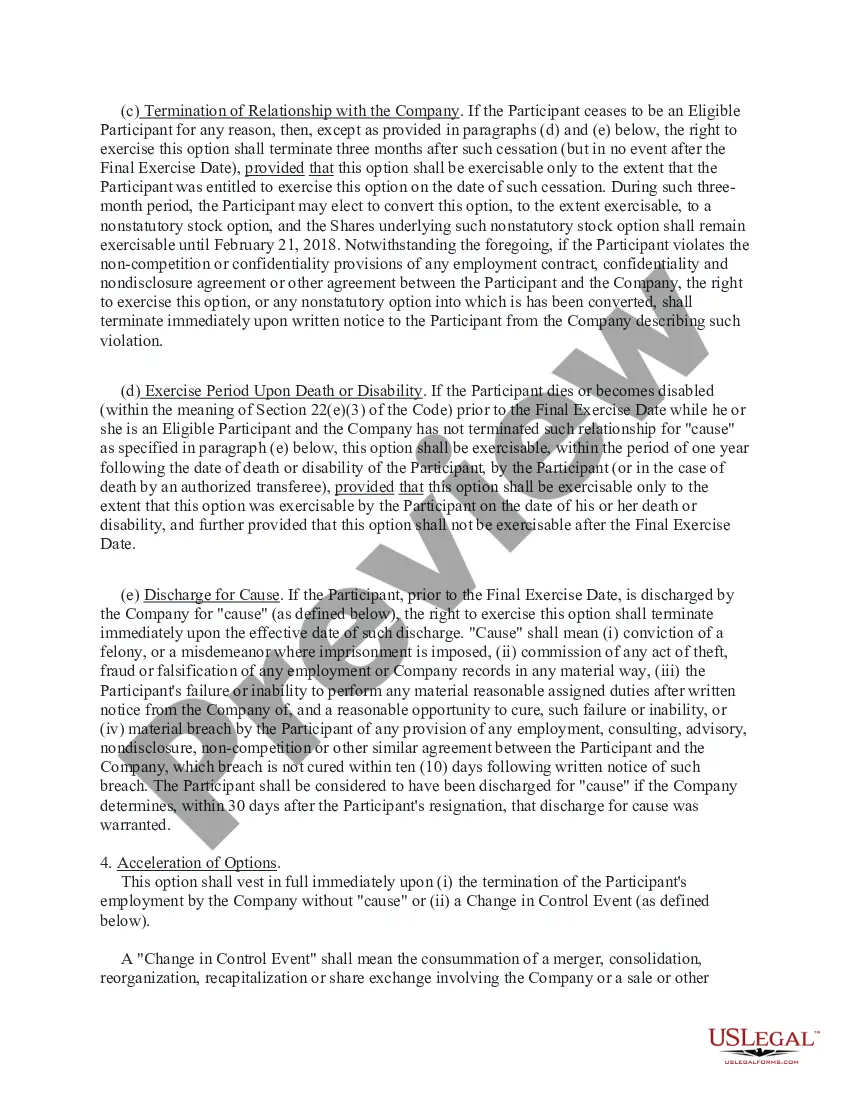
- Conditions under which the option may be exercised, including eligibility criteria for the participant.
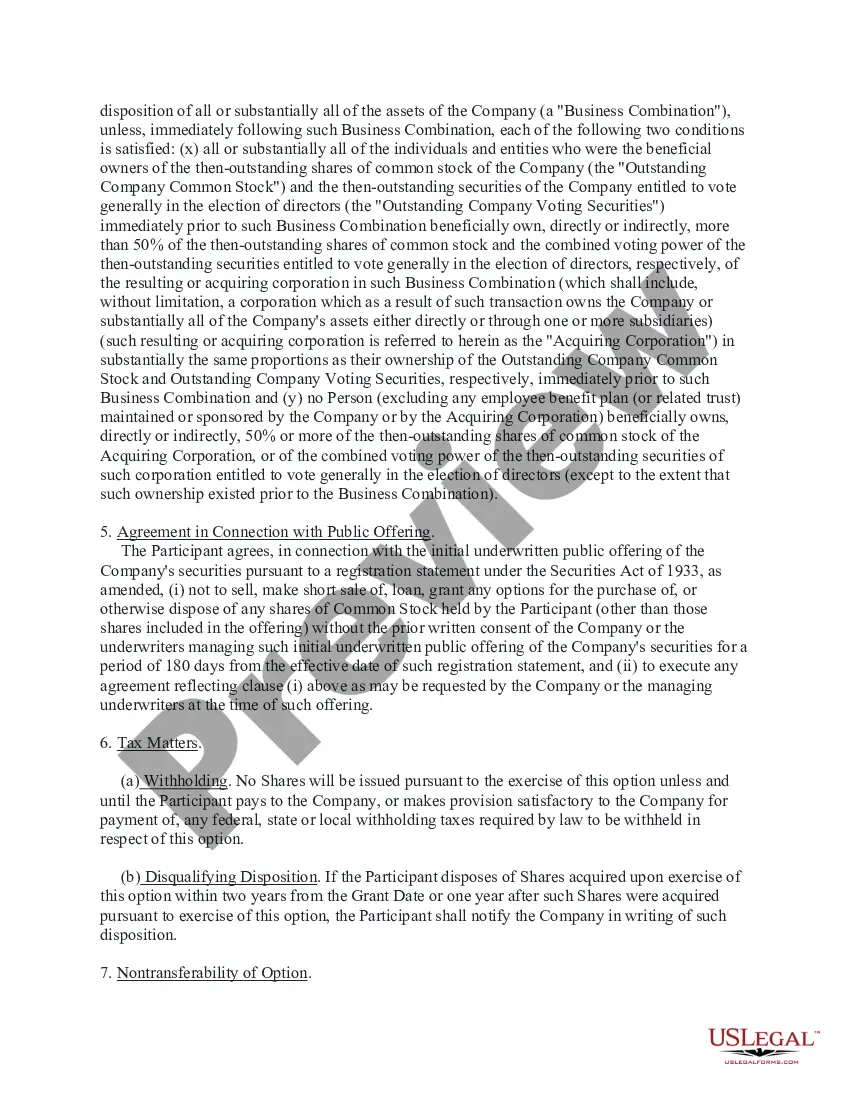
- Provisions regarding termination of the option in case of employment cessation.
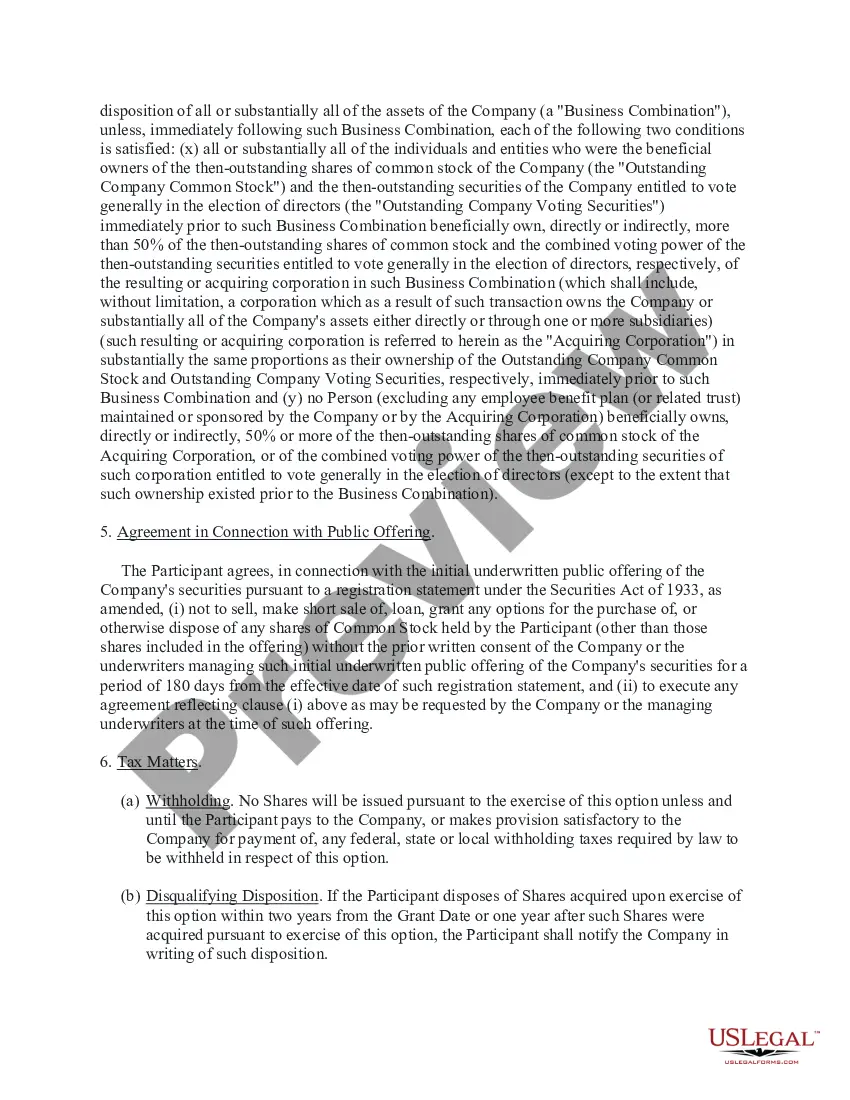
- Details related to the transferability of the option and tax implications.



Situations where this form applies
This form is essential for companies offering stock options as part of their employee benefits package. It should be used when granting options to employees who fulfill certain eligibility criteria, such as continuing employment. It's particularly useful in scenarios where a business aims to incentivize employees through stock ownership, aligning their interests with those of shareholders.
Who should use this form
- Employers seeking to implement an incentive stock option plan to attract and retain talent.
- Employees who are eligible to receive stock options as part of their compensation package.
- Human resources professionals tasked with managing employee benefits and incentives.
Instructions for completing this form
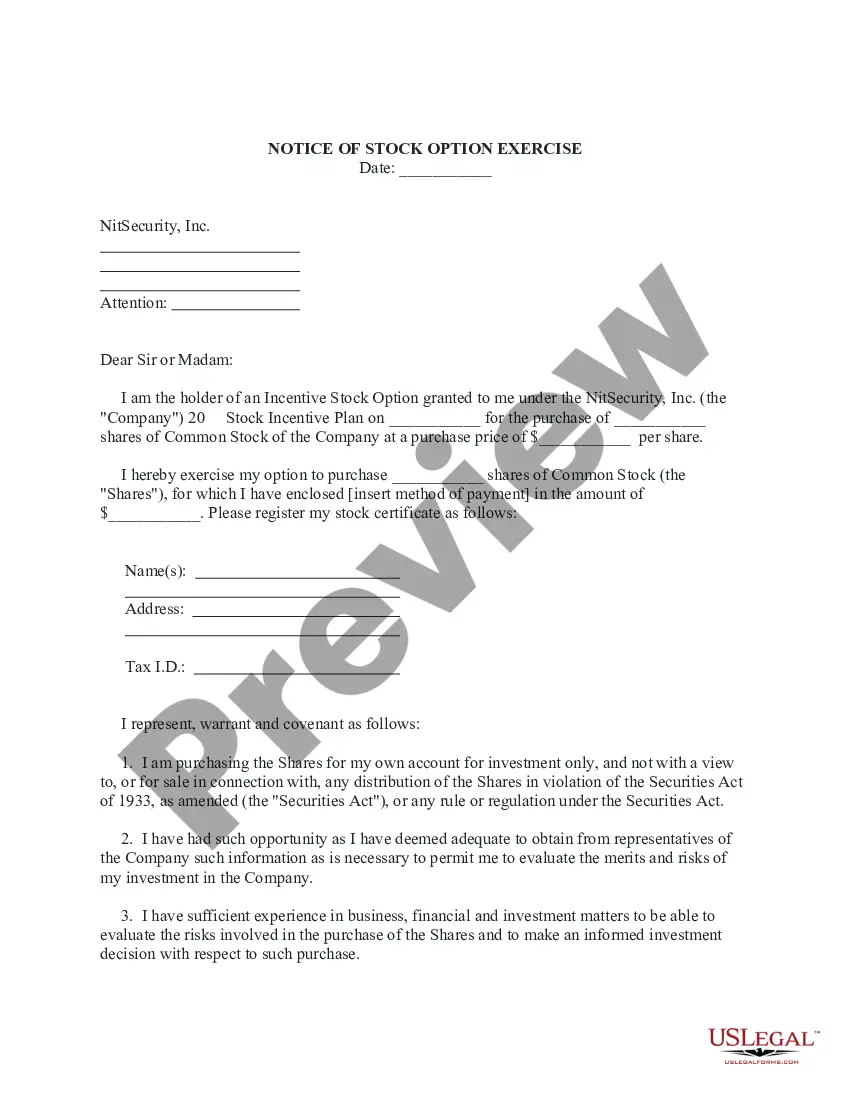
- Identify the company and the employee being granted the stock options.
- Specify the total number of shares being granted and the purchase price per share.
- Complete the vesting schedule detailing when the options will become exercisable.
- Include terms regarding the termination of the agreement in case of employment changes.
- Ensure all parties understand the tax implications and sign the agreement accordingly.
Does this form need to be notarized?
This form does not typically require notarization unless specified by local law.
Get your form ready online
Our built-in tools help you complete, sign, share, and store your documents in one place.
Make edits, fill in missing information, and update formatting in US Legal Forms—just like you would in MS Word.
Download a copy, print it, send it by email, or mail it via USPS—whatever works best for your next step.
Sign and collect signatures with our SignNow integration. Send to multiple recipients, set reminders, and more. Go Premium to unlock E-Sign.
If this form requires notarization, complete it online through a secure video call—no need to meet a notary in person or wait for an appointment.
We protect your documents and personal data by following strict security and privacy standards.

Make edits, fill in missing information, and update formatting in US Legal Forms—just like you would in MS Word.

Download a copy, print it, send it by email, or mail it via USPS—whatever works best for your next step.

Sign and collect signatures with our SignNow integration. Send to multiple recipients, set reminders, and more. Go Premium to unlock E-Sign.

If this form requires notarization, complete it online through a secure video call—no need to meet a notary in person or wait for an appointment.

We protect your documents and personal data by following strict security and privacy standards.
Avoid these common issues
- Failing to clearly outline the vesting schedule, which can lead to confusion.
- Not specifying the conditions under which the option can be exercised.
- Neglecting to inform participants of tax implications associated with exercising the options.
Why use this form online
- Convenient download and customization of the form to fit specific company needs.
- Easy access to updates reflecting current legal requirements and best practices.
- Secure storage of completed forms ensuring confidentiality and compliance.
Legal use & context
- This form provides legal documentation for the sale of shares under specified conditions.
- It helps ensure compliance with IRS regulations associated with incentive stock options.
- Utilizing this form can protect both the employer and employee in the event of disputes.
Quick recap
- The Incentive Stock Option Agreement is critical for companies to offer stock options effectively.
- Detailed understanding of vesting schedules and tax implications is essential for both parties.
- Ensuring accurate and compliant documentation can prevent legal issues in the future.
Looking for another form?
Form popularity
FAQ
Non-qualified stock options are more straightforward, as the tax implications at exercise are generally agreed to be easier to understand. Incentive stock options, while more complicated, offer the opportunity for long-term capital gains if you meet the requisite holding period requirements.
When you exercise Incentive Stock Options, you buy the stock at a pre-established price, which could be well below actual market value. The advantage of an ISO is you do not have to report income when you receive a stock option grant or when you exercise that option.
Grant price: The price an employee must pay the company for shares purchased when exercising options. The grant price is set on the grant date. Also referred to as the option price, exercise price or strike price. Incentive stock option (ISO): A type of stock option that qualifies for special tax treatment.
422(d)$100,000 per Year Limitation Paragraph (1) shall be applied by taking options into account in the order in which they were granted. For purposes of paragraph (1), the fair market value of any stock shall be determined as of the time the option with respect to such stock is granted.
ISOs require a vesting period of at least two years and a holding period of more than one year before they can be sold. ISOs often have more favorable tax treatment on profits than other types of employee stock purchase plans.
The ISO $100K limit, also known as the ?ISO limit? or ?$100K rule,? exists to prevent employees from taking too much advantage of the tax benefits associated with ISOs. It states that employees can't receive more than $100,000 worth of exercisable ISOs in a given calendar year.
Incentive stock options (ISOs) are popular measures of employee compensation received as rights to company stock. These are a particular type of employee stock purchase plan intended to retain key employees or managers. ISOs often have more favorable tax treatment than other types of employee stock purchase plan.
You report the taxable income only when you sell the stock. And, depending on how long you own the stock, that income could be taxed at capital gain rates ranging from 0% to 23.8% (for sales in 2022)?typically a lot lower than your regular income tax rate.