Mississippi Quitclaim Deed from a Trust to an Individual
What this document covers
This Quitclaim Deed from a Trust to an Individual is a legal document where a Grantor, acting as a Trust, transfers any interest they may have in a specific property to the Grantee, an individual. Unlike other deeds, a quitclaim deed does not guarantee that the Grantor holds a valid title; it merely releases any interest in the property. This form ensures compliance with all state statutory laws.
What’s included in this form
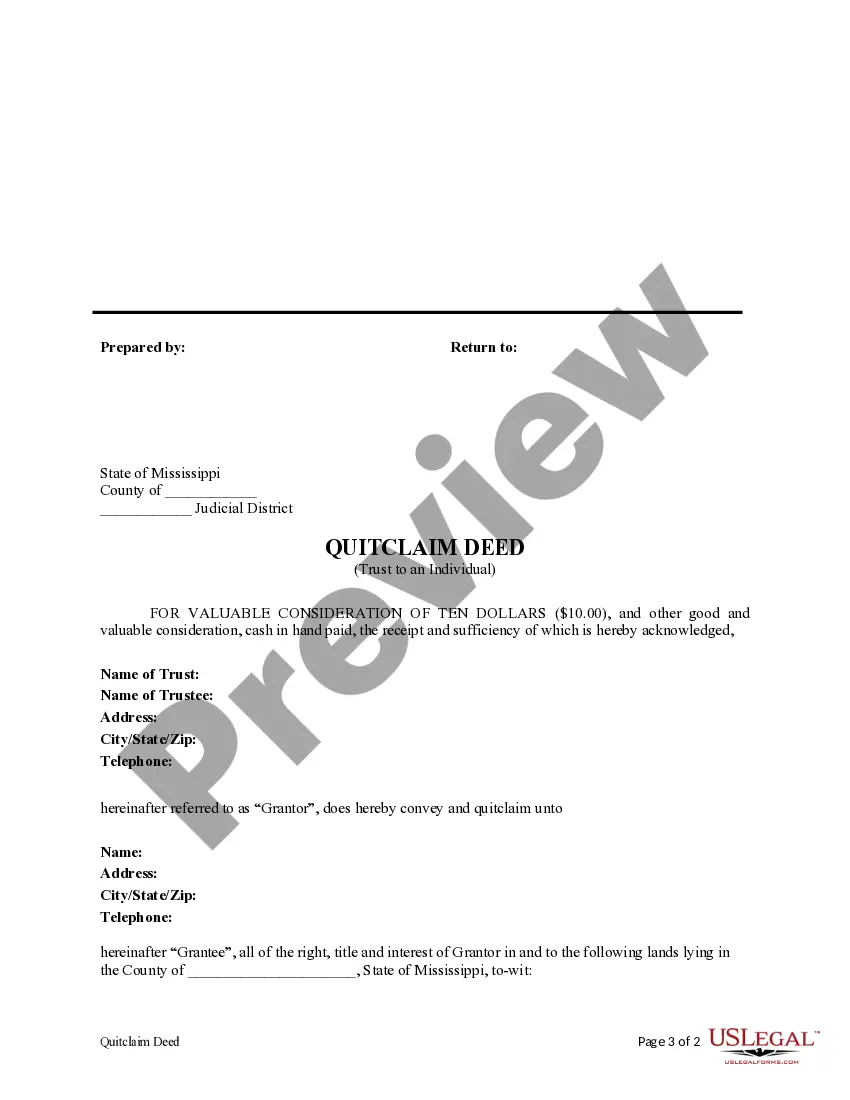
- Grantor and Grantee details: Names and addresses of the Trust (Grantor) and the Individual (Grantee).
- Property description: A clear and concise description of the property being transferred.
- Consideration statement: A declaration of the consideration (monetary value or services) exchanged for the deed.
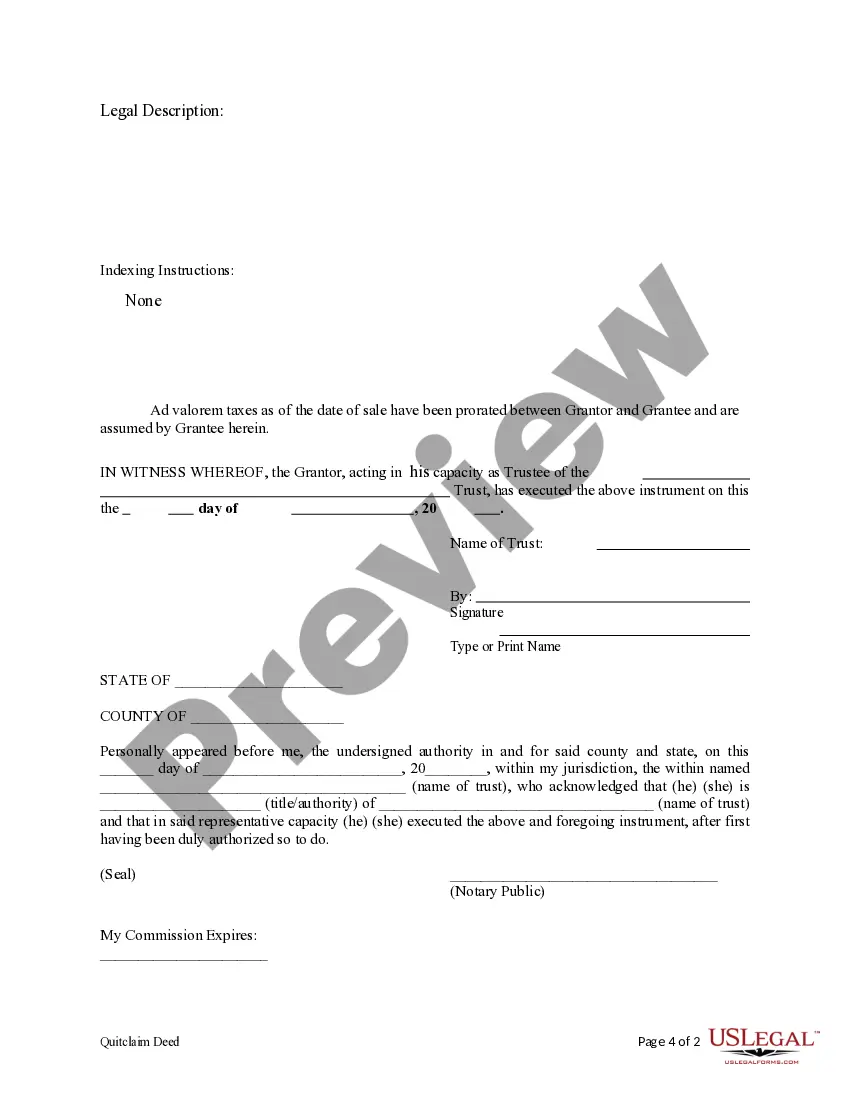
- Notary section: A place for the notary public to sign and stamp, verifying the authenticity of the document.





Situations where this form applies
This form is needed when a Trust wishes to transfer ownership of real property to an individual. Common scenarios include estate planning, where a trustee from the Trust conveys property to a beneficiary, or when simplifying asset ownership after the dissolution of a Trust.
Who needs this form
- Trustees who manage assets held in a Trust.
- Individuals who are beneficiaries of a Trust and need to receive property.
- Parties involved in estate planning or modification of property ownership.
How to complete this form
- Identify the parties: Enter the names and addresses of the Grantor (Trust) and Grantee (Individual).
- Specify the property: Provide a detailed description of the property being conveyed.
- Complete the consideration statement: Declare the amount of consideration given, typically a nominal amount.
- Sign the document: The Grantor must sign the form in the presence of a notary public.
- Notarize the deed: Ensure the notary public completes the notary section to validate the deed.
Notarization guidance
Yes, this form must be notarized to be legally valid. U.S. Legal Forms offers integrated online notarization services, providing 24/7 access through secure video calls, ensuring that the process is convenient and compliant with legal standards.
Get your form ready online
Our built-in tools help you complete, sign, share, and store your documents in one place.
Make edits, fill in missing information, and update formatting in US Legal Forms—just like you would in MS Word.
Download a copy, print it, send it by email, or mail it via USPS—whatever works best for your next step.
Sign and collect signatures with our SignNow integration. Send to multiple recipients, set reminders, and more. Go Premium to unlock E-Sign.
If this form requires notarization, complete it online through a secure video call—no need to meet a notary in person or wait for an appointment.
We protect your documents and personal data by following strict security and privacy standards.

Make edits, fill in missing information, and update formatting in US Legal Forms—just like you would in MS Word.

Download a copy, print it, send it by email, or mail it via USPS—whatever works best for your next step.

Sign and collect signatures with our SignNow integration. Send to multiple recipients, set reminders, and more. Go Premium to unlock E-Sign.

If this form requires notarization, complete it online through a secure video call—no need to meet a notary in person or wait for an appointment.

We protect your documents and personal data by following strict security and privacy standards.
Mistakes to watch out for
- Incomplete property description: Ensure the property is properly identified to avoid confusion.
- Missing signatures: The Grantor's signature must be present alongside notarization.
- Improper notation of consideration: Make sure the consideration amount is accurately stated.
Benefits of completing this form online
- Convenience: Download and complete the form from anywhere at your convenience.
- Editability: Easily fill in form fields digitally or print and complete manually.
- Compliance: Ensure your form meets state-specific requirements without the need for prior legal knowledge.
Looking for another form?

Form popularity
FAQ
But you might be wondering if an owner can transfer a deed to another person without a real estate lawyer. The answer is yes. Parties to a transaction are always free to prepare their own deeds.A quitclaim deed, for example, is far simpler than a warranty deed.
A quitclaim deed can be used to transfer property from a trust, but a Special Warranty Deed seems to be a more common way to do this.
Before a quitclaim deed can be recorded with a county recorder in Mississippi, the grantor must sign and acknowledge it. The names, addresses, and telephone numbers of the grantors and grantees to the quit claim deed, along with a legal description of the real property should be provided on the first page (89-5-24).
Yes, a quit claim deed supercedes the trust. The only thing that can be done is to file a suit in court challenging the deed as the product of fraud and undue influence. A court action like that will cost thousands of dollars, but might be worth it if the house was owned free and clear.
Yes, you can use a Quitclaim Deed to transfer a gift of property to someone. You must still include consideration when filing your Quitclaim Deed with the County Recorder's Office to show that title has been transferred, so you would use $10.00 as the consideration for the property.
When you're ready to transfer trust real estate to the beneficiary who is named in the trust document to receive it, you'll need to prepare, sign, and record a deed. That's the document that transfers title to the property from you, the trustee, to the new owner.
A deed of trust acts as an agreement between youthe homebuyerand your lender. It states not just that you'll repay the loan, but that a third party called the trustee will hold legal title to the property until you do. A deed of trust is the security for your loan, and it's recorded in the public records.
As you stated in your question, it is recorded among the land records, and your lender keeps the original. When you pay off the loan, the lender will return the deed of trust with the promissory note. This document is rather lengthy and quite legalistic.
In real estate in the United States, a deed of trust or trust deed is a legal instrument which is used to create a security interest in real property wherein legal title in real property is transferred to a trustee, which holds it as security for a loan (debt) between a borrower and lender.