South Carolina RECEIVING GIFTS FOR PROCURING LOANS
Overview of this form
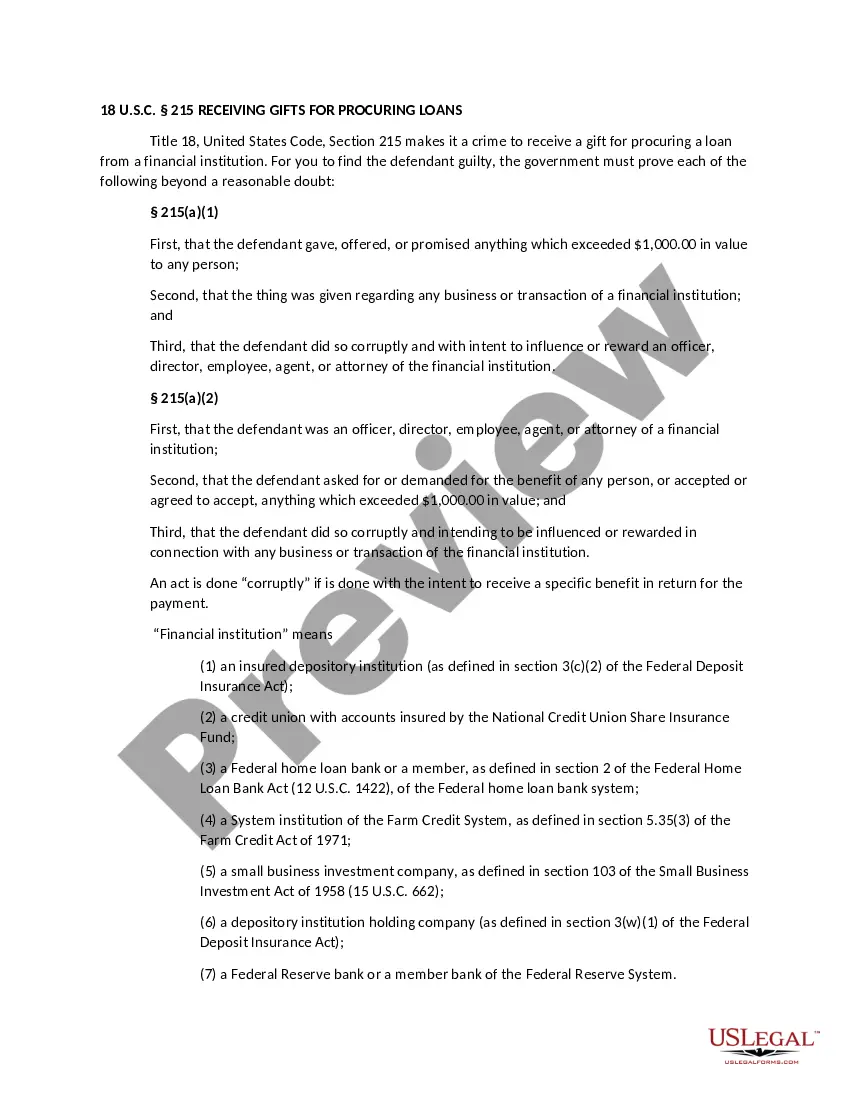
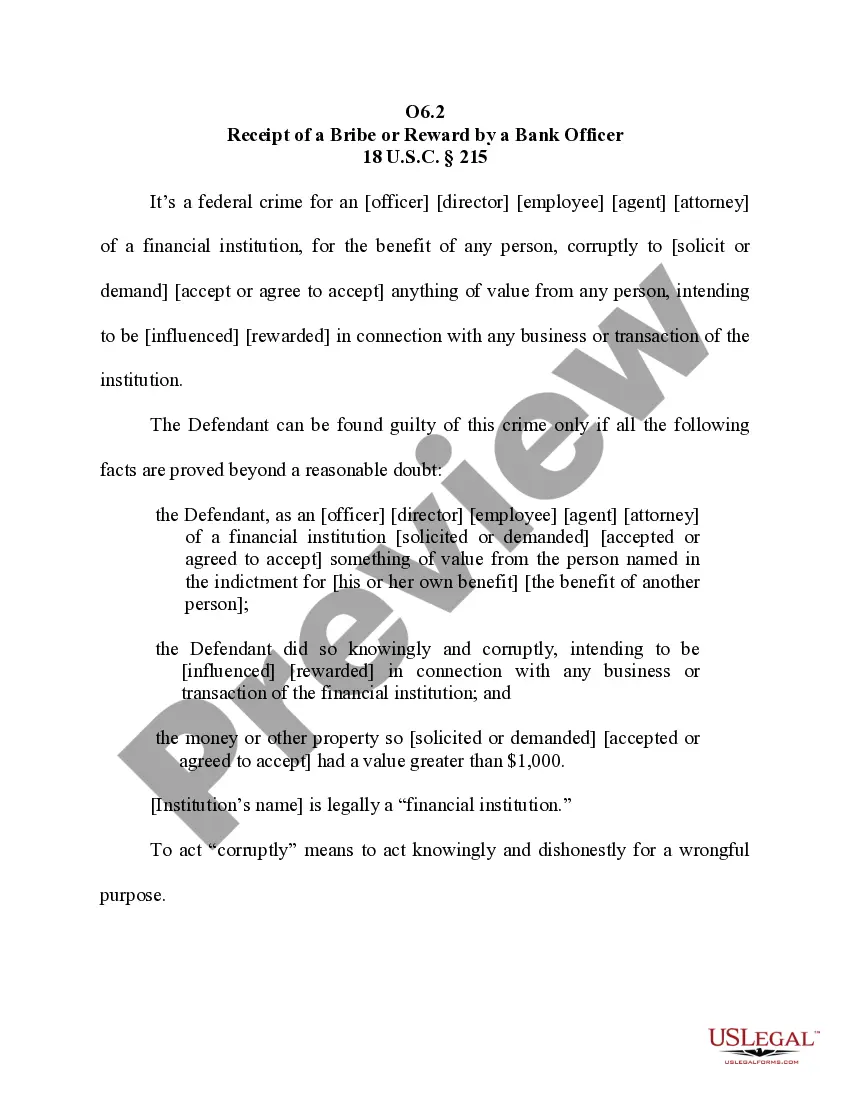
The Receiving Gifts for Procuring Loans form outlines the legal parameters surrounding the acceptance of gifts for procuring loans from financial institutions. This form is particularly significant in ensuring that both lenders and borrowers comply with federal law, specifically Title 18, United States Code, Section 215, which makes it a crime to receive or give gifts intended to influence financial transactions. Understanding this form can help parties avoid legal pitfalls associated with corrupt practices in financing.
Key parts of this document
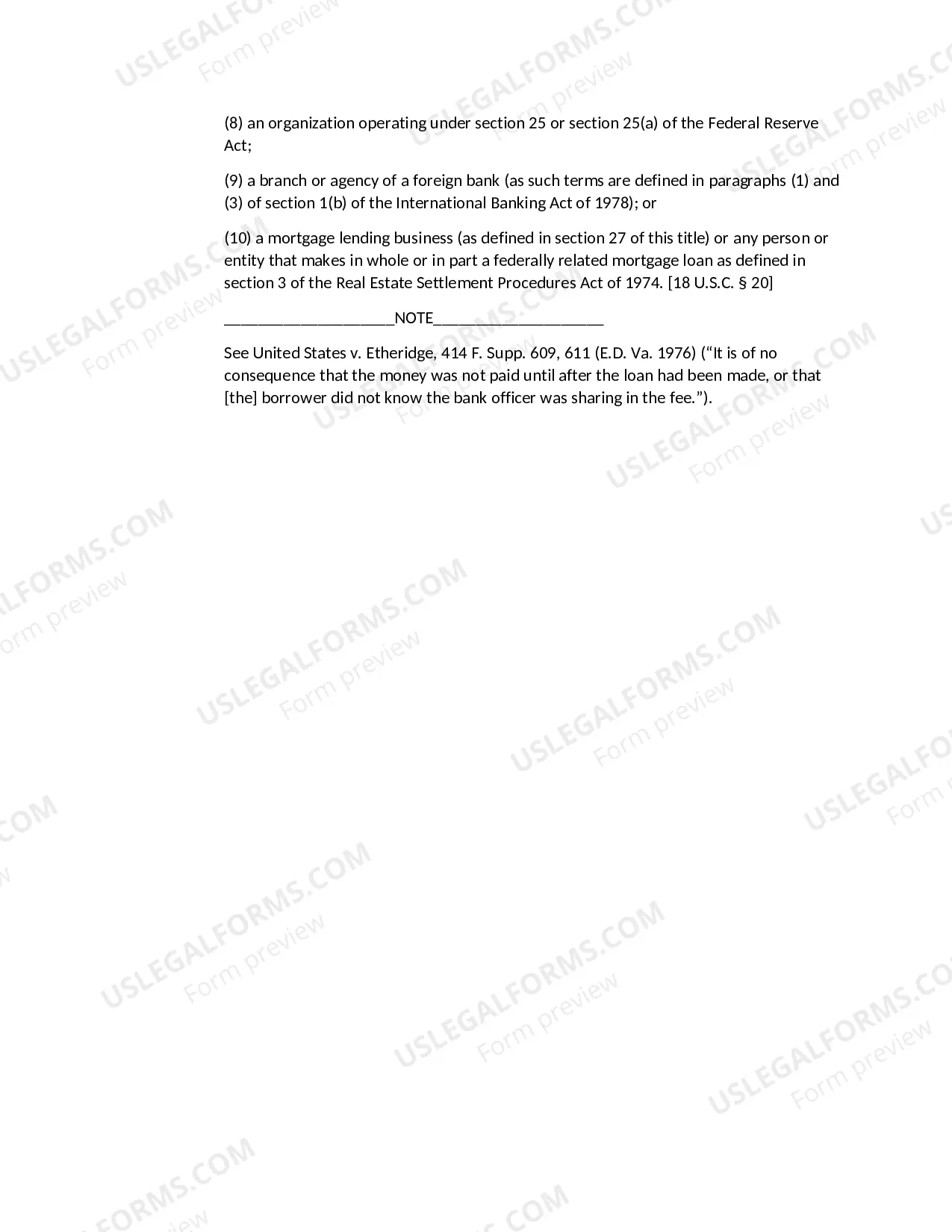
- Definitions of key terms such as "financial institution" and "corrupt intent."
- Criteria for establishing guilt under Section 215(a)(1) and (a)(2).
- Details on the value threshold of $1,000.00 for gifts given related to financial transactions.
- Identification of roles such as officers, employees, agents, and attorneys of financial institutions.
- Legal precedents and interpretations relevant to the enforcement of these regulations.
When this form is needed
This form should be utilized in scenarios where there are concerns about the legality of receiving or giving gifts related to loans from financial institutions. It can be relevant for borrowers who are considering offering gifts as part of a loan application or for financial professionals who must navigate potential conflicts of interest related to gift acceptance.
Who should use this form
- Individuals applying for loans who may contemplate offering gifts to financial institutions.
- Financial professionals, including officers and agents of financial institutions, to ensure compliance with legal regulations.
- Legal advisors or attorneys who represent clients in financial transactions involving loans.
Completing this form step by step
- Review the relevant sections of Title 18, United States Code, Section 215.
- Identify all parties involved, including the giver and receiver of any gifts.
- Clarify the nature of the business transaction or loan for which the gift is being offered.
- Assess the value of the gift to ensure it exceeds the $1,000.00 threshold.
- Document the intent behind the gift to establish it was not meant to influence the loan process corruptly.
Notarization requirements for this form
This form does not typically require notarization to be legally valid. However, some jurisdictions or document types may still require it. US Legal Forms provides secure online notarization powered by Notarize, available 24/7 for added convenience.
Get your form ready online
Our built-in tools help you complete, sign, share, and store your documents in one place.
Make edits, fill in missing information, and update formatting in US Legal Forms—just like you would in MS Word.
Download a copy, print it, send it by email, or mail it via USPS—whatever works best for your next step.
Sign and collect signatures with our SignNow integration. Send to multiple recipients, set reminders, and more. Go Premium to unlock E-Sign.
If this form requires notarization, complete it online through a secure video call—no need to meet a notary in person or wait for an appointment.
We protect your documents and personal data by following strict security and privacy standards.

Make edits, fill in missing information, and update formatting in US Legal Forms—just like you would in MS Word.

Download a copy, print it, send it by email, or mail it via USPS—whatever works best for your next step.

Sign and collect signatures with our SignNow integration. Send to multiple recipients, set reminders, and more. Go Premium to unlock E-Sign.

If this form requires notarization, complete it online through a secure video call—no need to meet a notary in person or wait for an appointment.

We protect your documents and personal data by following strict security and privacy standards.
Mistakes to watch out for
- Failing to understand the definition of a financial institution.
- Miscalculating the value of gifts or failing to document them properly.
- Assuming that gifts under $1,000.00 are exempt from scrutiny.
- Not considering the intent behind the gift when documenting the transaction.
Benefits of completing this form online
- Immediate access to updated legal forms drafted by licensed attorneys.
- Convenience of downloading and completing the form at your own pace.
- Easy navigation and access to legal guidance regarding the use of these forms.
Looking for another form?



Form popularity
FAQ
Ing to SC Code Section 11-35-5320 ?all political subdivisions of the state shall adopt ordinances or procedures embodying sound principles of appropriately competitive procurement.? The law does not require municipalities to adopt state procedures.
SECTION 37-3-105. First mortgage real estate loans. (1) Except as otherwise provided in subsection (2), unless the loan is made subject to this title by agreement (Section 37-3-601), "consumer loan" does not include a loan secured by a first lien or equivalent security interest in real estate.
4 SC Code § 11-35-3215 provides for a preference for resident design services when qualifications appear to be equal. A business responding to an invitation for design services must submit a certification with its response stating whether it is a South Carolina resident.
Multiterm contracts. (1) Specified Period. Unless otherwise provided by law, a contract for supplies, services, or information technology must not be entered into for any a period of more than one year unless approved in a manner prescribed by regulation of the board.
The governing body of the governmental body or its designee shall negotiate a contract for services with the most qualified person or firm at a compensation that is fair and reasonable to the State.
Current through 2023 Act No. 14. Any term or condition in any contract entered into by the State that requires the State to defend, indemnify, or hold harmless another person, must be void ab initio, unless such term is expressly authorized by law.
SC Code § 11-35-3220(5) requires the agency Selection Committee to evaluate each of the persons or firms interviewed in view of their (1) past performance; (2) the ability of professional personnel; (3) demonstrated ability to meet time and budget requirements; (4) location and knowledge of the locality of the project;