South Carolina RECEIVING STOLEN PROPERTY
What this document covers
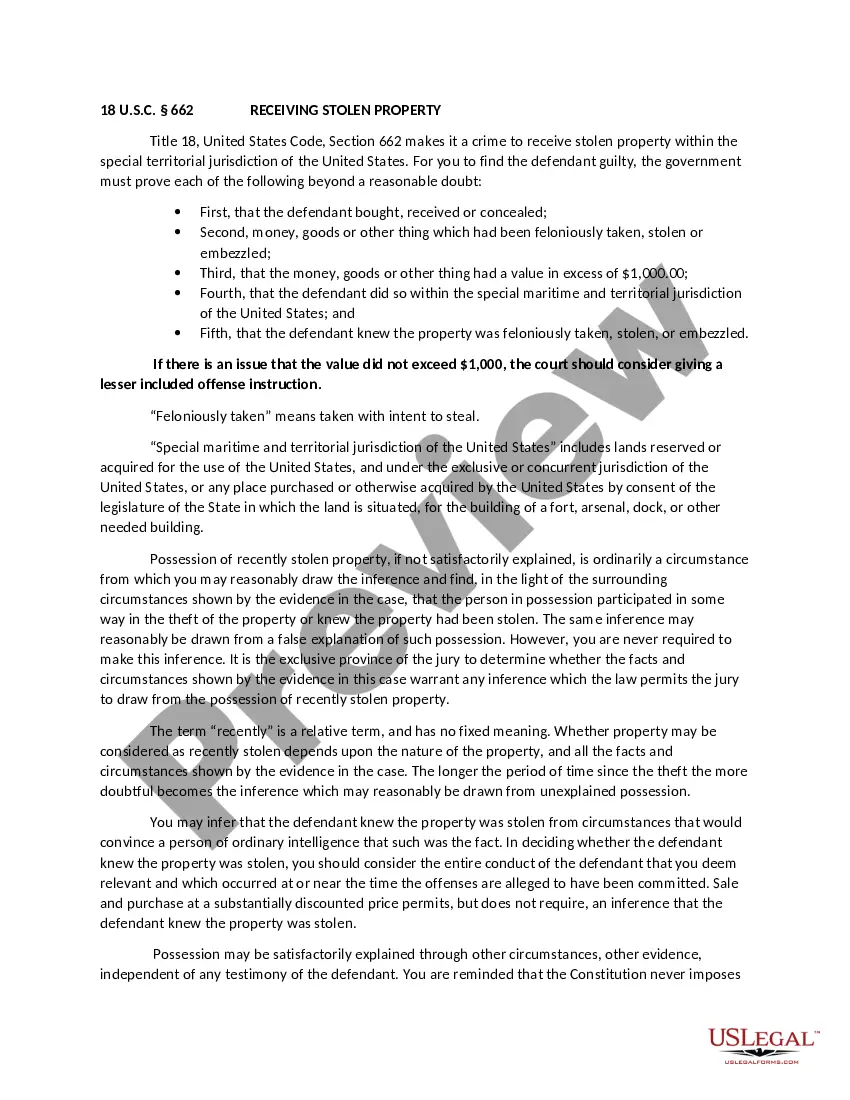
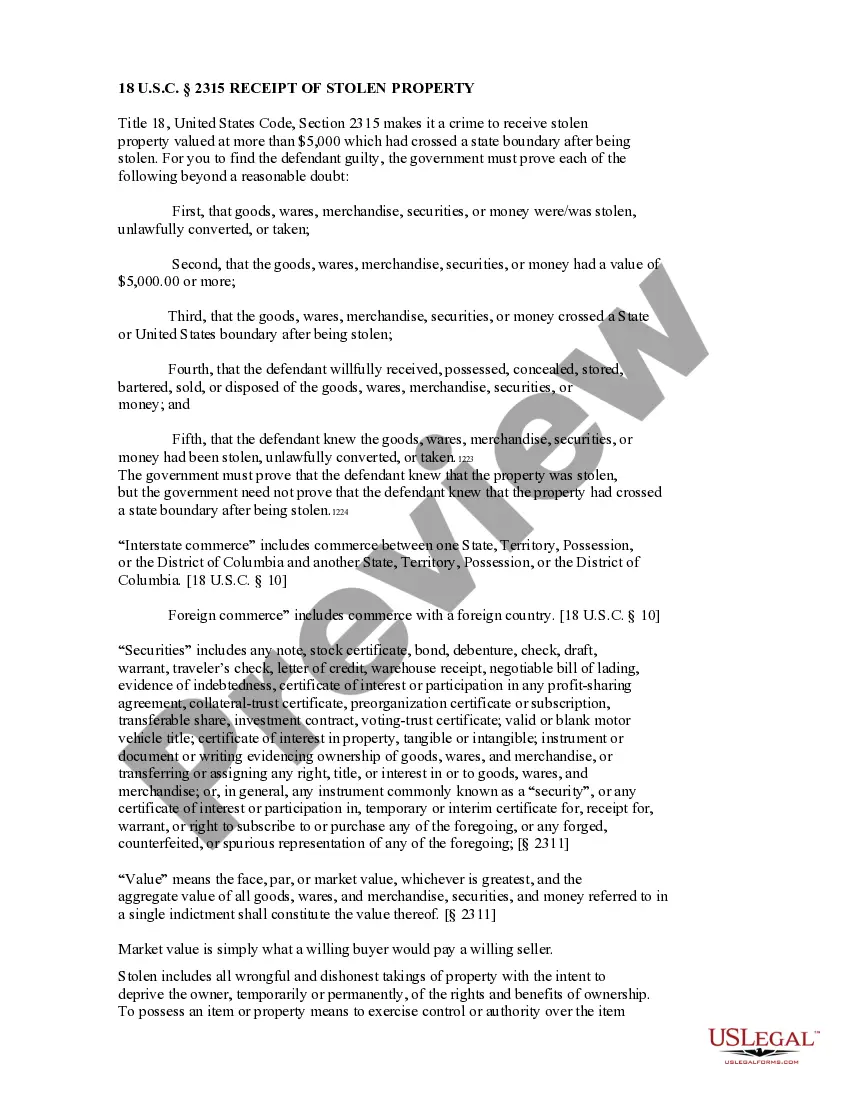
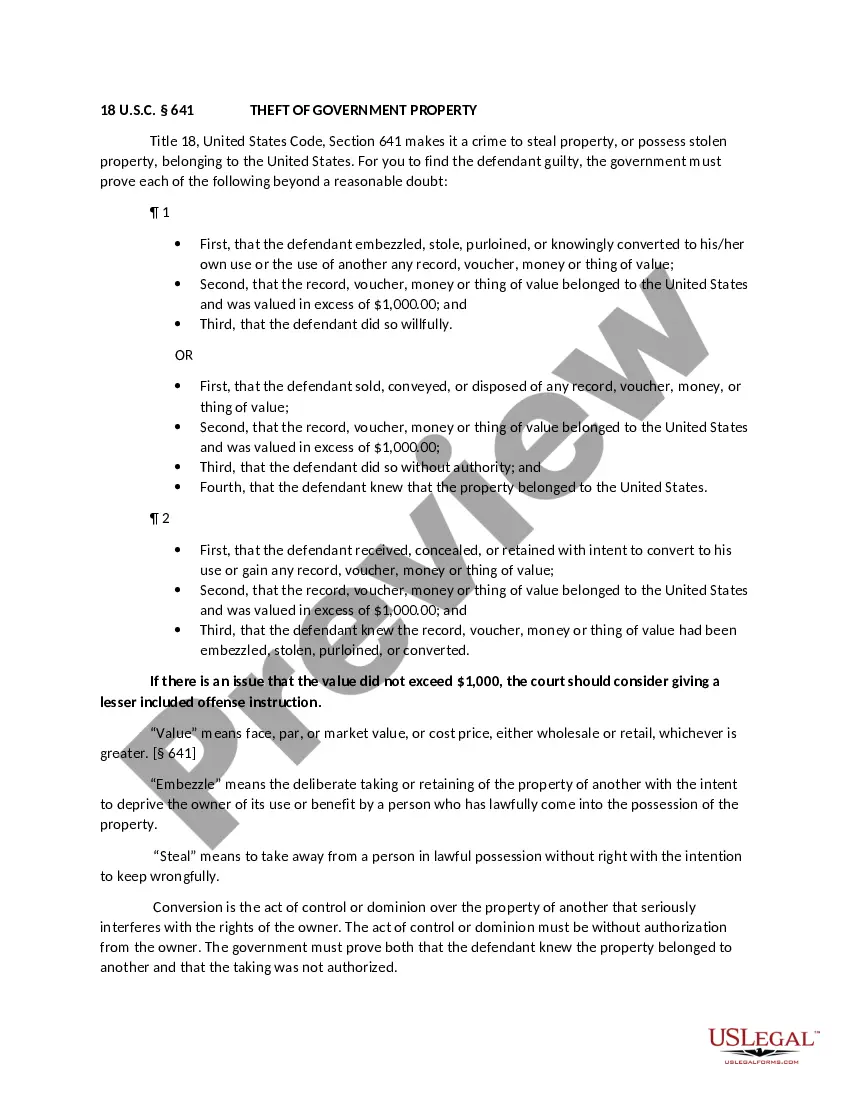
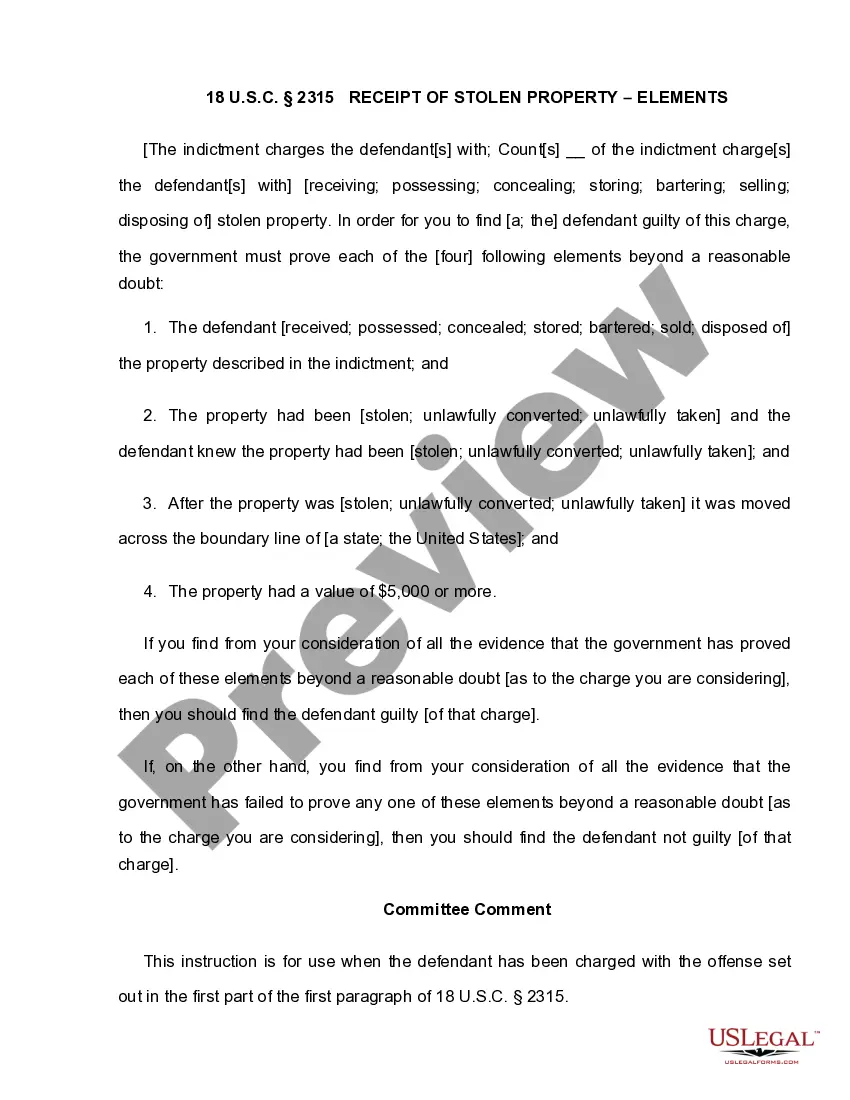
The Receiving Stolen Property form provides the official jury instructions related to the crime of knowingly receiving stolen property under federal law. This form clarifies the legal elements the prosecution must prove to establish guilt, distinguishing it from other related legal forms. It serves as a guideline for jurors in federal district courts to determine if a defendant is guilty of this crime.
Key parts of this document
- The elements of the crime that must be proven: purchase, reception, or concealment of stolen property.
- Definition of "feloniously taken" and "recently stolen property."
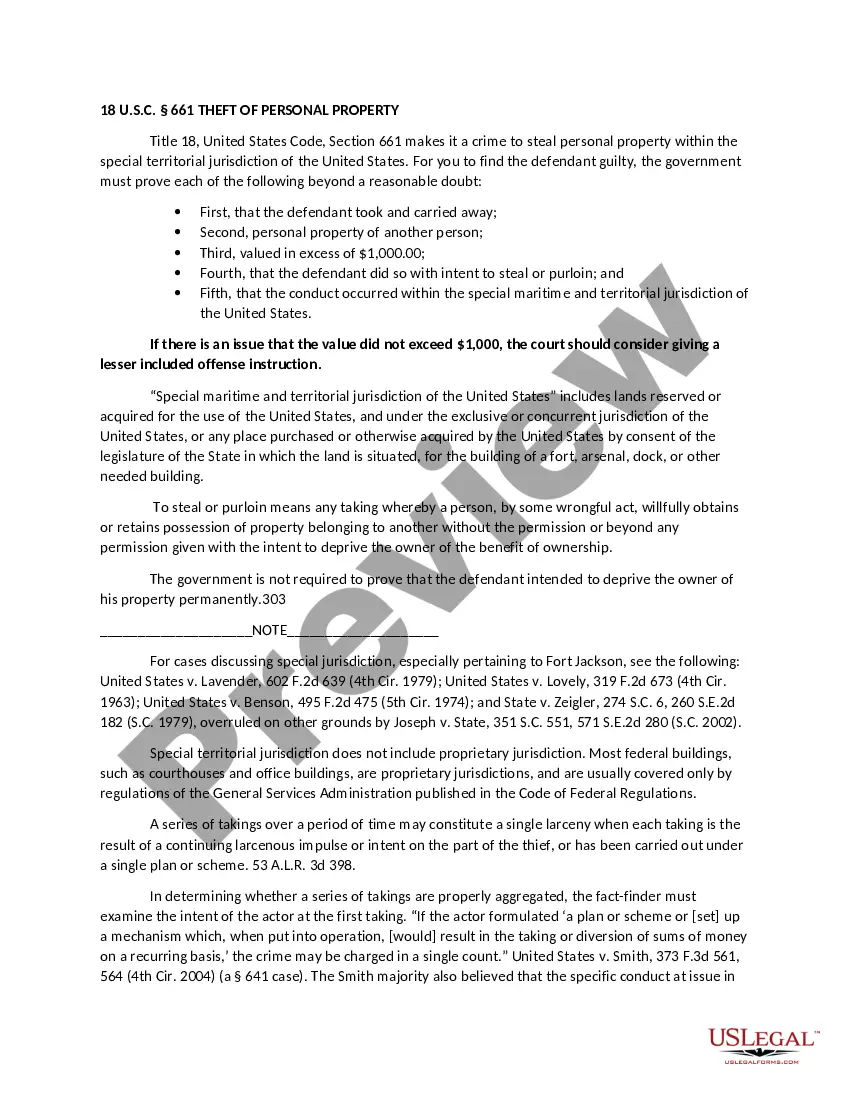
- Explanation of special maritime and territorial jurisdiction of the United States.
- Considerations for juries when inferring knowledge regarding stolen property.
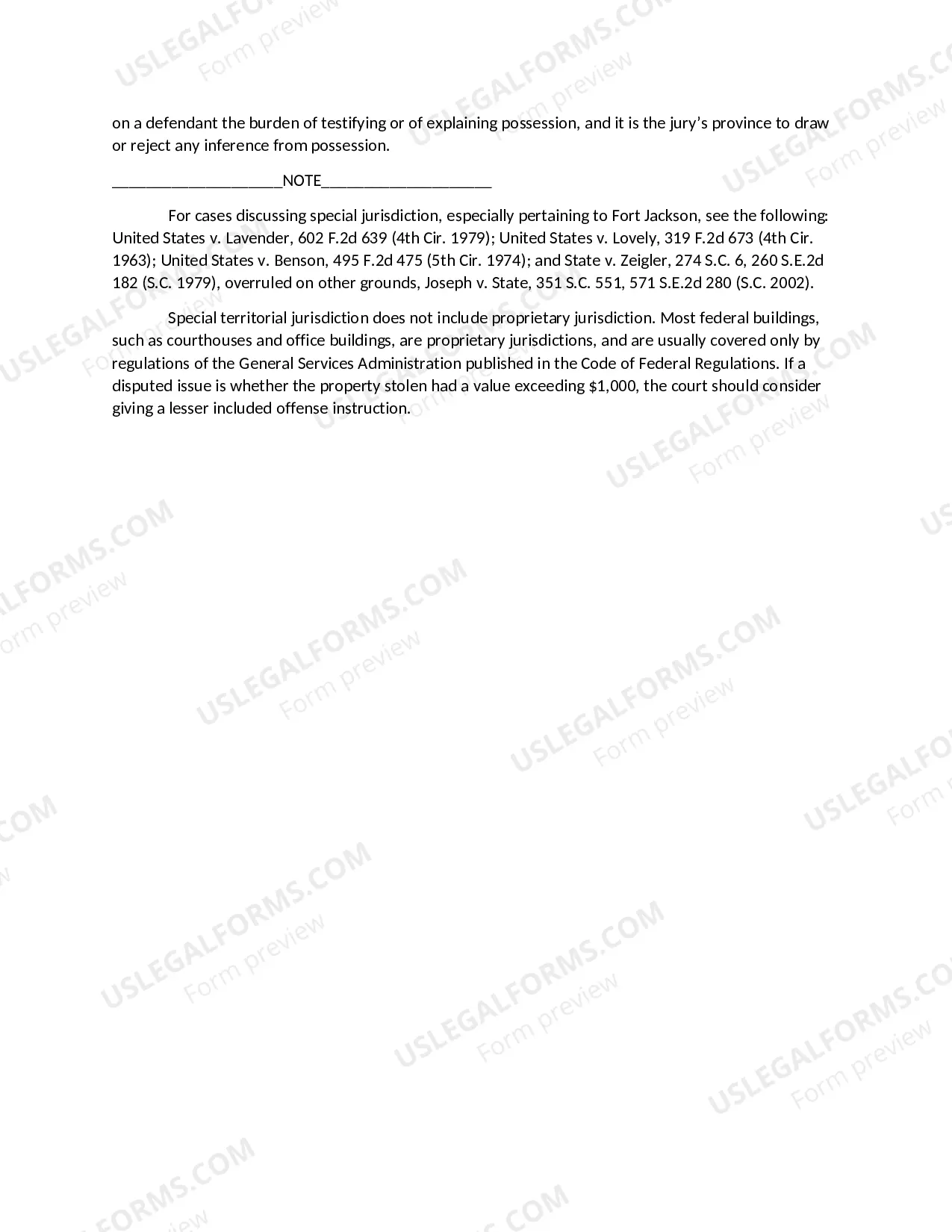
- References to relevant case law regarding jurisdiction and evidence.
When to use this document
This form is used during criminal cases in federal district courts when a defendant is accused of receiving stolen property. It provides the jury with specific instructions to assess whether the prosecution has sufficiently proven the defendant's guilt beyond a reasonable doubt.
Who can use this document
This form is intended for use by:
- Jurors serving on federal criminal cases regarding receiving stolen property.
- Judges who need to provide jury instructions in related criminal trials.
- Legal practitioners who are preparing for a case involving allegations of receiving stolen property.
Steps to complete this form
- Review the elements of the crime set out in Title 18, United States Code, Section 662.
- Understand the criteria for proving that the property was stolen and its value exceeded $1,000.
- Evaluate evidence regarding the defendant's possession and any related circumstances.
- Determine any relevant implications of recently stolen property and its documentation.
- Discuss the instructions among jurors when rendering a verdict based on the evidence supplied.
Does this form need to be notarized?
In most cases, this form does not require notarization. However, some jurisdictions or signing circumstances might. US Legal Forms offers online notarization powered by Notarize, accessible 24/7 for a quick, remote process.
Get your form ready online
Our built-in tools help you complete, sign, share, and store your documents in one place.
Make edits, fill in missing information, and update formatting in US Legal Forms—just like you would in MS Word.
Download a copy, print it, send it by email, or mail it via USPS—whatever works best for your next step.
Sign and collect signatures with our SignNow integration. Send to multiple recipients, set reminders, and more. Go Premium to unlock E-Sign.
If this form requires notarization, complete it online through a secure video call—no need to meet a notary in person or wait for an appointment.
We protect your documents and personal data by following strict security and privacy standards.

Make edits, fill in missing information, and update formatting in US Legal Forms—just like you would in MS Word.

Download a copy, print it, send it by email, or mail it via USPS—whatever works best for your next step.

Sign and collect signatures with our SignNow integration. Send to multiple recipients, set reminders, and more. Go Premium to unlock E-Sign.

If this form requires notarization, complete it online through a secure video call—no need to meet a notary in person or wait for an appointment.

We protect your documents and personal data by following strict security and privacy standards.
Common mistakes
- Failing to recognize the importance of proving all elements of the crime beyond a reasonable doubt.
- Mistaking possession for guilt without considering the context or evidence.
- Overlooking the definition of "recently stolen" when deliberating on the case.
Why use this form online
- Convenience: Easily accessible from anywhere, allowing for quick reference during jury deliberations.
- Editability: The Word format allows for customization to fit specific case requirements.
- Reliability: Drafted by licensed attorneys, ensuring adherence to legal standards.
Legal use & context
- This form outlines the legal framework for evaluating accusations of receiving stolen property in federal courts.
- The instructions must be followed to uphold the integrity of the legal process and ensure fair trials.
- Understanding these instructions is crucial for jurors to make well-informed decisions.
Main things to remember
- The Receiving Stolen Property form is essential for jury instructions in federal criminal cases.
- It defines key legal terms and the elements that must be proven to establish guilt.
- Jurors must carefully consider all evidence and context when deliberating on charges related to stolen property.
Looking for another form?
Form popularity
FAQ
(A) It is unlawful for a person to buy, receive, or possess stolen goods, chattels, or other property if the person knows or has reason to believe the goods, chattels, or property is stolen. A person is guilty of this offense whether or not anyone is convicted of the property theft.
SECTION 16-21-80. Receiving, possessing, concealing, selling, or disposing of stolen vehicle.
Penalties for Larceny in South Carolina The crime of petit larceny in South Carolina is a misdemeanor punishable by a maximum period of incarceration of 30 days in the county jail and/or a one thousand dollar fine.
As laid out in South Carolina General Code Section 16-13-240, it is a crime to obtain a signature, money, or property from someone under false pretenses or misrepresentation of a fact with ?intent to cheat and defraud a person of that property.? Simply put, if you obtain money, property, or the title to property from
As laid out in South Carolina General Code Section 16-13-240, it is a crime to obtain a signature, money, or property from someone under false pretenses or misrepresentation of a fact with ?intent to cheat and defraud a person of that property.? Simply put, if you obtain money, property, or the title to property from
Penalties for Possession of Stolen Goods and Larceny If the dollar amount is less than $2,000, the crime is a misdemeanor that is punishable by up to 30 days in jail. If the dollar amount is greater than $2,000 but no more than $10,000, the crime is a felony that is punishable by up to five years in prison.
A person commits grand larceny, a felony, when the value of the stolen property is over $2,000. South Carolina divides grand larceny into two categories, depending on the value of the taken property. Class F felony.
In order order to be found guilty of the crime, receiving stolen property, the following legal elements must be established beyond a reasonable doubt: (1) that the defendant bought, received, or aided in the concealment of stolen property and. (2) that the defendant had knowledge the property was stolen. Commonwealth v