North Dakota Commercial Contractor Package
What this form package covers
The North Dakota Commercial Contractor Package includes essential legal documents specifically designed for commercial contractors, owners, suppliers, or subcontractors. This package serves to assert rights or claims and address important legal aspects related to construction projects. Unlike packages that focus on residential construction, this package centers around commercial construction and features a comprehensive commercial construction contract as its core document.
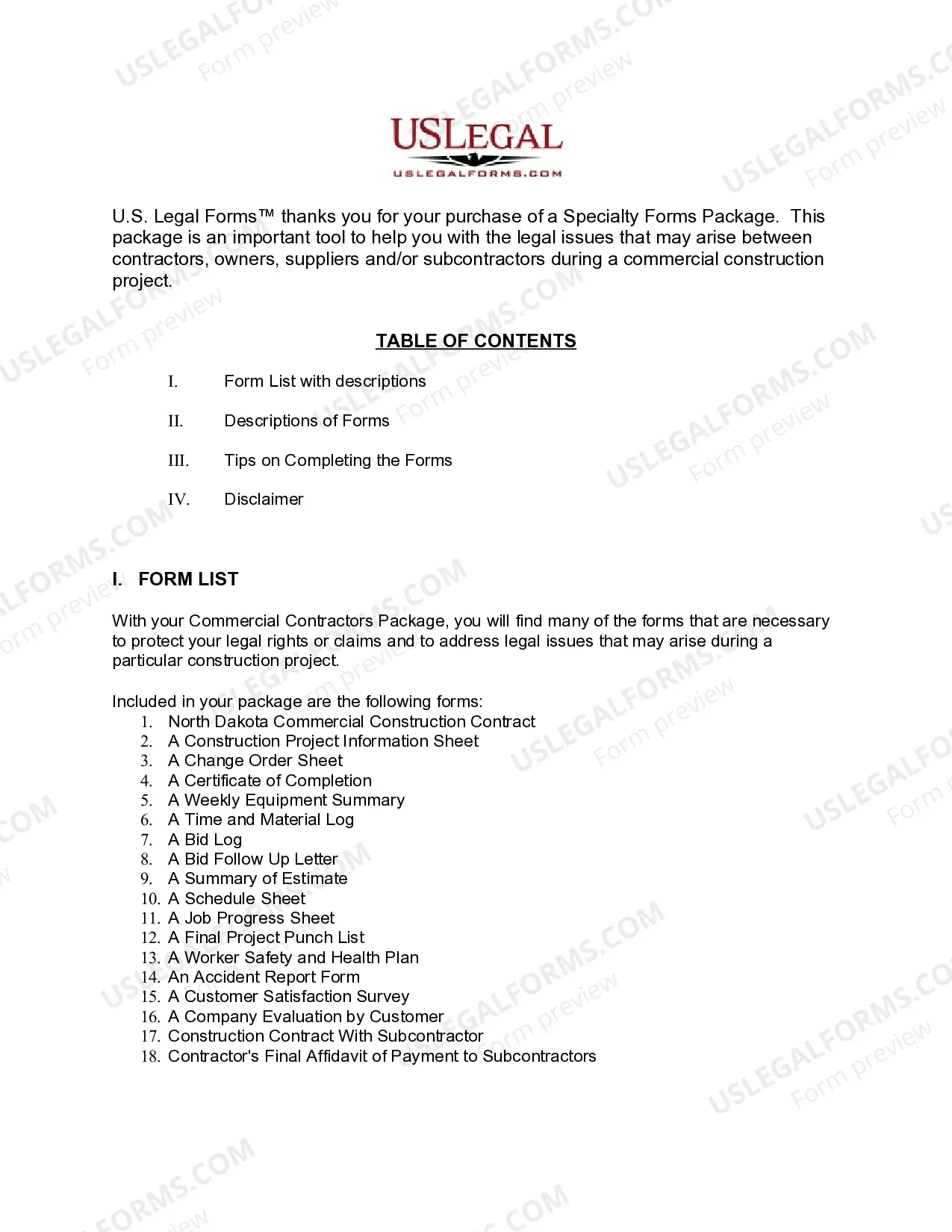
Forms you’ll find in this package
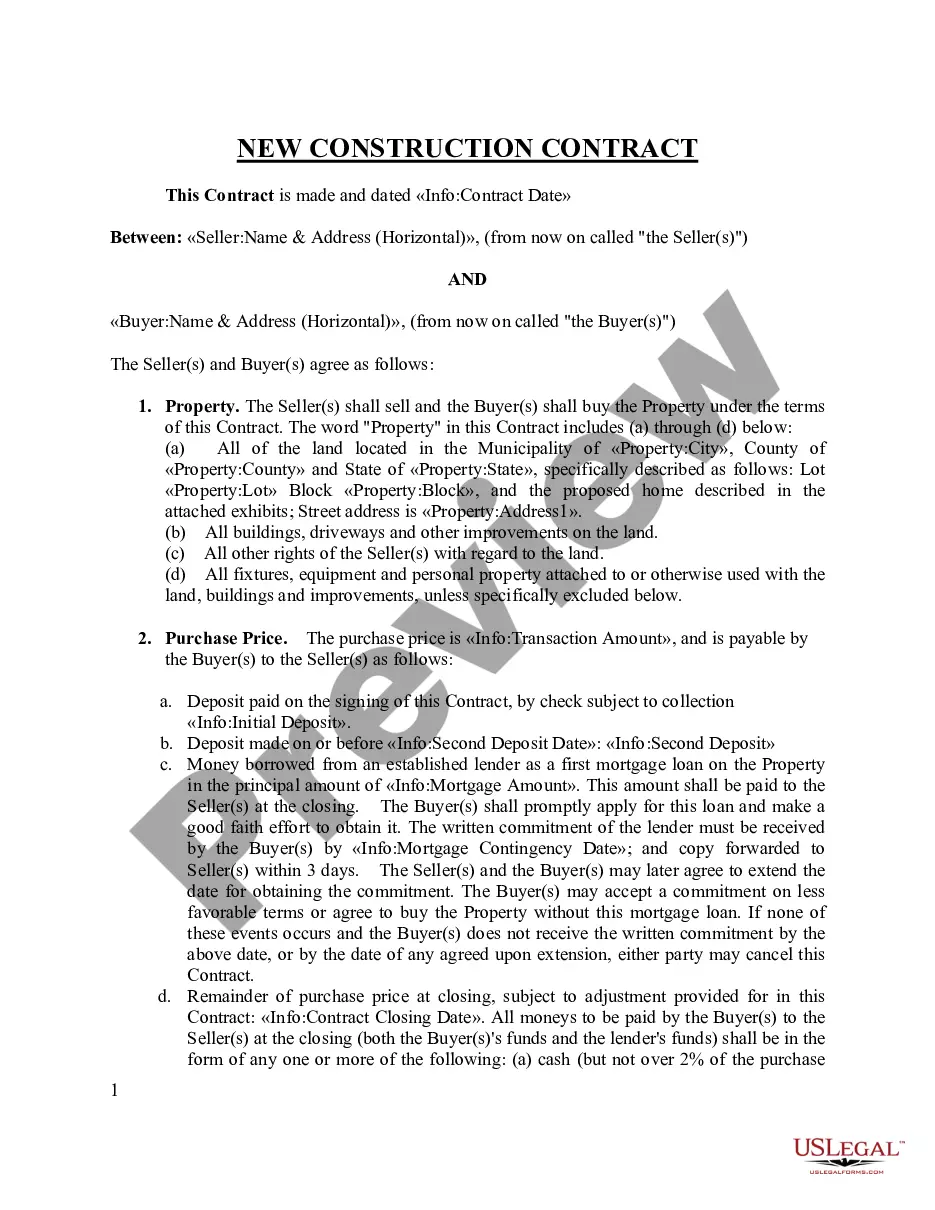
- Commercial Contract for Contractor
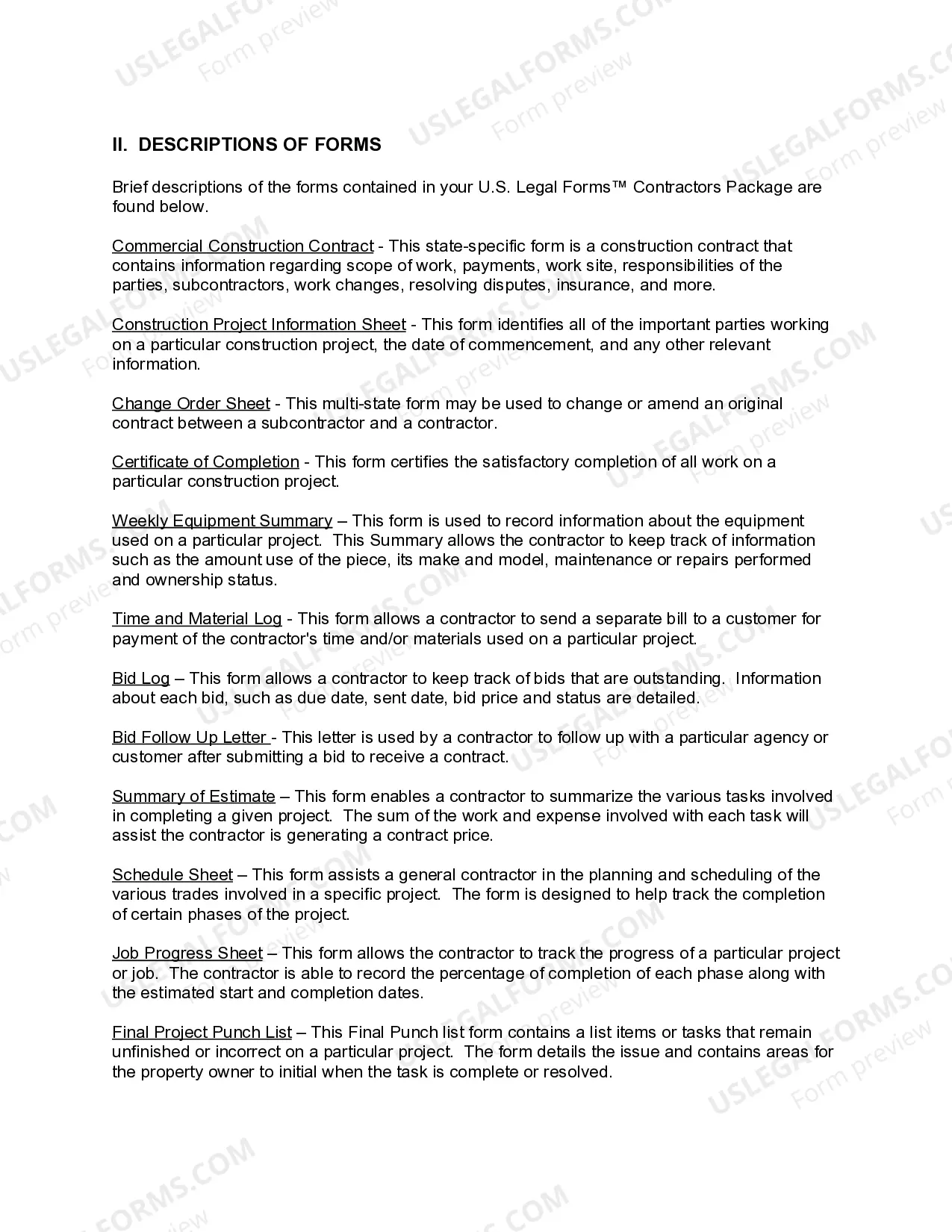
- Contractor's Weekly Equipment Summary
- Contractor's Time and Materials Log
- Contractor's Bid Log
- Contractor's Bid Follow Up Letter
- Contractor's Final Affidavit of Payment to Subcontractors
- Contractor's Summary of an Estimate
- Contractor's Schedule Sheet
- Contractor's Job Progress Sheet
- Contractor's Final Punch List
- Customer Satisfaction Survey
- Construction Company Evaluation by a Customer
- Construction Accident Report
- Construction Safety and Health Plan
- Construction Contract with Subcontractor
- Change Order for Construction or Repairs by Contractor
- Certification of Completion by Contractor
- Construction Project Information Sheet
Situations where these forms applies
This form package is useful in various scenarios, such as:
- When entering into a commercial construction agreement.
- When modifications or changes to a contract need to be documented.
- When completion and performance of a construction project need to be certified.
- When tracking equipment usage and labor hours for billing purposes.
- When gathering feedback from clients after project completion.
Who needs this form package
- Commercial contractors.
- Construction project owners.
- Subcontractors involved in commercial projects.
- Suppliers catering to commercial construction needs.
- Any stakeholders looking to manage legal documentation in commercial construction.
Completing these forms step by step
- Review the included forms and familiarize yourself with their purposes.
- Identify all parties involved in the construction project and provide their details on the Construction Project Information Sheet.
- Enter relevant dates, signatures, and other required information on the forms.
- Complete the Commercial Contract and any necessary Change Orders as needed.
- Ensure all project documentation, such as progress and completion certifications, are filled out accurately.
Do documents in this package require notarization?
Some forms in this package need notarization to be legally binding. Our online notarization service, powered by Notarize, lets you verify and sign documents remotely through an encrypted video session, available 24/7.
Get your form ready online
Our built-in tools help you complete, sign, share, and store your documents in one place.
Make edits, fill in missing information, and update formatting in US Legal Forms—just like you would in MS Word.
Download a copy, print it, send it by email, or mail it via USPS—whatever works best for your next step.
Sign and collect signatures with our SignNow integration. Send to multiple recipients, set reminders, and more. Go Premium to unlock E-Sign.
If this form requires notarization, complete it online through a secure video call—no need to meet a notary in person or wait for an appointment.
We protect your documents and personal data by following strict security and privacy standards.

Make edits, fill in missing information, and update formatting in US Legal Forms—just like you would in MS Word.

Download a copy, print it, send it by email, or mail it via USPS—whatever works best for your next step.

Sign and collect signatures with our SignNow integration. Send to multiple recipients, set reminders, and more. Go Premium to unlock E-Sign.

If this form requires notarization, complete it online through a secure video call—no need to meet a notary in person or wait for an appointment.

We protect your documents and personal data by following strict security and privacy standards.
Common mistakes
- Failing to complete all necessary forms for a project.
- Not including all relevant parties' details in the Construction Project Information Sheet.
- Overlooking the need for signatures on critical documents.
- Neglecting to keep records of changes made through Change Orders.
- Not tracking equipment use accurately in the Weekly Equipment Summary.
Why complete this package online
- Convenient access to all necessary forms in one package.
- Editable forms that allow customization to fit specific project needs.
- Reliable, attorney-drafted documents that ensure legal compliance.
- Save time and reduce costs compared to purchasing individual forms separately.
- Easy download process for immediate use in construction projects.
Summary of main points
- This package provides essential legal documentation for commercial construction in North Dakota.
- It is suitable for contractors, property owners, subcontractors, and suppliers.
- Forms ensure compliance with local regulations and help manage project risks effectively.
- Using this package can save time and costs, while ensuring legal integrity in agreements and claims.
Looking for another form?
Form popularity
FAQ
Class A General Engineering Contractor The principal business is in connection with fixed works requiring specialized engineering knowledge and skill.
While a general contractor is hired to oversee the total status and completion of a construction job, a specialty contractor specializes in the completion of a particular task.Depending on the project, specialty contractors can be hired to do more than one task if they have the necessary licenses.
Class B General Building Contractor The principal business is in connection with any structure built, being built, or to be built, requiring in its construction the use of at least two unrelated building trades or crafts.
(a) A specialty contractor is a contractor whose operations as such are the performance of construction work requiring special skill and whose principal contracting business involves the use of specialized building trades or crafts.
Completed examination application and $330 fee. California business license and Tax ID (if LLC or Corporation) Fingerprinting Live Scan. Completion of Law and Business exam. Completion of secondary trade-related exam. Completion of the asbestos open-book examination.
In case of Class "A" Contractors, the firm o r individual :- i) Has sound financial capacity to execute works of the. Department in that class; and.
Complete a Contractor's Application (SFN 12012) using the exact name your business is registered under. The application requires a statement of the applicant's experience and qualifications as a contractor, which will be signed under oath. You must be 18 years of age or older to sign this certificate.
Builders usually are not responsible for mechanical work such as heating and cooling units, electrical work or plumbing. A general contractor oversees a team of subcontractors and is viewed as the big picture guy.
Class B General Building Contractors, unlike both a Class A General Engineering Contractor and a Class C Specialty Contractor, may enter into direct contracts and subcontracts involving: (1) Projects involving framing or carpentry only; (2) Projects involving two or more unrelated trades other than framing or