Service Agreement between Internet Service Provider and Subscriber with a Liquidated Damage and Exculpatory Provision
What this document covers
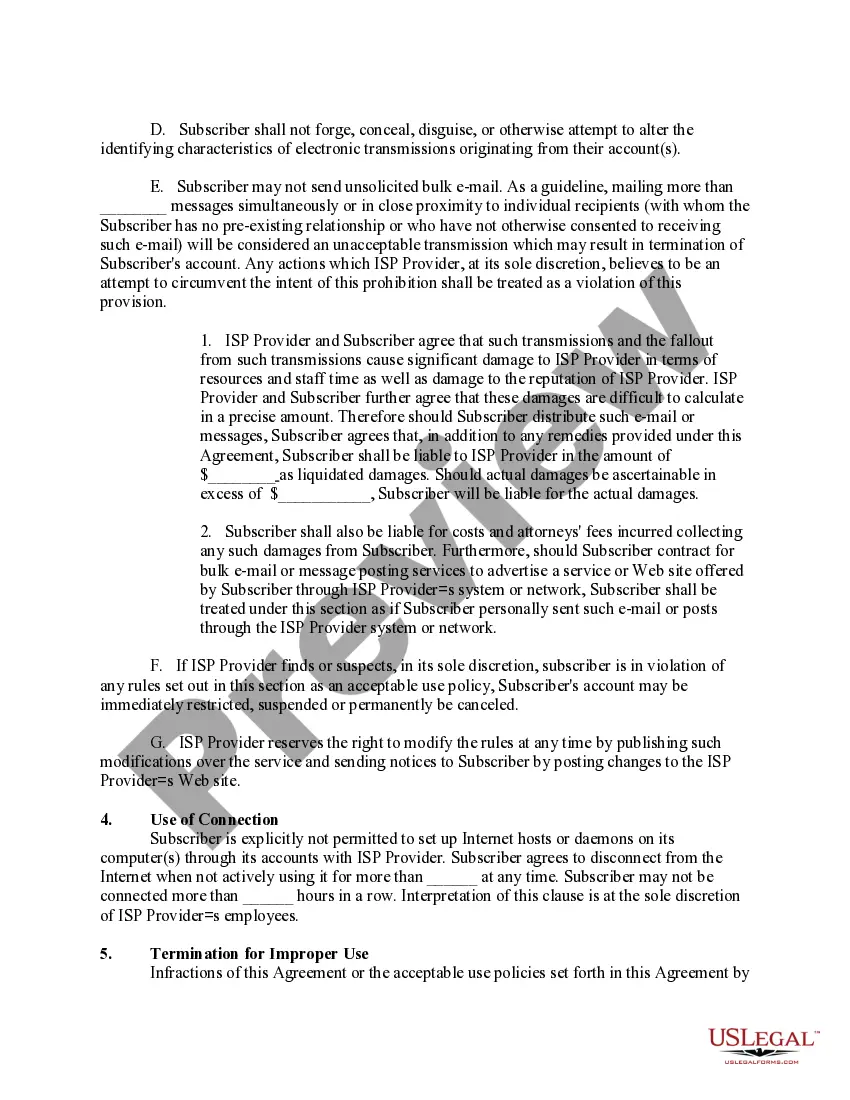
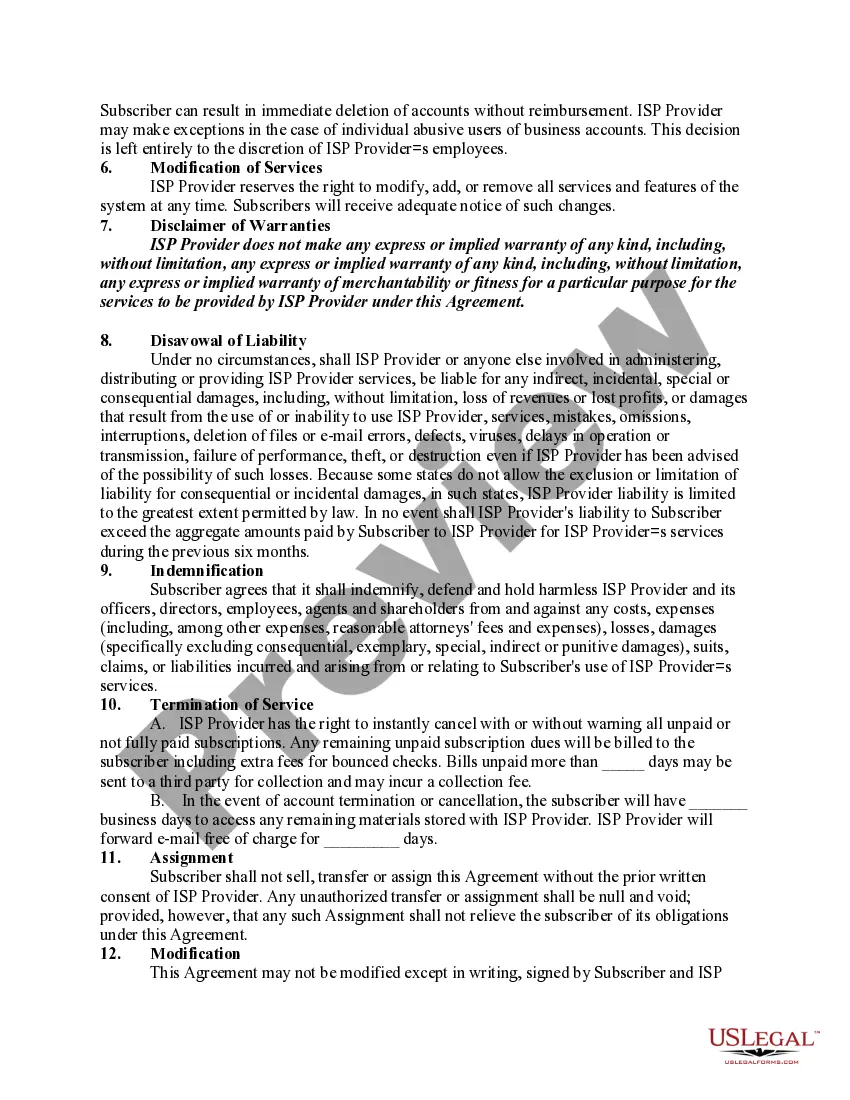
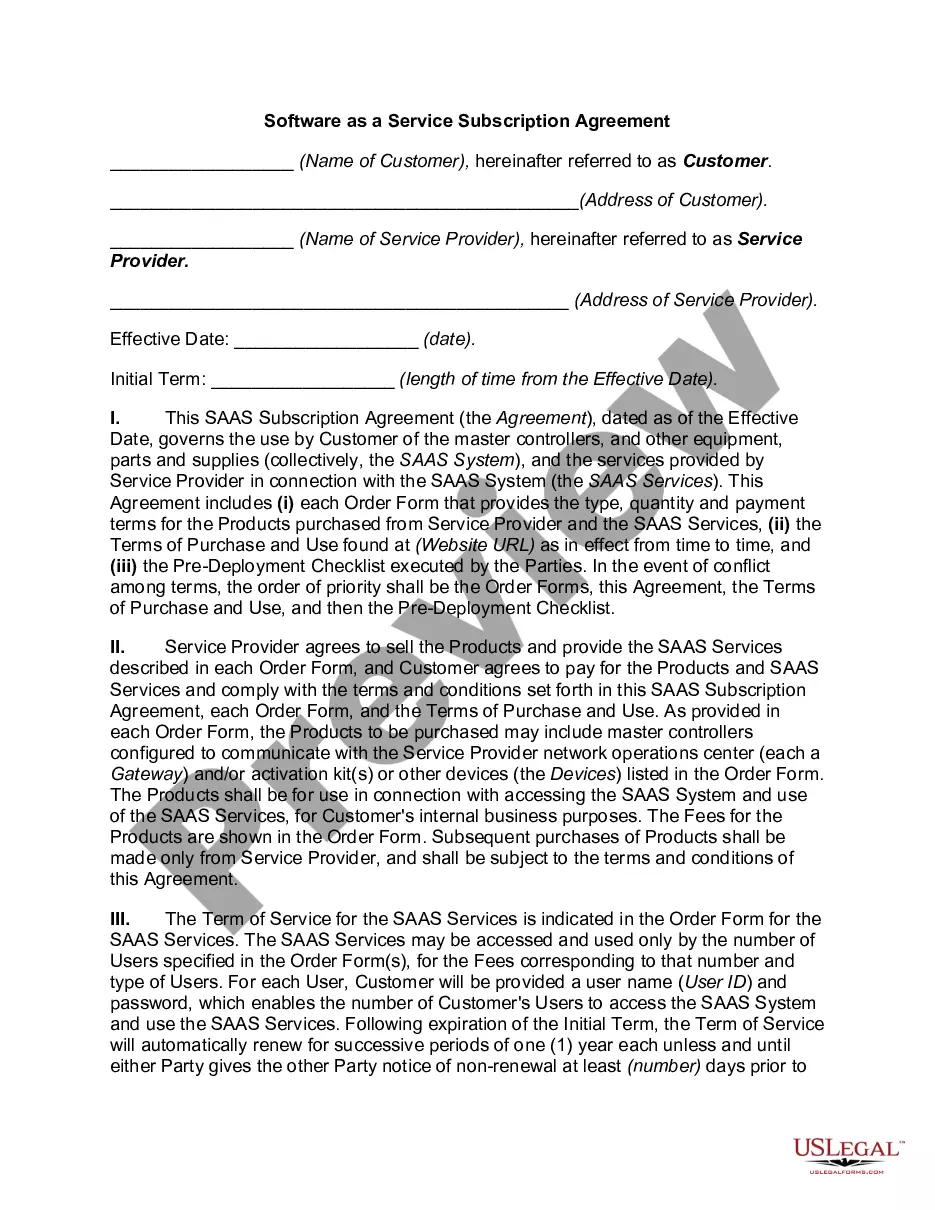
This Service Agreement between an Internet Service Provider (ISP) and Subscriber outlines the terms and conditions for the provision of internet services. It includes a liquidated damage clause, which specifies predetermined damages that may be claimed if the Subscriber breaches the Use Policy. This agreement helps clarify expectations and protects both parties by delineating rights and responsibilities, making it essential for establishing a transparent service relationship.
What’s included in this form
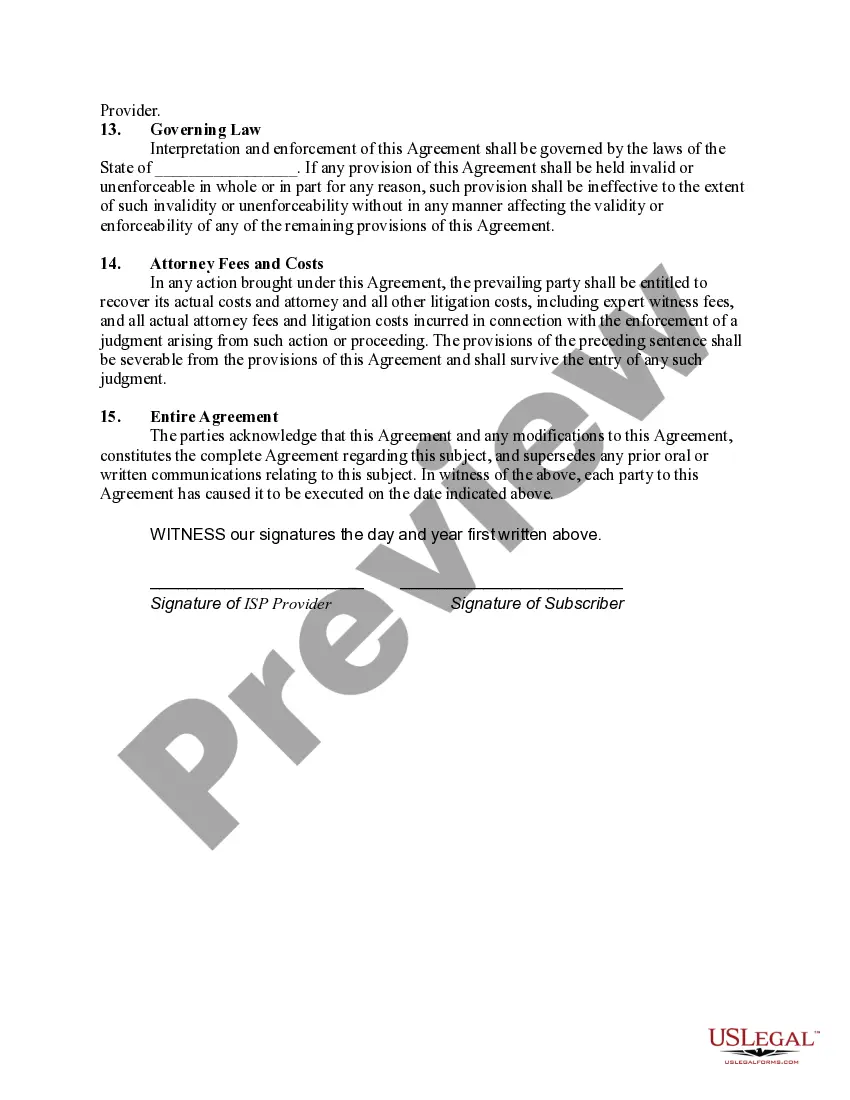
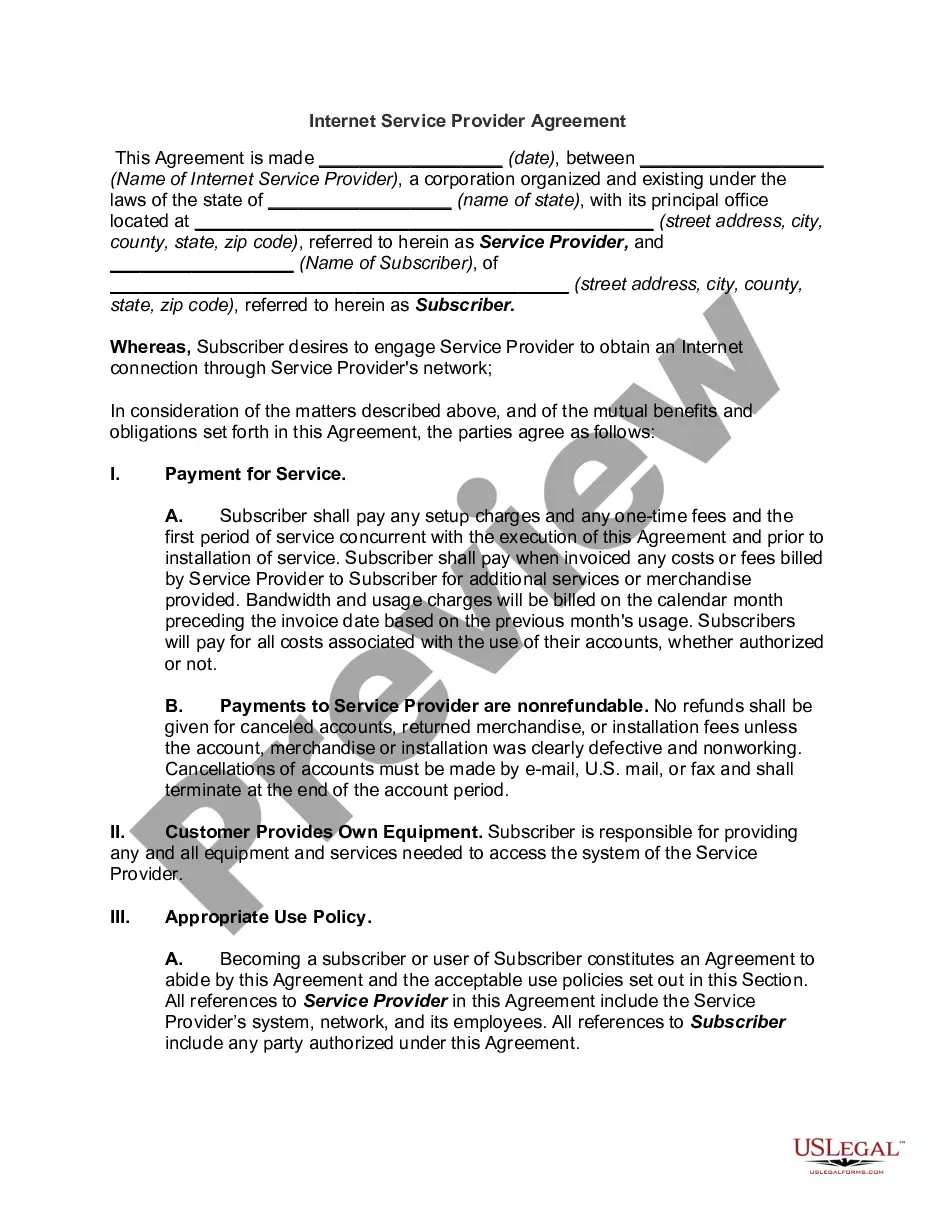
- Payment obligations, including setup and recurring fees
- Subscriber responsibilities for equipment and service usage
- Acceptable use policies governing internet activity
- Liquidated damages clauses for policy violations
- Terms for account termination and modifications
- Indemnification clauses for liability protection

When to use this document
This form is needed when a subscriber seeks to enter into a formal agreement with an internet service provider for the delivery of internet services. It is particularly important for defining responsibilities regarding payment, usage policies, and what constitutes a breach of agreement. Using this form can prevent misunderstandings and legal disputes over service terms.
Who can use this document
- Consumers or businesses looking to establish internet service with an ISP
- ISPs seeking a clear contractual agreement with their subscribers
- Users wanting to understand their rights and obligations within the service
How to complete this form
- Identify and enter the names and addresses of the ISP and Subscriber.
- Specify the payment details, including any setup charges and recurring fees.
- Detail the acceptable use policies as required by the ISP.
- Fill in the liquidated damage amounts that apply to policy violations.
- Include terms for account termination and modification provisions.
- Ensure both parties sign and date the agreement.
Notarization guidance
In most cases, this form does not require notarization. However, some jurisdictions or signing circumstances might. US Legal Forms offers online notarization powered by Notarize, accessible 24/7 for a quick, remote process.
Get your form ready online
Our built-in tools help you complete, sign, share, and store your documents in one place.
Make edits, fill in missing information, and update formatting in US Legal Forms—just like you would in MS Word.
Download a copy, print it, send it by email, or mail it via USPS—whatever works best for your next step.
Sign and collect signatures with our SignNow integration. Send to multiple recipients, set reminders, and more. Go Premium to unlock E-Sign.
If this form requires notarization, complete it online through a secure video call—no need to meet a notary in person or wait for an appointment.
We protect your documents and personal data by following strict security and privacy standards.

Make edits, fill in missing information, and update formatting in US Legal Forms—just like you would in MS Word.

Download a copy, print it, send it by email, or mail it via USPS—whatever works best for your next step.

Sign and collect signatures with our SignNow integration. Send to multiple recipients, set reminders, and more. Go Premium to unlock E-Sign.

If this form requires notarization, complete it online through a secure video call—no need to meet a notary in person or wait for an appointment.

We protect your documents and personal data by following strict security and privacy standards.
Common mistakes
- Failing to clearly specify payment obligations and due dates.
- Ignoring to outline all acceptable use policies effectively.
- Not defining liquidated damages amounts, leading to disputes.
- Missing signatures from both the ISP and the Subscriber.
Benefits of using this form online
- Convenience of easy access and downloading from anywhere.
- Editability allows users to customize terms as needed.
- Reliability of having a professionally drafted agreement.
- Immediate availability for timely service initiation.
Legal use & context
- This Service Agreement establishes enforceable rights and responsibilities for both parties.
- Liquidated damages clauses help mitigate losses for both ISP and Subscriber.
- Adhering to the agreement helps protect against legal liabilities.
Summary of main points
- The agreement defines the terms of service between the ISP and Subscriber.
- Liquidated damages provide a clear framework for addressing breaches.
- Both parties should understand their rights and obligations within the agreement.
Looking for another form?


Form popularity
FAQ
Exculpatory is the adjectival form of the verb exculpate, meaning "to clear from guilt." The pair of words cannot be accused of being secretive-their joint etymology reveals all: they are tied to the Latin verb exculpatus, a word that combines the prefix ex-, meaning "out of" or "away from," with the Latin noun culpa,
The general rule is that exculpatory clauses are enforceable if they are reasonable. They are not valid if they are unconscionable or unreasonable. Additionally, they cannot excuse liability from harm which is caused intentionally or recklessly.
California makes it a felony for prosecutors to withhold or alter exculpatory evidence. More than two years into a dispute over alleged misconduct by Orange County, California, prosecutors trying a multiple-murder case, the state of California has made it a felony crime to withhold exculpatory evidence.
Information that increases a defendant's probability of innocence or absolutely relieves them of liability. Often used to describe evidence in a criminal trial that justifies, excuses, or creates reasonable doubt about a defendant's alleged actions or intentions.
An exculpatory statement is defined as a statement by the defendant that tends to clear a defendant from alleged guilt, or a statement that tends to justify or excuse his/her actions or presence.
Material evidence is important evidence that's directly relevant to an issue in the defendant's case. Exculpatory evidence is evidence favorable to the defendant in that it clears or tends to clear him of guilt.
Exculpatory evidence is evidence favorable to the defendant in a criminal trial that exonerates or tends to exonerate the defendant of guilt. It is the opposite of inculpatory evidence, which tends to present guilt.
Any evidence that is favorable to the defendant in a criminal trial is considered exculpatory. Another example of exculpatory evidence would be DNA evidence on a knife in a murder case that links another individual to a crime.