Receipt for Damages (Fiber Optic Communications System)
Overview of this form
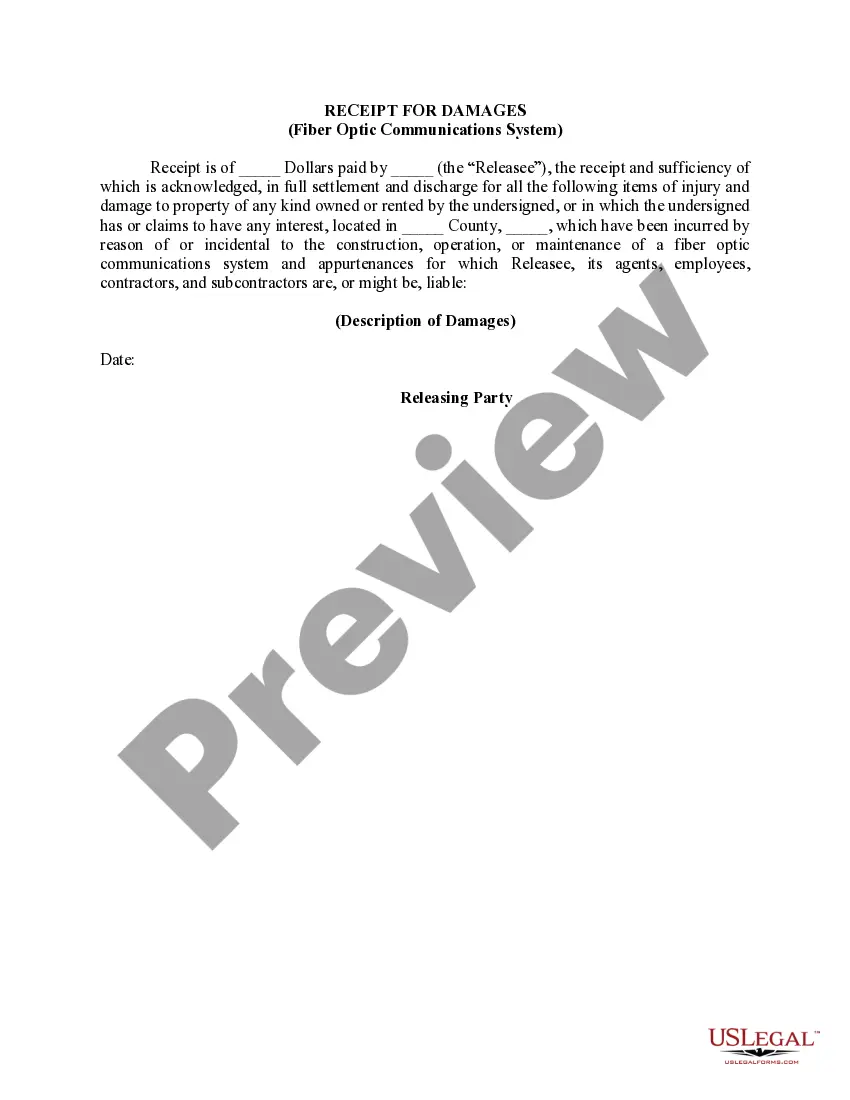
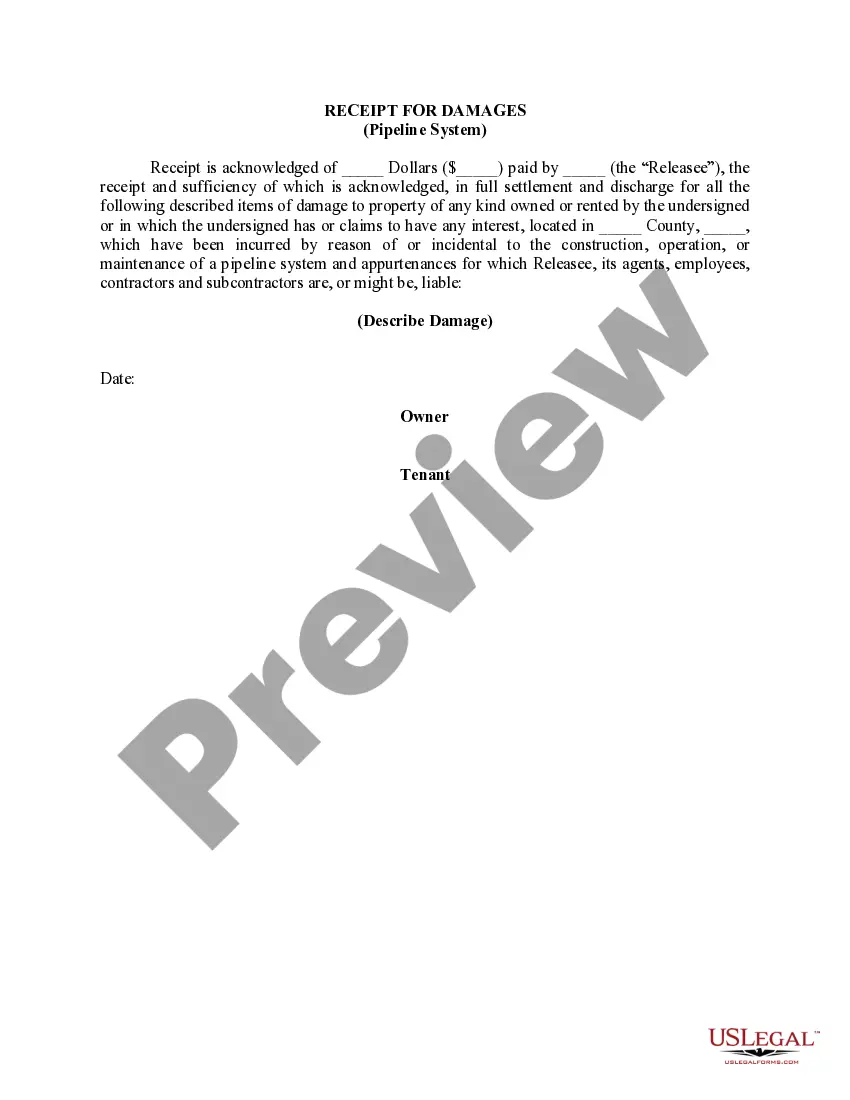
The Receipt for Damages (Fiber Optic Communications System) is a legal document acknowledging the payment made by a party (the Releasee) as full settlement for injuries and damages related to the construction, operation, or maintenance of a fiber optic communications system. This form serves as an important record, distinguishing it from other types of receipts by specifically addressing damages associated with fiber optic systems, ensuring clarity and legal protection for both parties involved.
Key components of this form
- Payment amount: Identifies the total amount paid by the Releasee.
- Parties involved: Names the Releasee and the undersigned (the releasing party).
- Description of damages: Specifies the nature of the injuries and damages being settled.
- Location: Indicates the county and state where the damages occurred.
- Date: Records the date the receipt is issued.
When to use this form
This form should be used when a property owner or tenant has sustained damages related to the installation, operation, or maintenance of a fiber optic communications system. It is essential to document the resolution of such issues to protect both the party responsible for the damages and the individual or entity receiving the payment.
Intended users of this form
- Property owners who have experienced damages due to fiber optic installations.
- Tenants renting properties with fiber optic systems that have incurred damages.
- Contractors or service providers involved in the fiber optic installation or maintenance.
- Individuals who are settling claims related to fiber optic system damages.
How to prepare this document
- Identify the parties: Enter the name of the Releasee and the undersigned (releasing party).
- Specify the payment amount: Indicate the amount being paid in settlement of damages.
- Describe the damages: Clearly outline the items of injury and damages claimed.
- Enter the location: Fill in the county and state where the damages occurred.
- Date the form: Include the date the receipt is being issued.
Is notarization required?
This form does not typically require notarization to be legally valid. However, some jurisdictions or document types may still require it. US Legal Forms provides secure online notarization powered by Notarize, available 24/7 for added convenience.
Get your form ready online
Our built-in tools help you complete, sign, share, and store your documents in one place.
Make edits, fill in missing information, and update formatting in US Legal Forms—just like you would in MS Word.
Download a copy, print it, send it by email, or mail it via USPS—whatever works best for your next step.
Sign and collect signatures with our SignNow integration. Send to multiple recipients, set reminders, and more. Go Premium to unlock E-Sign.
If this form requires notarization, complete it online through a secure video call—no need to meet a notary in person or wait for an appointment.
We protect your documents and personal data by following strict security and privacy standards.

Make edits, fill in missing information, and update formatting in US Legal Forms—just like you would in MS Word.

Download a copy, print it, send it by email, or mail it via USPS—whatever works best for your next step.

Sign and collect signatures with our SignNow integration. Send to multiple recipients, set reminders, and more. Go Premium to unlock E-Sign.

If this form requires notarization, complete it online through a secure video call—no need to meet a notary in person or wait for an appointment.

We protect your documents and personal data by following strict security and privacy standards.
Avoid these common issues
- Forgetting to include a detailed description of the damages.
- Not entering the date or location where the damages occurred.
- Omitting signatures from the involved parties.
- Failing to confirm the correct payment amount prior to submission.
Why use this form online
- Convenient access: Download and fill out the form from anywhere at any time.
- Editability: Easily modify the form as necessary to fit your specific needs.
- Reliability: Ensure compliance with legal standards by using professionally drafted documents.
Key takeaways
- The Receipt for Damages is crucial for documenting settlements related to fiber optic systems.
- Complete all sections of the form to avoid common mistakes.
- Review state-specific requirements to ensure compliance with local laws.
- Using this form online enhances convenience and reliability.
Looking for another form?

Form popularity
FAQ
Optics is the branch of physics that studies the behaviour and properties of light, including its interactions with matter and the construction of instruments that use or detect it. Optics usually describes the behaviour of visible, ultraviolet, and infrared light.
An optical instrument (or "optic" for short) is a device that processes light waves (or photons), either to enhance an image for viewing or to analyze and determine their characteristic properties. Common examples include periscopes, microscopes, telescopes, and cameras.
There are three main types of optical telescopes: refractive, reflective, and catadioptric. Refractive telescopes, such as the one invented by Galileo, use an objective lens and an eyepiece.
1 : eye. 2a : any of the elements (such as lenses, mirrors, or light guides) of an optical instrument or system usually used in plural. b : an optical instrument. Synonyms & Antonyms Example Sentences Learn More about optic.
Optical instruments are based on optics. They use mirrors and lenses to reflect and refract light and form images. The light microscope and telescope use convex lenses and mirrors to make enlarged images of very tiny or distant objects. A camera uses a convex lens to make a reduced image of an object.
There are two major branches of optics, physical and geometrical. Physical optics deals primarily with the nature and properties of light itself. Geometrical optics has to do with the principles that govern the image-forming properties of lenses, mirrors, and other devices that make use of light.
The OPTIC Strategy for Visual Analysis is a simple method of rhetorical criticism designed to help with the process of analyzing visuals. OPTIC is an acronym, standing for Overview, Parts, Title, Interrelationship, and Conclusion.
Fiber optics, or optical fibers, are long, thin strands of carefully drawn glass about the diameter of a human hair. These strands are arranged in bundles called optical cables.So, the optical fiber transmits data by light to a receiving end, where the light signal is decoded as data.
OPTIC stands for Overview, Parts, Title, Interrelationship, and Conclusion.