North Carolina Non- Foreign Affidavit
About this form
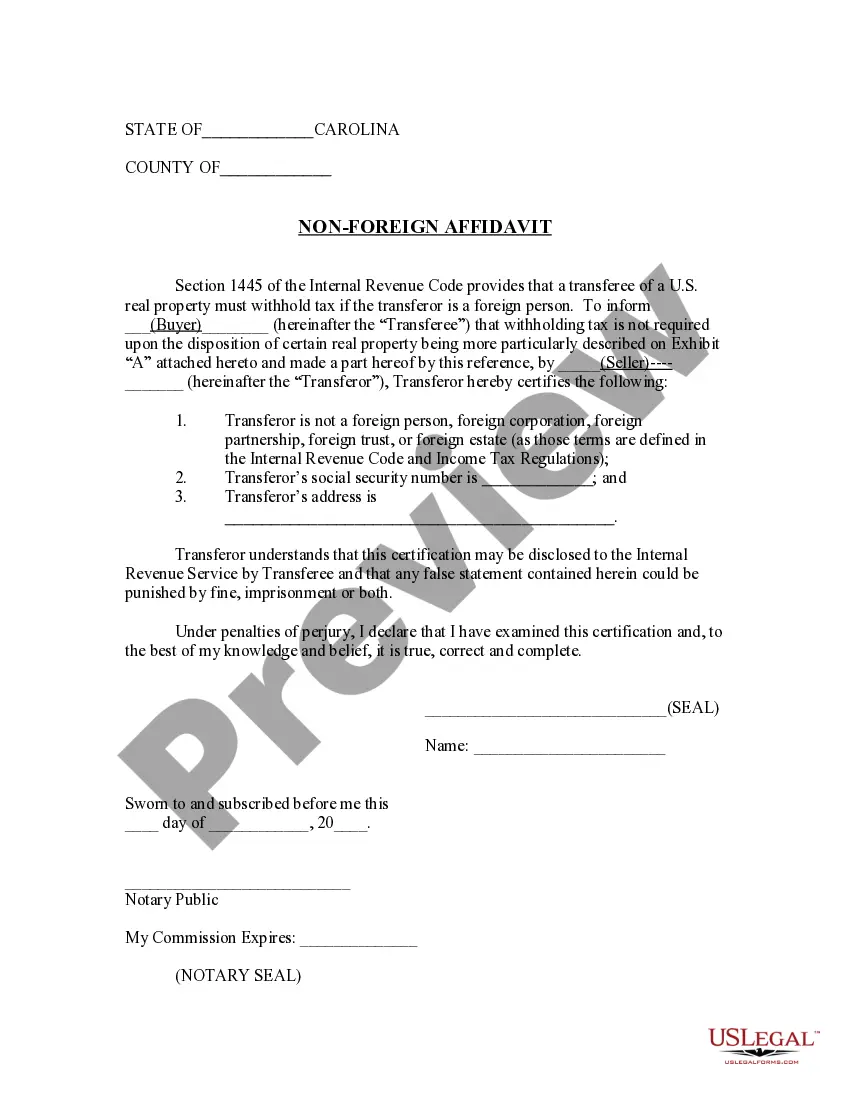
The Non-Foreign Affidavit is a legal document used by sellers who are purchasing property in the U.S. to certify that they are not foreign citizens. This certification is essential to inform the buyer that withholding tax is not required under Section 1445 of the Internal Revenue Code when the seller is a U.S. person. By completing this affidavit, sellers affirm their status, ensuring compliance with federal tax regulations. This form is distinct from other affidavits as it specifically addresses foreign status in real estate transactions.
Main sections of this form
- Name of the seller (Transferor).
- U.S. taxpayer identification number (Social Security number).
- Home address of the seller.
- Certification statement regarding foreign status.
- Signature line for the seller.
- Notary section for validation.
When to use this form
This form should be used during the sale of U.S. real estate when the seller needs to verify that they are not a foreign entity. It is particularly necessary to prevent any withholding tax that the buyer would have to pay if the seller were a foreign person. It is commonly used in residential and commercial property transactions.
Who this form is for
This form is intended for:
- Individual sellers of real estate in the U.S.
- Corporations selling property and certifying their U.S. status.
- Partnerships and trusts involved in real estate transactions.
- Anyone who is a U.S. citizen or resident that needs to confirm non-foreign status in a property sale.
Completing this form step by step
- Enter the state and county where the affidavit is being executed.
- Fill in the seller's full name and address.
- Provide the seller's social security number.
- Read and acknowledge the certification statement regarding foreign status.
- Sign and date the affidavit in front of a notary public.
- Ensure the notary completes their section and affixes their seal.
Notarization guidance
Yes, this form must be notarized to be legally valid. Having a notary public will confirm the identity of the signer, ensuring the affidavit is authentic and enforceable. US Legal Forms provides an integrated online notarization service, allowing you to complete this process securely through video calls at any time, eliminating the need for in-person visits.
Get your form ready online
Our built-in tools help you complete, sign, share, and store your documents in one place.
Make edits, fill in missing information, and update formatting in US Legal Forms—just like you would in MS Word.
Download a copy, print it, send it by email, or mail it via USPS—whatever works best for your next step.
Sign and collect signatures with our SignNow integration. Send to multiple recipients, set reminders, and more. Go Premium to unlock E-Sign.
If this form requires notarization, complete it online through a secure video call—no need to meet a notary in person or wait for an appointment.
We protect your documents and personal data by following strict security and privacy standards.

Make edits, fill in missing information, and update formatting in US Legal Forms—just like you would in MS Word.

Download a copy, print it, send it by email, or mail it via USPS—whatever works best for your next step.

Sign and collect signatures with our SignNow integration. Send to multiple recipients, set reminders, and more. Go Premium to unlock E-Sign.

If this form requires notarization, complete it online through a secure video call—no need to meet a notary in person or wait for an appointment.

We protect your documents and personal data by following strict security and privacy standards.
Common mistakes
- Failing to provide the correct social security number.
- Leaving the form unsigned or undated.
- Not having the affidavit notarized if required by local laws.
- Providing inaccurate information about foreign status.
Benefits of completing this form online
- Convenient access and immediate download.
- Editability allows for customization to fit specific needs.
- Reliability from forms created by licensed attorneys.
Looking for another form?


Form popularity
FAQ
Yes, in North Carolina, most affidavits, including the North Carolina Non-Foreign Affidavit, must be notarized to be legally binding. Notarization helps verify the identity of the signer and adds an extra layer of authenticity to the document. It is advisable to ensure that your affidavit is properly executed to avoid any potential legal issues. If you need assistance with forms or notarization, USLegalForms offers resources and solutions to help you navigate this requirement.
In North Carolina, the withholding rate for nonresident partners varies based on the type of income. Generally, a flat withholding rate of 5.25% applies to partnerships distributing income to nonresident partners. This requirement ensures compliance with state tax laws, and you might need to complete a North Carolina Non-Foreign Affidavit to report this correctly. For further guidance, consider using USLegalForms to simplify the process.
If you are not a foreign person, you do not need a FIRPTA affidavit to sell your house. This means you will not be subject to withholding tax related to the sale. However, you may still need to provide a non-foreign affidavit, which confirms your status to the buyer. Understanding these requirements can help you navigate the selling process smoothly.
Yes, in North Carolina, an affidavit must be notarized to ensure its legal validity. Notarization provides an official verification of the identities of the signers, which is crucial in real estate transactions. This step adds a layer of protection for both buyers and sellers. To facilitate this process, you can rely on services like USLegalForms to guide you through the notarization requirements.
A FIRPTA affidavit is required if the seller is a foreign person selling U.S. real estate. This document ensures that the buyer understands their withholding obligations under the law. If the seller is a non-foreign person, a FIRPTA affidavit is not necessary. Knowing whether you need this affidavit can prevent complications during the closing process.
foreign person affidavit is a declaration confirming that the seller is not a foreign person and does not fall under FIRPTA guidelines. This affidavit assures the buyer that no withholding tax will be necessary at closing. It is an essential part of real estate transactions in North Carolina, providing clarity and confidence to both parties involved. When using USLegalForms, you can easily prepare a nonforeign person affidavit to streamline the process.
The E500 form in North Carolina is used to report the sale of property by a non-foreign person. This form is typically accompanied by a non-foreign affidavit to confirm the seller's status. Completing the E500 ensures compliance with state regulations, facilitating a smooth transaction. Using platforms like USLegalForms can help you accurately fill out the E500 and related documents.
foreign affidavit is a legal document used in real estate transactions to confirm that the seller is not a foreign person. This affidavit is essential for tax purposes, particularly under the Foreign Investment in Real Property Tax Act (FIRPTA). By providing this affidavit, the seller assures the buyer that withholding tax will not apply, simplifying the closing process. In North Carolina, a nonforeign affidavit is a standard requirement for such transactions.