North Carolina Framing Contractor Package
What this form package covers
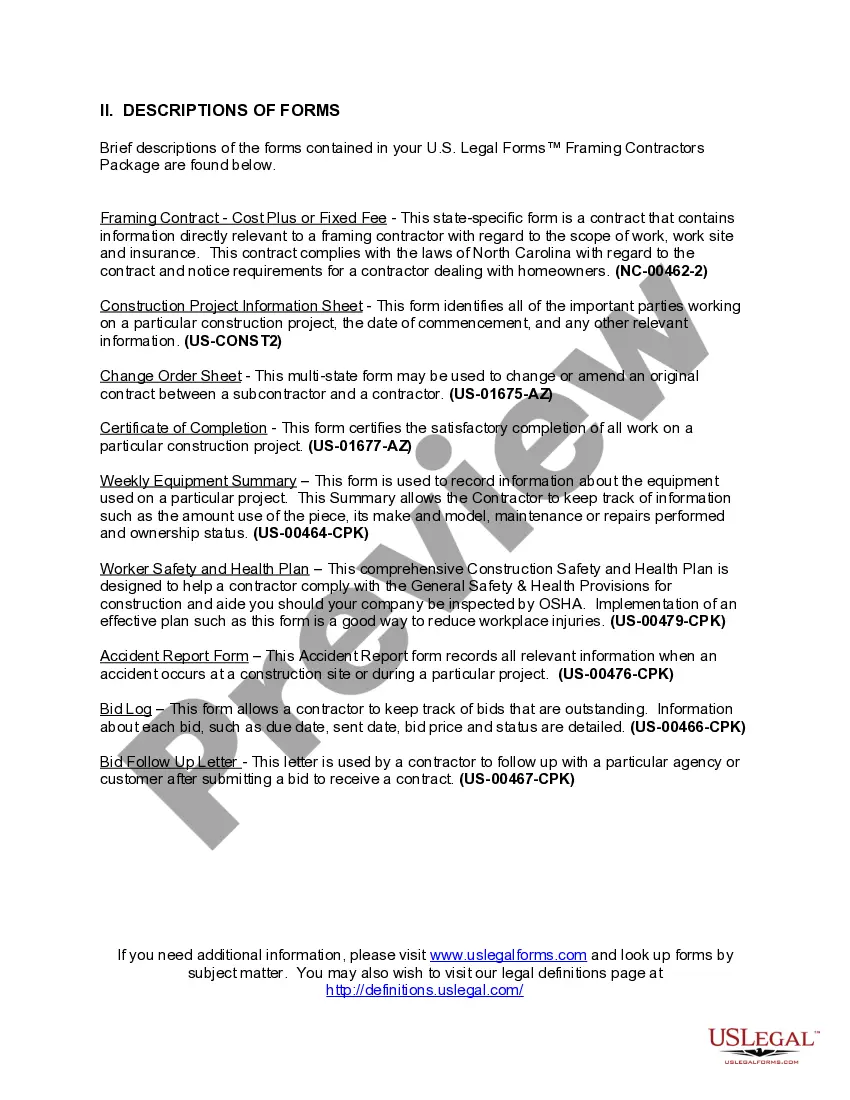
The North Carolina Framing Contractor Package is a comprehensive collection of legal documents designed specifically for framing contractors, owners, and subcontractors. This package ensures compliance with state laws and helps assert legal rights, manage risks, and document essential project information. It includes key forms essential for the successful management of framing projects, setting it apart from generic contractor packages.
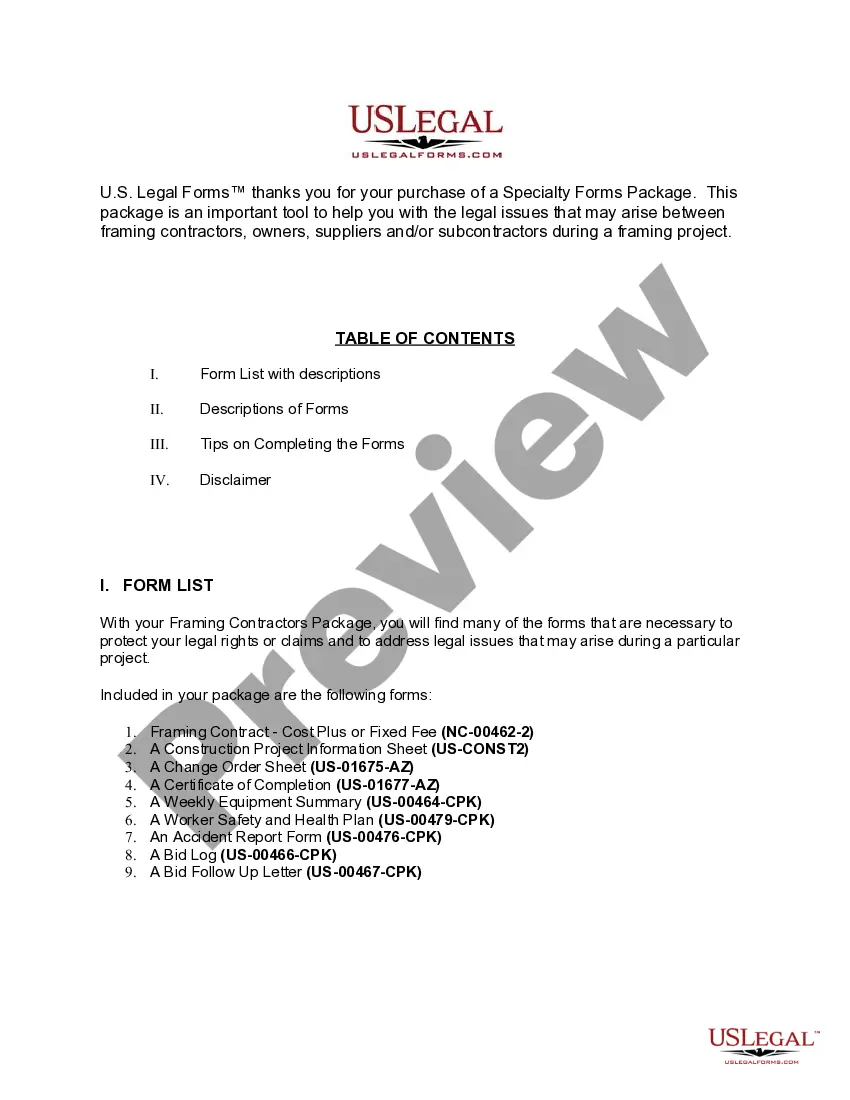
Forms provided in this package
- Framing Contract for Contractor
- Contractor's Weekly Equipment Summary
- Contractor's Bid Log
- Contractor's Bid Follow Up Letter
- Construction Accident Report
- Construction Safety and Health Plan
- Change Order for Construction or Repairs by Contractor
- Certification of Completion by Contractor
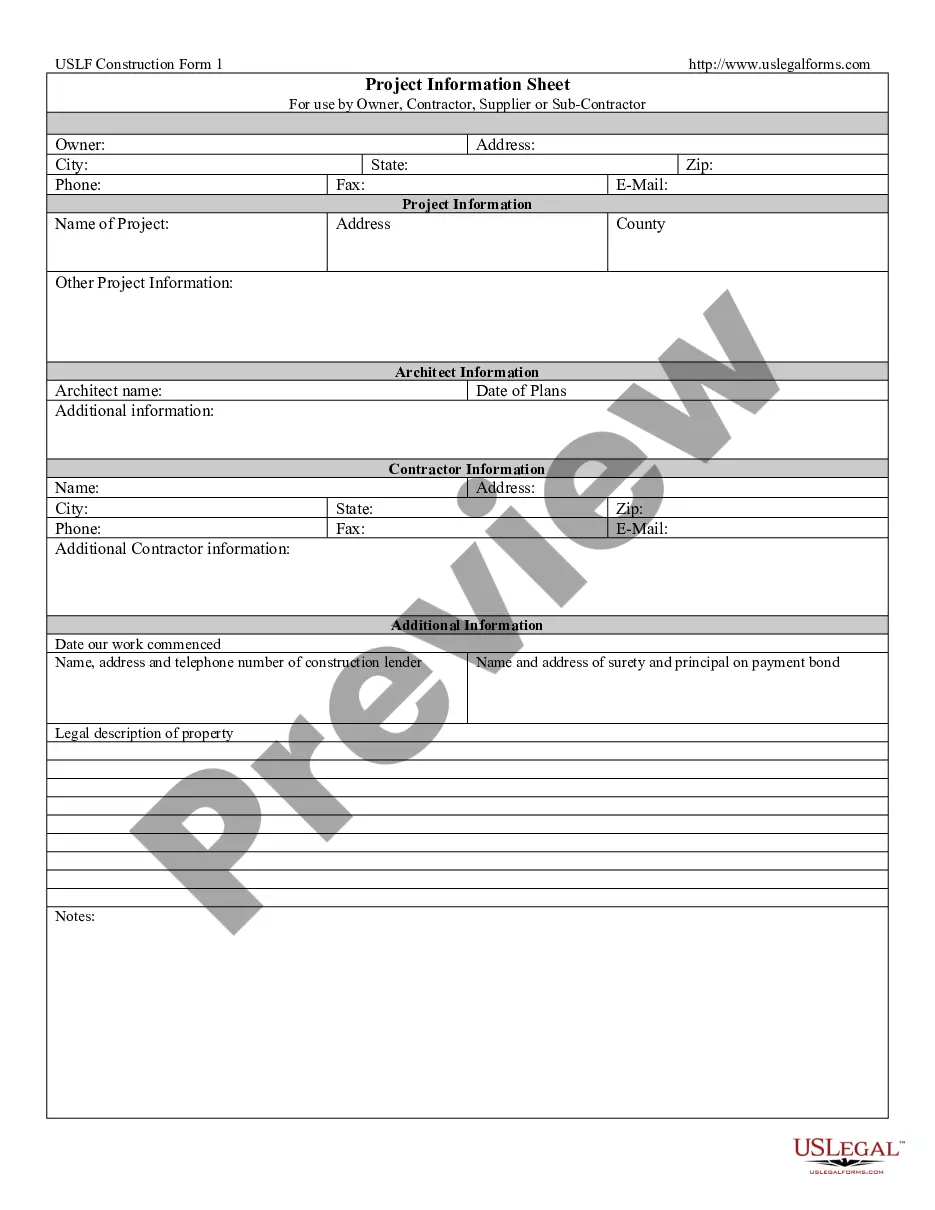
- Construction Project Information Sheet
Situations where these forms applies
This form package is useful in various situations, including:
- When starting a new framing project and needing to establish a formal relationship with clients or subcontractors.
- When changes to an existing contract are required during a construction project.
- To ensure safety and compliance by providing a worker safety and health plan.
- When tracking equipment usage and ensuring project completion is documented properly.
- To manage bids and follow up with clients effectively.
Who this form package is for
- Framing contractors looking to formalize their agreements and protect their rights.
- Construction project owners needing structured documentation for their projects.
- Framing subcontractors aiming to ensure clarity and compliance in their agreements with contractors.
- Any party involved in the framing construction process that requires legal documentation.
Instructions for completing these forms
- Review included forms to understand what is required for your project.
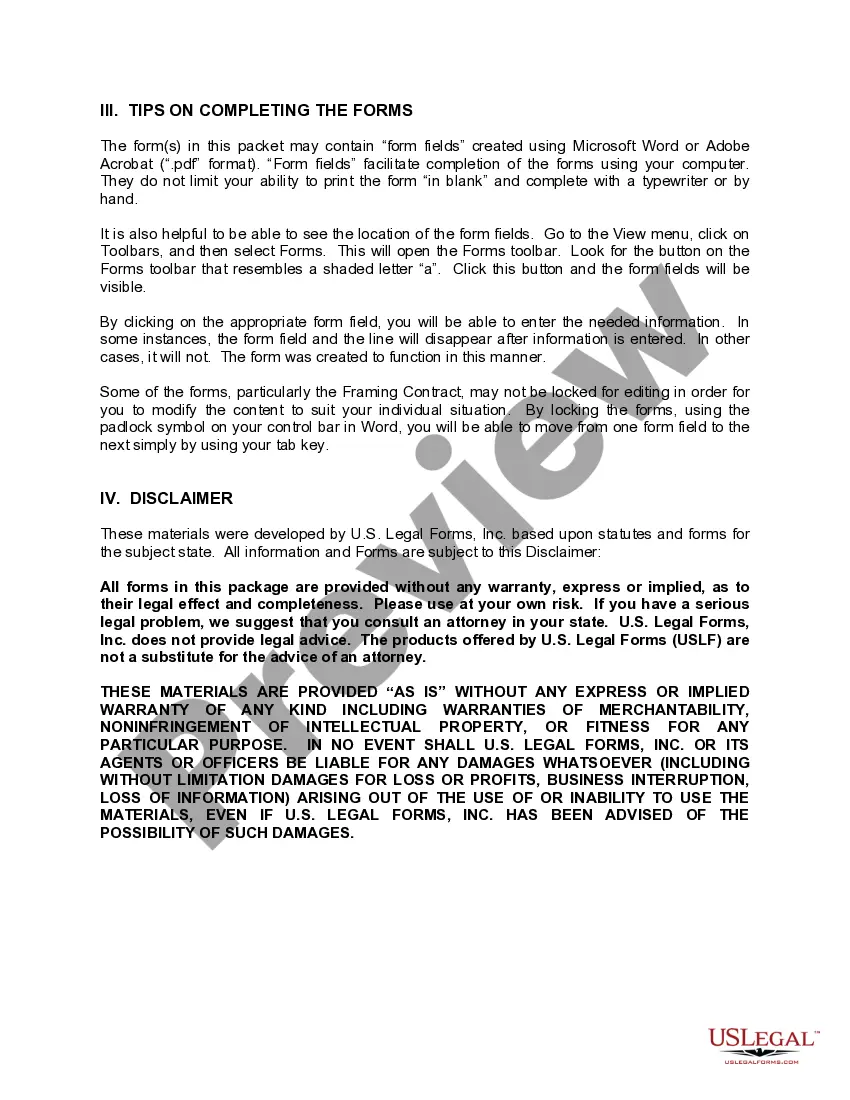
- Identify all parties involved in the framing project and fill in relevant details on the Construction Project Information Sheet.
- Select either the Cost Plus or Fixed Fee option for the Framing Contract based on your agreement.
- Document any changes to the project using the Change Order Sheet as needed throughout the process.
- Complete the Certificate of Completion once the project is finished to certify acceptable work.
- Utilize the Weekly Equipment Summary to keep accurate records of used equipment during the project.
Do documents in this package require notarization?
Forms in this package usually don’t need notarization, but certain jurisdictions or signing circumstances may require it. US Legal Forms provides a secure online notarization option powered by Notarize, accessible 24/7 from anywhere.
Get your form ready online
Our built-in tools help you complete, sign, share, and store your documents in one place.
Make edits, fill in missing information, and update formatting in US Legal Forms—just like you would in MS Word.
Download a copy, print it, send it by email, or mail it via USPS—whatever works best for your next step.
Sign and collect signatures with our SignNow integration. Send to multiple recipients, set reminders, and more. Go Premium to unlock E-Sign.
If this form requires notarization, complete it online through a secure video call—no need to meet a notary in person or wait for an appointment.
We protect your documents and personal data by following strict security and privacy standards.

Make edits, fill in missing information, and update formatting in US Legal Forms—just like you would in MS Word.

Download a copy, print it, send it by email, or mail it via USPS—whatever works best for your next step.

Sign and collect signatures with our SignNow integration. Send to multiple recipients, set reminders, and more. Go Premium to unlock E-Sign.

If this form requires notarization, complete it online through a secure video call—no need to meet a notary in person or wait for an appointment.

We protect your documents and personal data by following strict security and privacy standards.
Avoid these common issues
- Failing to complete all required fields in the Framing Contract.
- Not keeping accurate records in the Weekly Equipment Summary, which can lead to disputes later.
- Neglecting to update the Change Order Sheet as modifications occur during the project.
- Overlooking the necessity of a Certificate of Completion, which can impact payment release.
Advantages of online completion
- Convenient access to all necessary forms for framing projects in one package.
- Editability allows contractors to customize contracts to fit specific project needs.
- Reliability of professionally drafted forms created by licensed attorneys, ensuring legal compliance.
Looking for another form?
Form popularity
FAQ
Start by only answering the easy questions. Read the entire exam and only answer the questions you absolutely know the answer to. If you don't know it, wait. Don't second guess yourself. There is no penalty for guessing. Don't compete with other applicants.
North Carolina does not issue handyman licenses. Handyman professionals are required to apply for a general contractor license in order to work on projects that exceed $30,000. The North Carolina licensing board restricts the types of services that handyman professionals are authorized to provide.
It is a common misconception that since the builder exam is open book, it is not difficult to pass. In actuality the North Carolina construction license exam is more difficult to pass than similar closed book exams due to the fact that you have books available as a resource during the contractor exam.
Becoming a contractor may be a smart move if you have the required experience or education, or simply have a passion for construction work.However, becoming a contractor takes several years of experience first, as well as licensing requirements that can be difficult to meet without the proper preparation.
If an application is submitted with a completed exam, the licensing process takes about 30 days. If an exam is required, it will depend on when exams are successfully completed. It takes about 2 to 3 weeks after exams are completed before a license to be granted.
You need a general contractor license in North Carolina if you want to bid, construct, superintend or manage the construction of buildings, highways, public utilities and other types of projects over $30,000. To get licensed, you must apply to the North Carolina Licensing Board for General Contractors (NCLBGC).
If an application is submitted with a completed exam, the licensing process takes about 30 days. If an exam is required, it will depend on when exams are successfully completed. It takes about 2 to 3 weeks after exams are completed before a license to be granted.
The maximum allowed is $10,000. Also, contractors that have provided materials and labor to property may have lien rights against the real property.
Since the licensure statute requires a license only for projects that cost $30,000 or more, there is arguably a fourth tier which is sometimes known as the "handyman exception"for construction projects that cost under $30,000, no license is required.