Mississippi Concrete Mason Contractor Package
What is this form package?
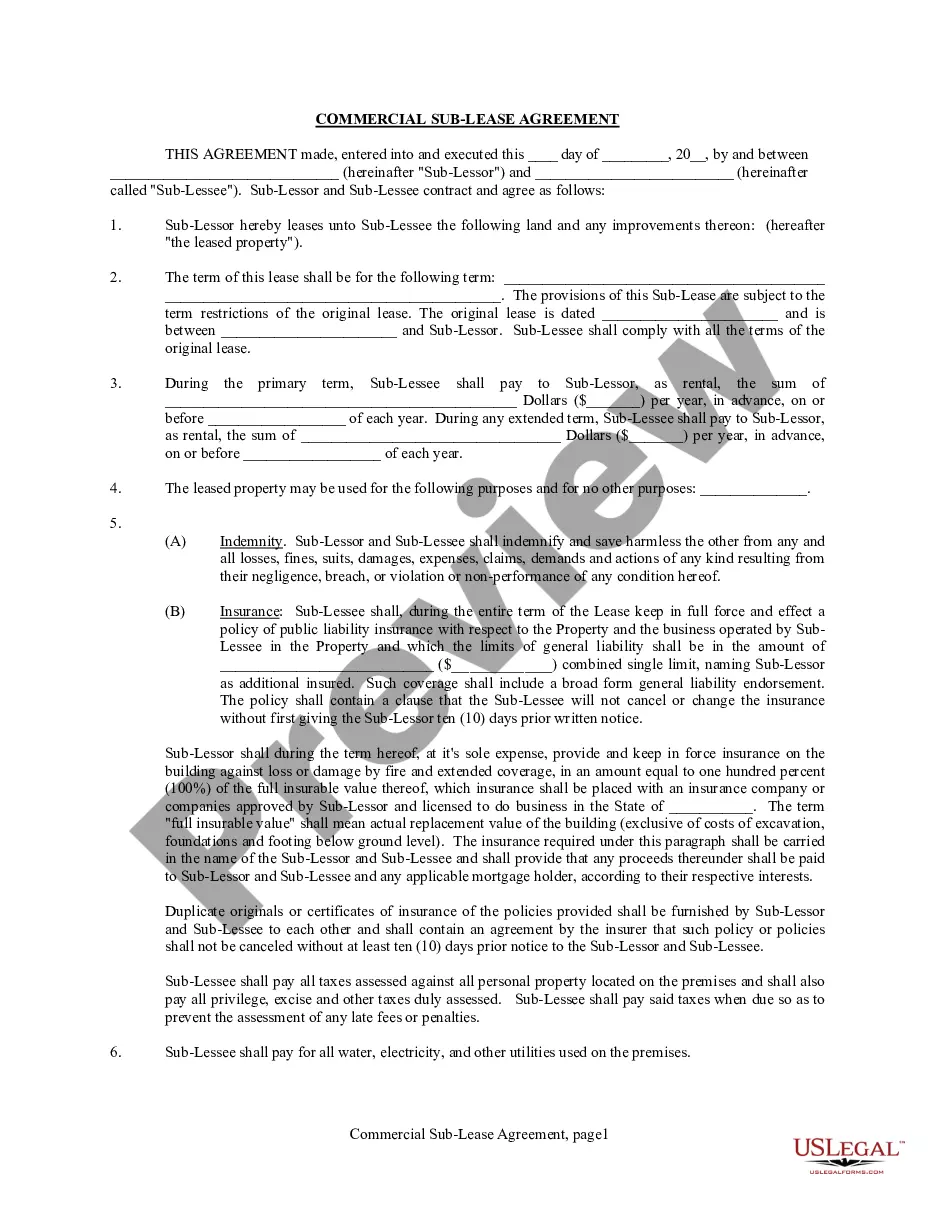
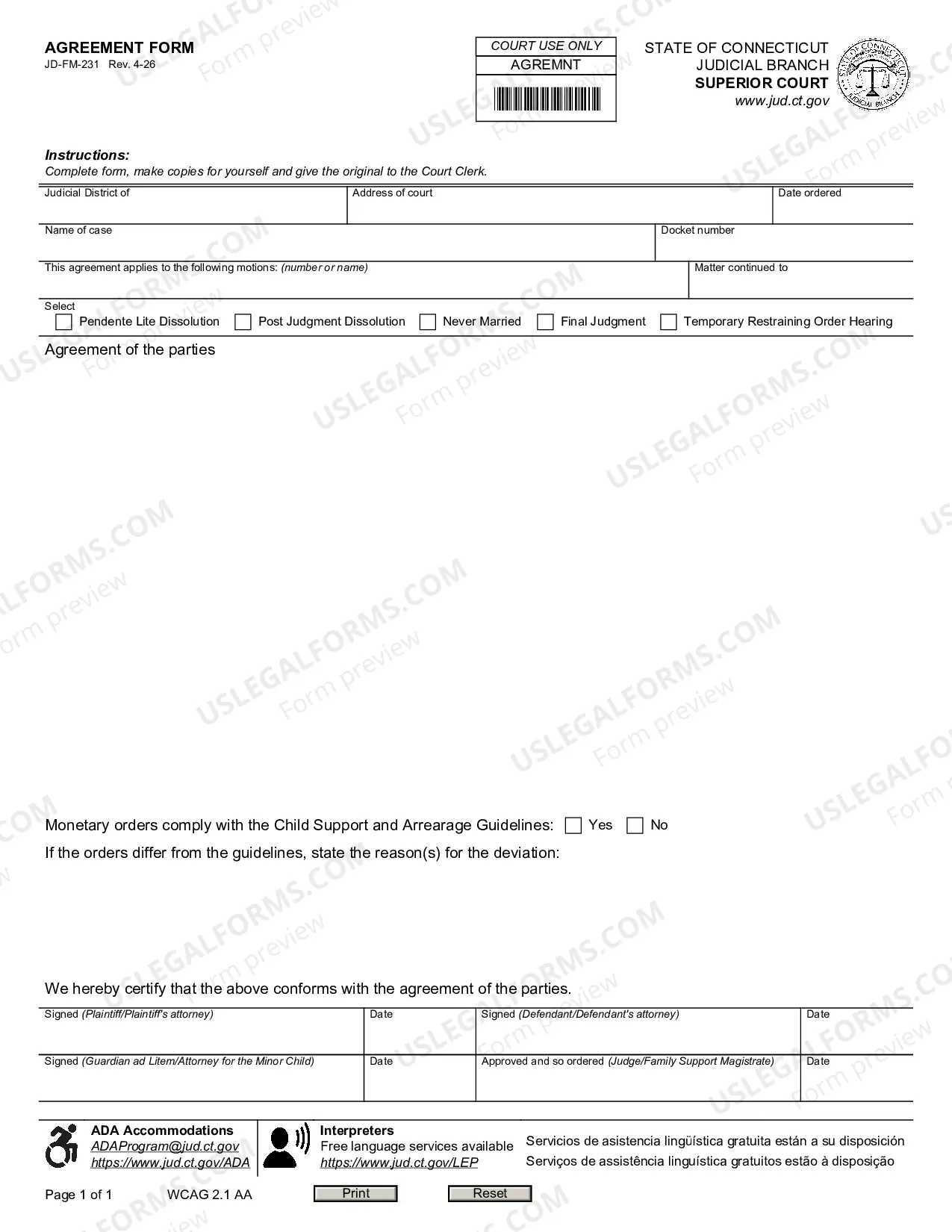
The Mississippi Concrete Mason Contractor Package contains essential legal documents tailored for contractors who work with concrete in various construction projects, such as structures, floors, patios, steps, stoops, or driveways. This package includes a concrete contract that adheres to Mississippi state law, helping contractors assert their legal rights and address key legal matters. Unlike generic templates, this package is specifically designed to meet the legal needs of contractors in Mississippi.
What’s included in this form package
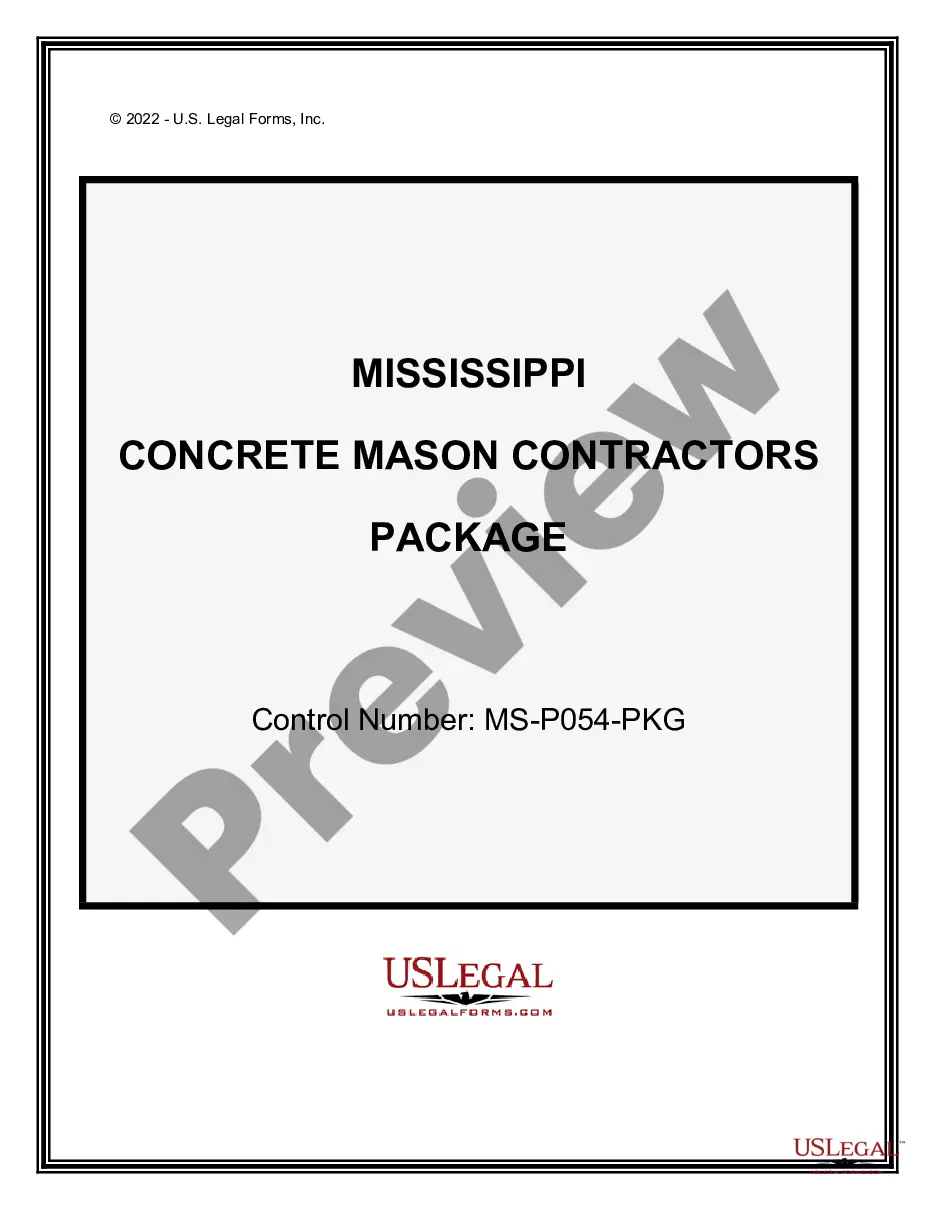
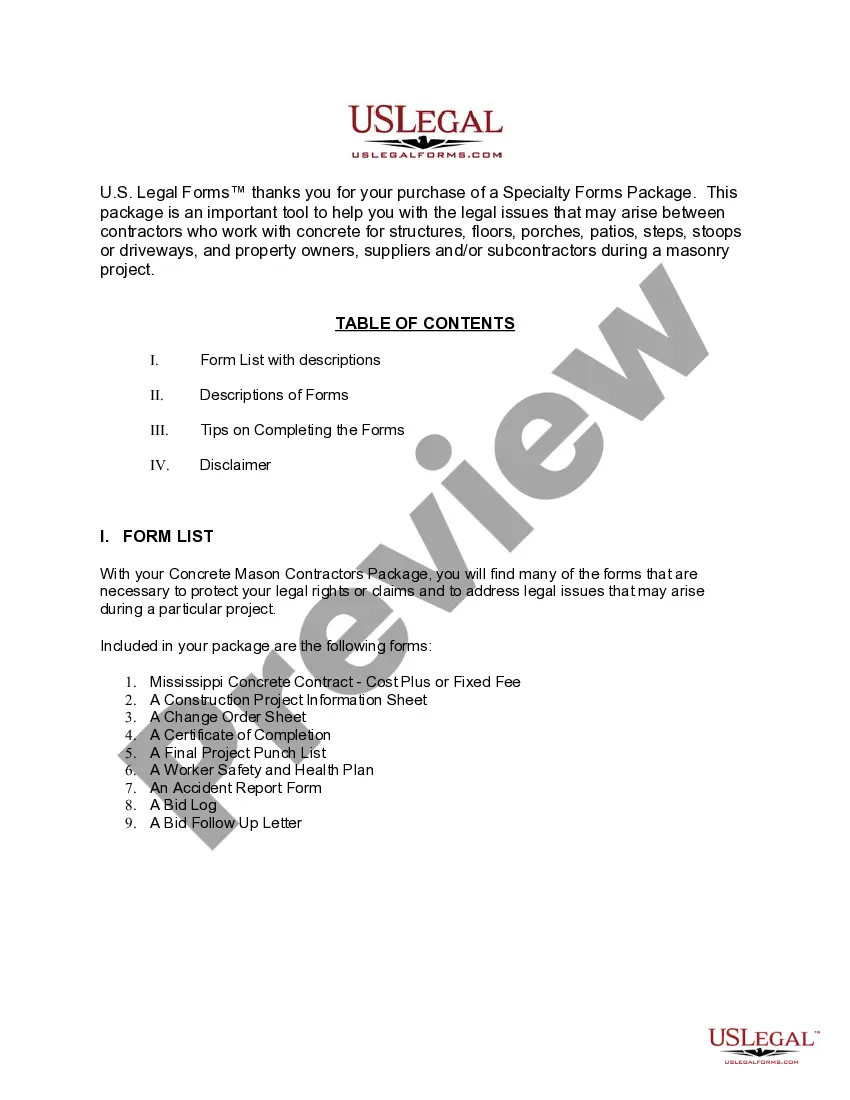
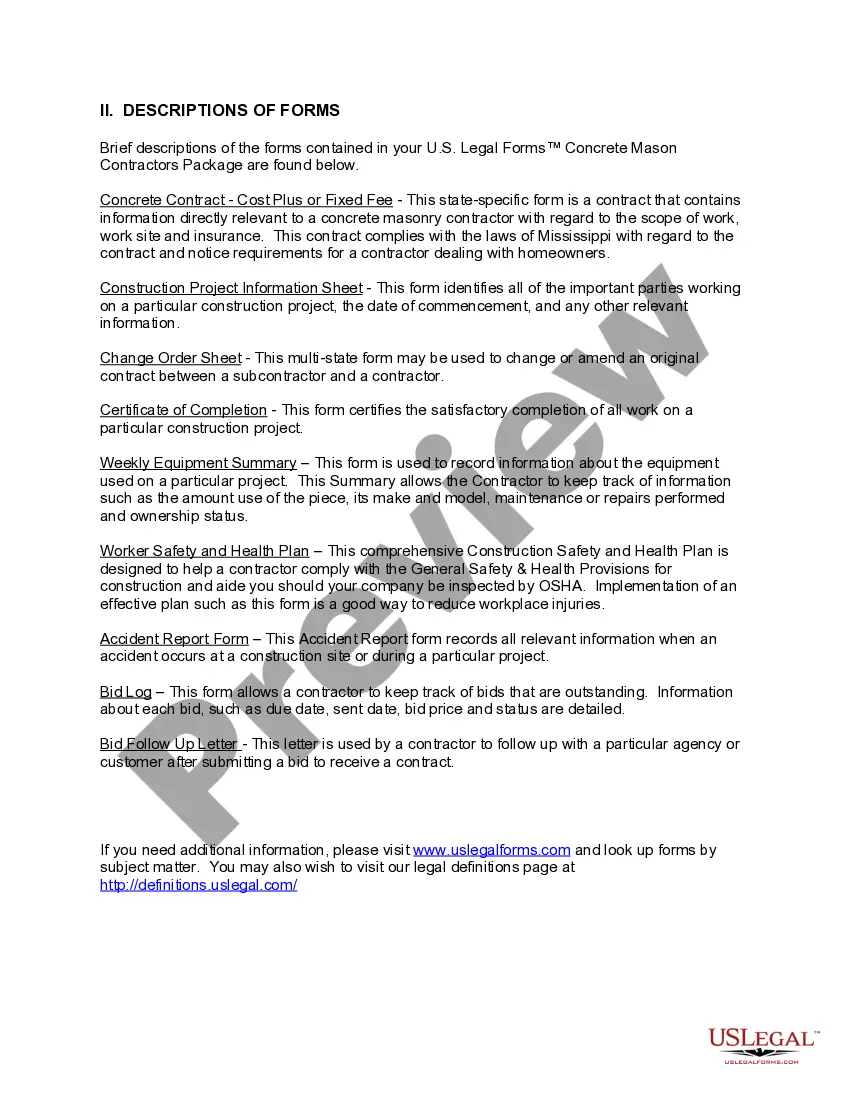
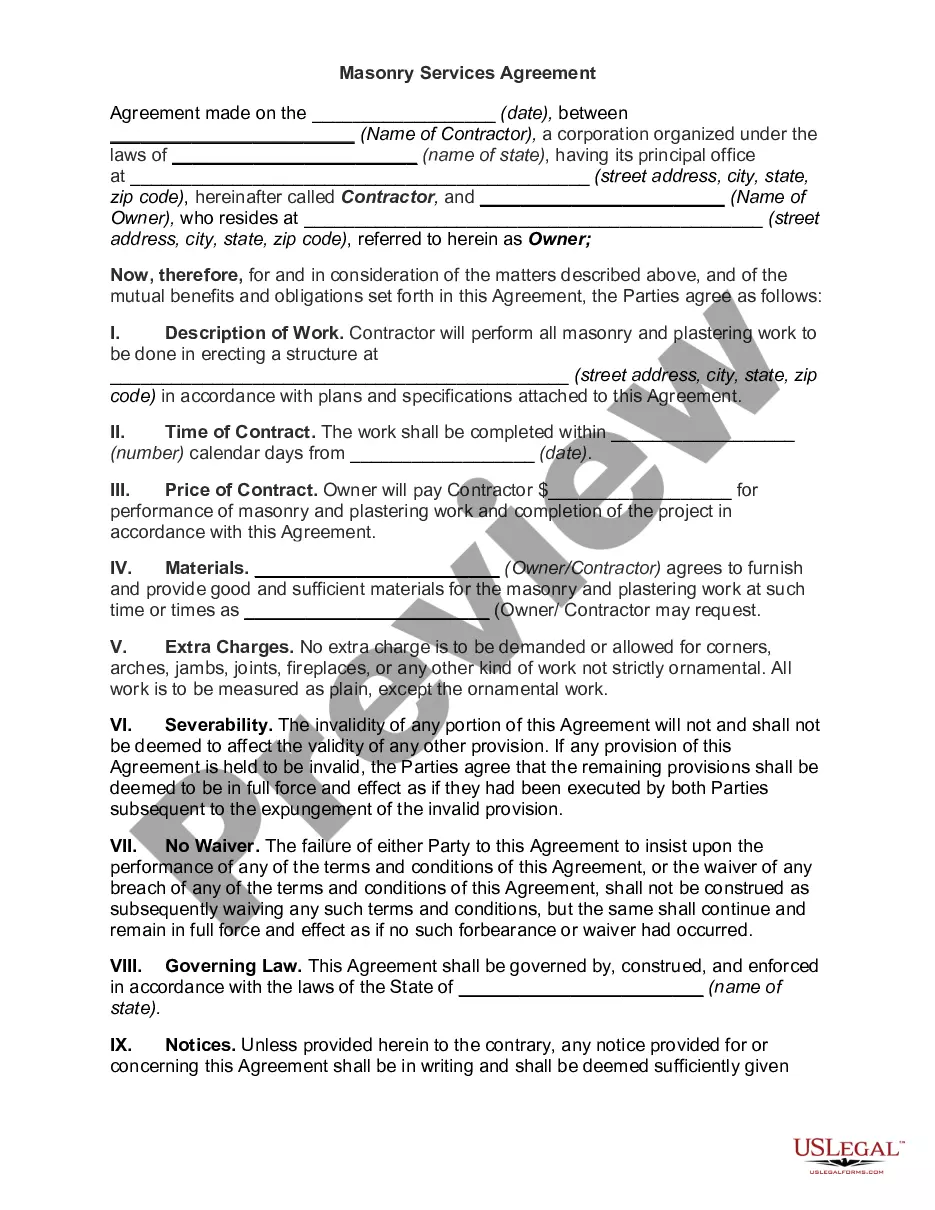
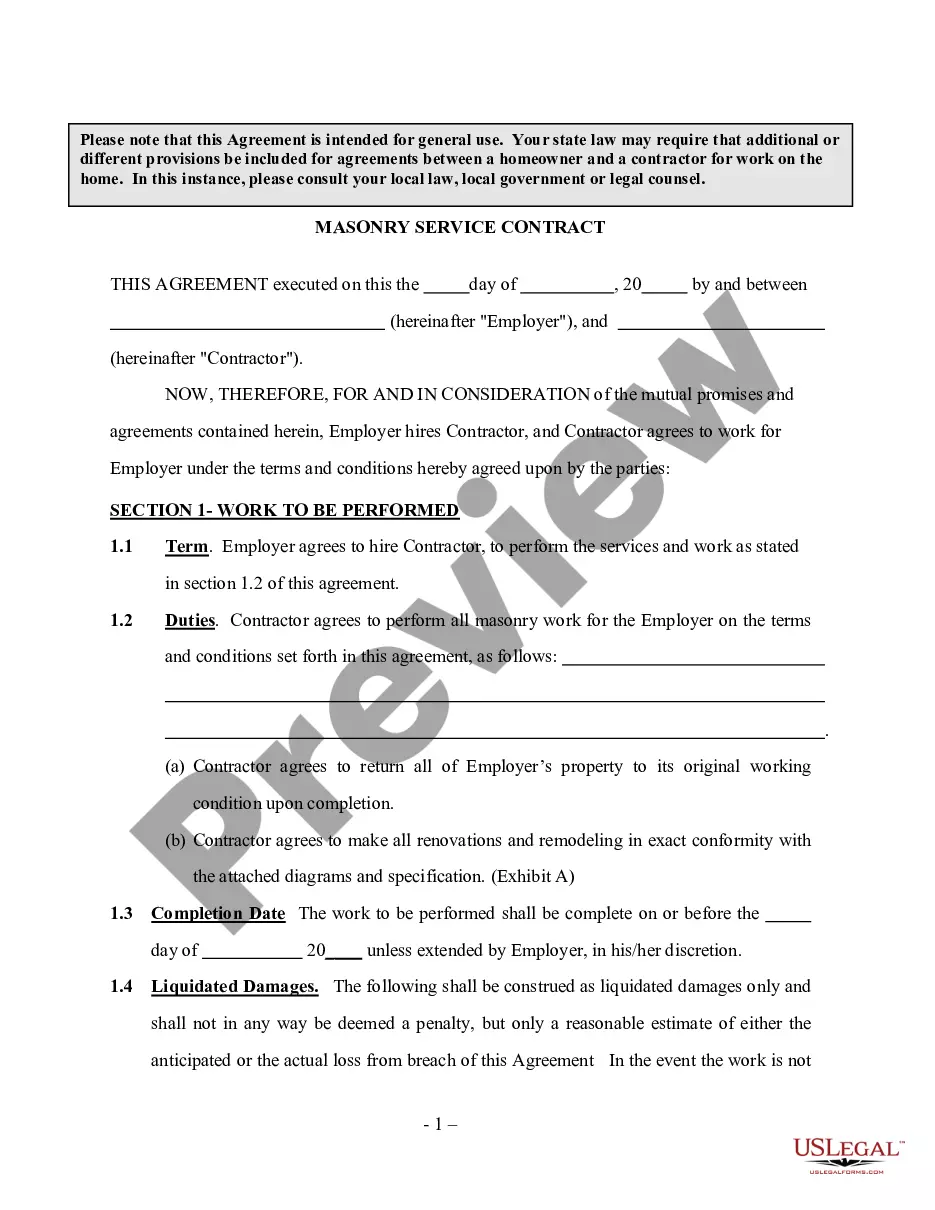
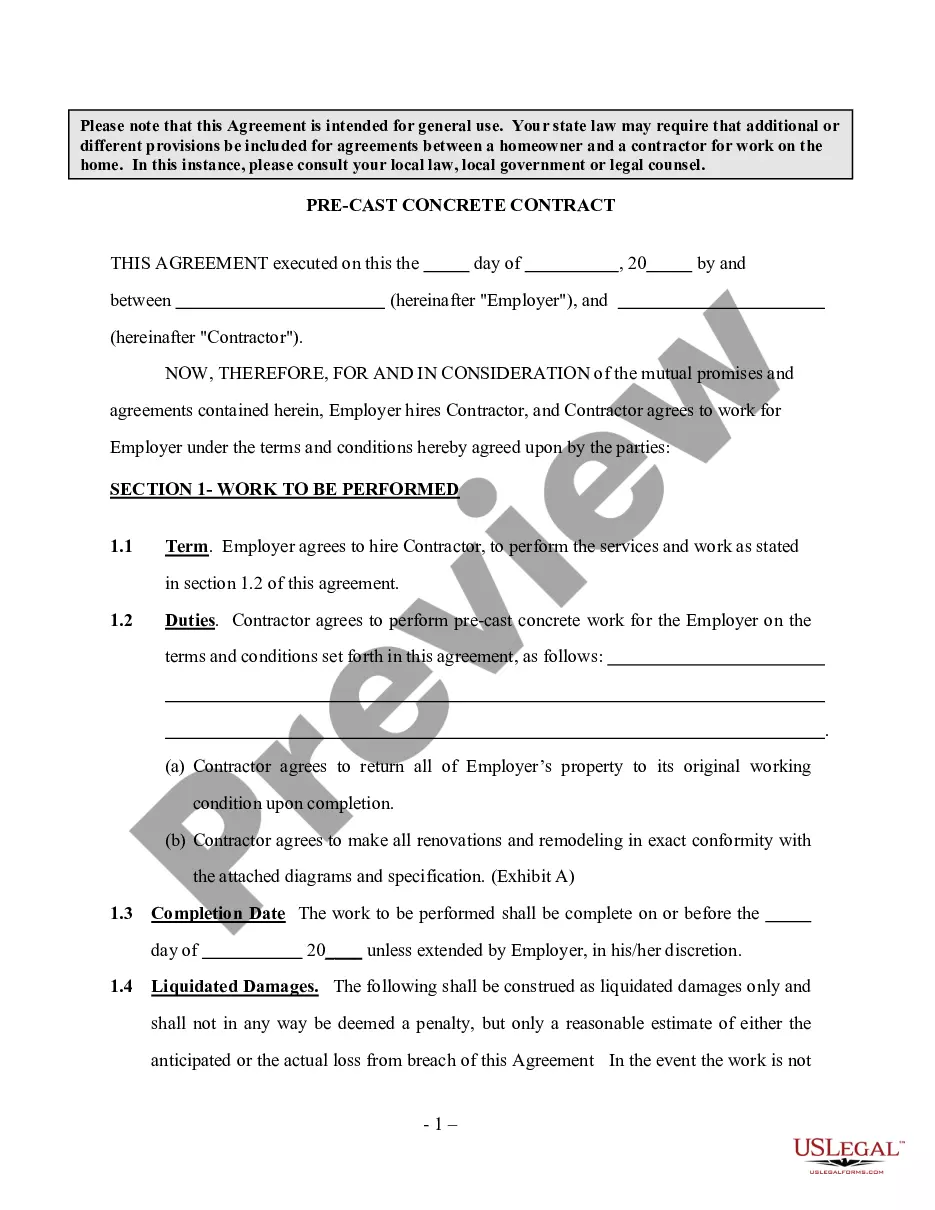
- Concrete Mason Contract for Contractor
- Contractor's Weekly Equipment Summary
- Contractor's Bid Log
- Contractor's Bid Follow Up Letter
- Construction Accident Report
- Construction Safety and Health Plan
- Change Order for Construction or Repairs by Contractor
- Certification of Completion by Contractor
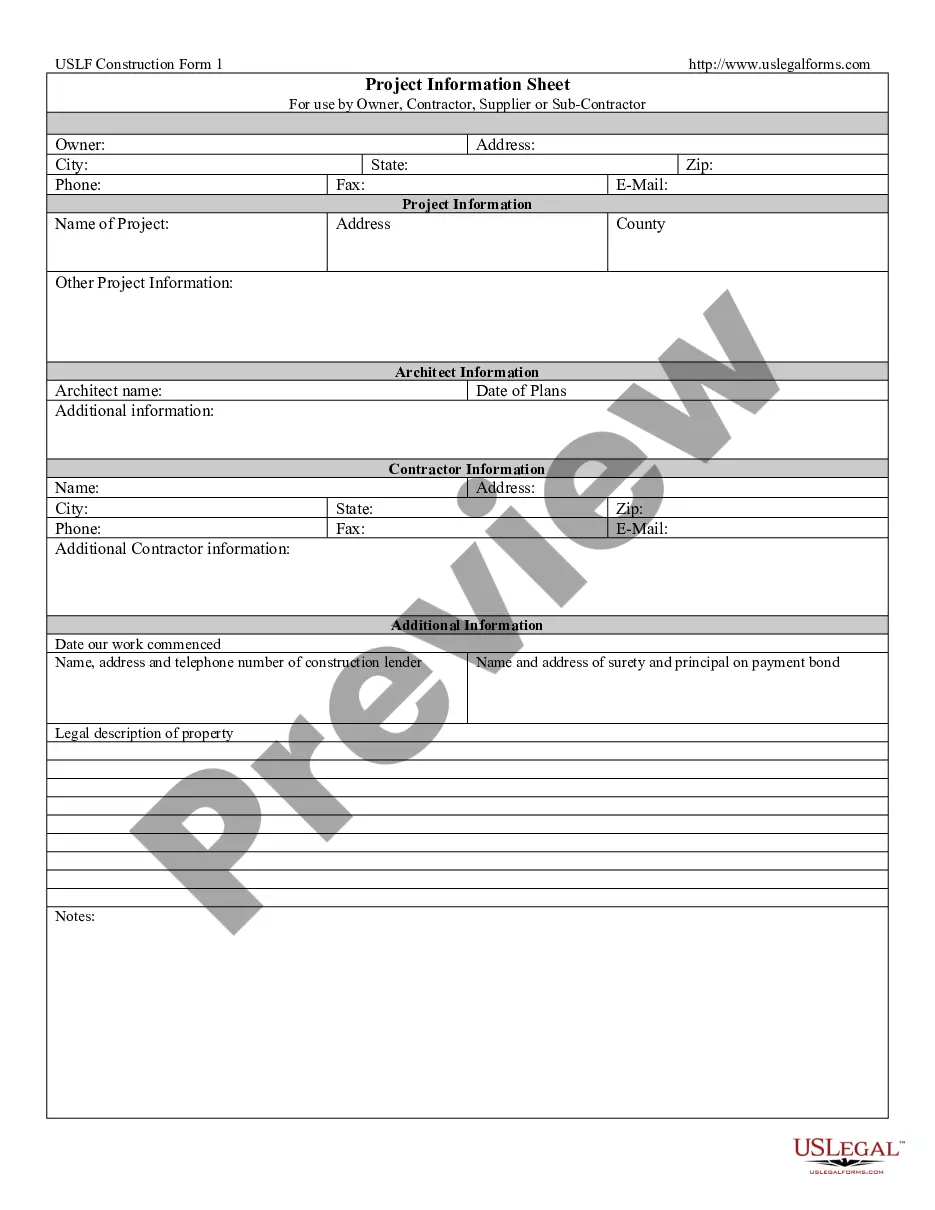
- Construction Project Information Sheet
Common use cases
This form package is ideal in the following scenarios:
- When you are starting a new concrete construction project.
- If you need to make amendments to an existing contract through a change order.
- To ensure compliance with safety regulations and health standards on your job site.
- When finalizing a project and needing to certify its completion.
- If you want to maintain organized records of bids and project details.
Who should use this form package
- Concrete contractors operating in Mississippi.
- Subcontractors needing to formalize agreements related to concrete work.
- Business owners managing construction projects that involve concrete.
- Individuals seeking to understand and manage their contractual obligations and rights in concrete masonry work.
Instructions for completing these forms
- Review the included forms carefully to understand each one's purpose.
- Identify all parties involved in the construction project and complete the Construction Project Information Sheet.
- Fill in the necessary details in the Concrete Contract based on your agreement.
- Use the Change Order Sheet to document any amendments to the original contract.
- Record equipment usage and project details accurately in the Weekly Equipment Summary.
Notarization requirements for forms in this package
Notarization is not commonly needed for forms in this package. However, if your state’s laws require it, our notarization service, powered by Notarize, allows you to finalize documents online 24/7 without in-person visits.
Get your form ready online
Our built-in tools help you complete, sign, share, and store your documents in one place.
Make edits, fill in missing information, and update formatting in US Legal Forms—just like you would in MS Word.
Download a copy, print it, send it by email, or mail it via USPS—whatever works best for your next step.
Sign and collect signatures with our SignNow integration. Send to multiple recipients, set reminders, and more. Go Premium to unlock E-Sign.
If this form requires notarization, complete it online through a secure video call—no need to meet a notary in person or wait for an appointment.
We protect your documents and personal data by following strict security and privacy standards.

Make edits, fill in missing information, and update formatting in US Legal Forms—just like you would in MS Word.

Download a copy, print it, send it by email, or mail it via USPS—whatever works best for your next step.

Sign and collect signatures with our SignNow integration. Send to multiple recipients, set reminders, and more. Go Premium to unlock E-Sign.

If this form requires notarization, complete it online through a secure video call—no need to meet a notary in person or wait for an appointment.

We protect your documents and personal data by following strict security and privacy standards.
Mistakes to watch out for
- Failing to include all parties in the Construction Project Information Sheet.
- Not documenting changes properly with the Change Order Sheet.
- Neglecting to obtain the necessary signatures on the Certificate of Completion.
- Overlooking safety protocols outlined in the Worker Safety and Health Plan.
Why use this package online
- Convenient access to all necessary forms in one package.
- Edit the forms digitally, saving time on manual entries.
- Reliability of legally compliant documents drafted by licensed attorneys.
- Instant download allows you to start working on your project immediately.
Summary of main points
- This package provides vital documents for concrete contractors in Mississippi.
- It supports legal compliance and helps protect contractors' rights.
- Understanding how to complete these forms correctly is crucial for effective project management.
Looking for another form?


Form popularity
FAQ
Cement Masons and Concrete Finishers rank #14 in Best Construction Jobs. Jobs are ranked according to their ability to offer an elusive mix of factors. Read more about how we rank the best jobs.
A three- or four-year apprenticeship program is the best way to train to become a cement mason. A high school diploma is usually not necessary, but anyone who wants to enter a formal apprenticeship program should take a high school math course. Blueprint reading and mechanical drawing courses are also helpful.
Cement masons and concrete finishers perform specialized masonry work with poured concrete (concrete finishers) and finished concrete (cement masons).Concrete finishers pour wet cement into various forms and tend to work on foundation slabs, sidewalks, roads, curbs and other ground-level projects.
Apprentices learn construction basics such as blueprint reading, mathematics, building code requirements, and safety and first-aid practices. After completing an apprenticeship program (usually lasting three to four years), cement masons are considered to be journey workers, qualifying them to do tasks on their own.
As of 2019, cement masons had an average annual income of $48,330 according to the Bureau of Labor Statistics. The average hourly cement mason salary was $23.24 per hour.
Brickmasons and Blockmasons earned an average salary of $56,470 in 2019. Comparable jobs earned the following average salary in 2019: Carpenters made $52,850, Cement Masons and Concrete Finishers made $48,330, Painters made $44,640, and Construction Workers made $41,730.
Although there are no specific education requirements for Cement Masons and Concrete Finishers usually must have a high school diploma. High school courses in math, mechanical drawing, and blueprint reading are considered to be helpful.
A concrete finisher is a skilled tradesperson who works with concrete by placing, finishing, protecting and repairing concrete in engineering and construction projects. Concrete finishers are often responsible for setting the concrete forms, ensuring they have the correct depth and pitch.