Mississippi Waiver of Special Venire
What is this form?
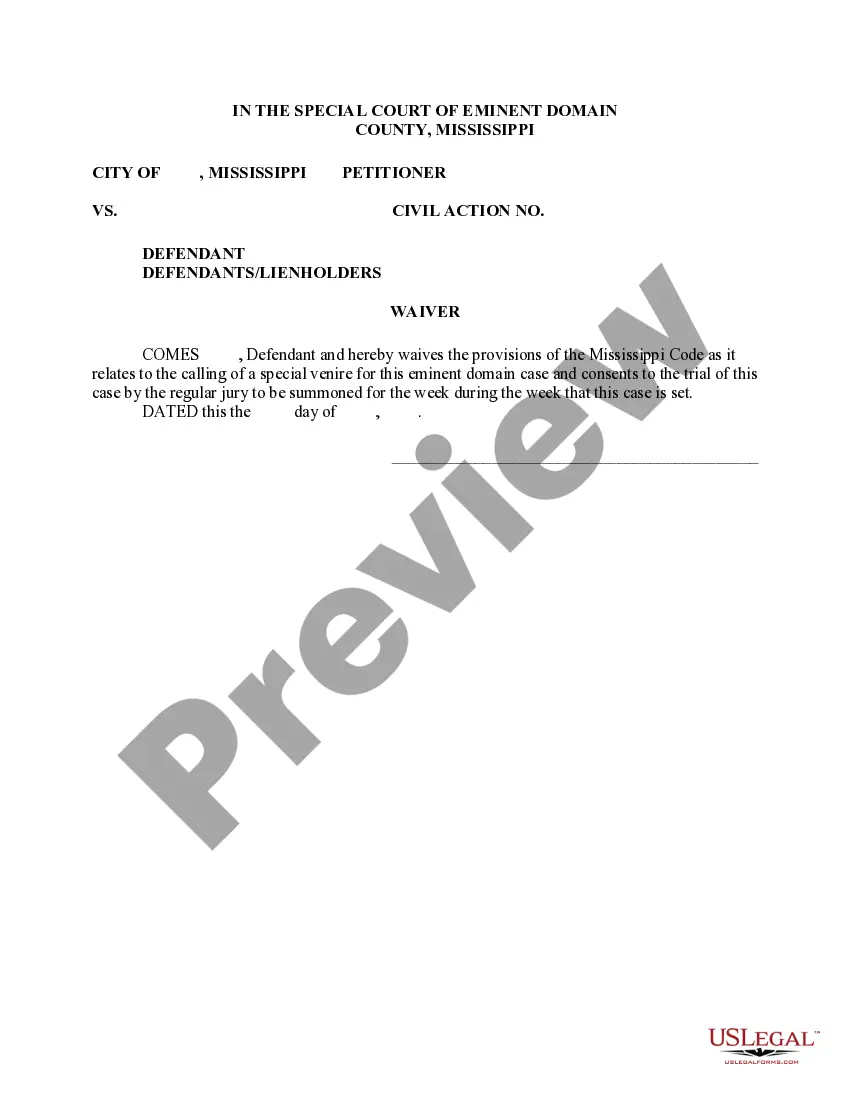
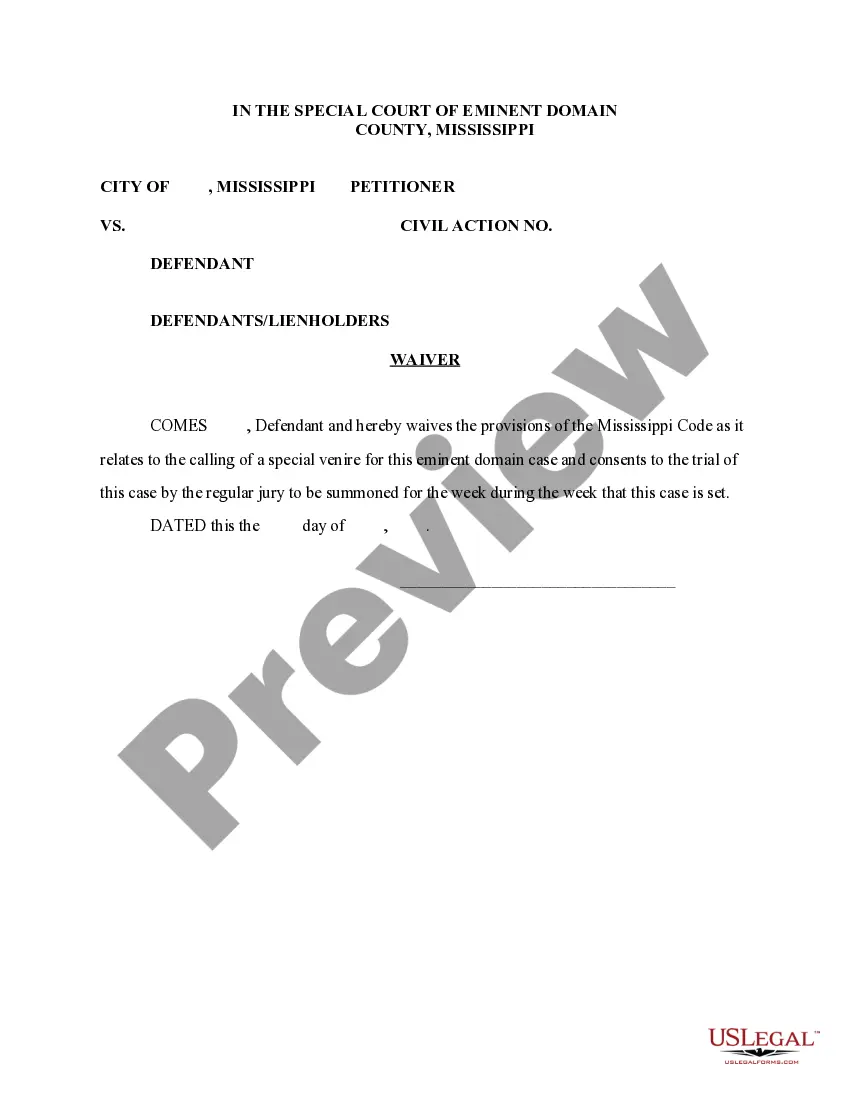
The Waiver of Special Venire is a legal document used by defendants in eminent domain cases. This form allows the defendant to agree to a standard jury rather than a specially selected one, simplifying the jury selection process in court. It differs from other waiver forms by its specific application to juries in eminent domain situations.
What’s included in this form
- Identification of the defendant.
- Agreement statement waiving the right to a special jury.
- Signature of the defendant indicating consent.
- Date of signing to establish the timeline of the waiver.
Situations where this form applies
This form should be used when a defendant is involved in an eminent domain case and prefers not to have a specially appointed jury for their trial. It typically arises in legal circumstances where the selection of a jury could delay proceedings or when the defendant is comfortable with a standard jury composition.
Who this form is for
- Defendants facing eminent domain actions.
- Legal representatives of defendants seeking to expedite jury selection.
- Individuals who wish to simplify their trial process without special jury considerations.
How to prepare this document
- Identify yourself as the defendant by entering your full name.
- Read the waiver statement carefully to understand your rights.
- Sign the form to indicate your agreement to waive the special jury.
- Include the date next to your signature for validation.
Notarization requirements for this form
Notarization is not commonly needed for this form. However, certain documents or local rules may make it necessary. Our notarization service, powered by Notarize, allows you to finalize it securely online anytime, day or night.
Get your form ready online
Our built-in tools help you complete, sign, share, and store your documents in one place.
Make edits, fill in missing information, and update formatting in US Legal Forms—just like you would in MS Word.
Download a copy, print it, send it by email, or mail it via USPS—whatever works best for your next step.
Sign and collect signatures with our SignNow integration. Send to multiple recipients, set reminders, and more. Go Premium to unlock E-Sign.
If this form requires notarization, complete it online through a secure video call—no need to meet a notary in person or wait for an appointment.
We protect your documents and personal data by following strict security and privacy standards.

Make edits, fill in missing information, and update formatting in US Legal Forms—just like you would in MS Word.

Download a copy, print it, send it by email, or mail it via USPS—whatever works best for your next step.

Sign and collect signatures with our SignNow integration. Send to multiple recipients, set reminders, and more. Go Premium to unlock E-Sign.

If this form requires notarization, complete it online through a secure video call—no need to meet a notary in person or wait for an appointment.

We protect your documents and personal data by following strict security and privacy standards.
Mistakes to watch out for
- Failing to include a date with the signature.
- Not reading the waiver statement fully before signing.
- Using the form without verifying local jurisdictional requirements.
Benefits of using this form online
- Convenience of downloading the form instantly from anywhere.
- Editable format allows for easy customization.
- Reliability of attorney-drafted templates ensuring legal compliance.
Summary of main points
- The Waiver of Special Venire allows defendants to expedite their eminent domain trials.
- This form is suitable for defendants wishing to waive their right to a specially selected jury.
- Ensure all fields are correctly filled out to avoid delays in court processing.
Looking for another form?


Form popularity
FAQ
If the presiding judge finds that service of summons by the sheriff is not suitable because of his direct or indirect interest in the action to be tried, the judge may appoint some suitable person in place of the sheriff to summon supplemental jurors.
Sixteen-year-old William Haymon has spent more than 500 days in an adult jail in rural Lexington, Mississippi. There are no state rules governing how long a person can be incarcerated without being formally charged with a crime.
The group of potential jurors (the "jury pool", also known as the venire) is first selected from among the community using a reasonably random method.The prospective jurors are randomly selected to sit in the jury box. At this stage, they will be questioned in court by the judge and/or attorneys in the United States.
The criminal statute of limitations requires prosecutors to file criminal charges against a suspect within two years for misdemeanors and within five years for certain felonies, but there is no time limit in Mississippi for charges of murder, kidnapping, rape, burglary, robbery, larceny, and several other serious
A juror selected in the same manner as a regular juror who hears all the evidence but does not help decide the case unless called on to replace a regular juror.
There are two types of juries serving different functions in the federal trial courts: trial juries, also known as petit juries, and grand juries.
If you are selected to serve on this Grand jury panel, you will serve approximately one to three days every month for an eighteen (18) month period.
The trial jury in either a civil or criminal case is chosen from a list called a venire or jury pool that has been compiled by the court. The method of selecting names for the venire varies.The jury pool is sometimes compiled with the help of jury commissioners appointed by the presiding judge.