Mississippi Waiver
What is this form?
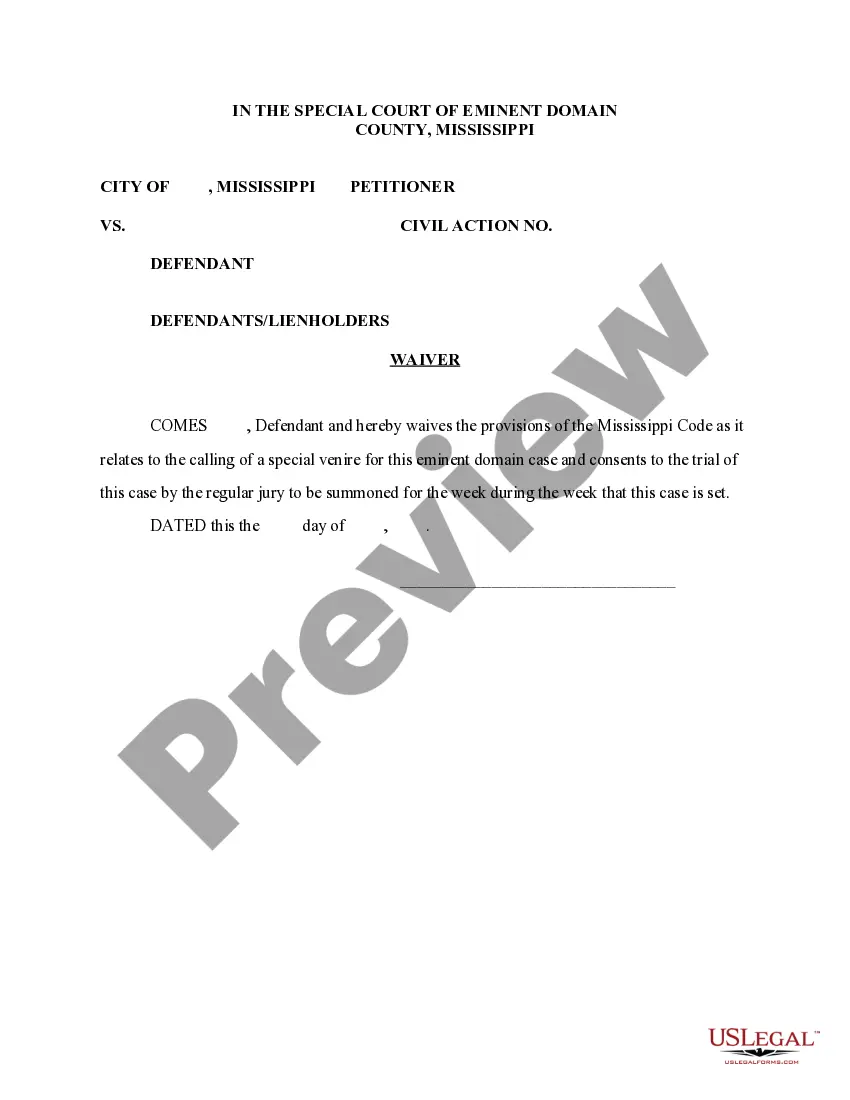
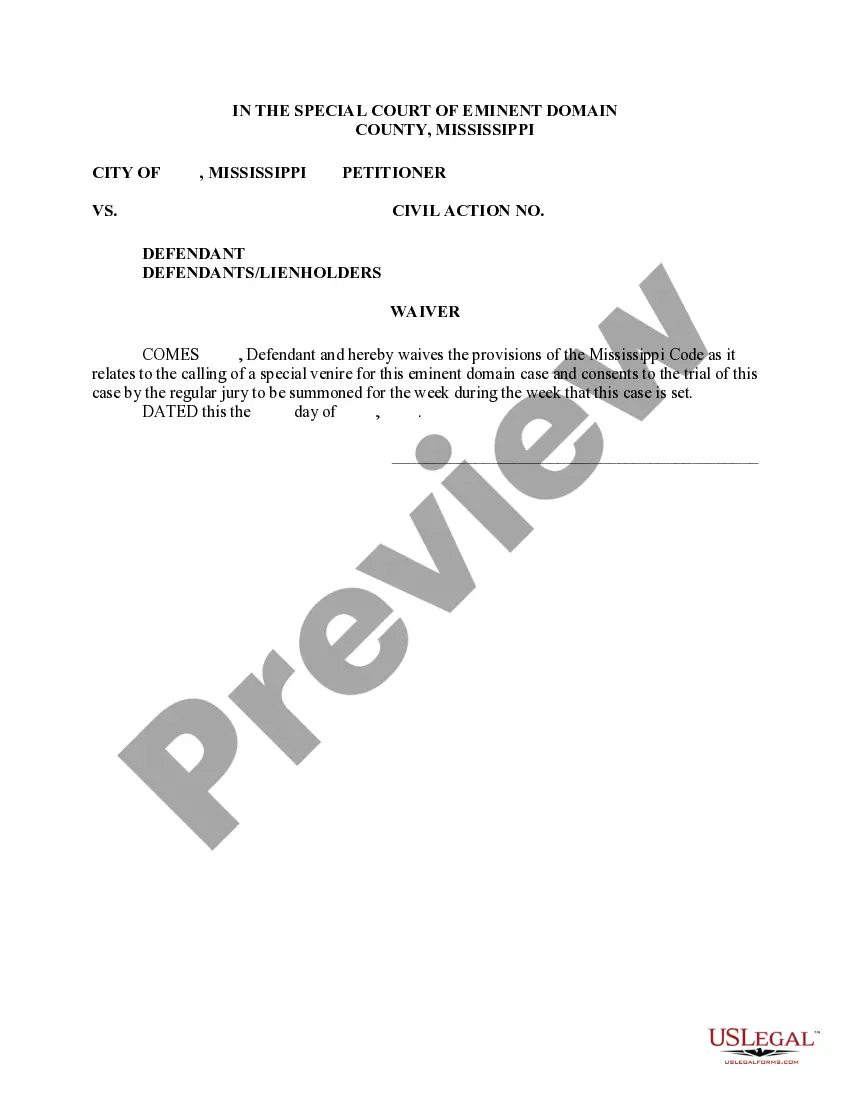
A waiver is a legal document used by a defendant in an eminent domain action. It allows the defendant to relinquish the right to a special jury, stating that the existing jury, initially present at a specified date and time, is sufficient for the case. This waiver simplifies the process by addressing the jury's presence, making it distinct from other legal forms related to jury selection.
Key components of this form
- Defendant's details: Information identifying the defendant involved in the case.
- Waiver statement: A clear declaration waiving the right to a special jury.
- Jury information: Details regarding the jury present at the specified date and time.
- Signature line: Space for the defendant's signature to validate the waiver.
- Date of execution: The date when the waiver is signed by the defendant.
When this form is needed
This waiver should be used when a defendant involved in an eminent domain cause of action prefers to forgo their right to a special jury. It is applicable in cases where the defendant is comfortable with the jury originally present at the specified date being sufficient for their hearing.
Who should use this form
- Defendants in eminent domain proceedings.
- Individuals seeking to streamline their legal process regarding jury selection.
- Legal representatives who advise clients on waiving certain jury rights.
How to prepare this document
- Identify the parties: Fill in the names and relevant details of the parties involved.
- State the waiver: Clearly articulate the waiver of the right to a special jury.
- Specify the jury information: Include details about the jury and the date and time they were present.
- Sign and date: The defendant should sign the waiver and enter the date of execution.
Does this document require notarization?
This form does not typically require notarization to be legally valid. However, some jurisdictions or document types may still require it. US Legal Forms provides secure online notarization powered by Notarize, available 24/7 for added convenience.
Get your form ready online
Our built-in tools help you complete, sign, share, and store your documents in one place.
Make edits, fill in missing information, and update formatting in US Legal Forms—just like you would in MS Word.
Download a copy, print it, send it by email, or mail it via USPS—whatever works best for your next step.
Sign and collect signatures with our SignNow integration. Send to multiple recipients, set reminders, and more. Go Premium to unlock E-Sign.
If this form requires notarization, complete it online through a secure video call—no need to meet a notary in person or wait for an appointment.
We protect your documents and personal data by following strict security and privacy standards.

Make edits, fill in missing information, and update formatting in US Legal Forms—just like you would in MS Word.

Download a copy, print it, send it by email, or mail it via USPS—whatever works best for your next step.

Sign and collect signatures with our SignNow integration. Send to multiple recipients, set reminders, and more. Go Premium to unlock E-Sign.

If this form requires notarization, complete it online through a secure video call—no need to meet a notary in person or wait for an appointment.

We protect your documents and personal data by following strict security and privacy standards.
Mistakes to watch out for
- Not including all required parties' details.
- Failing to specify the correct date and time of the jury's presence.
- Omitting the defendant's signature or date of execution.
Benefits of completing this form online
- Immediate access: Download the form instantly for prompt use.
- Editability: Tailor the form to meet specific case details before printing.
- Reliability: Ensure the form is prepared in accordance with legal standards
Legal use & context
- The waiver is legally binding upon signature by the defendant.
- It helps clarify jury requirements in eminent domain cases, reducing potential delays.
- Understanding the implications of waiving a special jury may benefit defendants in determining their legal strategy.
What to keep in mind
- A waiver is a specific document used in eminent domain cases.
- It allows a defendant to waive the right to a special jury hearing.
- Available in both Word and Rich Text formats for convenience.
- Ensure all information is accurately completed before submission.
Looking for another form?
Form popularity
FAQ
A very important distinction between nursing home Medicaid and Medicaid waivers is that nursing home Medicaid is considered an entitlement program, while waivers are not. Entitlement, in this situation means that if one meets the eligibility requirements, they are entitled to receive benefits.
A Medicaid waiver is a provision in Medicaid law which allows the federal government to waive rules that usually apply to the Medicaid program.Thanks to these waivers, states can provide services to their residents that wouldn't usually be covered by Medicaid.
Infants from birth to age 1 may qualify for CHIP if family income is between 194% 209% FPL. Children age 1-6 may qualify for CHIP if family income is between 143% 209% FPL. Children age 6-19 may qualify for CHIP if family income is between 133% 209% FPL.
To begin the application process for a Medicaid HCBS waiver program, contact your state Medicaid office. You can visit the Centers for Medicare & Medicaid Services to find the contact information for your state. You'll then be given information on how to submit an official application.
Earnings- the earnings limit is set at 250% of the federal poverty level. The gross income limit for earnings is: Individual limit - $5,383 per month (meaning an unmarried individual) Couple limit - $7,249 per month (meaning either one or both members of the couple are disabled and applying for Medicaid.)
This program, which is administered by the Mississippi Division of Medicaid's Office of Long Term Care, is available statewide in all Mississippi counties. One can learn more or apply for services from the Elderly and Disabled Waiver by contacting the Division of Medicaid Long Term Care at 800-421-2408.
The EW has eligibility criteria related to the age, finances, and the health of the applicant. Applicants must be at least 65 years of age and have significant health challenges to the extent that they require aid to complete their daily personal tasks. This is equivalent to the level of care provided in nursing homes.
There are no copayments for your child's dental care. But dental benefits are limited to $1500 per year. Braces are covered under this plan.
Call 1-800-318-2596 (TTY: 1-855-889-4325). Fill out an application through the Health Insurance Marketplace®. If it looks like anyone in your household qualifies for Medicaid or CHIP, we'll send your information to your state agency. They'll contact you about enrollment.