Custodian Agreement
What this document covers
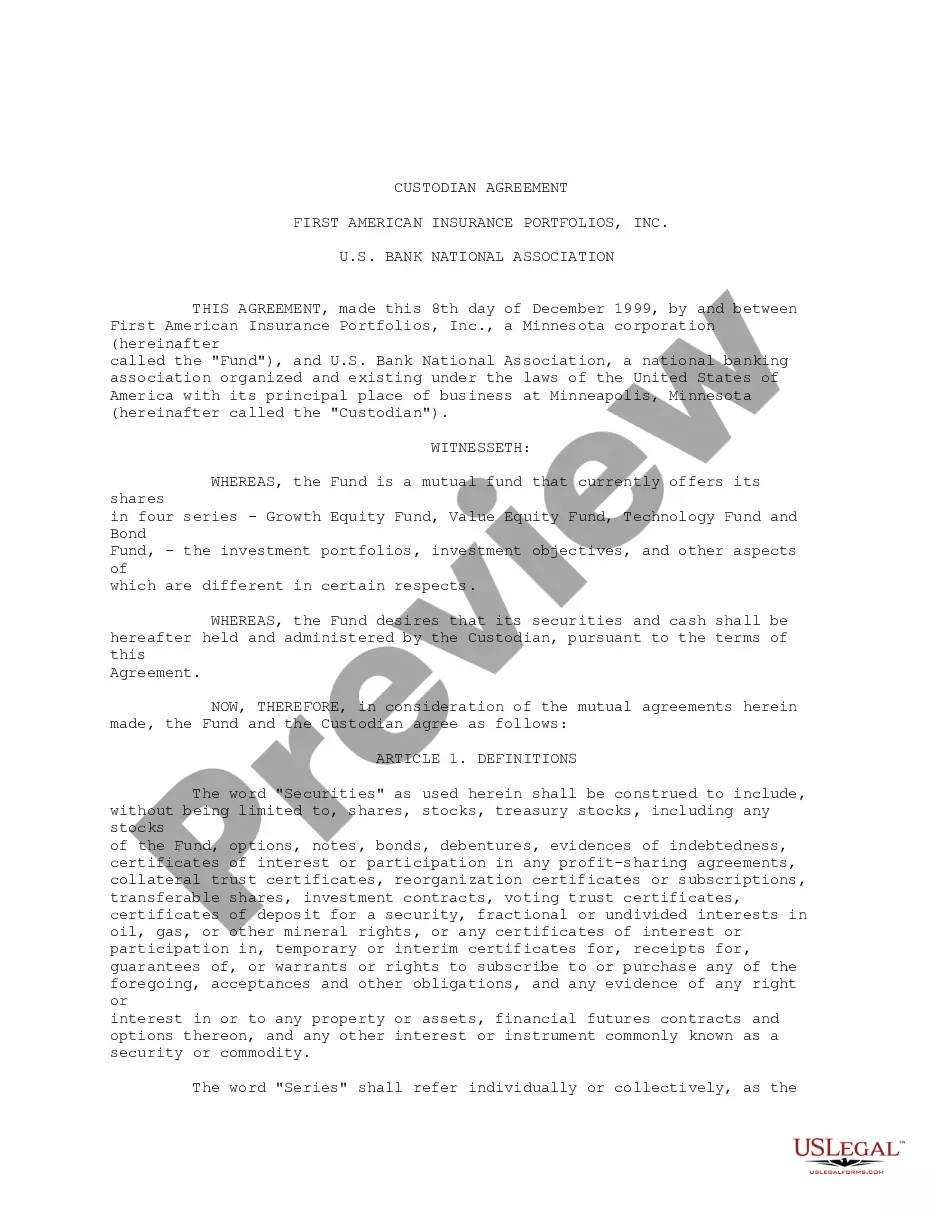
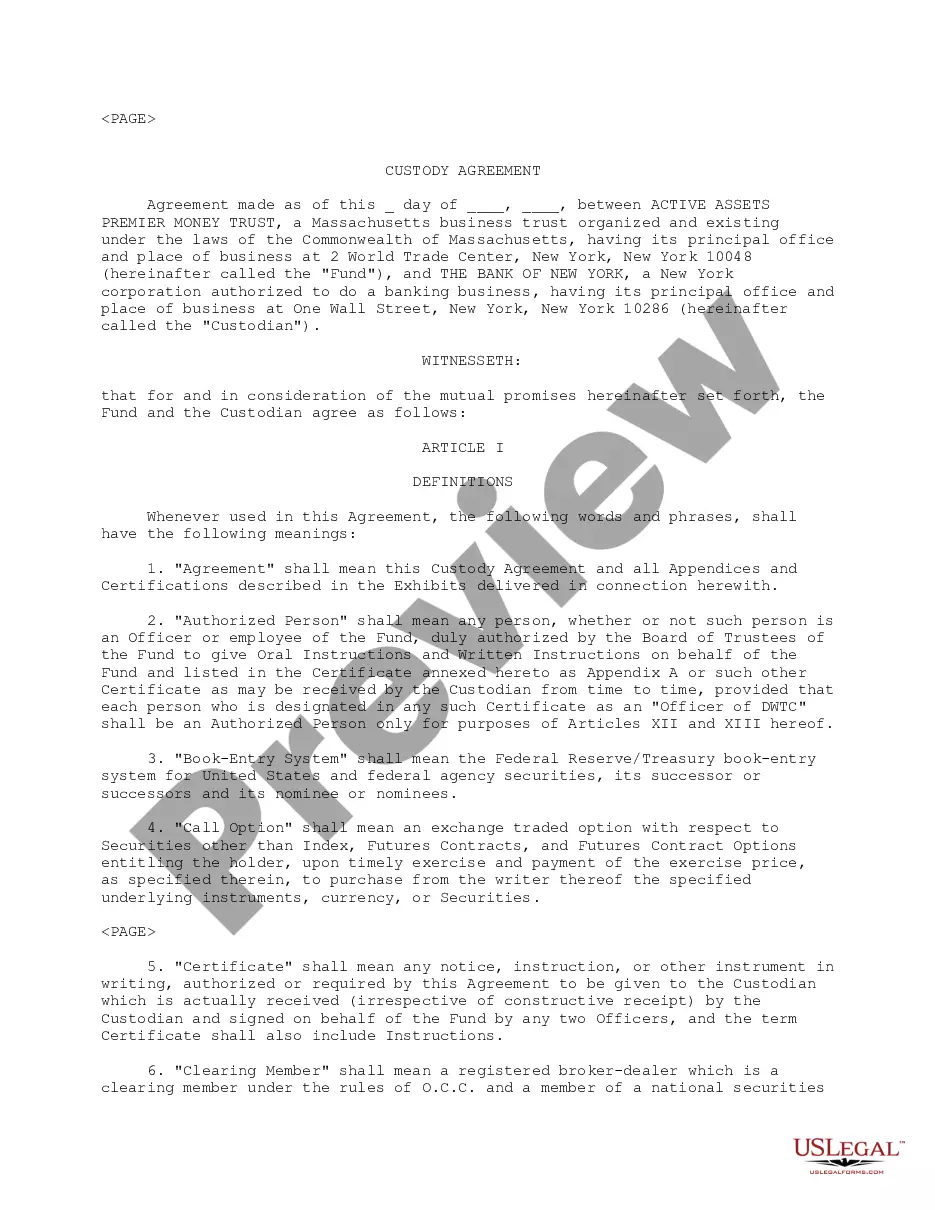
The Custodian Agreement is a legal document that outlines the relationship between a mutual fund and its custodian bank. Its primary purpose is to establish how the custodian will manage and protect the fund's assets, which can include securities and cash holdings. This agreement is essential for mutual funds to ensure compliance with financial regulations and proper safeguarding of investor assets. Unlike other financial agreements, the Custodian Agreement specifically focuses on the custodial responsibilities and the operational structure between the fund and the custodian bank.
Key parts of this document
- Definitions: Clarifies key terms used in the agreement, such as "Securities" and "Series."
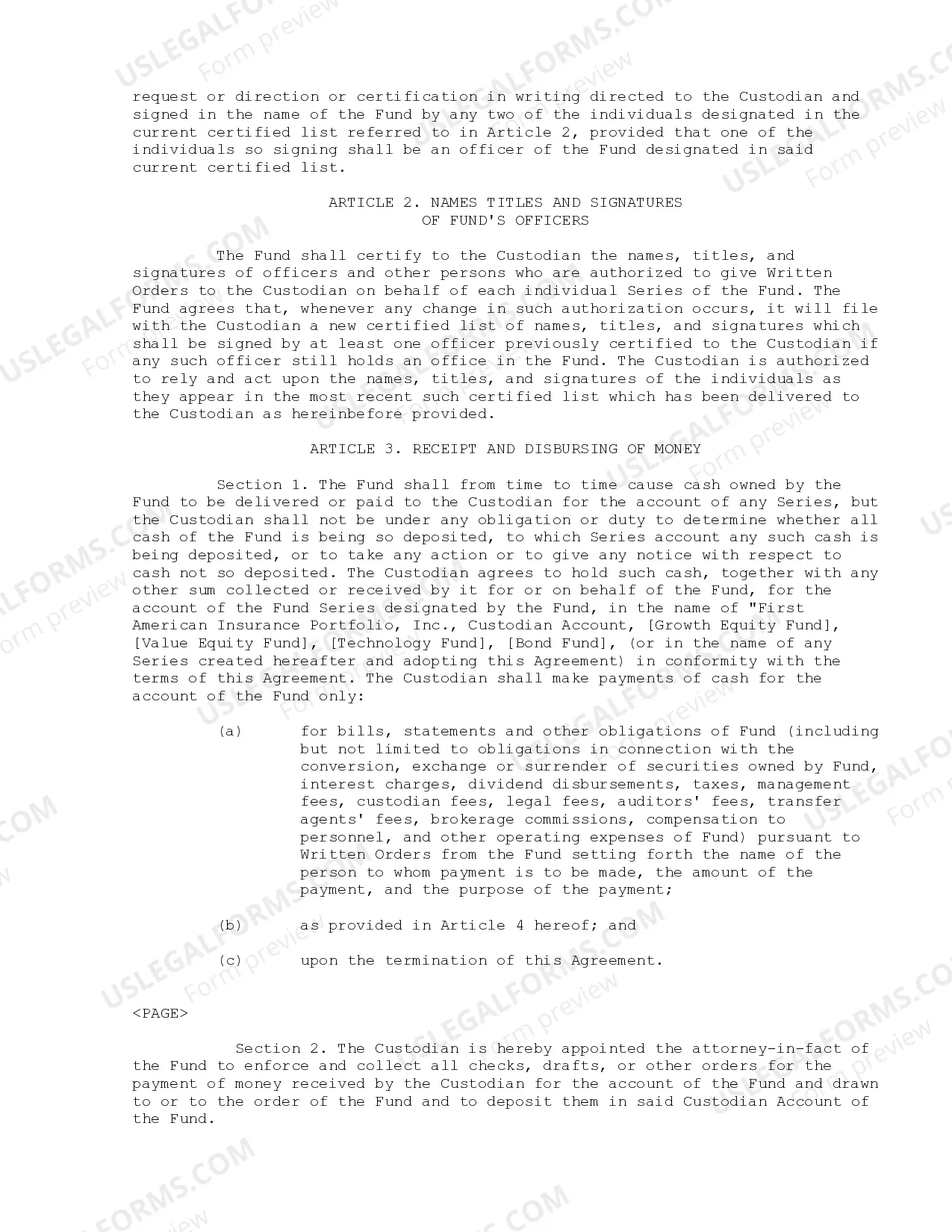
- Responsibilities: Outlines the duties of the custodian regarding cash and securities management.
- Instructions: Details the process for delivering written orders from the fund to the custodian.
- Termination: Describes how the agreement can be terminated by either party.
- Liability: Specifies the standard of care expected of the custodian and conditions for indemnity.


Situations where this form applies
This Custodian Agreement should be used when a mutual fund requires a professional bank to hold and manage its securities and cash. It is particularly applicable when launching a new fund or when existing funds are transitioning to a new custodian. This agreement is crucial for ensuring regulatory compliance and the safekeeping of assets, making it essential for the operations of any mutual fund.
Who should use this form
- Mutual funds that need to establish a formal relationship with a custodian bank.
- Financial institutions acting as custodians for mutual funds.
- Board members of a mutual fund overseeing financial agreements and responsibilities.
- Legal professionals involved in drafting or reviewing fund agreements.
Steps to complete this form
- Identify the parties involved: clearly state the names of the mutual fund and the custodian bank.
- Define the terms: ensure all key definitions are adequately outlined within the context of the agreement.
- Specify roles and responsibilities: detail the obligations of the custodian concerning the management of assets.
- Include written order procedures: describe how the fund will communicate orders to the custodian.
- Sign and date the agreement: ensure authorized representatives from both parties execute the agreement.
Is notarization required?
This form usually doesn’t need to be notarized. However, local laws or specific transactions may require it. Our online notarization service, powered by Notarize, lets you complete it remotely through a secure video session, available 24/7.
Get your form ready online
Our built-in tools help you complete, sign, share, and store your documents in one place.
Make edits, fill in missing information, and update formatting in US Legal Forms—just like you would in MS Word.
Download a copy, print it, send it by email, or mail it via USPS—whatever works best for your next step.
Sign and collect signatures with our SignNow integration. Send to multiple recipients, set reminders, and more. Go Premium to unlock E-Sign.
If this form requires notarization, complete it online through a secure video call—no need to meet a notary in person or wait for an appointment.
We protect your documents and personal data by following strict security and privacy standards.

Make edits, fill in missing information, and update formatting in US Legal Forms—just like you would in MS Word.

Download a copy, print it, send it by email, or mail it via USPS—whatever works best for your next step.

Sign and collect signatures with our SignNow integration. Send to multiple recipients, set reminders, and more. Go Premium to unlock E-Sign.

If this form requires notarization, complete it online through a secure video call—no need to meet a notary in person or wait for an appointment.

We protect your documents and personal data by following strict security and privacy standards.
Common mistakes
- Failing to clearly define the terms of the agreement, leading to confusion about responsibilities.
- Not specifying the procedure for terminating the agreement, which can lead to complications.
- Inadequately detailing the liability provisions, which may expose the fund or custodian to unnecessary risks.
- Not getting signatures from the correct authorized representatives.
Why complete this form online
- Convenience: Download and complete the form from anywhere, at any time.
- Editability: Easily modify the form based on specific needs before finalizing.
- Reliability: Use templates vetted by licensed attorneys to ensure compliance with legal standards.
- Accessibility: Retrieve and store digital copies for easy access during audits or reviews.
Looking for another form?
Form popularity
FAQ
Write clearly, and use your own words. Use bulleted lists for your major points. Don't insult or bash your ex. Attach evidence such as pay stubs or bank statements, but redact SSN and account numbers. Affirm that you are making your statement under oath, and under penalty of perjury.
A parenting time schedule. Information about how the parents will make decisions for the child. Information about finances and expenses. Parenting provisions (rules about raising the child) Any other information you want to include.
The statement must be signed, dated and contain a declaration that you believe the statement is true and recognise it may be placed before the court. On the top left-hand side of your statement, detail the court in capital letters, e.g. IN THE LONDON FAMILY COURT and the case number on the top right-hand side.
You can write a letter to the Judge but the Judge will not read it. You have to provide testimony through witnesses including yourself. You do not have to agree with what the GAL proposes. You need an attorney to represent you.
Even though wills are considered more complicated contracts, they can still be handwritten to be considered legally enforceable.It is important to note that even if a written requirement is required under the Statute of Frauds, a handwritten agreement will still work to make the document legally binding.
A declaration of custody. The division of parental authority and decision-making abilities. A child visitation schedule. Methods for reviewing and modifying the custody agreement. A method of dispute resolution. Any additional provisions you would like to include.
Begin your letter by introducing yourself and explaining your relationship to the parent and how long you've known her. Then, spend two or three paragraphs explaining why you think she should be awarded custody. Use your final paragraph to summarize the points you've made in the body of your letter.
You do not have to do any official paperwork if you agree about child arrangements. You can write down what you've agreed in a Parenting Plan if you want a record. If you want to make your agreement legally binding, a solicitor can help with the paperwork.
Parenting Schedule. Holidays and Special Dates. Travel and Vacations. Extended Family and Friends. Schedule Changes. Making Important Decisions. Expenses. Communicating With Kids When Away.