Minnesota Instructions — Default Scheduling Request is a document used by employers in the state of Minnesota to submit necessary information for wage garnishment. This document is used when an employee fails to make a payment on an obligation like a loan or debt. The employer will provide the creditor or collection agency with information about the employee’s wages anwithholdinggs, as well as the amount to be garnished. The employer must submit the Minnesota Instructions — Default Scheduling Request to the creditor or collection agency within five days of receiving the order. There are two types of Minnesota Instructions — Default Scheduling Request: the Order to Withhold Income for Child Support and the Order to Withhold Income for Non-Child Support Debt. The Order to Withhold Income for Child Support requires the employer to withhold a percentage of the employee’s wages for child support payments. The Order to Withhold Income for Non-Child Support Debt requires the employer to withhold a specific dollar amount from the employee’s wages for the payment of a debt.
Minnesota Instructions - Default Scheduling Request
Description

Get your form ready online
Our built-in tools help you complete, sign, share, and store your documents in one place.
Make edits, fill in missing information, and update formatting in US Legal Forms—just like you would in MS Word.
Download a copy, print it, send it by email, or mail it via USPS—whatever works best for your next step.
Sign and collect signatures with our SignNow integration. Send to multiple recipients, set reminders, and more. Go Premium to unlock E-Sign.
If this form requires notarization, complete it online through a secure video call—no need to meet a notary in person or wait for an appointment.
We protect your documents and personal data by following strict security and privacy standards.

Make edits, fill in missing information, and update formatting in US Legal Forms—just like you would in MS Word.

Download a copy, print it, send it by email, or mail it via USPS—whatever works best for your next step.

Sign and collect signatures with our SignNow integration. Send to multiple recipients, set reminders, and more. Go Premium to unlock E-Sign.

If this form requires notarization, complete it online through a secure video call—no need to meet a notary in person or wait for an appointment.

We protect your documents and personal data by following strict security and privacy standards.
Looking for another form?


How to fill out Minnesota Instructions - Default Scheduling Request?
Handling formal paperwork demands focus, precision, and utilizing well-prepared templates. US Legal Forms has been assisting individuals nationwide with this for 25 years, so when you select your Minnesota Instructions - Default Scheduling Request template from our collection, you can be confident it adheres to federal and state guidelines.
Utilizing our service is straightforward and fast. To acquire the required document, all you need is an account with a valid subscription. Here’s a concise guide for you to obtain your Minnesota Instructions - Default Scheduling Request in a matter of minutes.
All documents are designed for multiple uses, like the Minnesota Instructions - Default Scheduling Request you see on this page. If you need them again, you can fill them out without additional payment - simply access the My documents tab in your profile and finalize your document whenever you require it. Experience US Legal Forms and prepare your business and personal documents swiftly and in full legal compliance!
- Ensure to thoroughly review the form content and its alignment with general and legal standards by previewing it or reading its description.
- Search for an alternative official template if the one you initially opened doesn’t fit your circumstances or state regulations (the tab for that is located in the top page corner).
- Log in to your account and download the Minnesota Instructions - Default Scheduling Request in your preferred format. If it’s your first time using our website, click Buy now to proceed.
- Create an account, choose your subscription plan, and pay using your credit card or PayPal account.
- Select the format in which you wish to receive your form and click Download. Print the template or incorporate it into a professional PDF editor to complete it electronically.
Form popularity
FAQ
A Rule 60 motion in Minnesota is a request to the court to relieve a party from a final judgment, order, or proceeding. This motion is typically used when new evidence emerges or if there was a mistake in the original ruling. When preparing a Minnesota Instructions - Default Scheduling Request, understanding how to file a Rule 60 motion can be crucial for your case. US Legal Forms offers templates and guidance to simplify this process.
A motion for default in Minnesota is a formal request made to the court when one party fails to respond to a lawsuit. This motion allows the other party to seek a judgment without the need for a trial. In the context of a Minnesota Instructions - Default Scheduling Request, this process can expedite your case resolution. Utilizing resources like US Legal Forms can guide you through the necessary steps and documentation.
Administrative default in Minnesota happens when a party fails to respond to a legal action, leading to a default judgment in favor of the other party. This can occur in divorce cases when one spouse does not submit a response after receiving the Minnesota Instructions - Default Scheduling Request. Understanding this concept is crucial, as it can significantly impact the outcome of your case. By using USLegalForms, you can ensure that you are informed about your rights and obligations in such situations.
Rule 77.04 in Minnesota pertains to the scheduling of hearings in civil cases, including divorce proceedings. This rule mandates that certain notices must be given to all parties involved, ensuring fairness in the judicial process. When you apply the Minnesota Instructions - Default Scheduling Request, understanding Rule 77.04 helps you comply with the legal requirements and avoid unnecessary delays. USLegalForms provides a comprehensive guide on this rule, making it easier for you to navigate the divorce process.
A default divorce in Minnesota occurs when one spouse files for divorce and the other spouse does not respond within the required timeframe. Essentially, this means that if you submit your Minnesota Instructions - Default Scheduling Request correctly, you may receive a divorce decree without the other party participating in the process. This option is particularly useful for individuals who cannot locate their spouse or believe that the spouse will not contest the divorce. Utilizing USLegalForms can simplify this process and ensure you follow the necessary steps.
In Minnesota, once a divorce petition has been served, you have a certain amount of time to address the issue before it defaults. Once a divorce has defaulted, the spouse who filed for divorce will get everything they asked for because they other party did not contest any of it.
Default Judgement Motion in Minnesota ? Template Form Package. A motion for default judgment is a request asking the court to provide a default judgment when the defendant has not responded to a complaint within the court-allotted time-frame.
A default hearing is scheduled when you want a divorce, other judgment or order of the Court when the opposing side does not respond in writing to your petition or motion.
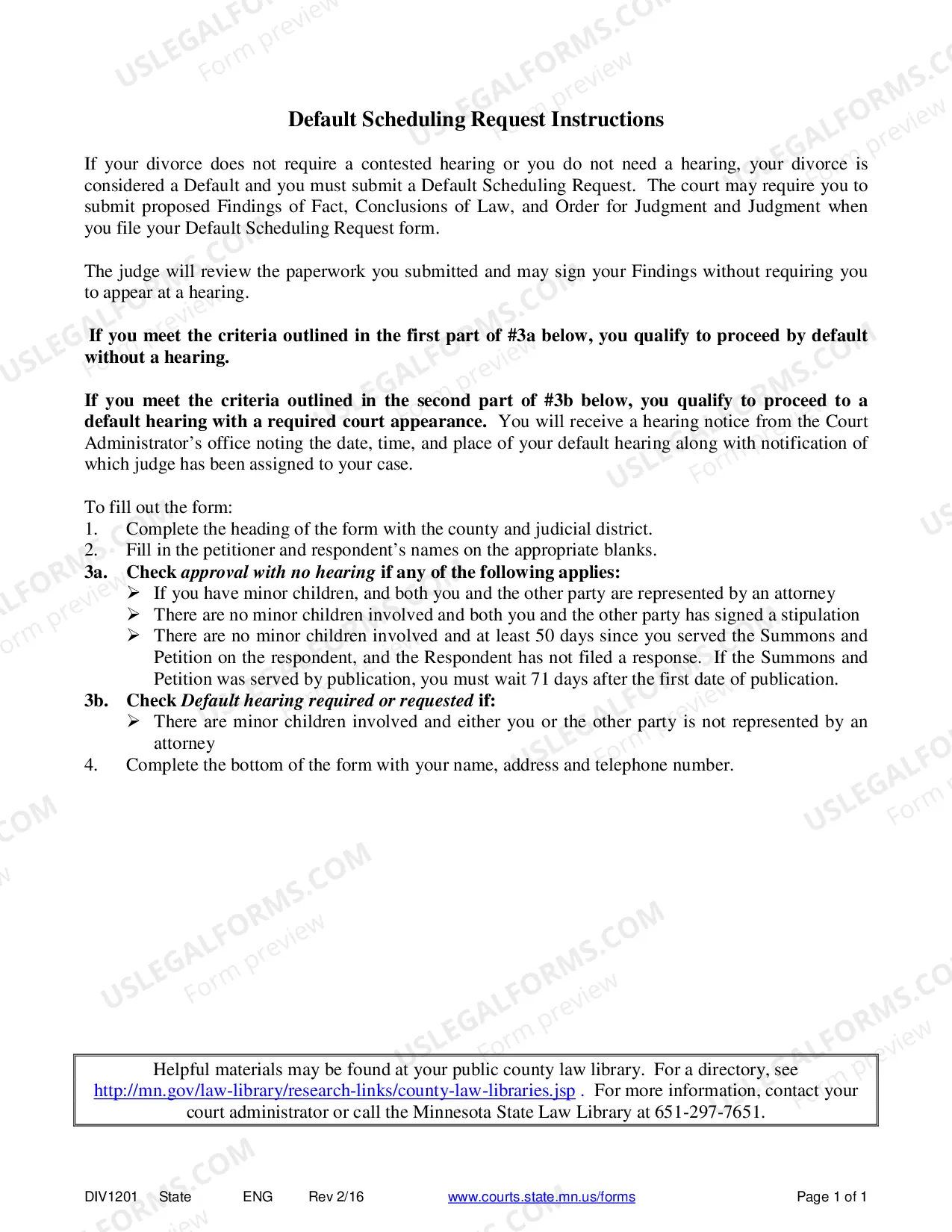
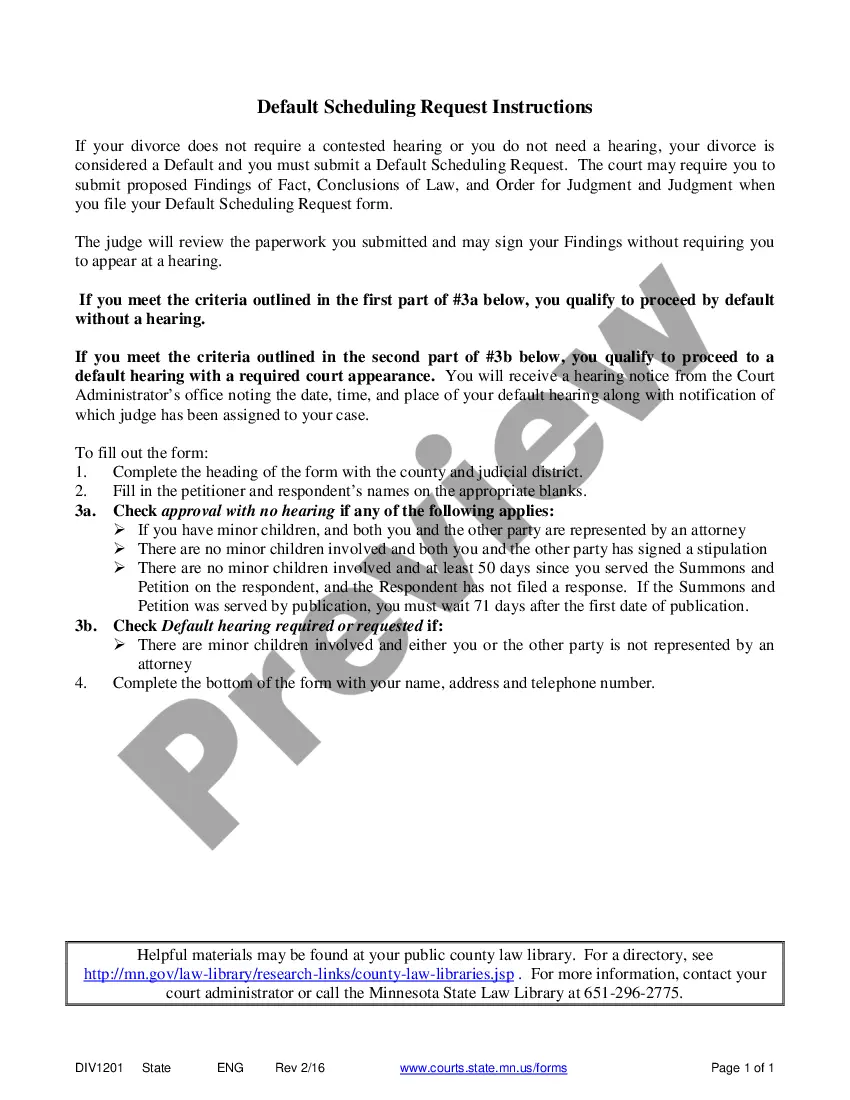
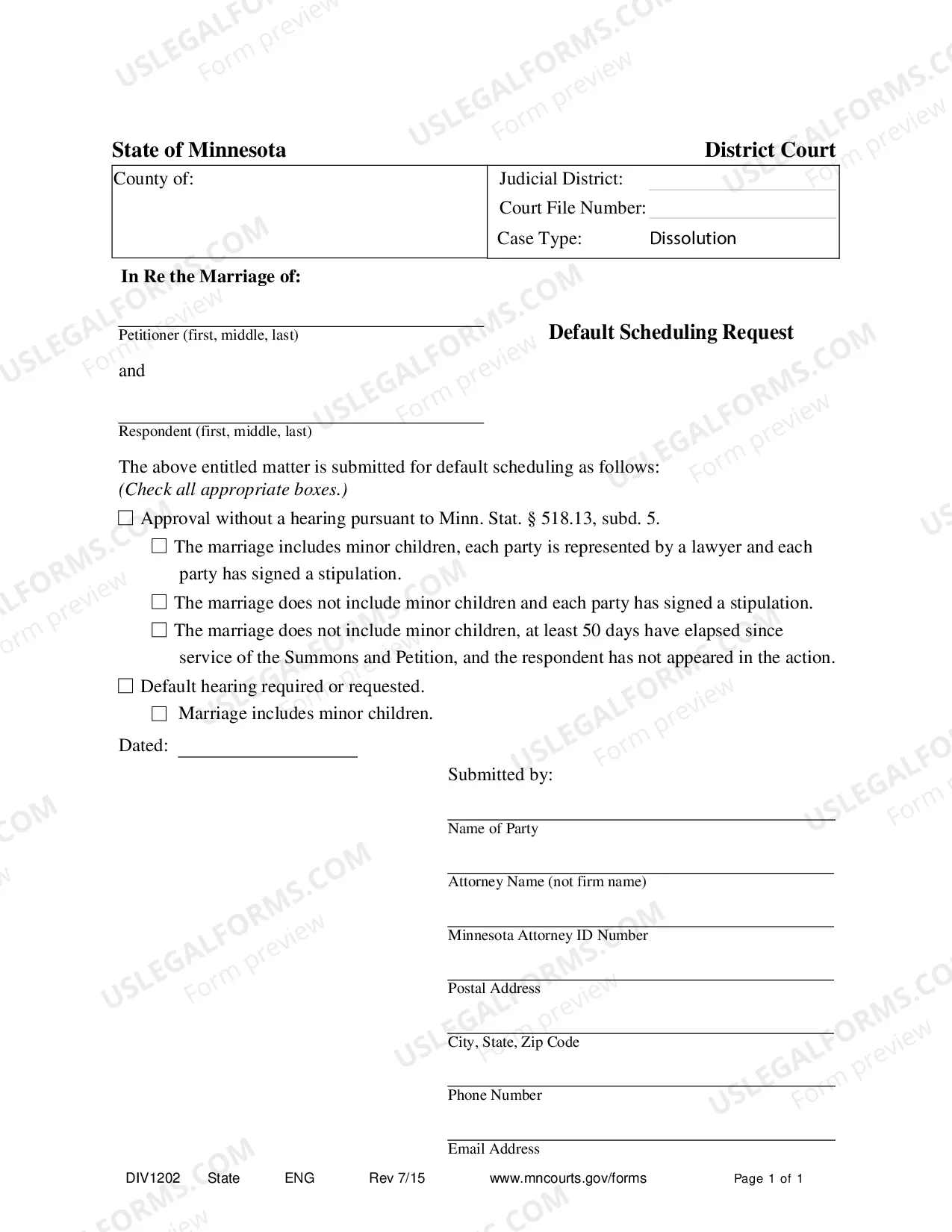
If your divorce does not require a contested hearing or you do not need a hearing, your divorce is considered a Default and you must submit a Default Scheduling Request.
Rule 306 attempts to make clear the role of notice required to be given to parties who are in default but who have "appeared" in some way in marriage dissolution proceedings.