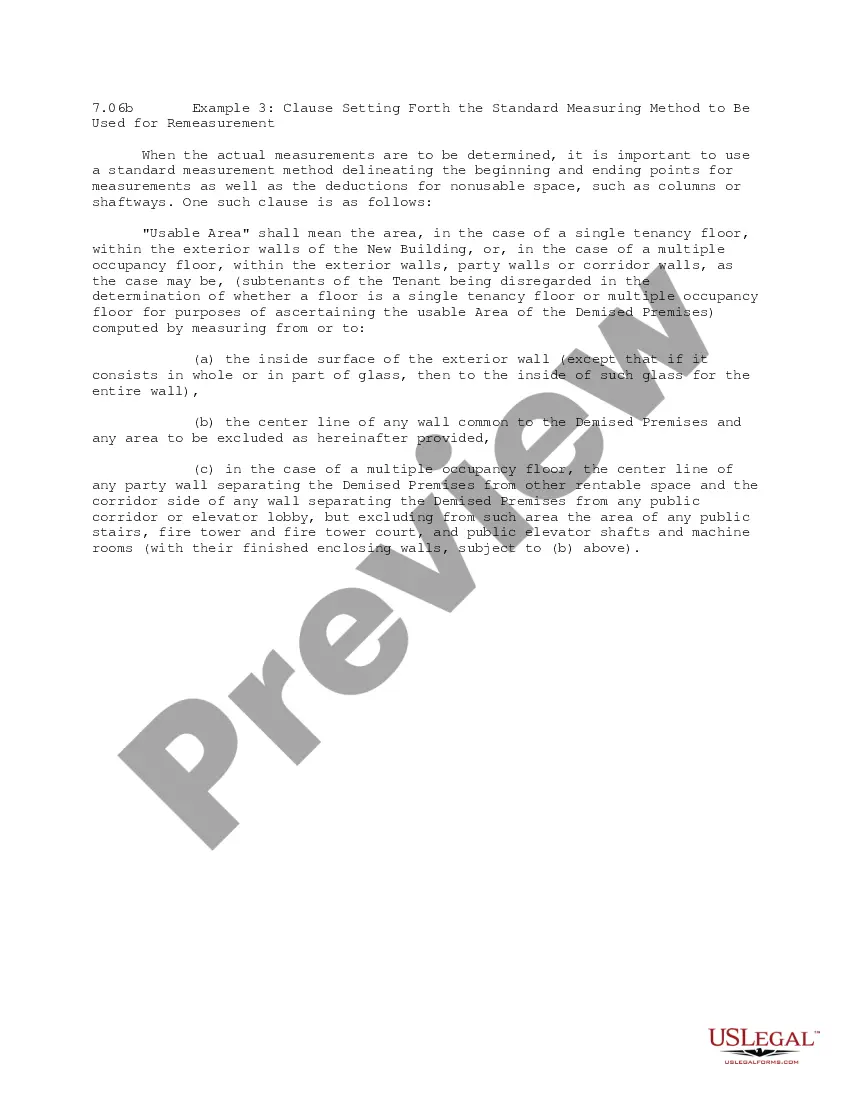
Clause Setting Forth the Standard Measuring Method to Be Used for Remeasurement
Understanding this form
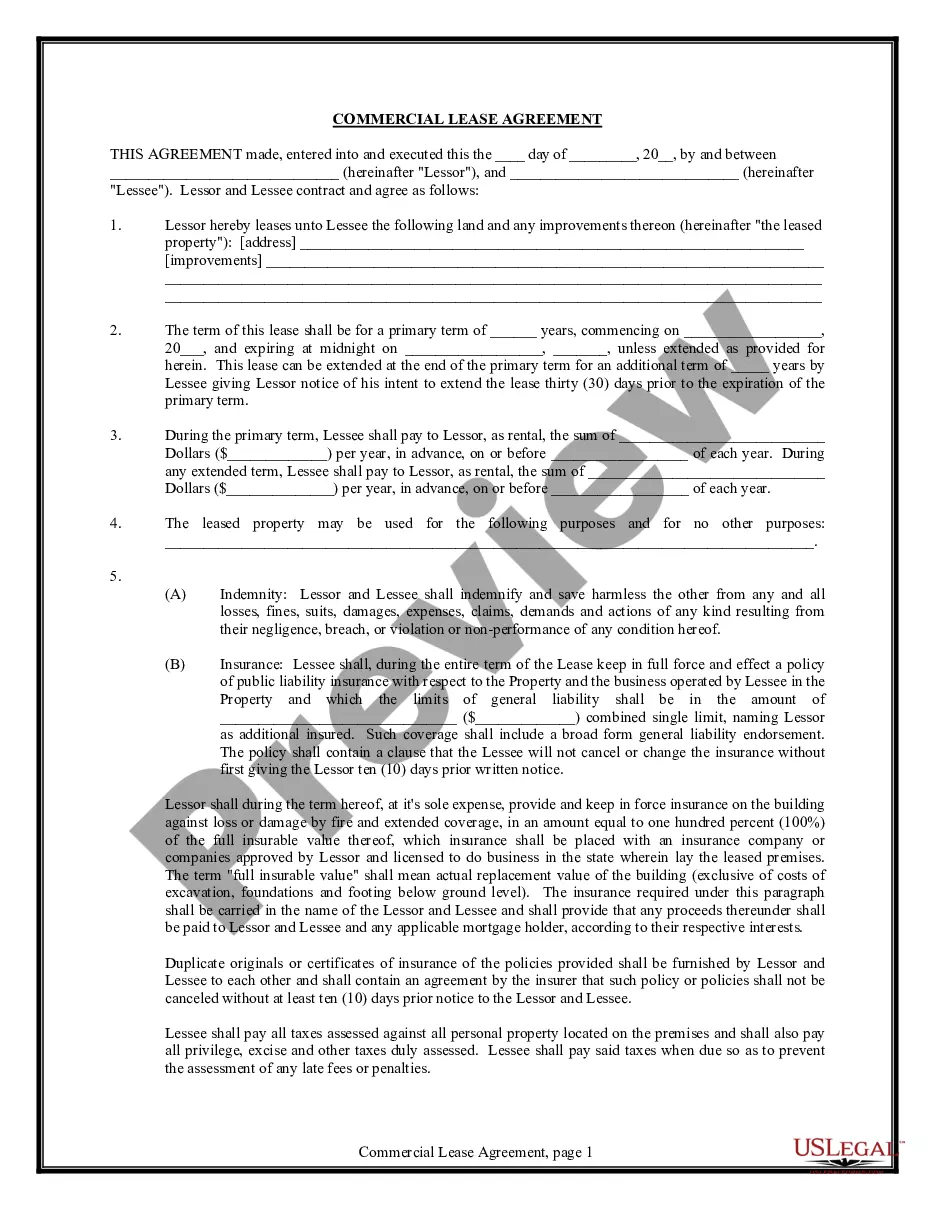
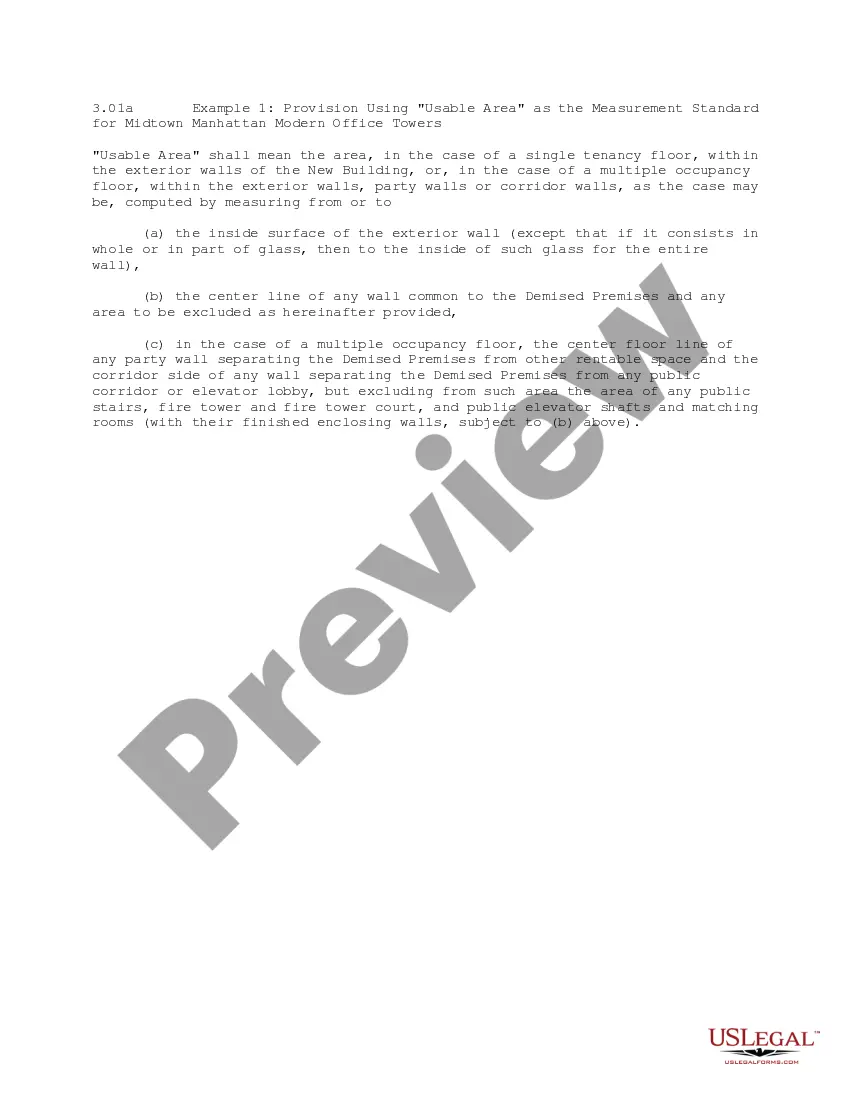
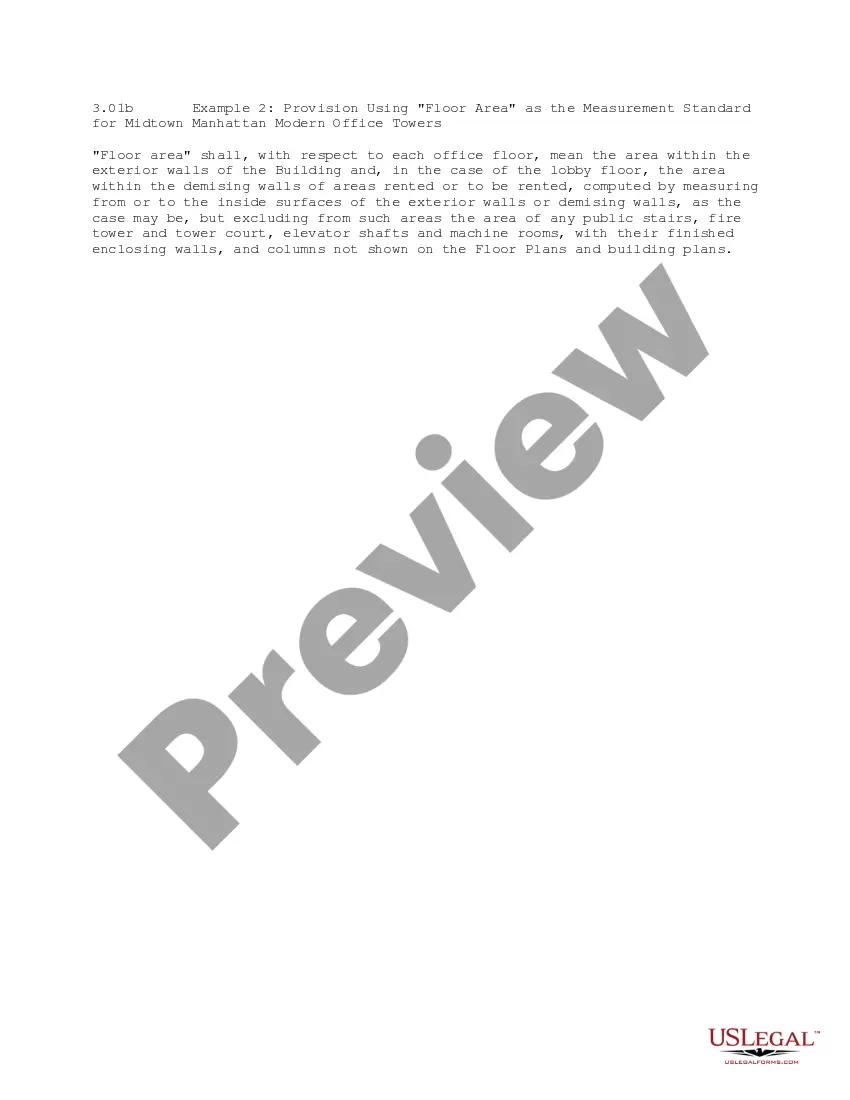
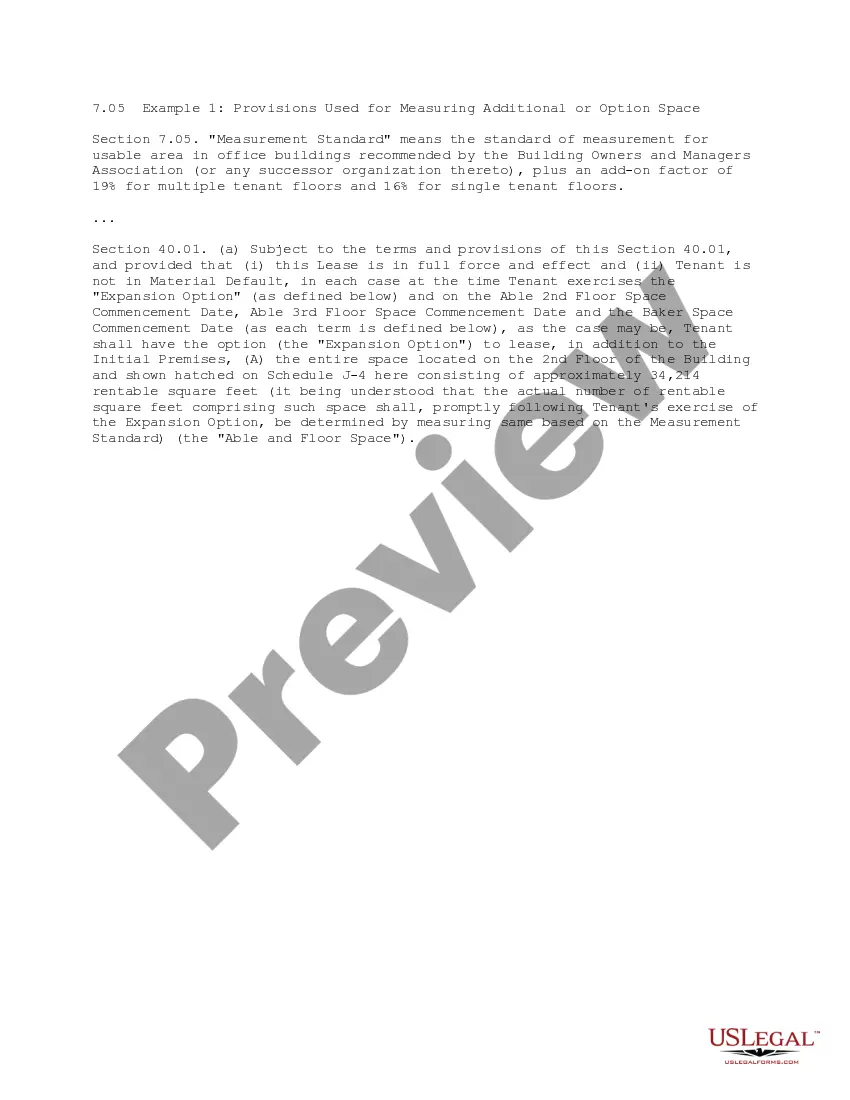
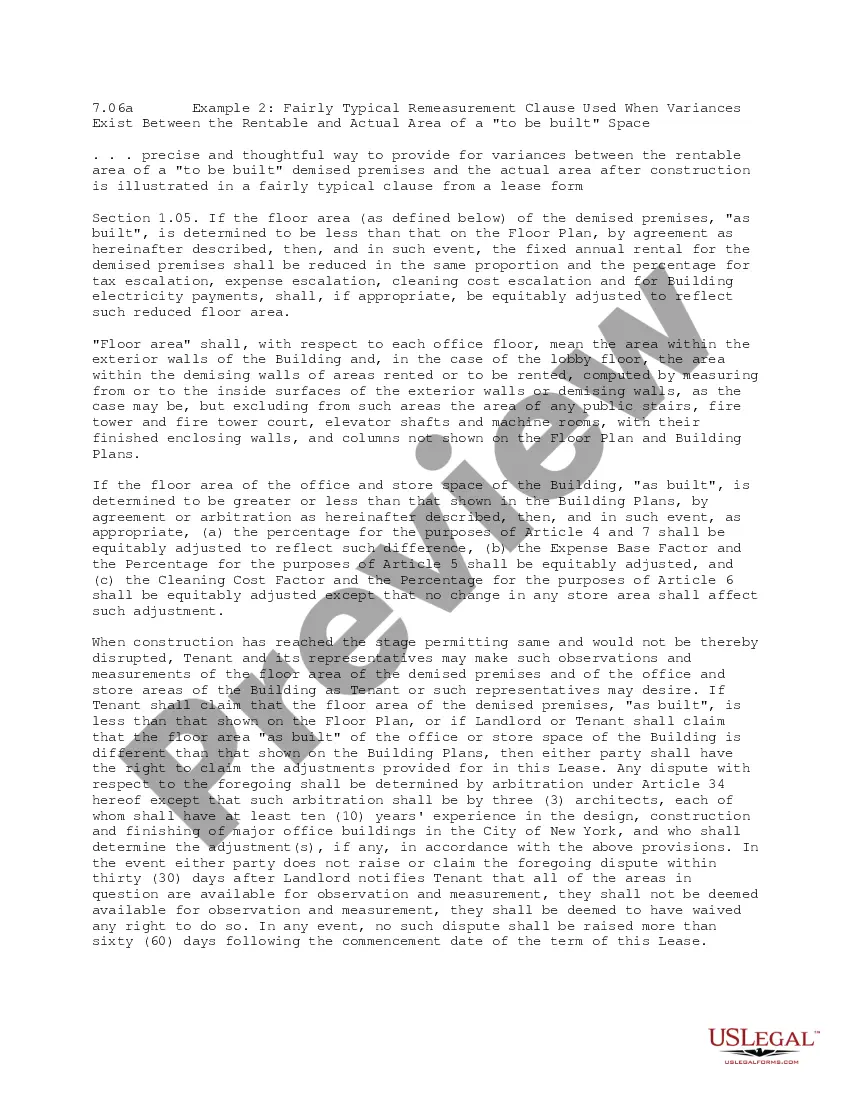
This form is a clause that sets forth the standard measuring method to be used for remeasurement in an office lease. It establishes clear guidelines for how measurements should be taken, ensuring consistency and accuracy. Unlike other lease forms, this specific clause focuses on the definition of usable area by specifying measurement points and deductions for nonusable space, which is crucial for both landlords and tenants to understand their obligations and rights regarding the leased property.
Key components of this form
- Definition of usable area within a single or multiple occupancy floor.
- Measurement points, such as the inside surface of exterior walls and center lines of common walls.
- Exclusions for nonusable spaces like columns, fire towers, and public elevator shafts.
- Clarification on the disregarding of subtenants in determining usable area.
Situations where this form applies
Who should use this form
The following parties should consider using this form:
- Landlords wishing to standardize measurement methods in their leases.
- Tenants concerned about the correctness of the leased space measurements.
- Property managers looking to clarify measurement processes for multiple occupants.
- Legal professionals assisting clients with lease agreements.
Completing this form step by step
- Identify the parties involved in the lease agreement.
- Define the leased property and its boundaries, including exterior walls.
- Determine the measurement points as specified in the form.
- Calculate the usable area, considering exclusions for nonusable space.
- Enter the finalized measurements into the lease document.
Notarization guidance
This form does not typically require notarization unless specified by local law. It is always advisable to check the specific requirements within your jurisdiction to ensure validity.
Get your form ready online
Our built-in tools help you complete, sign, share, and store your documents in one place.
Make edits, fill in missing information, and update formatting in US Legal Forms—just like you would in MS Word.
Download a copy, print it, send it by email, or mail it via USPS—whatever works best for your next step.
Sign and collect signatures with our SignNow integration. Send to multiple recipients, set reminders, and more. Go Premium to unlock E-Sign.
If this form requires notarization, complete it online through a secure video call—no need to meet a notary in person or wait for an appointment.
We protect your documents and personal data by following strict security and privacy standards.

Make edits, fill in missing information, and update formatting in US Legal Forms—just like you would in MS Word.

Download a copy, print it, send it by email, or mail it via USPS—whatever works best for your next step.

Sign and collect signatures with our SignNow integration. Send to multiple recipients, set reminders, and more. Go Premium to unlock E-Sign.

If this form requires notarization, complete it online through a secure video call—no need to meet a notary in person or wait for an appointment.

We protect your documents and personal data by following strict security and privacy standards.
Avoid these common issues
- Misidentifying measurement points, leading to incorrect usable area calculations.
- Failing to account for nonusable spaces that should be excluded from the total area.
- Not clearly defining whether the property is a single or multiple occupancy floor.
Benefits of completing this form online
- Convenient access to professionally drafted templates that save time.
- Editability to customize the measurements and clauses according to specific needs.
- Reliability due to providing clear standards for measurement that help avoid disputes.
Legal use & context
- Establishes clear measurement standards may prevent future legal disputes.
- Enhances transparency in lease agreements regarding usable space.
- Holds parties accountable to previously agreed-upon standards.
Looking for another form?

Form popularity
FAQ
Remeasurement is the process of re-establishing the value of an item or asset to provide a more accurate financial record of its value. Companies use remeasurement when translating the financial statements of a foreign subsidiary that's denominated in another currency.
Translation vs Remeasurement DifferencesTranslation is a process to convert the financial numbers of a subsidiary into the functional currency of the parent company. Remeasurement, on the other hand, is the process to convert financial results in another currency into the company's functional currency.
ASC 830 (aka FAS 52) provides the accounting and reporting requirements for foreign currency transactions and the translation of financial statements from a foreign currency to the reporting currency.
Foreign currency translation, or simply currency translation is an accounting method by which an international company translates the results of its foreign subsidiaries in its reporting currency.Convert the financial statements of the foreign subsidiary into the parent company's functional currency.
The foreign currency translation adjustment or the cumulative translation adjustment (CTA) compiles all the fluctuations caused by varying exchange rate. Businesses with international operations must translate their transactions like the acquisition of assets or the purchase of services into their functional currency.
Remeasurement is the process of re-establishing the value of an item or asset to provide a more accurate financial record of its value. Companies use remeasurement when translating the financial statements of a foreign subsidiary that's denominated in another currency.
Determine the functional currency of the foreign entity. Remeasure the financial statements of the foreign entity into the functional currency. Record gains and losses on the translation of currencies. Current rate Method. Temporal Rate Method.
Translate all foreign currency items into Canadian dollars. Record the rate of exchange on the date the transaction occurred. Record the gains and losses of the translation between currencies.