Utah Revised Uniform Anatomical Gift Act Donation
About this form
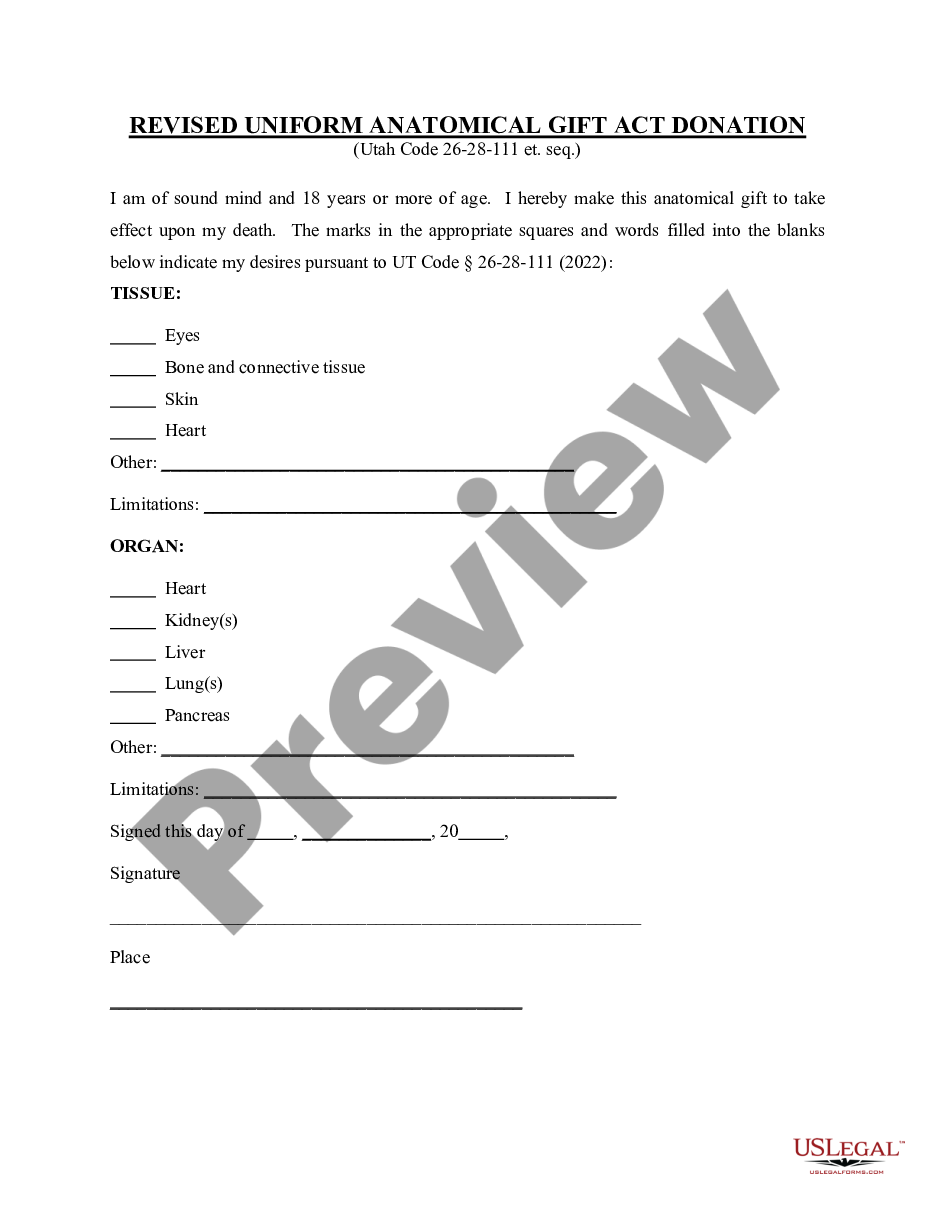
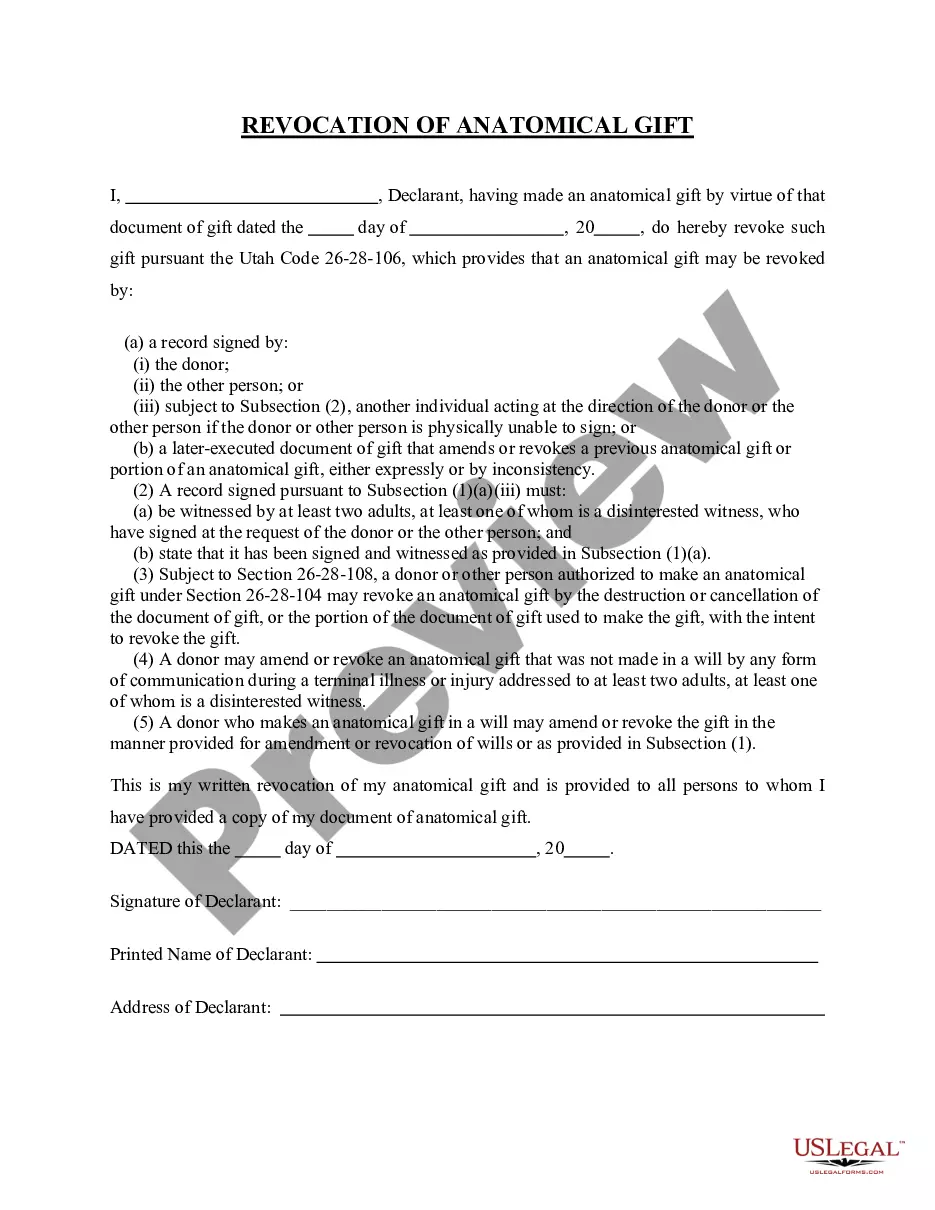
The Revised Uniform Anatomical Gift Act Donation form allows individuals to legally designate specific body parts and organs they wish to donate upon their death. This form is important for ensuring that your donation wishes are documented and respected, setting it apart from general wills and different types of advance directives. By using this anatomical gift form, you can contribute to transplant medicine, research, and education in a meaningful way.
Main sections of this form
- Donor's declaration of intent to make an anatomical gift.
- Specification of the body parts or organs to be donated.
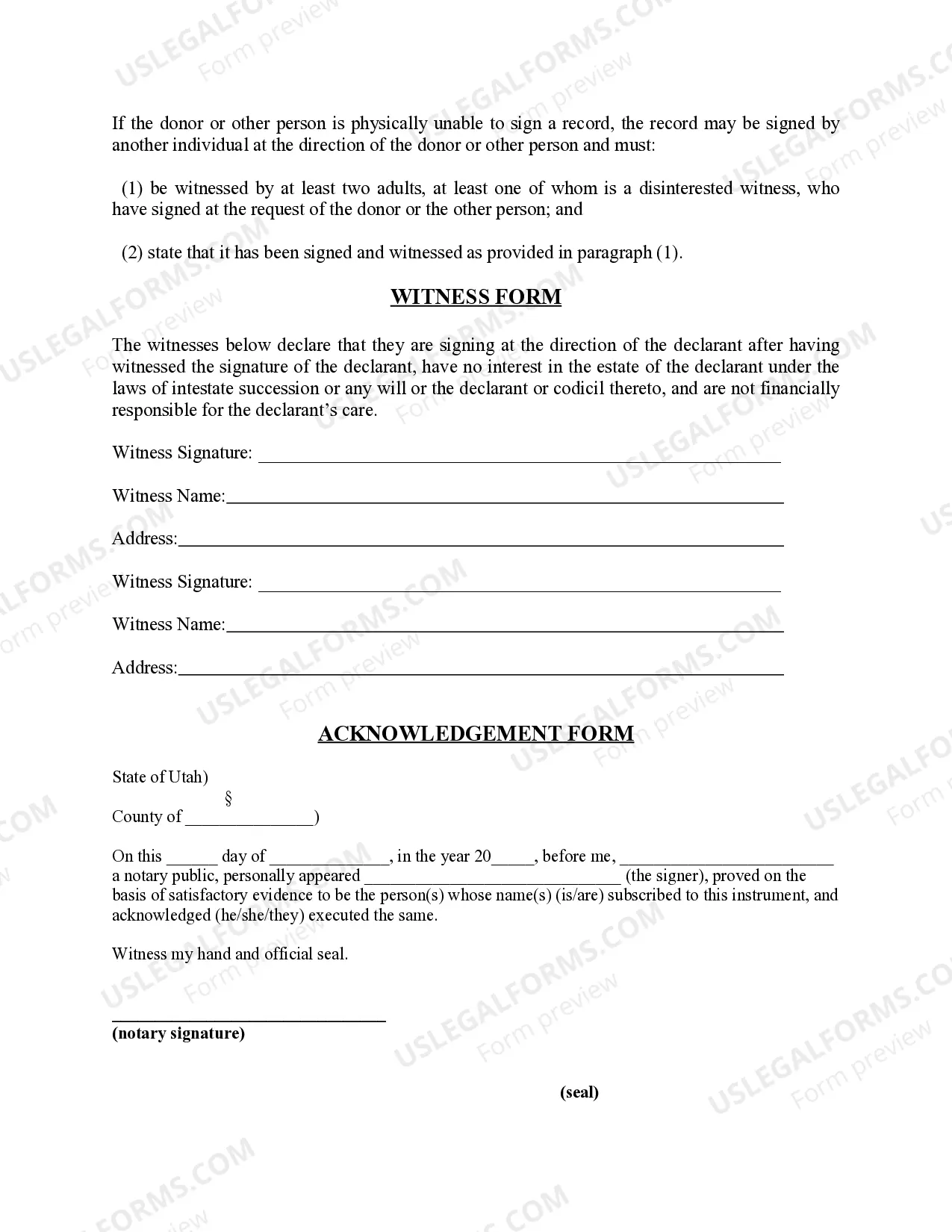
- Requirement for witnessing and notarization of the form.
- Provisions for signing by another individual if the donor is unable.
When to use this form
You should use the Revised Uniform Anatomical Gift Act Donation form if you wish to clearly express your desire to donate organs or tissues after your death. It is particularly relevant if you have thought about how your contributions to medical science can benefit others. Consider this form especially when approaching end-of-life discussions with your family or health care providers or when updating your estate plan.
Who can use this document
Individuals who are 18 years of age or older and of sound mind may use this form. Specifically, it is suitable for:
- Persons wishing to specify their organ and tissue donation preferences.
- Individuals who want to ensure their wishes regarding anatomical gifts are recognized.
- Those involved in planning their estate or advance health care directives.
Completing this form step by step
- Confirm your eligibility: Ensure you are at least 18 years old and of sound mind.
- Fill out the donation specifics: Indicate which body parts or organs you wish to donate.
- Sign the form: Ensure your signature is completed where indicated.
- Arrange for witnessing: Have at least two adults witness your signing.
- Notarize the form: Find a notary public to notarize the document.
Is notarization required?
In most cases, this form does not require notarization. However, some jurisdictions or signing circumstances might. US Legal Forms offers online notarization powered by Notarize, accessible 24/7 for a quick, remote process.
Get your form ready online
Our built-in tools help you complete, sign, share, and store your documents in one place.
Make edits, fill in missing information, and update formatting in US Legal Forms—just like you would in MS Word.
Download a copy, print it, send it by email, or mail it via USPS—whatever works best for your next step.
Sign and collect signatures with our SignNow integration. Send to multiple recipients, set reminders, and more. Go Premium to unlock E-Sign.
If this form requires notarization, complete it online through a secure video call—no need to meet a notary in person or wait for an appointment.
We protect your documents and personal data by following strict security and privacy standards.

Make edits, fill in missing information, and update formatting in US Legal Forms—just like you would in MS Word.

Download a copy, print it, send it by email, or mail it via USPS—whatever works best for your next step.

Sign and collect signatures with our SignNow integration. Send to multiple recipients, set reminders, and more. Go Premium to unlock E-Sign.

If this form requires notarization, complete it online through a secure video call—no need to meet a notary in person or wait for an appointment.

We protect your documents and personal data by following strict security and privacy standards.
Mistakes to watch out for
- Failing to have the form properly witnessed and notarized.
- Leaving the donation specifics section blank or incomplete.
- Not confirming eligibility before signing, such as being under 18.
Advantages of online completion
- Convenience: Easily complete and store your anatomical gift form digitally.
- Editability: Make changes to your preferences simply and quickly.
- Reliability: Access legally drafted templates reviewed by licensed attorneys.
Key takeaways
- The form allows individuals to specify their wishes for organ donation upon death.
- It requires the signatures of the donor, witnesses, and notarization to be valid.
- Using this form can facilitate a clear process for your loved ones in the event of your passing.
Looking for another form?


Form popularity
FAQ
What Happens to Your Remains Afterwards? With organ and tissue donations, everything is typically removed immediately upon death and your body is returned to your family all at no cost so they can proceed with a timely funeral. Likewise, body donation is also free of charge.
To donate your whole body, contact your preferred university or hospital. They can answer questions about coordinating organ and tissue donation and whole body donation. Contact the Association of Medical Schools of New York at info@amsny.org or 212-218-4610 for more information on whole body donation.
Any person wishing to donate their body can make prior arrangements with the local medical college, hospital, or an NGO, before death. Individuals may request a consent form from a medical institution or an NGO, who will then give information about policies and procedures followed after the potential donor is deceased.
The potential donor has an infectious or contagious disease (such as HIV/AIDS, hepatitis B or hepatitis C, or prion diseases). The next of kin objects to the donation of the body. The body is not acceptable for anatomical study (extremely emaciated or extremely obese).