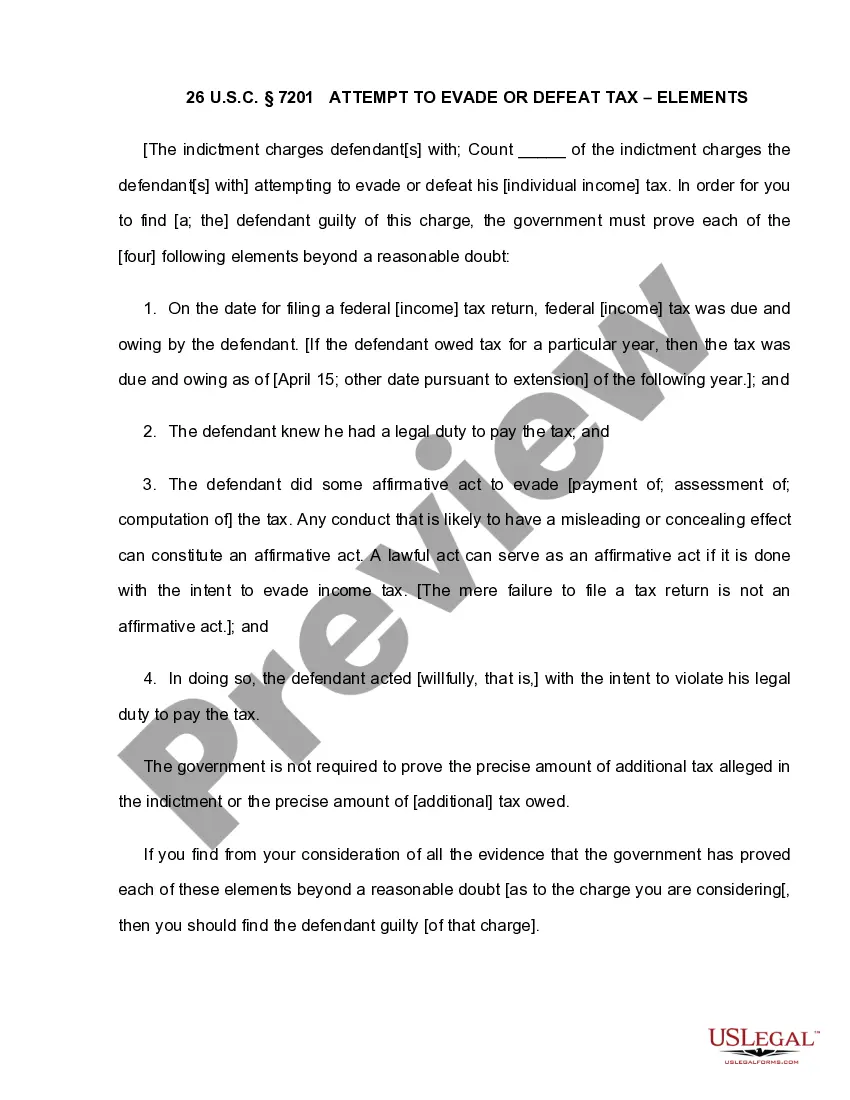
Minnesota Letter to Pension Plan Administrator regarding Division of Plan Proceeds per Court Order
Understanding this form
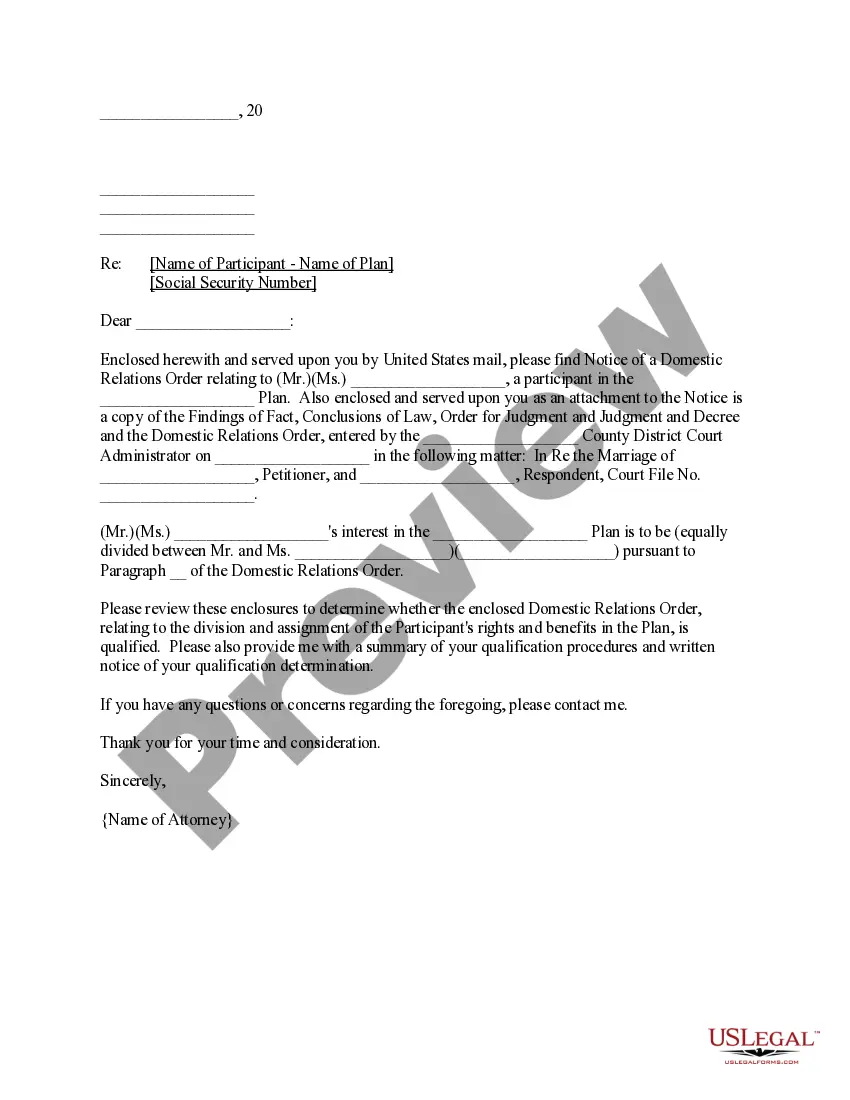
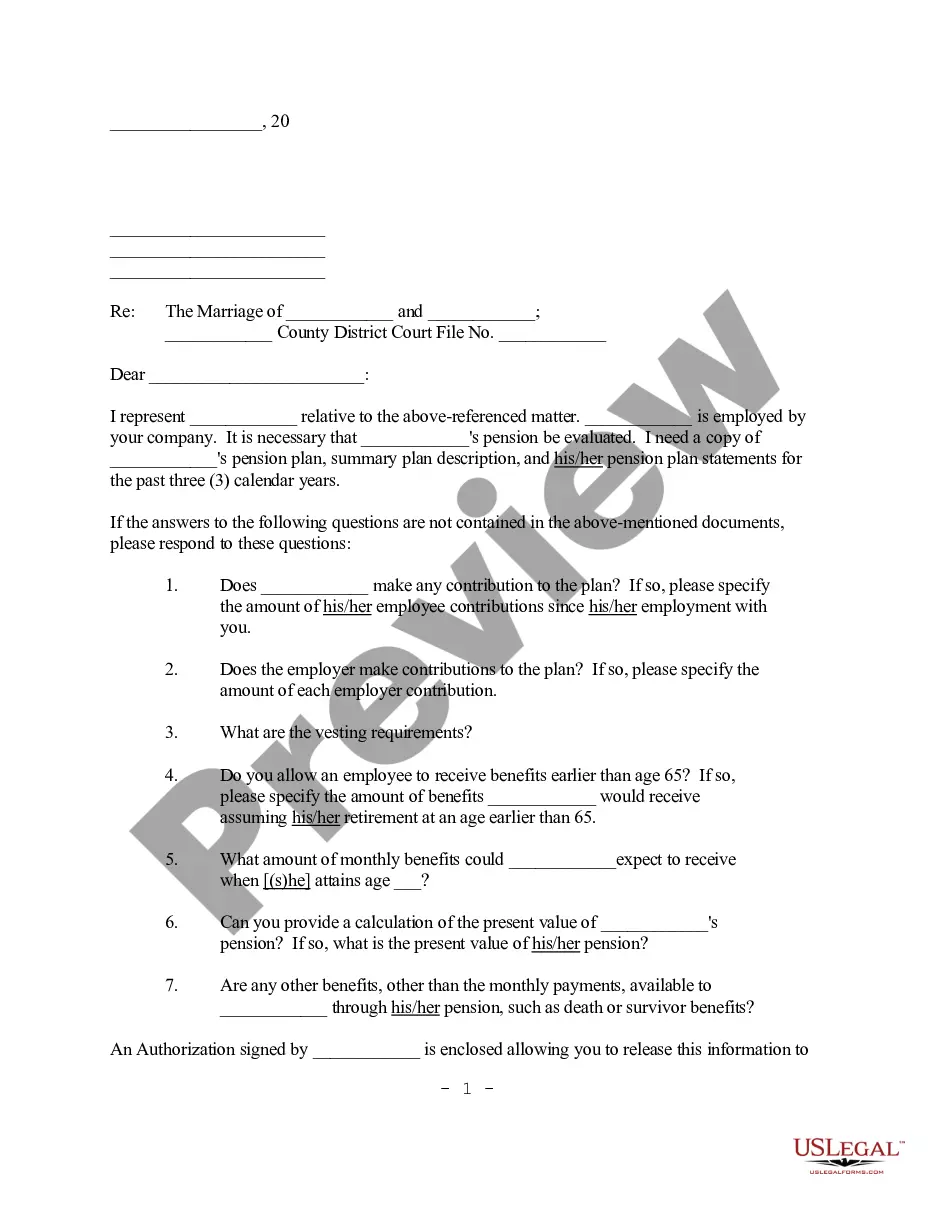
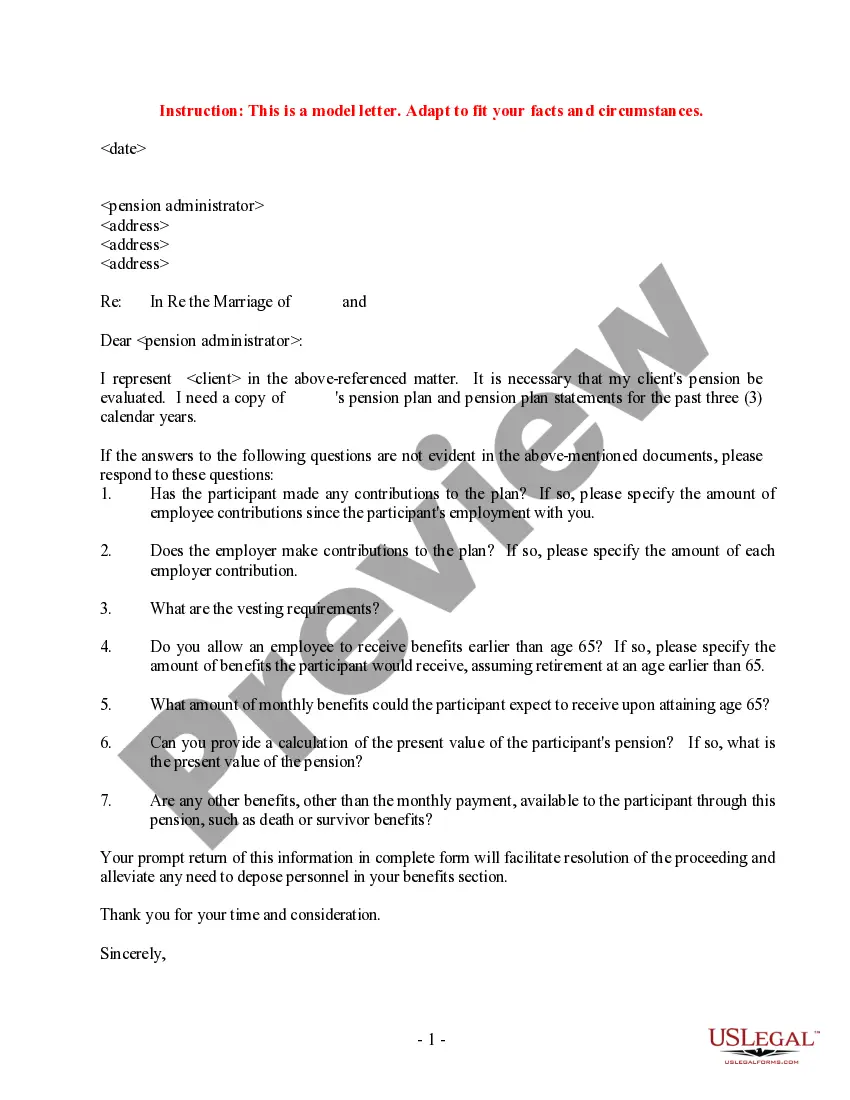
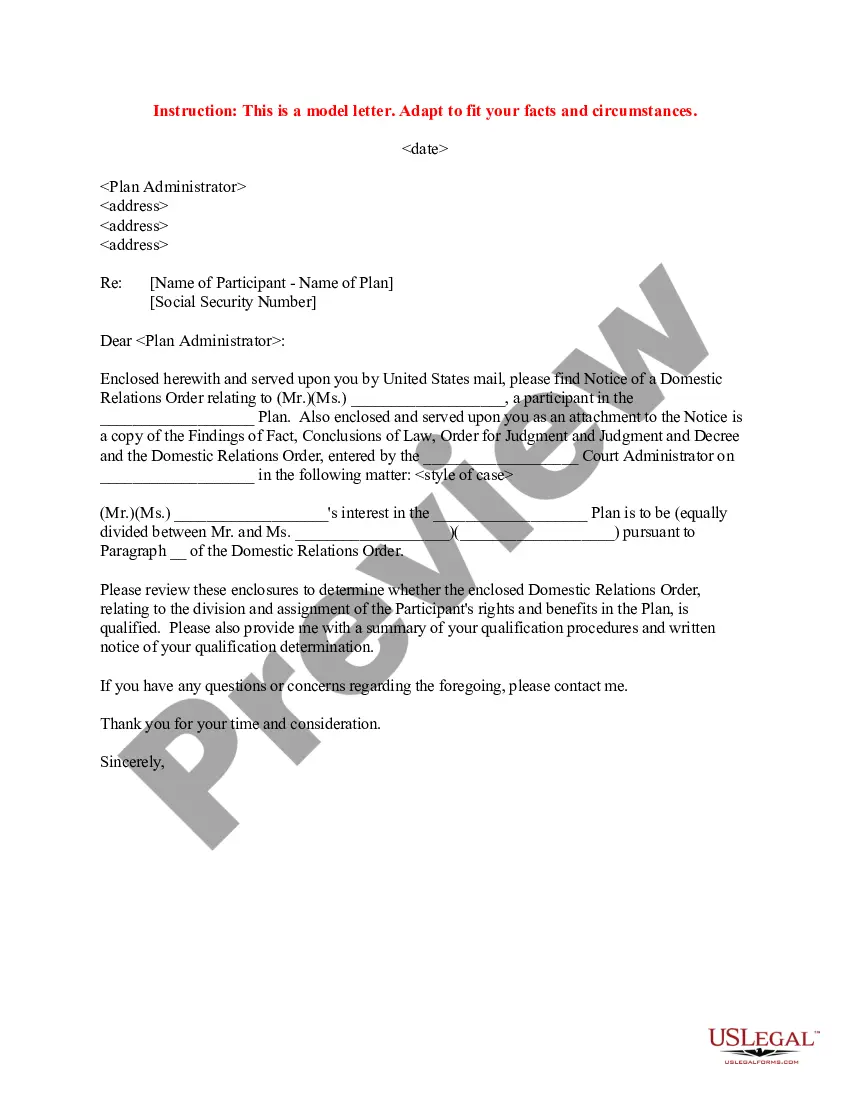
This form is a Letter to Pension Plan Administrator regarding Division of Plan Proceeds per Court Order. It is an attorney's letter that formally requests the division of pension plan proceeds according to a court order related to the dissolution of marriage. This form specifically addresses the needs of divorcing couples concerning retirement benefits, helping ensure compliance with legal mandates for equitable distribution of assets.
Key components of this form
- Heading: Identifies the document as an official communication regarding the pension plan.
- Recipient Information: Section to fill in the name and details of the pension plan administrator.
- Parties Involved: Space to identify the names of both spouses referenced in the divorce.
- Plan Information: Area to specify which pension plan is under review.
- Details of the Court Order: Section to outline the court order's specifics, including case references and dates.
- Request for Qualification Procedures: A prompt asking the administrator to provide a summary of their qualification procedures.
When this form is needed
This form should be used when a divorce has finalized and a domestic relations order has been issued concerning the division of pension plan proceeds. It is crucial for ensuring that both parties receive their entitled benefits as mandated by the court during divorce proceedings. Use this letter when you need to formally communicate with the pension fund administrator about executing the court's directives.
Who can use this document
- Attorneys representing clients in divorce proceedings.
- Divorcing individuals who wish to ensure fair division of retirement benefits.
- Pension plan administrators who are responding to court orders related to asset division.
Steps to complete this form
- Identify the parties involved by entering their names in the designated sections.
- Specify the name of the pension plan in question.
- Fill in the details of the court order, including case number and dates.
- Outline how the plan proceeds will be divided, referencing the domestic relations order.
- Provide your contact information for any follow-up questions from the plan administrator.
Does this form need to be notarized?
Notarization is generally not required for this form. However, certain states or situations might demand it. You can complete notarization online through US Legal Forms, powered by Notarize, using a verified video call available anytime.
Get your form ready online
Our built-in tools help you complete, sign, share, and store your documents in one place.
Make edits, fill in missing information, and update formatting in US Legal Forms—just like you would in MS Word.
Download a copy, print it, send it by email, or mail it via USPS—whatever works best for your next step.
Sign and collect signatures with our SignNow integration. Send to multiple recipients, set reminders, and more. Go Premium to unlock E-Sign.
If this form requires notarization, complete it online through a secure video call—no need to meet a notary in person or wait for an appointment.
We protect your documents and personal data by following strict security and privacy standards.

Make edits, fill in missing information, and update formatting in US Legal Forms—just like you would in MS Word.

Download a copy, print it, send it by email, or mail it via USPS—whatever works best for your next step.

Sign and collect signatures with our SignNow integration. Send to multiple recipients, set reminders, and more. Go Premium to unlock E-Sign.

If this form requires notarization, complete it online through a secure video call—no need to meet a notary in person or wait for an appointment.

We protect your documents and personal data by following strict security and privacy standards.
Mistakes to watch out for
- Failing to include necessary enclosures, such as the domestic relations order or court findings.
- Not specifying the pension plan accurately, which can lead to confusion.
- Omitting important case details like the court file number.
Why complete this form online
- Convenience: Download and complete the form from home at any time.
- Editability: Customize the form to fit your specific case with ease.
- Reliability: Utilize legally reviewed templates to ensure accuracy and compliance.
Looking for another form?
Form popularity
FAQ
A spouse or former spouse who receives QDRO benefits from a retirement plan reports the payments received as if he or she were a plan participant. The spouse or former spouse is allocated a share of the participant's cost (investment in the contract) equal to the cost times a fraction.
During divorce proceedings, both parties will identify the assets that need to be divided, including retirement plans. If you're awarded part of your former spouse's retirement account (either through a property settlement or via a judge), the court will issue a QDRO that may have been drafted by your divorce attorney.
Step 1 Gathering Information. Step 2 Drafting your QDRO. Step 3 Approval By the Other Party. Step 4 Approval by Plan as Draft. Step 5 Signature of QDRO by Judge of the State Divorce Court. Step 6 Obtain a Certified Copy of the QDRO.
It is critical to check with the plan administrator for each plan and QDRO, which is done by a QDRO preparer . Attorneys do not typically prepare QDROs, as they are prepared by actuaries and companies specializing in QDROs.
Who determines whether an order is a QDRO? Under Federal law, the administrator of the retirement plan that provides the benefits affected by an order is the individual (or entity) initially responsible for determining whether a domestic relations order is a QDRO.
Step 1 Gathering Information. Step 2 Drafting your QDRO. Step 3 Approval By the Other Party. Step 4 Approval by Plan as Draft. Step 5 Signature of QDRO by Judge of the State Divorce Court. Step 6 Obtain a Certified Copy of the QDRO.
The answer to this question depends on what type of retirement plan is being divided. If it is a defined contribution plan (a 401(k), 457, 403(b) or similar plan), or an IRA, the funds are typically transferred into an account in the alternate payee's name within two to five weeks.