Minnesota Objection To Referee Rehearing Case
What is this form?
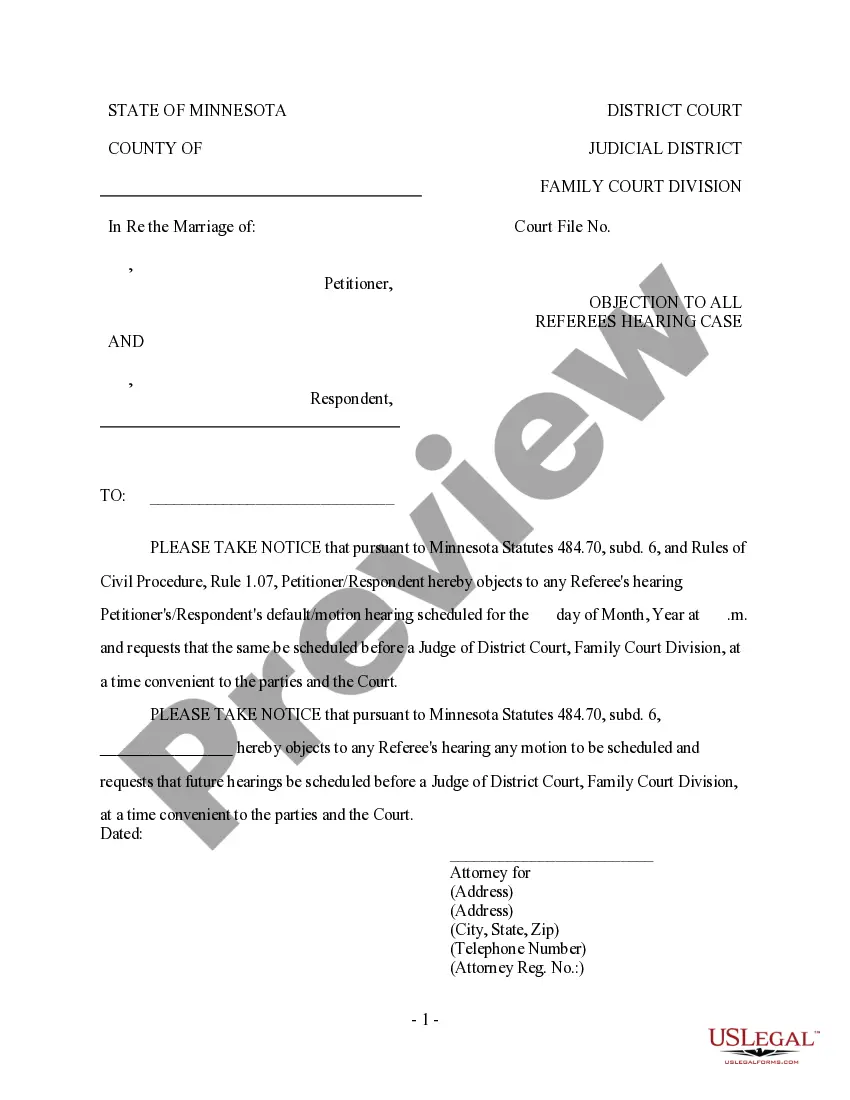
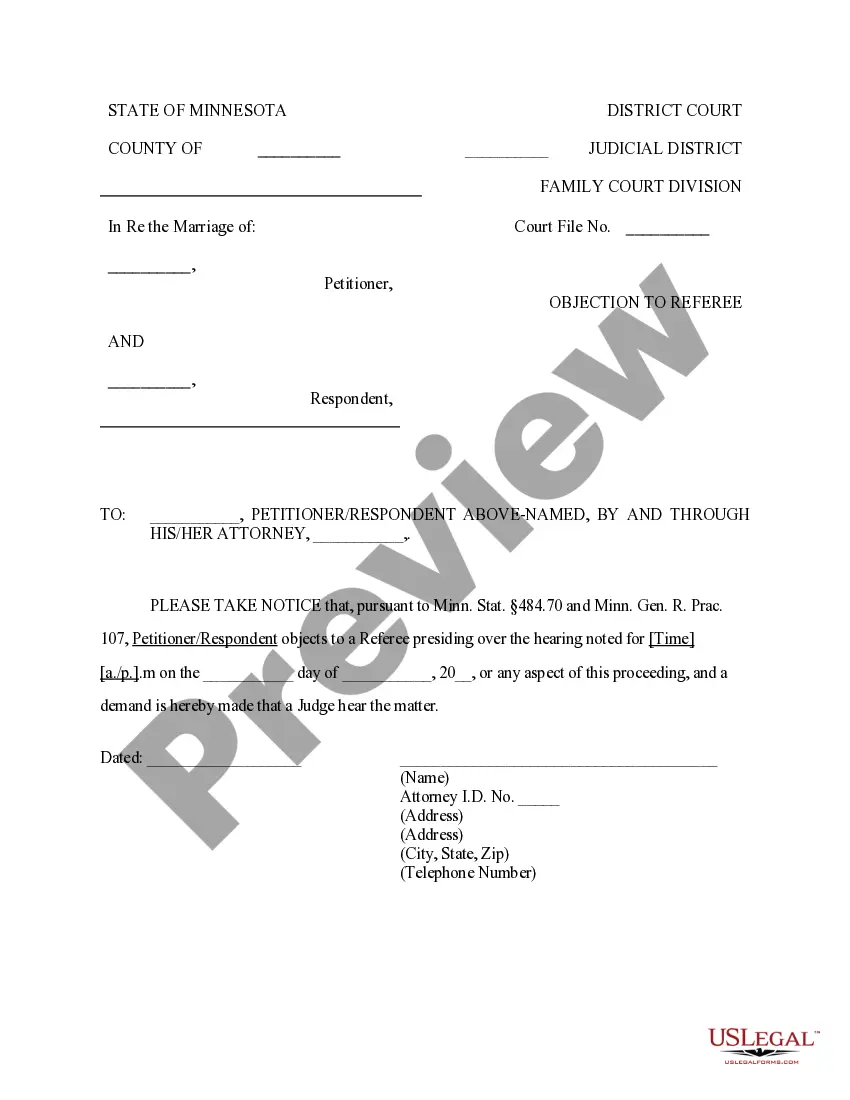
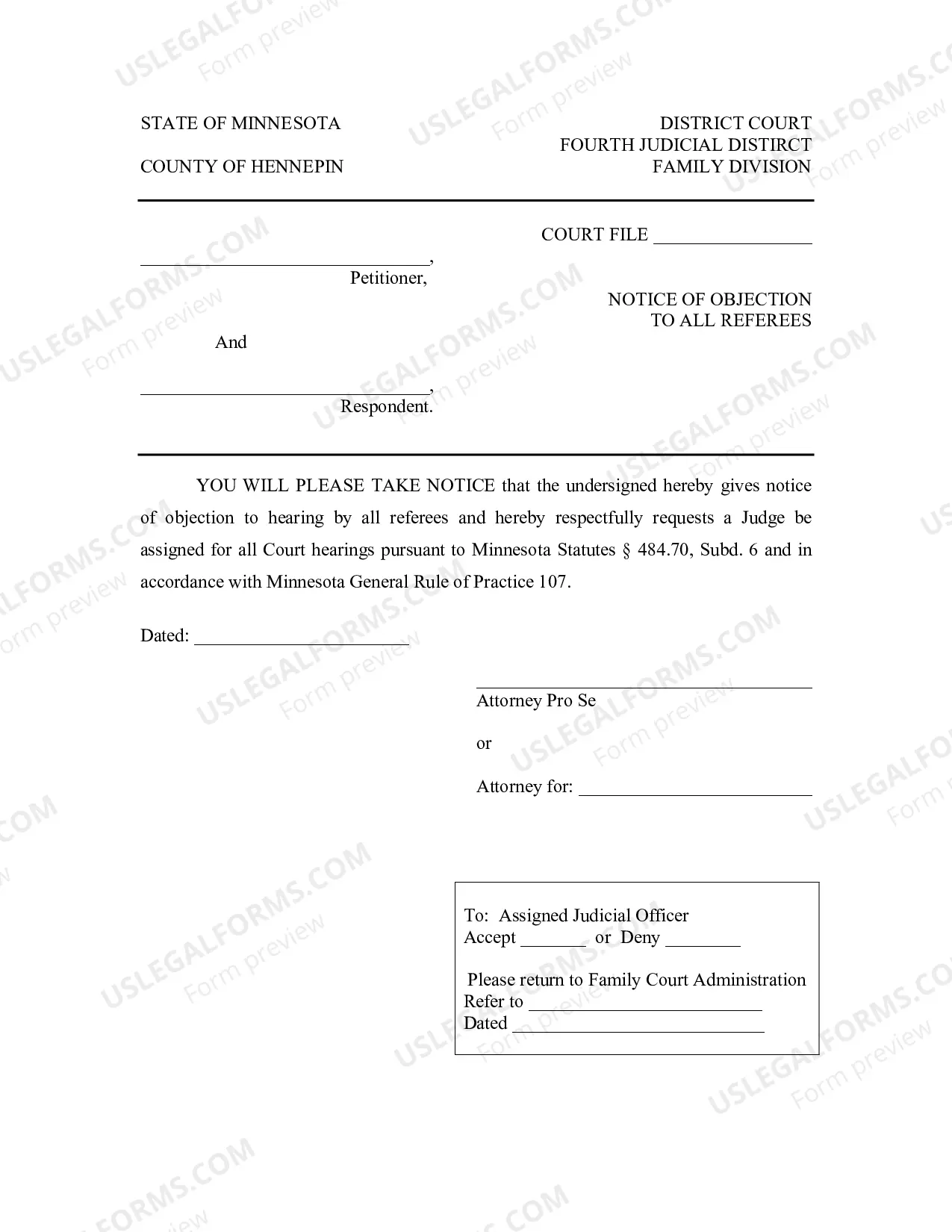
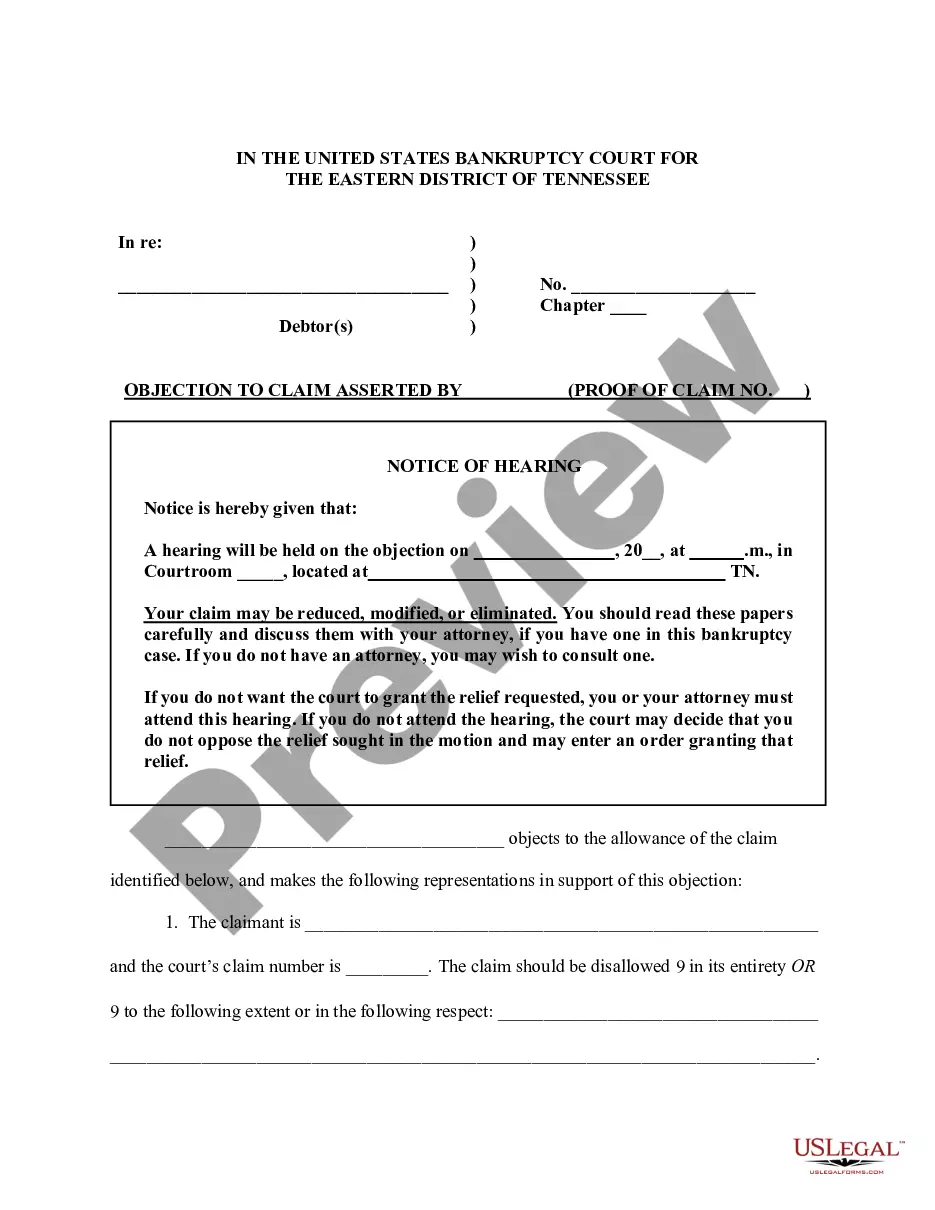
The Objection to Referee Rehearing Case form is a legal document used to formally object to the hearings conducted by court-appointed referees in dissolution of marriage proceedings. Unlike other legal forms, this specific document demands that the case be reviewed by a judge in the District Court's Family Court Division, ensuring that the matter is heard by an official with authority to make critical decisions in the case.
Key parts of this document
- Notification of the objection to the referee's scheduled hearing.
- Details of the date and time for the hearing in question.
- Request for scheduling the matter before a judge instead of a referee.
- Contact information and attorney registration details of the petitioner/respondent.
When to use this form
This form should be used when a party involved in a divorce proceeding wishes to contest decisions made by a court-appointed referee. It is appropriate to file this objection when a hearing has been scheduled, and the objecting party believes that the matter should be addressed by a judge instead. This could occur in situations where the party feels their case will be better resolved in front of a judge due to the complexities involved.
Who this form is for
- Individuals undergoing a dissolution of marriage proceeding in which referees are appointed.
- Parties who wish to contest or challenge a scheduled hearing conducted by a referee.
- Attorneys representing clients in divorce cases who need to file an objection.
Steps to complete this form
- Enter the names of the petitioner and respondent at the top of the form.
- Specify the date and time of the referee's hearing that is being contested.
- Clearly state the objection to the referee's authority concerning the hearing.
- Provide your attorney's contact information, including address and phone number.
- Sign and date the form to finalize your objection.
Notarization guidance
This form does not typically require notarization unless specified by local law. It is advisable to check with local court rules to ensure compliance with current requirements.
Get your form ready online
Our built-in tools help you complete, sign, share, and store your documents in one place.
Make edits, fill in missing information, and update formatting in US Legal Forms—just like you would in MS Word.
Download a copy, print it, send it by email, or mail it via USPS—whatever works best for your next step.
Sign and collect signatures with our SignNow integration. Send to multiple recipients, set reminders, and more. Go Premium to unlock E-Sign.
If this form requires notarization, complete it online through a secure video call—no need to meet a notary in person or wait for an appointment.
We protect your documents and personal data by following strict security and privacy standards.

Make edits, fill in missing information, and update formatting in US Legal Forms—just like you would in MS Word.

Download a copy, print it, send it by email, or mail it via USPS—whatever works best for your next step.

Sign and collect signatures with our SignNow integration. Send to multiple recipients, set reminders, and more. Go Premium to unlock E-Sign.

If this form requires notarization, complete it online through a secure video call—no need to meet a notary in person or wait for an appointment.

We protect your documents and personal data by following strict security and privacy standards.
Common mistakes
- Failing to include the correct date and time of the scheduled hearing.
- Not providing complete contact information for the attorney or party involved.
- Omitting the signature or date on the form, making it invalid.
- Not clearly stating the reasons for the objection to the referee's authority.
Benefits of completing this form online
- Convenience of downloading and completing the form at your own pace.
- Editability allows you to customize the document based on your specific needs.
- Access to professionally drafted legal language to ensure compliance and accuracy.
Legal use & context
- This form must be submitted in accordance with Minnesota court rules regarding objections in family law cases.
- Failure to submit this objection correctly could result in a waiver of the right to contest the referee's authority.
- Ensure that all relevant statutory references are followed for the form to be valid.
Key takeaways
- The Objection to Referee Rehearing Case is a critical tool for parties dissatisfied with a referee's involvement.
- Understanding when and how to use this form can significantly impact the outcome of your case.
- Always verify state-specific rules to ensure compliance and validity of your objection.
Looking for another form?
Form popularity
FAQ
Rule 69 in Minnesota refers to the enforcement of judgments and the collection of debts through legal means. It provides clear guidelines for both creditors and debtors on how to proceed after a judgment has been made. For individuals facing a Minnesota Objection To Referee Rehearing Case, understanding Rule 69 is essential for navigating the legal landscape and ensuring compliance with enforcement procedures.
Rule 33 of the Minnesota Rules of Civil Procedure pertains to interrogatories, which are a set of written questions one party can send to another during litigation. This rule allows for the discovery of information that can be vital in cases, including a Minnesota Objection To Referee Rehearing Case. By utilizing Rule 33 effectively, parties can gather crucial evidence and clarify positions, contributing to a more efficient resolution.
The rule of civil procedure 69 in Minnesota governs the enforcement of judgments. It includes procedures for executing judgments and addressing objections, which is essential for individuals navigating a Minnesota Objection To Referee Rehearing Case. By following this rule, parties can ensure they are complying with legal requirements and properly addressing any disputes that arise during enforcement.
Rule 69 is a provision in the Minnesota Rules of Civil Procedure that outlines the process for obtaining a judgment. It specifically deals with the enforcement of judgments and the methods available to collect debts. Understanding Rule 69 is crucial for anyone involved in a Minnesota Objection To Referee Rehearing Case, as it dictates how creditors can pursue collections and what obligations debtors have.
Statute 484.70 in Minnesota addresses the powers and duties of referees in legal proceedings. This statute plays a vital role in shaping the framework for a Minnesota Objection To Referee Rehearing Case. Understanding these regulations can help parties challenge or support referee decisions effectively. To ensure compliance and accuracy, explore the helpful resources available on the US Legal Forms platform.
A motion to reconsider in Minnesota allows a party to request a review of a court's previous decision. This motion is particularly relevant in a Minnesota Objection To Referee Rehearing Case, as it can lead to a reevaluation of the referee's findings. Filing this motion requires strong justification and a clear argument for why the decision should be revisited. Utilize the tools and templates from US Legal Forms to simplify the process.
Rule 611 in Minnesota governs the examination of witnesses and the presentation of evidence in court. This rule is crucial in a Minnesota Objection To Referee Rehearing Case, as it dictates how parties can challenge testimony and introduce new evidence. Understanding this rule can greatly enhance your case strategy. For comprehensive guidance, check the resources provided by US Legal Forms.
Rule of Practice 521 in Minnesota outlines the procedures for filing an Objection To Referee Rehearing Case. This rule serves to ensure that parties have a clear understanding of how to present their objections regarding referee decisions. By following these guidelines, individuals can effectively navigate the legal process and promote fair hearings. For assistance with this process, consider using the resources available on the US Legal Forms platform.