Minnesota Order to Amend Judgment and Decree - to Correct Clerical Errors
About this form
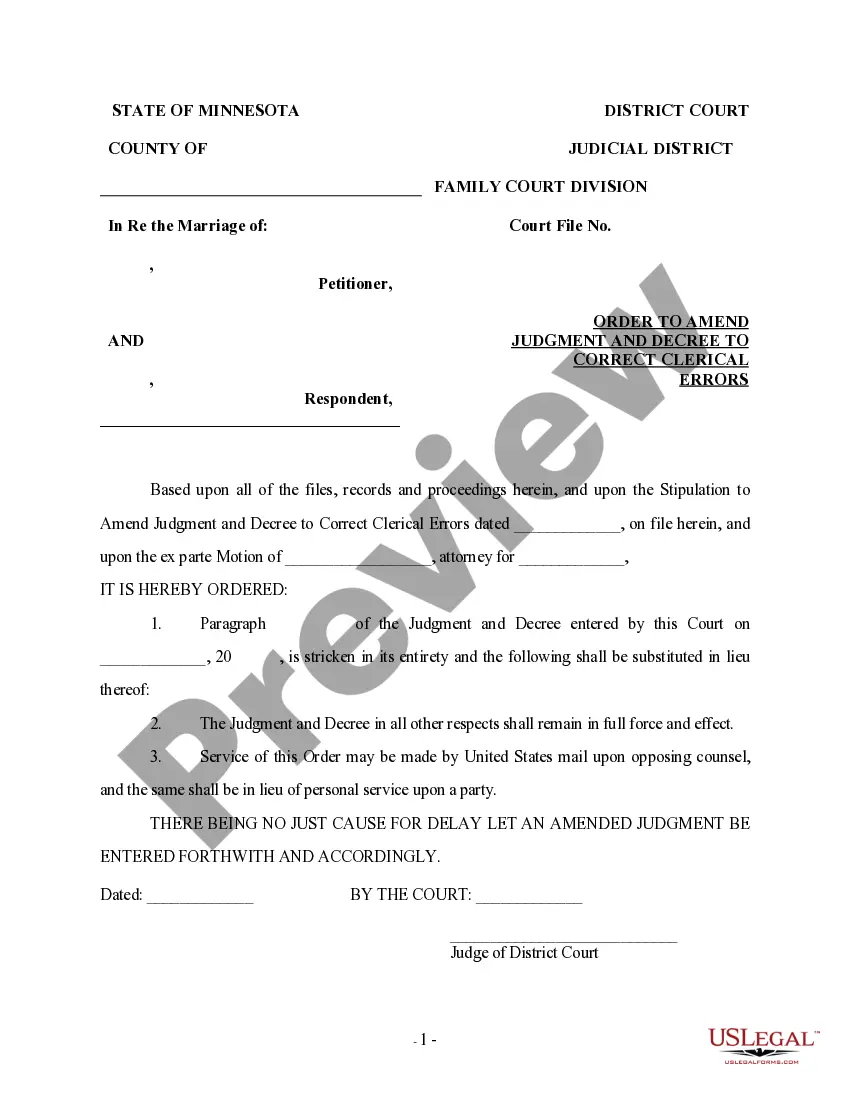
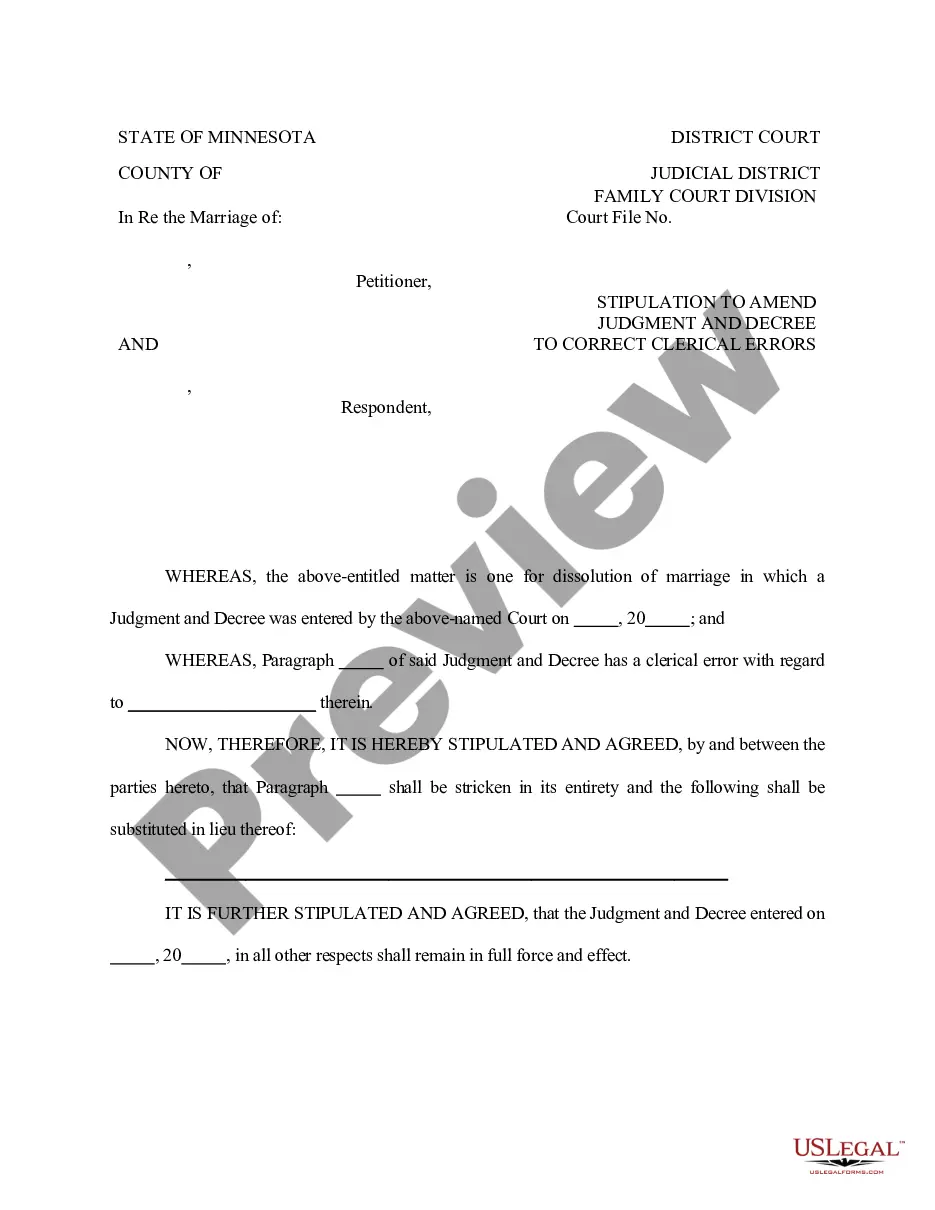
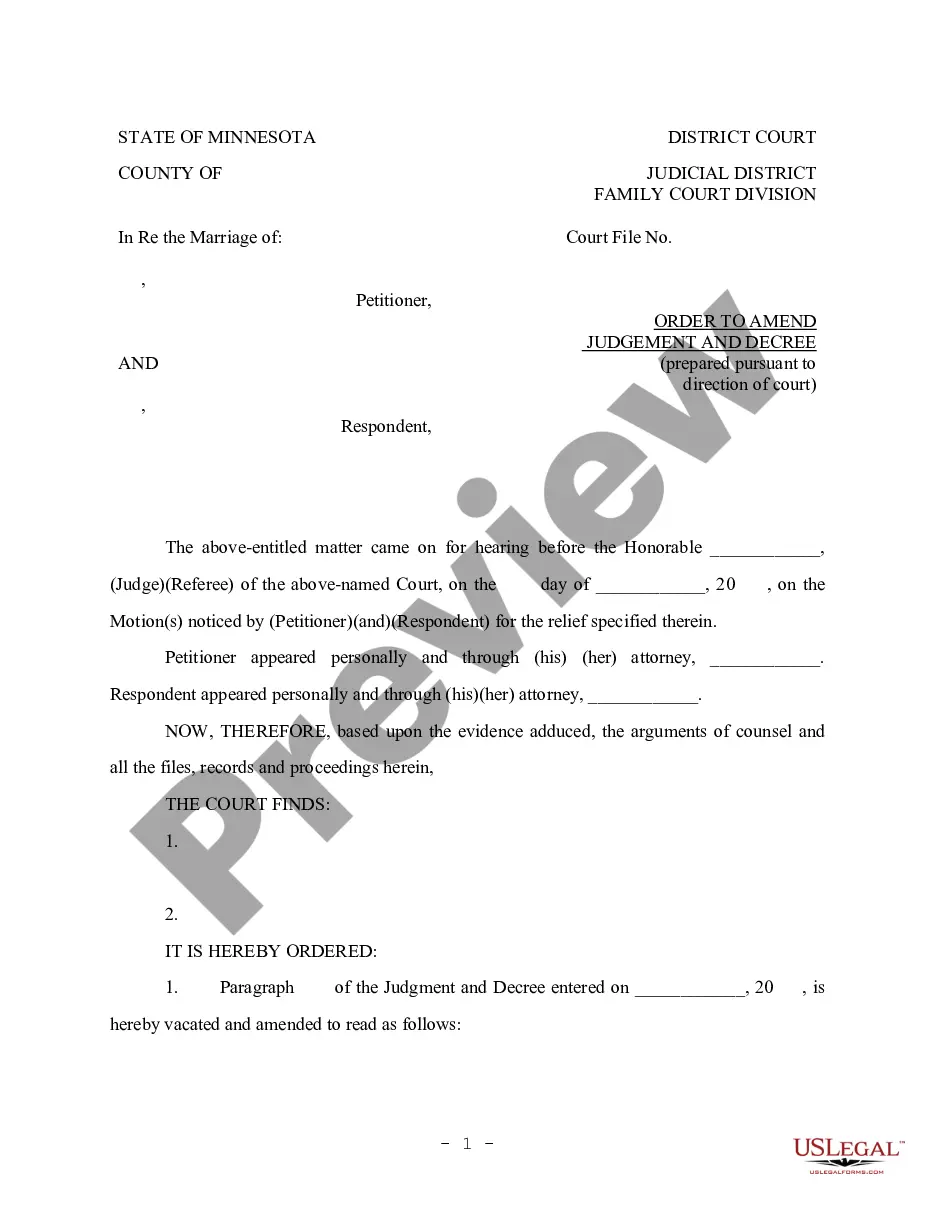
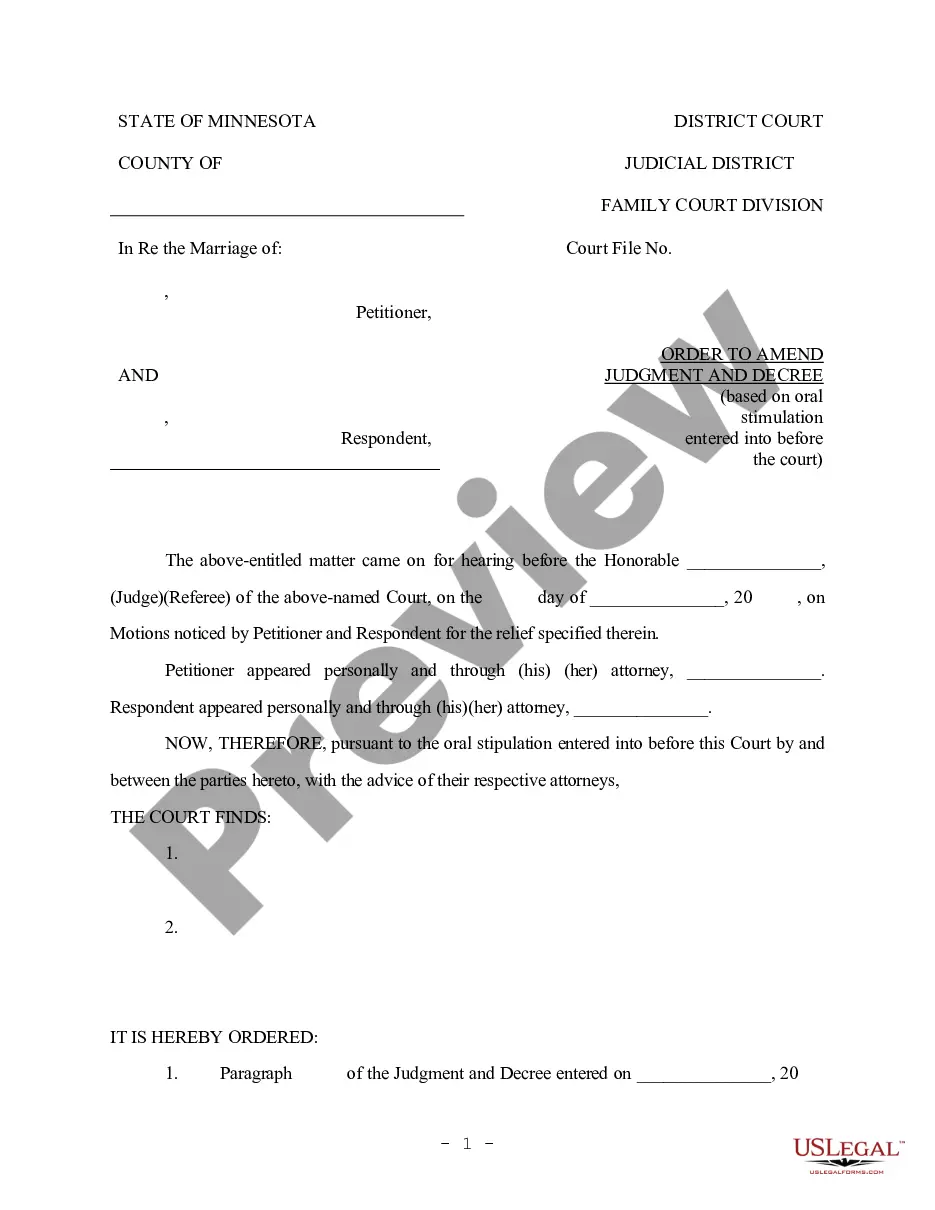
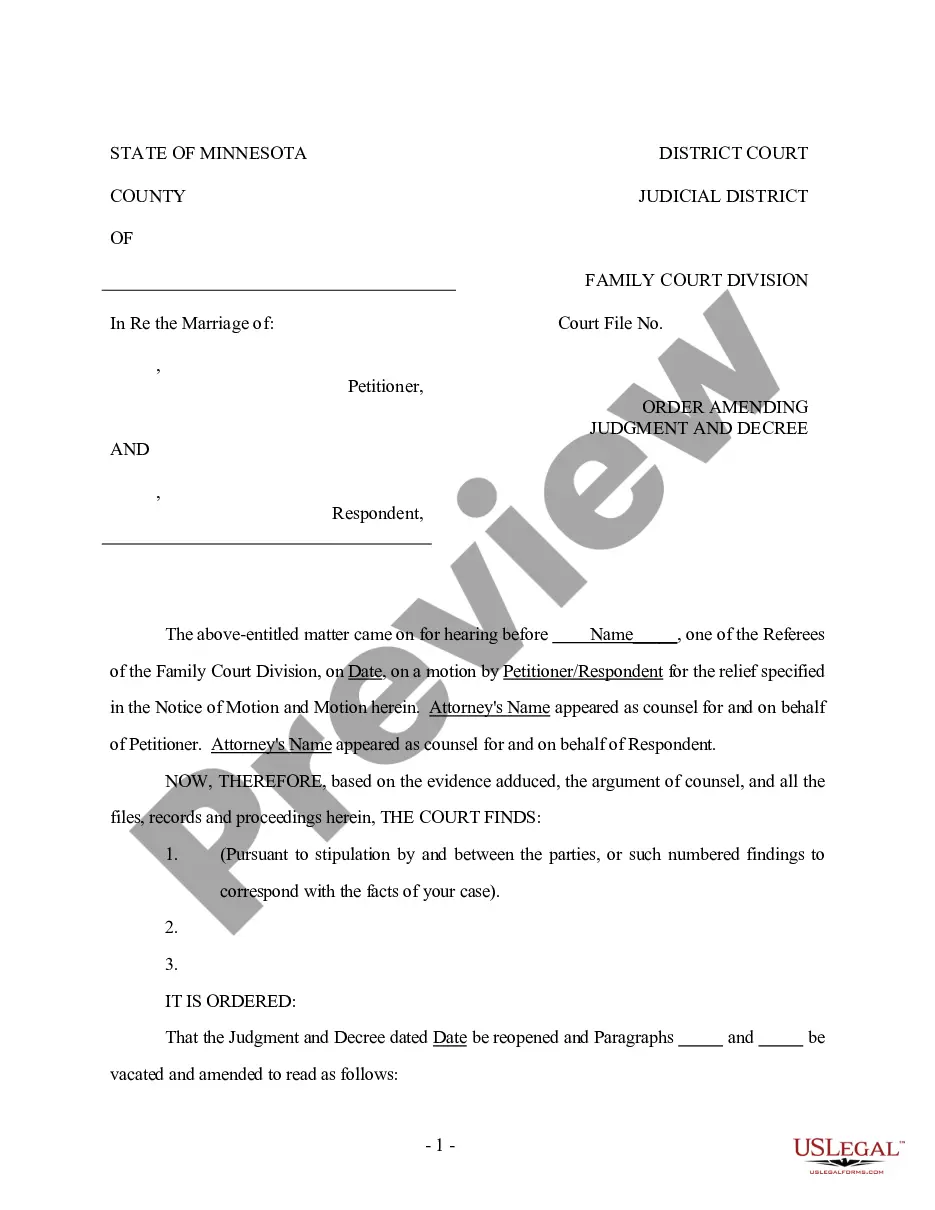
This form is an Order to Amend Judgment and Decree to Correct Clerical Errors. Its purpose is to rectify mistakes in a court judgment by specifying which paragraphs should be removed and what should replace them. This form is essential for ensuring that court records accurately reflect the intended rulings, setting it apart from other judgment forms which may not specifically address clerical errors.
Key components of this form
- Identification of the incorrect paragraphs that need to be stricken.
- Providing the new language to replace the incorrect paragraphs.
- Sections for court date and judge's signature.
- Instructions for service of the order to opposing counsel.
When to use this document
This form should be used when a clerical error has been identified in a court judgment or decree. Common scenarios include typographical errors, misnumbered paragraphs, or other inaccuracies that do not reflect the court's original decision. Timely filing of this form is crucial to correct such mistakes and maintain accurate court records.
Intended users of this form
- Individuals involved in a court case who notice clerical errors in a judgment.
- Attorneys representing clients needing to amend court documents.
- Parties seeking to ensure that legal documents accurately represent the court's decisions.
How to prepare this document
- Read the original judgment to identify the specific clerical errors.
- Fill in the paragraphs that need correction, specifying the incorrect text to be stricken.
- Provide the correct paragraphs that should replace the erroneous ones.
- Include the date for prompt issuance of the amended judgment.
- Sign the document in the designated area for the judge's approval.
Does this document require notarization?
This form does not typically require notarization to be legally valid. However, some jurisdictions or document types may still require it. US Legal Forms provides secure online notarization powered by Notarize, available 24/7 for added convenience.
Get your form ready online
Our built-in tools help you complete, sign, share, and store your documents in one place.
Make edits, fill in missing information, and update formatting in US Legal Forms—just like you would in MS Word.
Download a copy, print it, send it by email, or mail it via USPS—whatever works best for your next step.
Sign and collect signatures with our SignNow integration. Send to multiple recipients, set reminders, and more. Go Premium to unlock E-Sign.
If this form requires notarization, complete it online through a secure video call—no need to meet a notary in person or wait for an appointment.
We protect your documents and personal data by following strict security and privacy standards.

Make edits, fill in missing information, and update formatting in US Legal Forms—just like you would in MS Word.

Download a copy, print it, send it by email, or mail it via USPS—whatever works best for your next step.

Sign and collect signatures with our SignNow integration. Send to multiple recipients, set reminders, and more. Go Premium to unlock E-Sign.

If this form requires notarization, complete it online through a secure video call—no need to meet a notary in person or wait for an appointment.

We protect your documents and personal data by following strict security and privacy standards.
Typical mistakes to avoid
- Failing to clearly identify which paragraphs need amendment.
- Not replacing incorrect text with precise, revised language.
- Omitting necessary signatures or dates that may delay processing.
Benefits of completing this form online
- Convenience of accessing the form at any time from home.
- Editability allows users to customize the form easily.
- Reliability of obtaining professionally drafted documents.
Summary of main points
- The Order to Amend Judgment is essential for correcting clerical errors in legal judgments.
- This form clearly outlines the errors and corrections required, providing legal clarity.
- Correct use of this form can prevent future disputes regarding the content of the judgment.
Looking for another form?
Form popularity
FAQ
Rule of Practice 521 in Minnesota pertains to correcting clerical mistakes in court documents. This rule outlines the procedures and guidelines for filing a motion to amend judgments and decrees, ensuring clarity in legal proceedings. The Minnesota Order to Amend Judgment and Decree - to Correct Clerical Errors is directly influenced by this rule, emphasizing the importance of accuracy in legal records. For those looking to navigate these rules, uslegalforms can be an excellent resource.
Yes, the court can correct clerical errors in judgments. When a motion is submitted, the court has the authority to amend its judgment to reflect the accurate information. This function is crucial for upholding the integrity of legal documents, as reflected in the Minnesota Order to Amend Judgment and Decree - to Correct Clerical Errors. Utilizing uslegalforms can provide valuable assistance in preparing and submitting your motion.
To correct a clerical error in a judgment, you must file a motion with the appropriate court. This motion should clearly identify the errors and request the court to amend the judgment. The Minnesota Order to Amend Judgment and Decree - to Correct Clerical Errors facilitates this process by allowing individuals to ensure their legal documents are precise and accurate. Uslegalforms offers resources to help you navigate this process smoothly.
Clerical mistakes in a judgment can be corrected through a motion filed with the court, specifically requesting an amendment. The court will review the motion and, if it finds the errors to be clerical, will issue an order to amend the judgment accordingly. This process is essential for maintaining the accuracy of legal records and is governed by the Minnesota Order to Amend Judgment and Decree - to Correct Clerical Errors. Using platforms like uslegalforms can simplify this process, providing necessary templates and guidance.
A motion to correct clerical mistakes is a formal request made to the court to amend errors that occurred in a legal document. This process aims to rectify minor inaccuracies, such as typographical errors or miscalculations, in a judgment or decree. In Minnesota, this is often part of the Minnesota Order to Amend Judgment and Decree - to Correct Clerical Errors. It ensures that the legal documents reflect the true intentions of the parties involved.
Rule 69 in Minnesota governs the process for enforcing judgments and decrees in civil cases. It outlines the procedures that a party must follow to collect a judgment, including the necessary documentation and potential remedies. When dealing with clerical errors in a judgment, the Minnesota Order to Amend Judgment and Decree - to Correct Clerical Errors can be utilized to ensure accuracy and clarity. By using resources like US Legal Forms, you can easily navigate the amendment process and ensure your legal documents are correctly filed.
Rule 37 of the Minnesota Rules of Civil Procedure allows parties to request the court to correct clerical errors in judgments and decrees. This rule is essential when errors in a judgment may cause confusion or misinterpretation. Specifically, the Minnesota Order to Amend Judgment and Decree - to Correct Clerical Errors can help ensure that the final judgment accurately reflects the court's intent. Utilizing uslegalforms can simplify the process by providing you with the necessary forms and guidance to amend your judgment effectively.