Michigan Request to Withhold Funds - Individual
Overview of this form
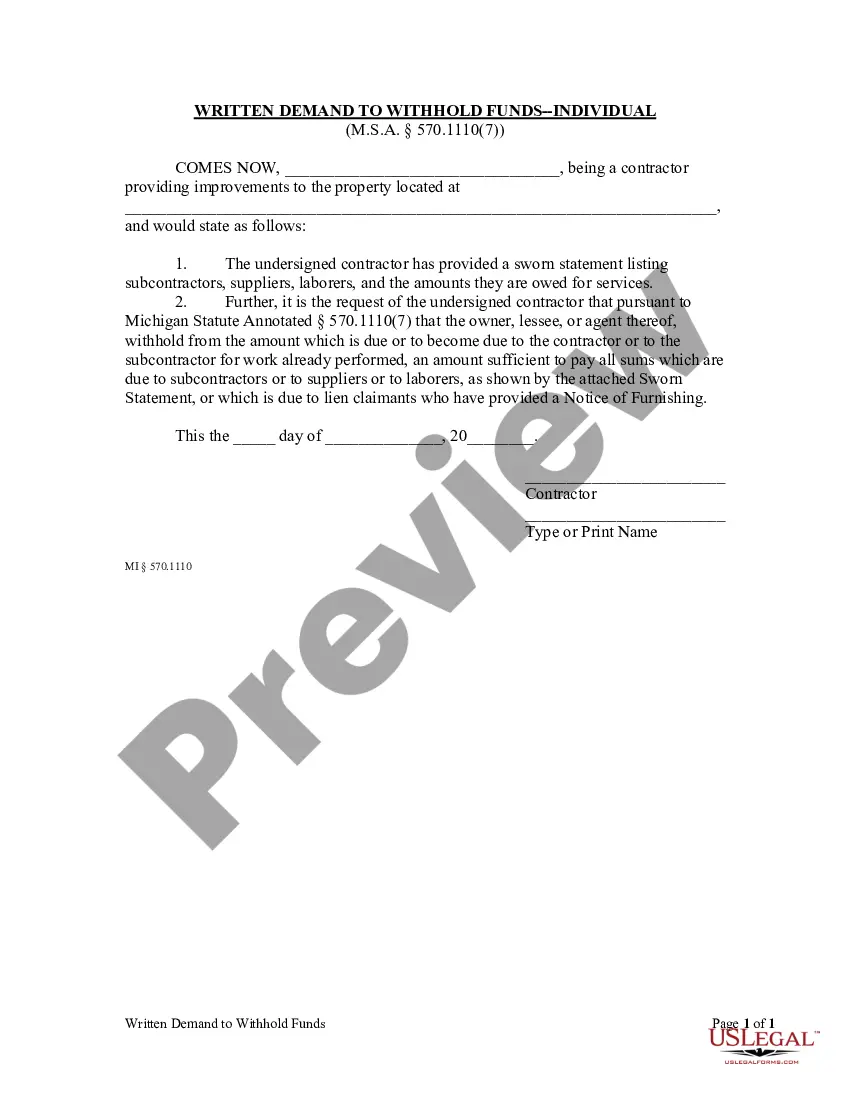
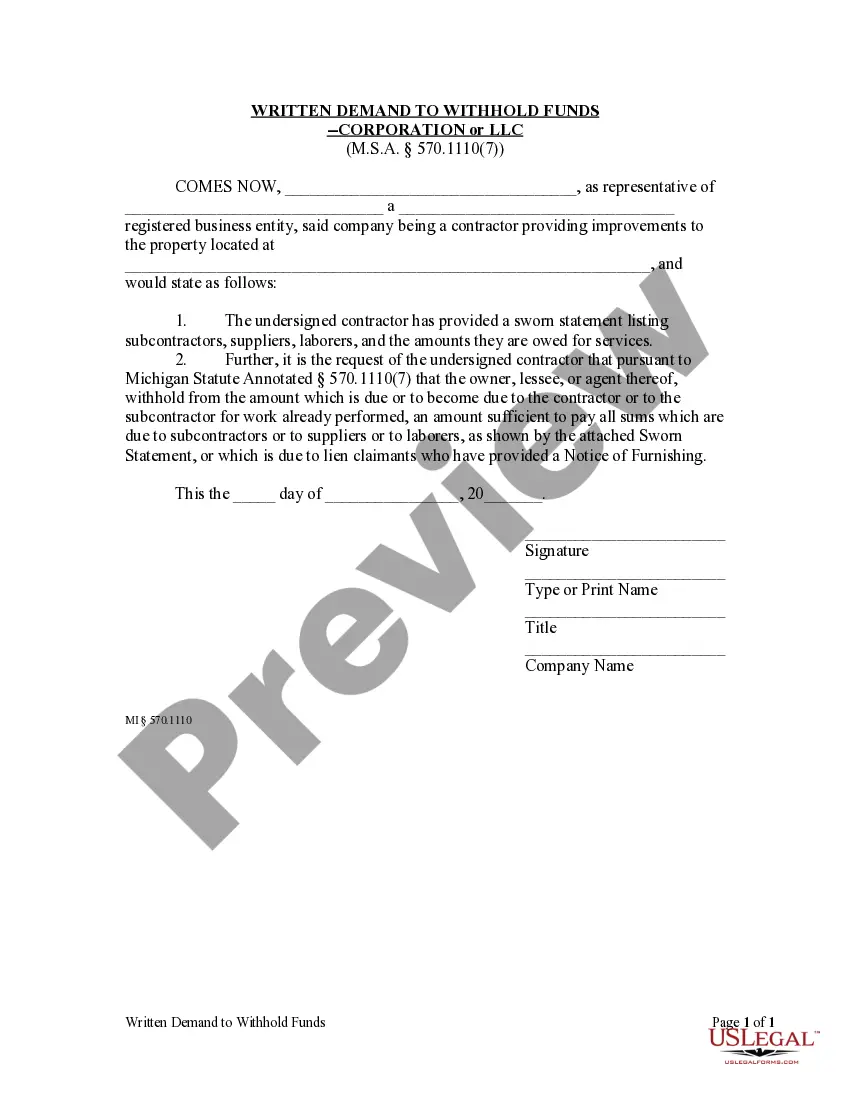
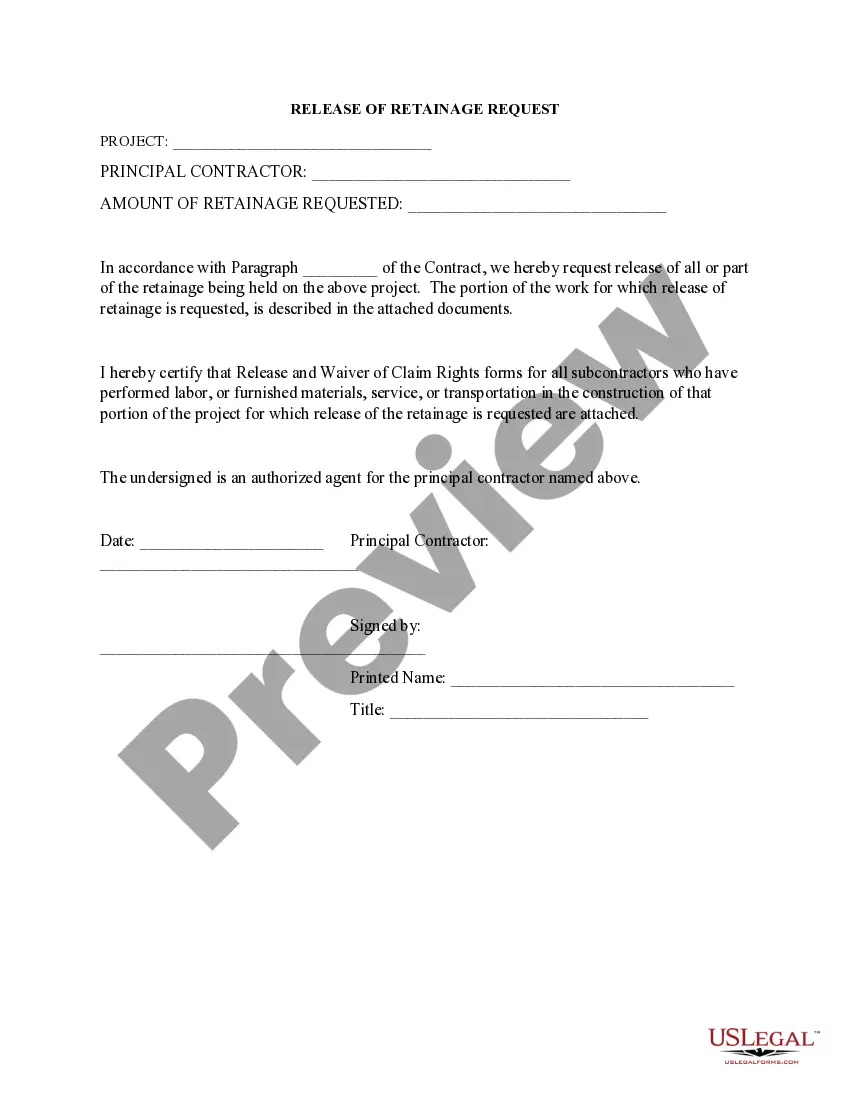
The Request to Withhold Funds - Individual form is a legal document that allows contractors to formally ask property owners or lessees to withhold payment to ensure that subcontractors, suppliers, and laborers are paid for their work. This form differs from other payment requests by specifically addressing the withholding of funds as required under Michigan law, providing necessary protections to those who perform essential work on a property.
What’s included in this form
- Identification of the contractor and property location
- A sworn statement listing all subcontractors, suppliers, and laborers owed payment
- A formal request for withholding funds to pay outstanding debts as required by law
- Date of request and contractor's signature
When this form is needed
This form should be used after a contractor provides a sworn statement of amounts owed to subcontractors, suppliers, and laborers. It is essential when a contractor believes that payment to them from the property owner should be partially withheld to protect the interests of those who have not been paid for their services, as stipulated by Michigan law.
Who this form is for
- Contractors seeking to ensure payment for subcontractors and suppliers
- Subcontractors and suppliers who have not received payment for services rendered
- Property owners or lessees wishing to comply with legal obligations regarding payments
- Legal representatives assisting contractors in payment disputes
Completing this form step by step
- Identify the contractor by filling in their name and the property address.
- List all subcontractors, suppliers, and laborers along with the amounts owed in the sworn statement.
- Draft the formal request for the owner or lessee to withhold the appropriate payment.
- Include the date of the request.
- Sign the document to validate the request.
Notarization requirements for this form
To make this form legally binding, it must be notarized. Our online notarization service, powered by Notarize, lets you verify and sign documents remotely through an encrypted video session.
Get your form ready online
Our built-in tools help you complete, sign, share, and store your documents in one place.
Make edits, fill in missing information, and update formatting in US Legal Forms—just like you would in MS Word.
Download a copy, print it, send it by email, or mail it via USPS—whatever works best for your next step.
Sign and collect signatures with our SignNow integration. Send to multiple recipients, set reminders, and more. Go Premium to unlock E-Sign.
If this form requires notarization, complete it online through a secure video call—no need to meet a notary in person or wait for an appointment.
We protect your documents and personal data by following strict security and privacy standards.

Make edits, fill in missing information, and update formatting in US Legal Forms—just like you would in MS Word.

Download a copy, print it, send it by email, or mail it via USPS—whatever works best for your next step.

Sign and collect signatures with our SignNow integration. Send to multiple recipients, set reminders, and more. Go Premium to unlock E-Sign.

If this form requires notarization, complete it online through a secure video call—no need to meet a notary in person or wait for an appointment.

We protect your documents and personal data by following strict security and privacy standards.
Mistakes to watch out for
- Not providing complete information about subcontractors and amounts owed.
- Forgetting to include the date of the request.
- Failing to sign the form, which can render it invalid.
- Not attaching the sworn statement that supports the request to withhold funds.
Why complete this form online
- Convenience of downloading and printing within minutes.
- Editability to customize the form to your specific situation.
- Access to templates drafted by licensed attorneys, ensuring legal reliability.
Looking for another form?
Form popularity
FAQ
Alabama. Arizona. Arkansas. California. Connecticut. District of Columbia. Georgia. Hawaii.
The Michigan Income Tax Act requires that all employers required to withhold federal income taxes that have employees working in Michigan register and withhold state income tax from residents and nonresidents performing services within the state.
The verb withhold means to deduct from a payment and hold back. Your job will withhold money from your paycheck for things like taxes. You may also choose to withhold money from your check for healthcare, retirement, and numerous other voluntary accounts. The past tense of the verb withhold is withheld.
Please call 517-636-4486 for tax inquiries or check your account online.
Every Michigan employer who is required to withhold federal income tax under the Internal Revenue Code must be registered for and withhold Michigan income tax. What is Michigan's 2020 payroll withholding tax rate? The tax rate for 2020 is 4.25%.
An employee may claim exemption from Michigan income tax withholding only if they do not anticipate a Michigan income tax liability for 2017 because employment is less than full time AND exemption allowances are greater than annual compensation.
Withholding Rate: 4.25% Personal Exemption: $4,400 2019 Michigan Income Tax Withholding Tables.
If the FTE is owned by a non-resident individual or is owned by a C corporation or a flow-through entity and has more than $200,000 in business income allocated or apportioned to Michigan, then the flow-through entity must file and pay flow-through withholding.