Maryland New Resident Guide
What this document covers
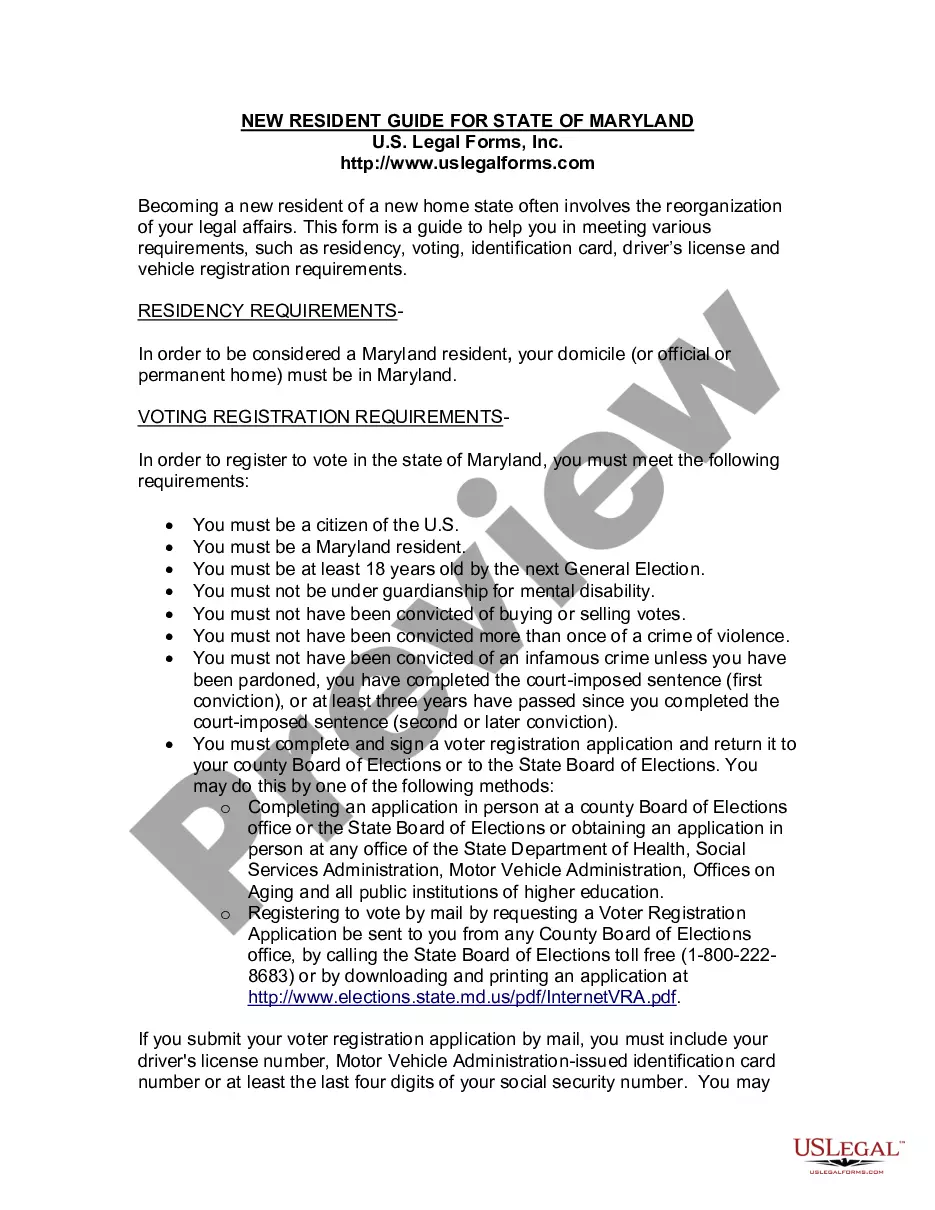
The New Resident Guide is an essential informational document designed for individuals who have recently relocated to a new state. This guide provides comprehensive details on state-specific requirements for residency, voter registration, identification cards, driver's licenses, and vehicle title and registration. By following this guide, new residents can streamline their transition and ensure compliance with local laws and regulations, differentiating it from other legal forms that may not provide such tailored information.
Main sections of this form
- Residency requirements: Information on how to establish and prove residency in the new state.
- Voting registration requirements: Steps and necessary criteria for registering to vote locally.
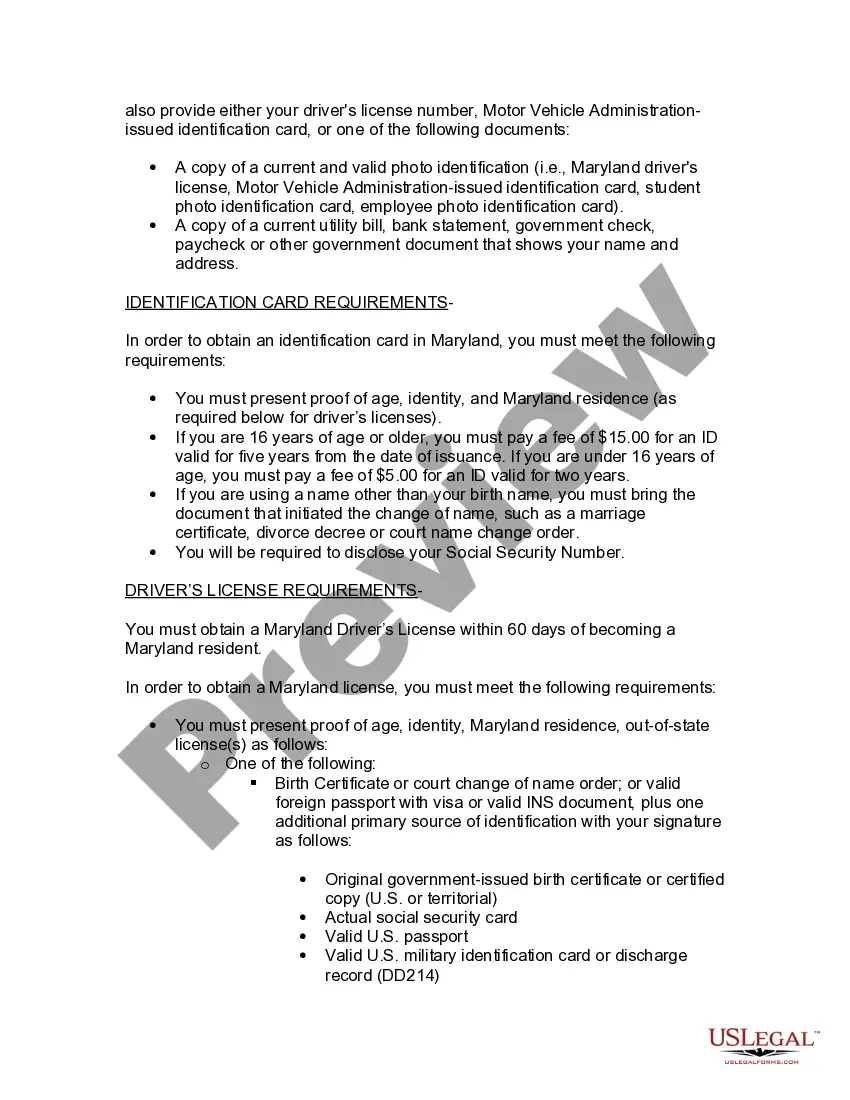
- Identification card requirements: Guidelines for obtaining a state-issued ID, including age and fee details.
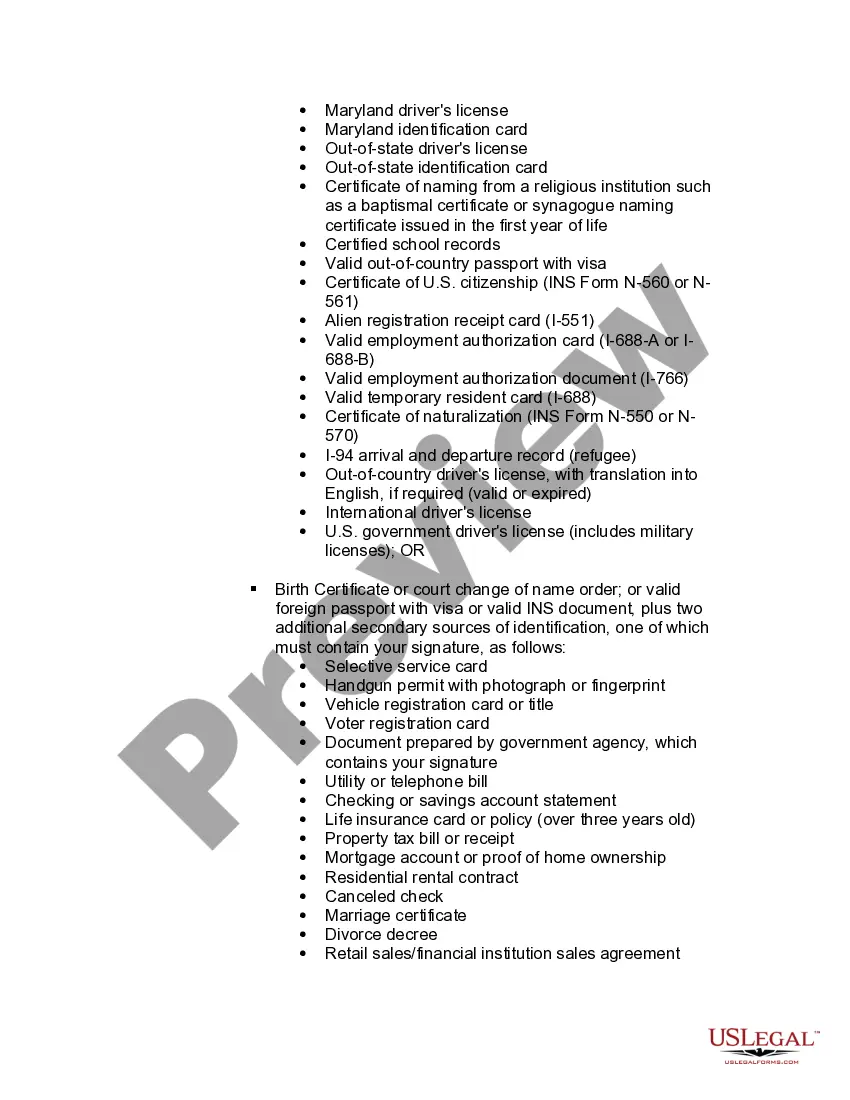
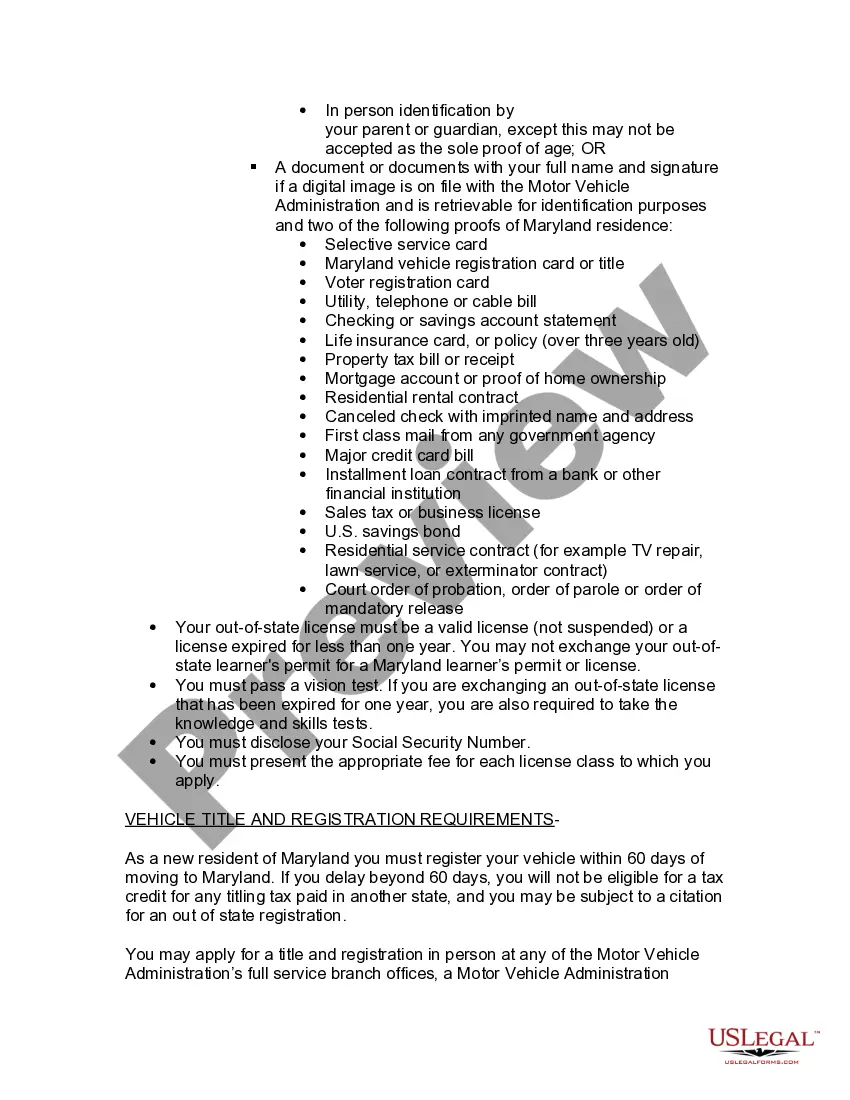
- Driver's license requirements: Requirements for obtaining a new driver's license within a specific timeframe.
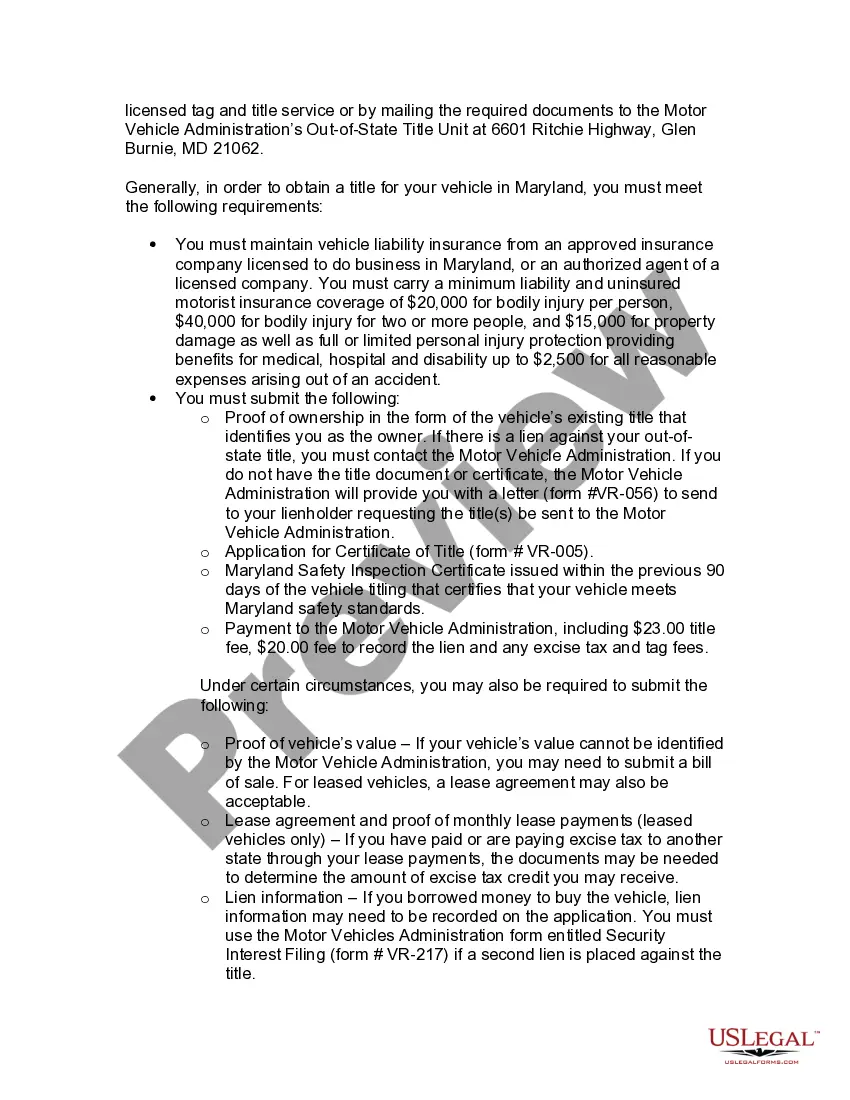
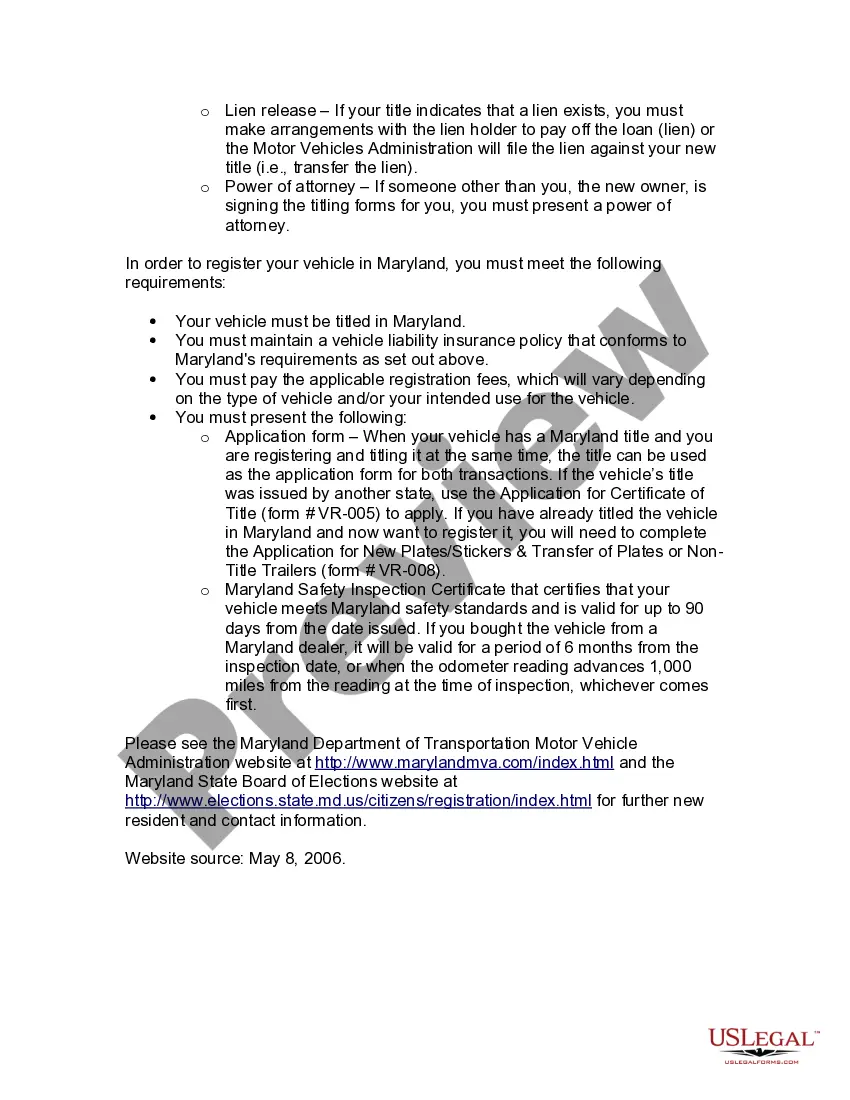
- Vehicle title and registration requirements: Steps to register your vehicle in the new state and ensure compliance.
When this form is needed
This guide should be utilized by individuals who have recently moved to a new state and need assistance in understanding the various legal requirements related to residency. It is especially important when establishing residency for purposes such as obtaining a driver's license or registering to vote in that state.
Who needs this form
- Individuals who have recently relocated to a different state.
- New residents looking to register to vote and establish residency.
- New residents needing to obtain a driver's license or state identification.
- New residents requiring information on vehicle title and registration.
Steps to complete this form
- Identify your state of residency and familiarize yourself with the local requirements.
- Gather necessary documents such as proof of identity and residency for the application processes.
- Complete any required forms for voter registration, identification, and driver's license.
- Submit your applications to the appropriate local offices or agencies as specified in the guide.
- Track your submissions to ensure that they are processed in compliance with state deadlines.
Notarization guidance
This form does not typically require notarization unless specified by local law. However, it is advisable to check with local requirements to ensure compliance with any specific regulations that may apply.
Get your form ready online
Our built-in tools help you complete, sign, share, and store your documents in one place.
Make edits, fill in missing information, and update formatting in US Legal Forms—just like you would in MS Word.
Download a copy, print it, send it by email, or mail it via USPS—whatever works best for your next step.
Sign and collect signatures with our SignNow integration. Send to multiple recipients, set reminders, and more. Go Premium to unlock E-Sign.
If this form requires notarization, complete it online through a secure video call—no need to meet a notary in person or wait for an appointment.
We protect your documents and personal data by following strict security and privacy standards.

Make edits, fill in missing information, and update formatting in US Legal Forms—just like you would in MS Word.

Download a copy, print it, send it by email, or mail it via USPS—whatever works best for your next step.

Sign and collect signatures with our SignNow integration. Send to multiple recipients, set reminders, and more. Go Premium to unlock E-Sign.

If this form requires notarization, complete it online through a secure video call—no need to meet a notary in person or wait for an appointment.

We protect your documents and personal data by following strict security and privacy standards.
Common mistakes
- Failing to submit applications within the required timeframes set by the state.
- Not including necessary documentation when applying for voter registration or driver's licenses.
- Missing signature on forms, which can result in application delays or rejections.
- Overlooking the specific ID requirements for vehicle registration and licensing.
Benefits of completing this form online
- Convenience of downloading and completing the form at your own pace.
- Editability allows you to correct mistakes easily before submission.
- Access to reliable legal forms drafted by licensed attorneys.
- Instant access to the necessary information without the need for in-person visits.
Legal use & context
- The New Resident Guide assists users in complying with state laws and regulations.
- Ensures that new residents meet legal residency requirements for various civic duties.
- Helps avoid potential fines or legal issues related to vehicle registration and voting.
What to keep in mind
- The New Resident Guide helps streamline the transition into a new state by outlining essential legal requirements.
- Understanding state-specific laws is crucial for compliance in residency, voting, and vehicle registration.
- Being prepared with the right documents can help avoid common pitfalls during the relocation process.
Looking for another form?
Form popularity
FAQ
Before relocating to Maryland, familiarize yourself with the local laws, housing market, and community resources. The Maryland New Resident Guide can help you navigate address changes, vehicle registration, and other legal necessities. Additionally, explore the diverse neighborhoods and cultural attractions that make Maryland unique. With the right information, your transition will be smoother, ensuring you feel at home in no time.
Proof of age and identity (either a birth certificate or passport) Social security card. Driver's license. Proof of Maryland residency (such as a utility bill or bank statement)
Residency Status in MarylandResident Status: You are considered a Maryland resident if your permanent home (domicile) is in the state or if you spent more than half of the year here. For income tax purposes, this means that you were physically present in the state for more at least 183 days.
Current out-of-state driver's license. Another form of identification. Proof of your Social Security number. Proof of your new residence with your new address. Pass a vision test. Payment for a new driver's license.
Current out-of-state driver's license. Another form of identification. Proof of your Social Security number. Proof of your new residence with your new address. Pass a vision test. Payment for a new driver's license.
To get a Maryland driver's license as a formerly out-of-state resident you'll have to go to a Maryland Motor Vehicle Administration office in person, since unfortunately you can't do a Maryland DMV change of address online or over the phone.
Proof of age and identity, such as an original U.S. birth certificate or U.S. passport. A Social Security Card, W-2 form (not more than 18 months old), or SSA-1099 form (not more than 18 months old)
Your current out-of-state license. Proof of identity. Proof of lawful presence. Social security card. Proof of Maryland residency (two documents)
Two (2) proofs of Maryland residency Examples: Insurance Card, Vehicle Registration, Credit Card Bill, Utility Bill, Bank Statement, or Mail from a Federal, State, or Local government agency. (Which display your name, Maryland residential address and are from two (2) separate organizations.)
The state of Maryland requires everyone who drives to have a driver's license. You can get your first learner's permit at the age of 15 years and 9 months. After you drive successfully with your learner's permit for 9 months, you can then obtain a provisional license, and eventually a regular license.