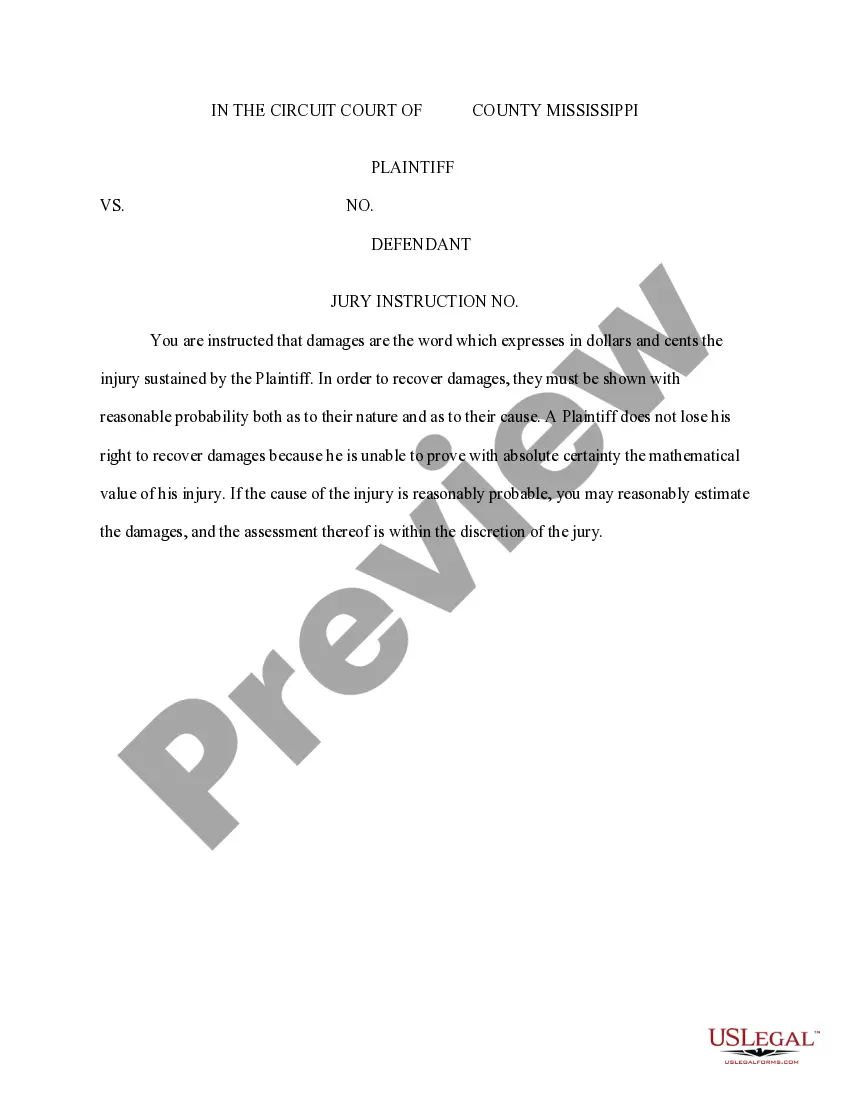
Louisiana Partial Release of Judicial Mortgage and Lien
Overview of this form
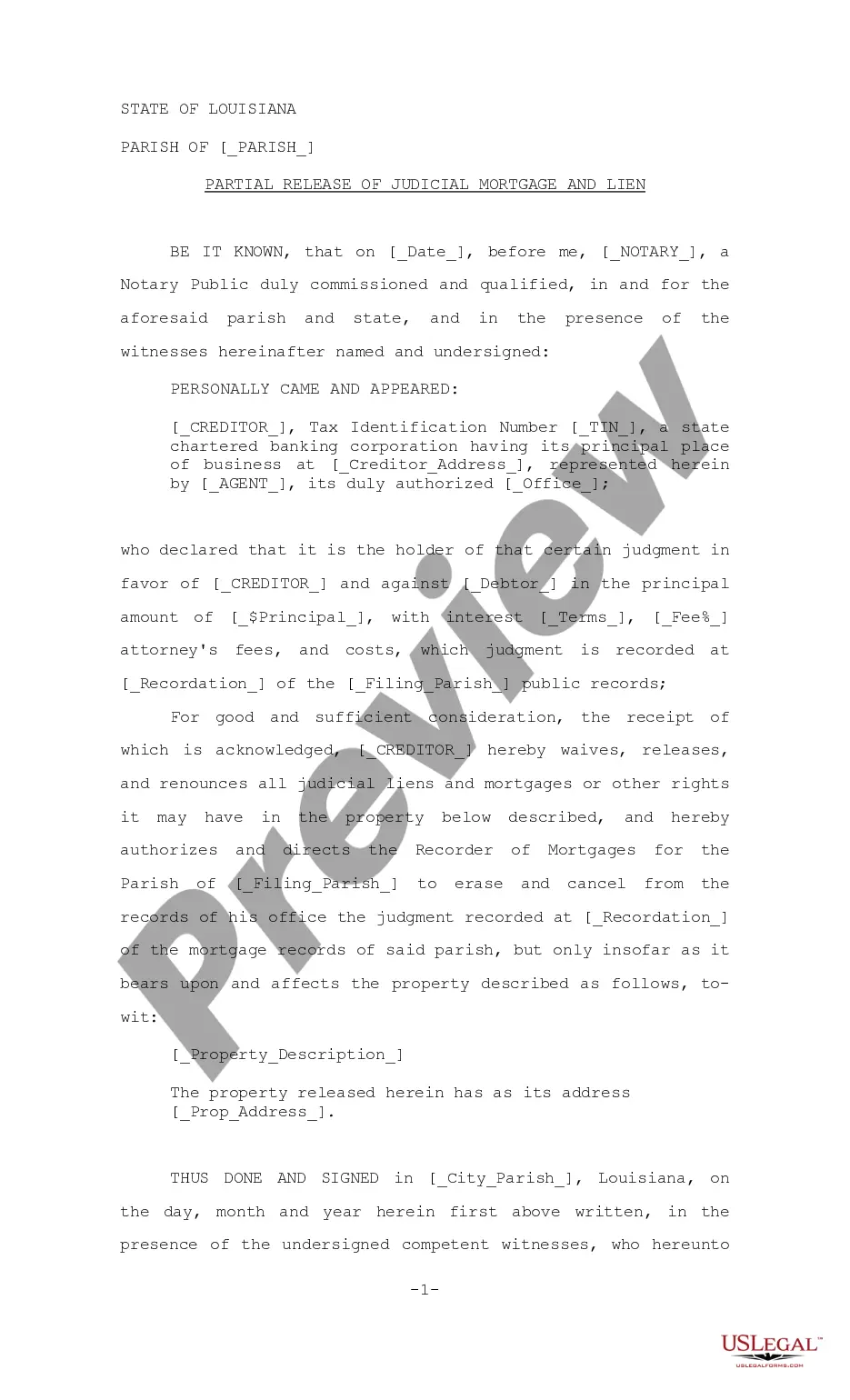
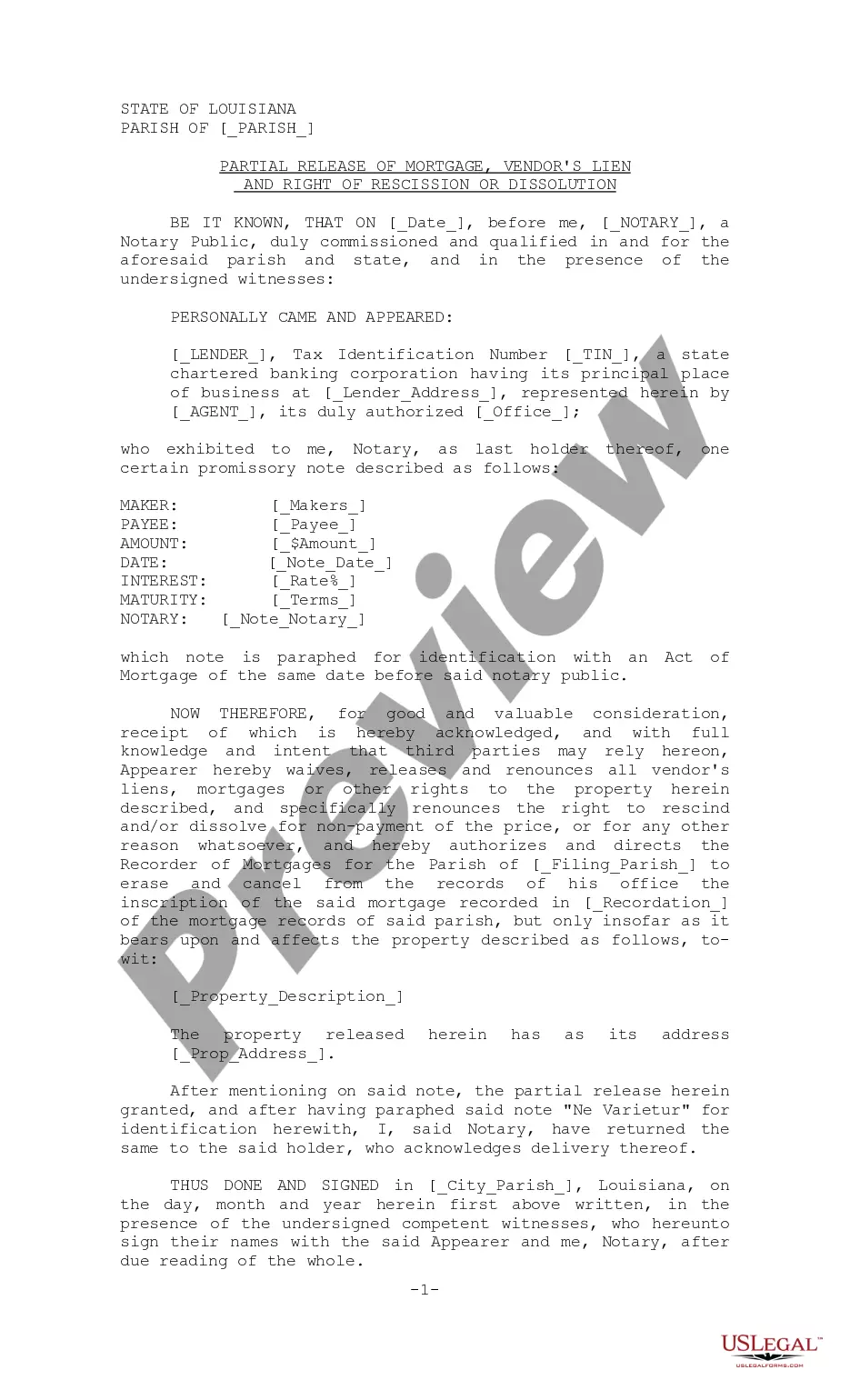
The Partial Release of Judicial Mortgage and Lien is a legal document executed by a judgment creditor to formally release a specific property from the obligations of a judgment. This process clears the property of liens and mortgages resulting from the judgment, distinguishing it from a full release, which would clear all properties involved. The Partial Release ensures only the designated property is freed from the judgment's effects, providing clarity and security for future transactions involving the property.
Key components of this form
- Parties involved: Information about the creditor and debtor is included.
- Property description: Specific details identifying the property being released.
- Judgment details: Information about the judgment, including the principal amount and any accrued fees.
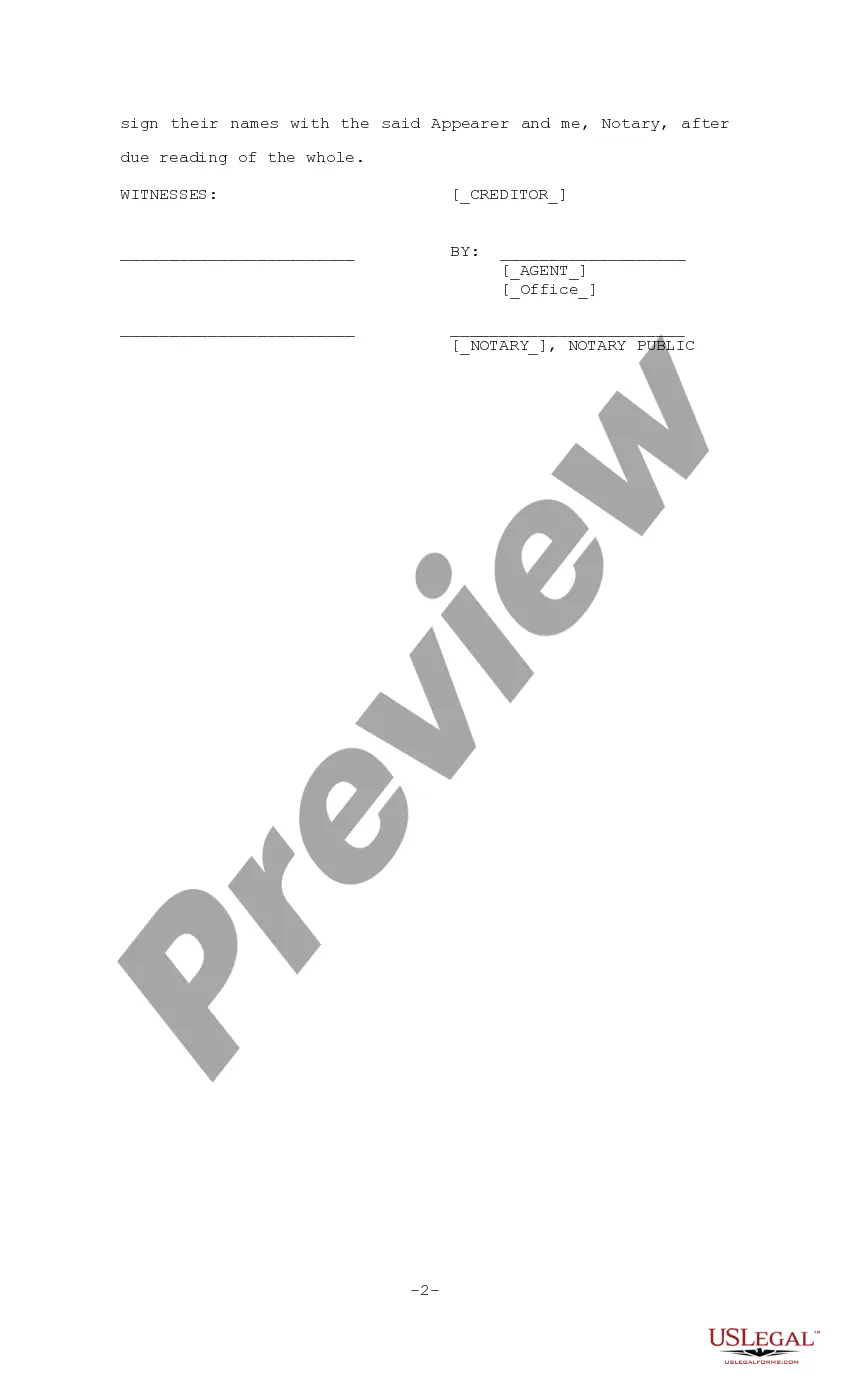
- Notary acknowledgment: Space for the notarization to validate the document.
- Witness signatures: Area for witnesses to sign, enhancing the form's legality.
When this form is needed
This form is typically used when a creditor wants to release a particular property from the impact of a judgment. For instance, if a debtor has paid a portion of their debt or if specific conditions have changed, the creditor may opt to use the Partial Release of Judicial Mortgage and Lien to allow the debtor to sell or refinance the property without the judgment affecting it. This situation often arises in real estate transactions, estate planning, or when negotiating settlements.
Who needs this form
- Creditors wanting to release a property from a judgment.
- Debtors seeking to manage their property rights post-judgment.
- Real estate professionals involved in transactions affected by liens.
- Attorneys handling cases related to creditor-debtor negotiations.
Completing this form step by step
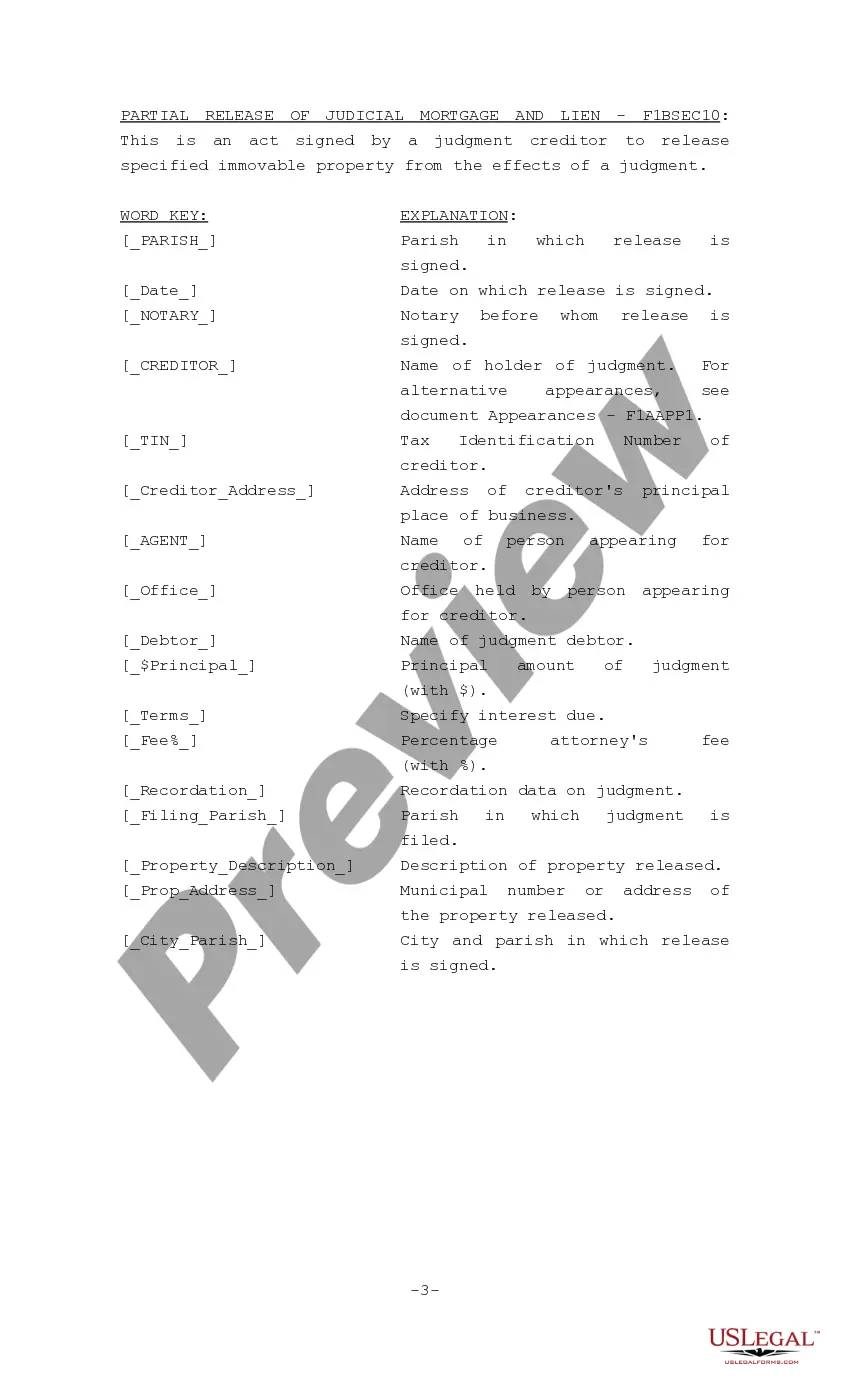
- Identify the parties, including the creditor and debtor, and their relevant details like addresses and Tax Identification Numbers.
- Specify the date and location where the form will be signed.
- Describe the property being released, including its address and any specific identifiers.
- Fill in relevant judgment information such as the principal amount, interest terms, and attorney fees.
- Ensure the document is signed by the creditor and the designated agent in the presence of a notary and witnesses.
Does this document require notarization?
This form must be notarized to be legally valid. US Legal Forms provides secure online notarization powered by Notarize, allowing you to complete the process through a verified video call.
Get your form ready online
Our built-in tools help you complete, sign, share, and store your documents in one place.
Make edits, fill in missing information, and update formatting in US Legal Forms—just like you would in MS Word.
Download a copy, print it, send it by email, or mail it via USPS—whatever works best for your next step.
Sign and collect signatures with our SignNow integration. Send to multiple recipients, set reminders, and more. Go Premium to unlock E-Sign.
If this form requires notarization, complete it online through a secure video call—no need to meet a notary in person or wait for an appointment.
We protect your documents and personal data by following strict security and privacy standards.

Make edits, fill in missing information, and update formatting in US Legal Forms—just like you would in MS Word.

Download a copy, print it, send it by email, or mail it via USPS—whatever works best for your next step.

Sign and collect signatures with our SignNow integration. Send to multiple recipients, set reminders, and more. Go Premium to unlock E-Sign.

If this form requires notarization, complete it online through a secure video call—no need to meet a notary in person or wait for an appointment.

We protect your documents and personal data by following strict security and privacy standards.
Mistakes to watch out for
- Failing to accurately describe the property being released.
- Not providing complete information about the judgment.
- Neglecting to obtain the necessary notarization and witness signatures.
- Omitting important details, such as the date and location of signing.
Benefits of using this form online
- Immediate access to customizable templates allows for quick completion.
- Secure documentation ensures confidentiality and protection of sensitive information.
- Easy to download and store, providing an efficient record-keeping solution.
- Available for use anytime, which allows for flexibility in preparation.
Key takeaways
- The Partial Release of Judicial Mortgage and Lien is essential for removing specific properties from the obligations of a judgment.
- Accurate completion of the form is crucial for legal effectiveness.
- Notarization is necessary to ensure the form's validity.
- This form is useful for creditors and debtors involved in real estate transactions.
Looking for another form?
Form popularity
FAQ
The subcontractor would file a lien waiver before a lien is filed. By doing so, the subcontractor is giving up his or her right to a lien against the property. In comparison, a lien release (also known as release of lien, cancellation of lien, or a lien cancellation) would come into play after the filing of a lien.
The main purpose of a lien waiver is to provide protection to the paying party. In exchange for such payment, the lien waiver waives the payee's right to file a lien for the exact value of the payment they have received.
Pay Off Your Entire Debt. Obviously, the fastest way to remove a tax lien is to pay your outstanding state tax debt in full, plus late fees, penalties, and interest. Set Up a Payment Plan. Apply for an Offer in Compromise. Prove the Lien Was in Error.
It basically states that you've paid the subcontractor what is owed, they accept the payment in full, and they waive the right to put a lien on your property. Simply present this form to the subcontractor with your payment and ask them to sign it. Make sure you get their signature!
Lien Release: After a lien has been filed, the California claimant can release or cancel the lien by filing a Mechanics Lien Release form with the county recorder's office where the lien was originally recorded.
Generally, this requires the assistance of a lawyer. The homeowner may petition the courts under Civil Code Section 8480 in California to remove the mechanic's lien when it is not timely issued or recorded. A lawsuit is usually necessary to file it against the owner by the contractor or subcontractor.
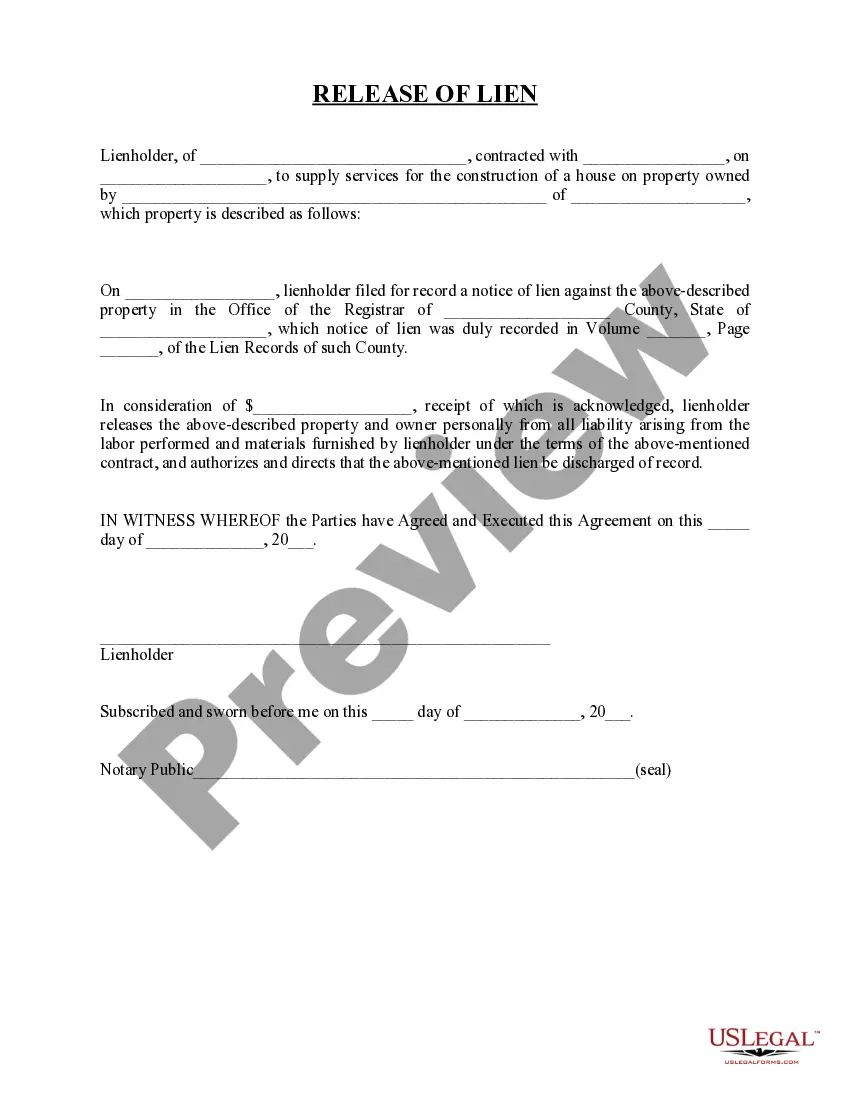
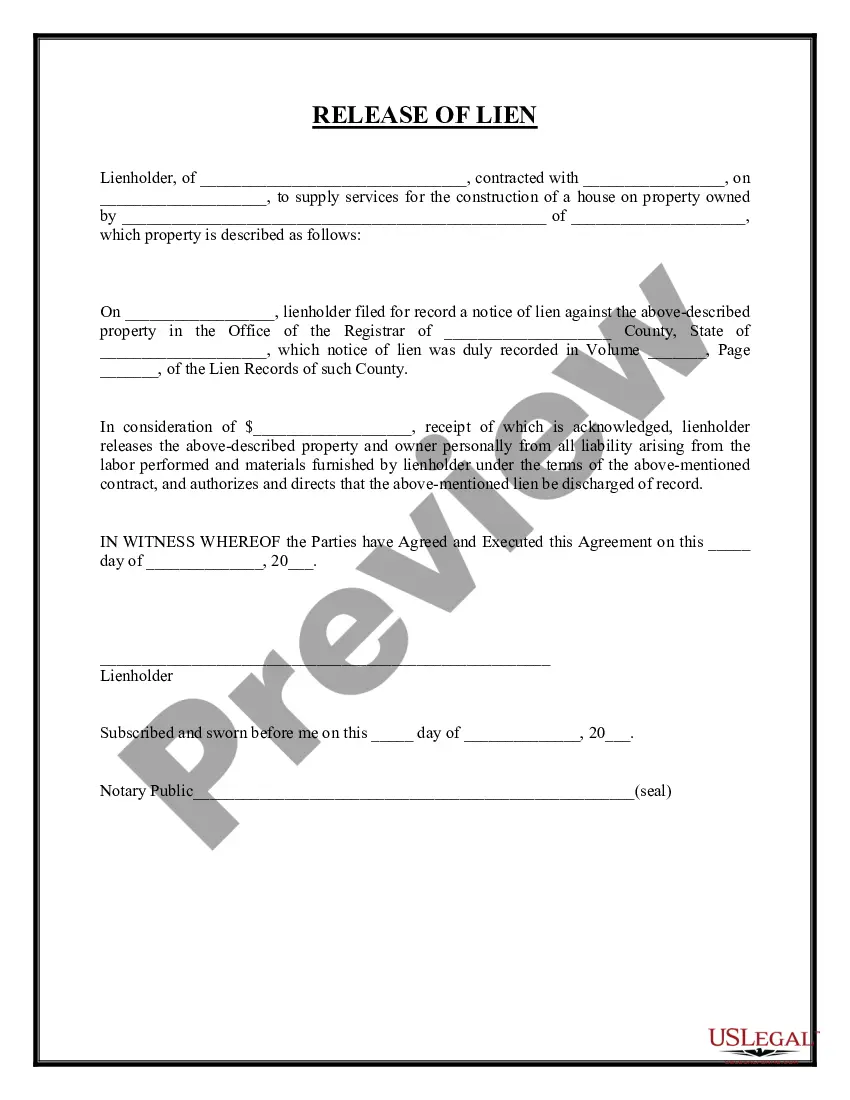
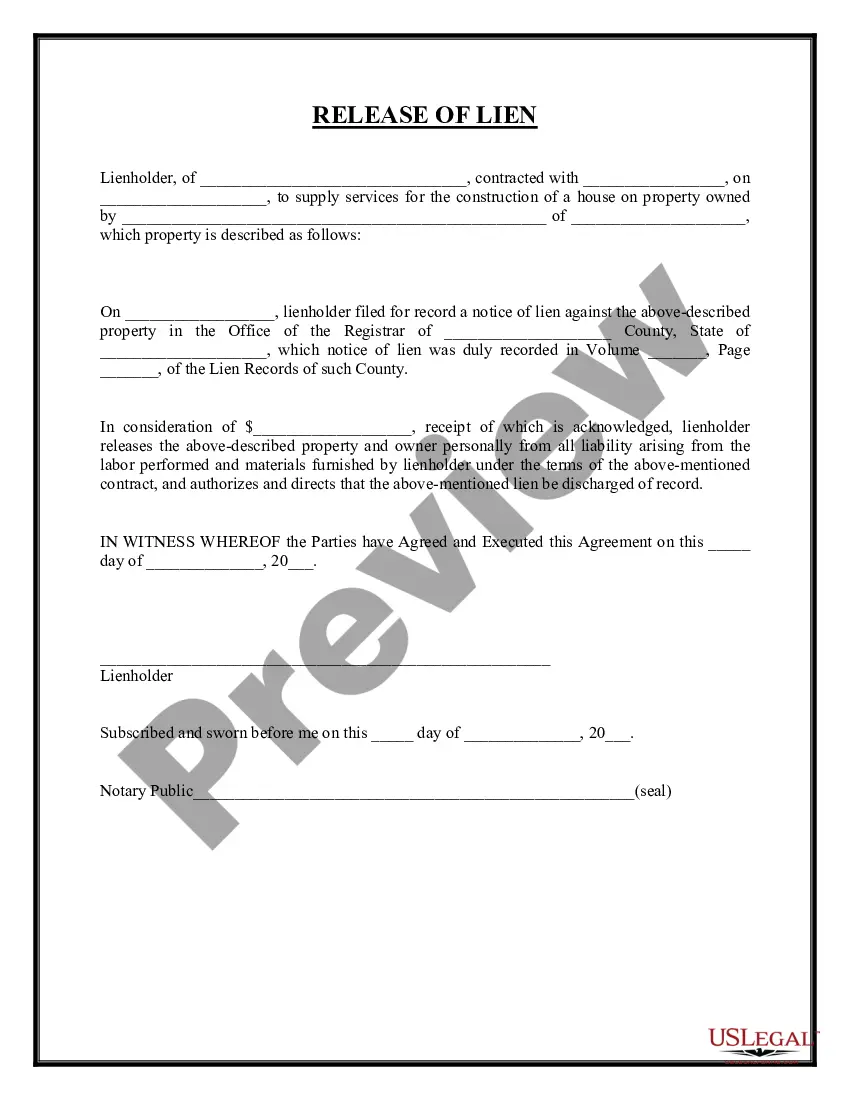
A lien is a claim on property to ensure payment of a debt. When you borrow money to purchase a car, the lender files a lien on the vehicle with the state to insure that if the loan defaults, the lender can take the car. When the debt is fully repaid, a release of the lien is provided by the lender.
Lien release/cancellations must be recorded, and not just emailed or faxed between parties. Lien waivers, on the other hand, are just exchanged between the parties. For lien waivers, electronic signatures are perfectly acceptable.
Lien release letters should have a conspicuous title such as Release of Lien at the top of the page. The first paragraph should list the date the lien was placed on the property and the names and addresses of both the lienholder and the owner of the property.