Mississippi Request for Jury Trial
What this document covers
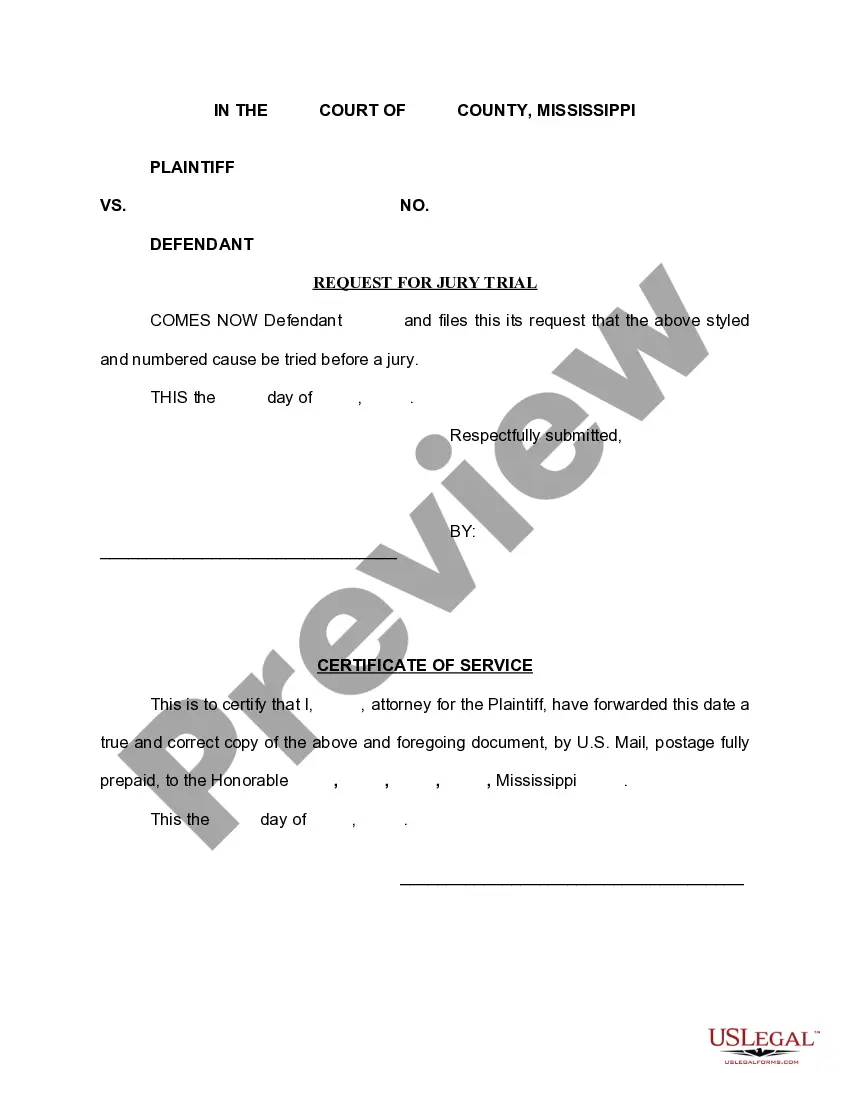
A Request for Jury Trial is a legal document used in Mississippi to formally ask the court to schedule a trial date where jurors will be present to hear your case. This document is essential when the party involved wishes to have their case decided by a jury instead of a judge. Unlike similar forms that may pertain to motion hearings or bench trials, the Request for Jury Trial specifically indicates your preference for a jury trial.
Key parts of this document
- Case information: The names of the parties involved and the case number.
- Request declaration: A clear statement indicating the desire for a jury trial.
- Signature field: Space for the party requesting the trial to sign and date the document.
- Certificate of service: A declaration that copies of the request were served to all involved parties.
- Compliance statement: Assurance that the form meets Mississippi legal requirements.
When to use this document
This form should be used when filing a lawsuit in Mississippi and you want to have your case heard by a jury. It is necessary in civil cases where the right to a jury trial is applicable, such as personal injury claims, breach of contract disputes, or other situations where a jury's verdict on the facts is desired.
Who should use this form
Individuals or entities that can benefit from this form include:
- Plaintiffs seeking a jury trial for civil matters.
- Defendants wanting to ensure their right to a jury trial is recognized.
- Parties involved in disputes covering a wide range of issues, including property, contracts, and personal injury law.
Completing this form step by step
To complete this form, follow these steps:
- Identify the parties involved by entering their names and addresses in the designated fields.
- Provide the case number, which is assigned by the court at the time of filing.
- Clearly state your request for a jury trial in the appropriate section.
- Sign and date the form to validate the request.
- Ensure that you complete the certificate of service section to confirm that all other parties have received a copy of this request.
Notarization guidance
This form does not typically require notarization unless specified by local law.
Get your form ready online
Our built-in tools help you complete, sign, share, and store your documents in one place.
Make edits, fill in missing information, and update formatting in US Legal Forms—just like you would in MS Word.
Download a copy, print it, send it by email, or mail it via USPS—whatever works best for your next step.
Sign and collect signatures with our SignNow integration. Send to multiple recipients, set reminders, and more. Go Premium to unlock E-Sign.
If this form requires notarization, complete it online through a secure video call—no need to meet a notary in person or wait for an appointment.
We protect your documents and personal data by following strict security and privacy standards.

Make edits, fill in missing information, and update formatting in US Legal Forms—just like you would in MS Word.

Download a copy, print it, send it by email, or mail it via USPS—whatever works best for your next step.

Sign and collect signatures with our SignNow integration. Send to multiple recipients, set reminders, and more. Go Premium to unlock E-Sign.

If this form requires notarization, complete it online through a secure video call—no need to meet a notary in person or wait for an appointment.

We protect your documents and personal data by following strict security and privacy standards.
Common mistakes
- Failing to serve other parties with a copy of the request.
- Not providing a case number or incorrect information in the case details.
- Omitting the signature, which can render the request invalid.
- Submitting the request after the statutory deadline for a jury trial.
Benefits of using this form online
- Convenience: Download and complete the form from the comfort of your home.
- Editability: Easily fill in the required information electronically before printing.
- Reliability: Forms are prepared by licensed attorneys to ensure compliance with state laws.
Main things to remember
- A Request for Jury Trial is essential for cases in Mississippi where you want a jury to decide the outcome.
- Ensure that you follow all procedural steps to avoid common mistakes.
- The form complies with all state statutes and is prepared by legal professionals to assist you effectively.
Looking for another form?
Form popularity
FAQ
Litigants denied a civil jury trial by a federal district court have at least three options: petitioning the court of appeals for a writ of mandamus; pursuing a permissive interlocutory appeal under 28 U.S.C. 1292(b); or appealing the denial of a jury trial after final judgment.
Jury lists are compiled from voter registrations and driver license or ID renewals.A panel of jurors is then assigned to a courtroom. The prospective jurors are randomly selected to sit in the jury box. At this stage, they will be questioned in court by the judge and/or attorneys in the United States.
On the average, jurors serve approximately 1-3 days during a one month term of service. The Judge will adjourn the jury each evening and will instruct you on what time you must return the following morning. You must check in with the Jury Department each morning.
According to the Supreme Court, the jury-trial right applies only when serious offenses are at handpetty offenses don't invoke it. For purposes of this right, a serious offense is one that carries a potential sentence of more than six months' imprisonment.
Generally one is entitled to be excused from jury duty if he or she faces a personal hardship, business hardship, or has served on a jury in this court in the last two years. Further, a potential juror who is 65 years of age or older, may choose to be exempt from jury service.
If the juror fails to show good cause for noncompliance with the summons, the juror may be held in civil contempt of court and may be fined not more than Five Hundred Dollars ($ 500.00) or imprisoned not more than three (3) days, or both.
Criminal trial: An individual is accused of committing a crime that is considered against society as a whole. Twelve people, and alternates, make up a criminal jury. Civil trial: Litigants seek remedies for private wrongs that don't necessarily have a broader social impact.
One may be excused from jury duty if their presence is required at home or if there is an emergency or personal illness. If you are 65 years of age or older and wish to be exempt from service, a juror's affidavit of excuse should be signed and mailed to the Circuit Clerk's office.
For example, a juror can be dismissed for cause if he or she is a close relative of one of the parties or one of the lawyers, or if he or she works for a company that is part of the lawsuit. Each lawyer may request the dismissal of an unlimited number of jurors for cause.