Jury Duty Policy
Overview of this form
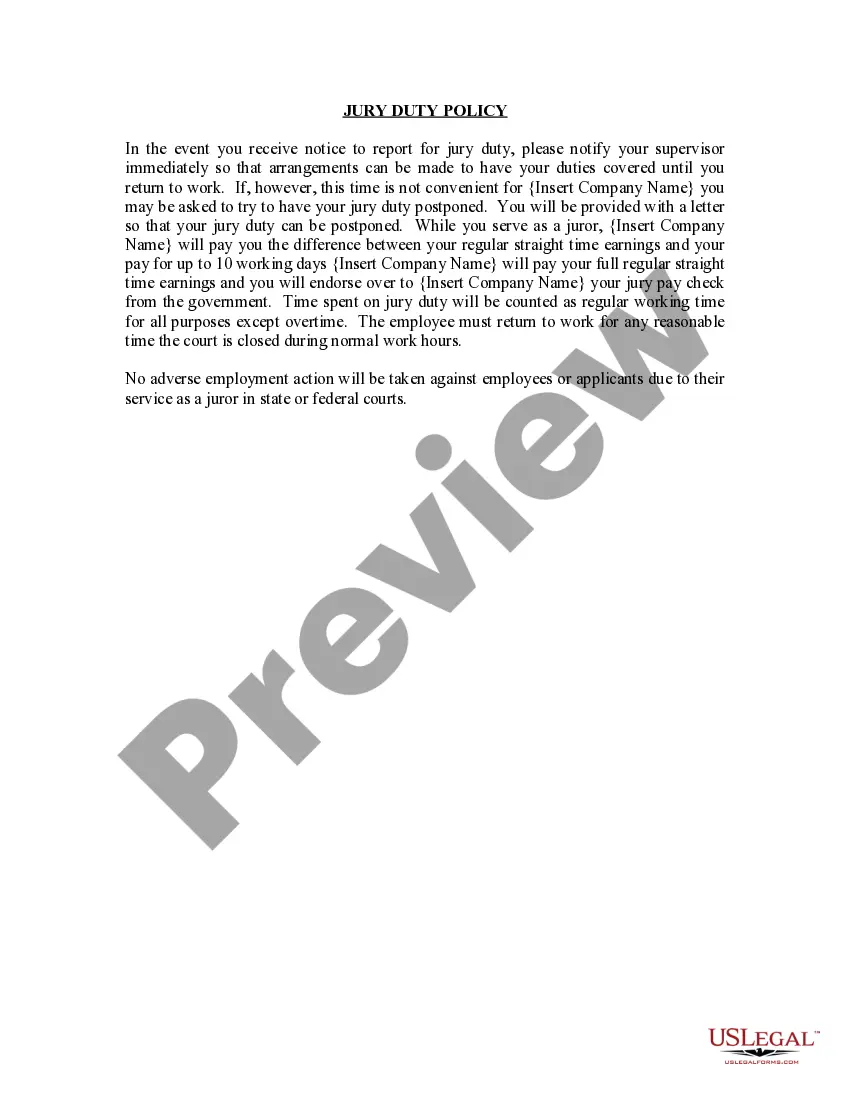
The Jury Duty Policy outlines the rights and responsibilities of employees when called to serve on a jury. This form is essential for ensuring that employees are aware of their obligations during jury duty and how their employer, Insert Company Name, will support them during this civic duty. Unlike other employment-related forms, this policy specifically addresses the intersection of duty to the court and workplace requirements.
What’s included in this form
- Notification requirements to supervisors upon receiving jury duty notice.
- Guidance on postponing jury duty if necessary.
- Details on compensation while serving as a juror, including pay differences covered by the company.
- Clarification on the treatment of jury duty time as regular working time except for overtime.
- Protection against adverse actions related to jury service.

Situations where this form applies
This form should be utilized when employees receive a notice for jury duty. It serves as a guideline for both employees and employers to ensure compliance with legal obligations while managing workplace responsibilities effectively. It is crucial for understanding what to do upon receiving the jury summons, how the company will respond, and what financial support is available during this time.
Who needs this form
- All employees of Insert Company Name who receive a jury duty summons.
- Human resources personnel responsible for managing employee leave and benefits.
- Supervisors who need to understand the company's policy on handling jury duty situations.
Steps to complete this form
- Notify your supervisor immediately upon receiving your jury duty summons.
- Document any requests for postponement and provide relevant details to your supervisor.
- Understand the compensation policy and keep records of your jury service paychecks.
- Return to work during any reasonable breaks in court proceedings as required.
- Review the policy with your HR department if you have any uncertainties.
Notarization requirements for this form
This form usually doesn’t need to be notarized. However, local laws or specific transactions may require it. Our online notarization service, powered by Notarize, lets you complete it remotely through a secure video session, available 24/7.
Get your form ready online
Our built-in tools help you complete, sign, share, and store your documents in one place.
Make edits, fill in missing information, and update formatting in US Legal Forms—just like you would in MS Word.
Download a copy, print it, send it by email, or mail it via USPS—whatever works best for your next step.
Sign and collect signatures with our SignNow integration. Send to multiple recipients, set reminders, and more. Go Premium to unlock E-Sign.
If this form requires notarization, complete it online through a secure video call—no need to meet a notary in person or wait for an appointment.
We protect your documents and personal data by following strict security and privacy standards.

Make edits, fill in missing information, and update formatting in US Legal Forms—just like you would in MS Word.

Download a copy, print it, send it by email, or mail it via USPS—whatever works best for your next step.

Sign and collect signatures with our SignNow integration. Send to multiple recipients, set reminders, and more. Go Premium to unlock E-Sign.

If this form requires notarization, complete it online through a secure video call—no need to meet a notary in person or wait for an appointment.

We protect your documents and personal data by following strict security and privacy standards.
Typical mistakes to avoid
- Failing to notify supervisors in a timely manner upon receipt of a jury summons.
- Not keeping a record of jury service paychecks for the compensation process.
- Assuming that all time spent on jury duty is considered paid working hours without clarifying overtime issues.
- Overlooking the need to return to work during court closures.
Benefits of using this form online
- Instant access to the latest legal templates prepared by licensed attorneys.
- Convenience of downloading and printing the form at your own pace.
- Editability allows users to fill in specific company details easily.
- Ensures compliance with legal requirements without the need for in-person visits or lengthy delays.
Looking for another form?
Form popularity
FAQ
Eligibility. In terms of the Jury Amendment Act 2010, you may have 'good cause' to be excused if: jury service would cause undue hardship or serious inconvenience to you or your family. you have a disability that makes you unsuitable or incapable of effectively serving as a juror, without reasonable accommodation.
Upon receiving a jury duty summons, you are legally obligated to respond, whether by showing up or providing a legitimate reason if you cannot appear on the scheduled date. Failure to appear for jury duty or respond to a summons can be viewed as contempt of court.
The Sheriff's officer/staff member while you're still in the jury assembly area. the judge or coroner when you're called into court.
GET A NOTE FROM A SPECIALIST. POSTPONE IT. TELL THEM YOU'RE A FULL-TIME STUDENT. CRY HARDSHIP. DATE SOMEONE IN PRISON. SAY "I DON'T BELIEVE IN DRACONIAN DRUG LAWS." "I DON'T TRUST POLICEMEN2026" "I DEAL WITH THESE KINDS OF PEOPLE ALL THE TIME."
When writing your or your employee's jury duty excuse letter, you must include basic information like the juror number, date, and your mailing address. You also need to include the clerk's information. Include detailed information about why you or your employee needs to be excused from serving jury duty.
You may be excused from jury duty for anxiety, or for any condition that may affect your ability to serve reliably as a juror. Receiving a doctor's note confirming your anxiety is likely the easiest way. You could also discuss your concerns with the judge privately during the juror selection process.
Eligibility. In terms of the Jury Amendment Act 2010, you may have 'good cause' to be excused if: jury service would cause undue hardship or serious inconvenience to you or your family. you have a disability that makes you unsuitable or incapable of effectively serving as a juror, without reasonable accommodation.
Requesting an Excuse means you are asking the court to either permanently excuse you for the entire term of your jury service or to temporarily excuse from a specific portion of your six week term. Some reasons may include: medical factors, age over 70, and residence outside of the Middle District.
Section 63 of the Act prescribes a maximum penalty of 20 penalty units, which is currently equivalent to $2,200, for anyone who fails to attend for jury service after being summoned to do so.