Louisiana Judgment on Rule on Restraining Order
Understanding this form
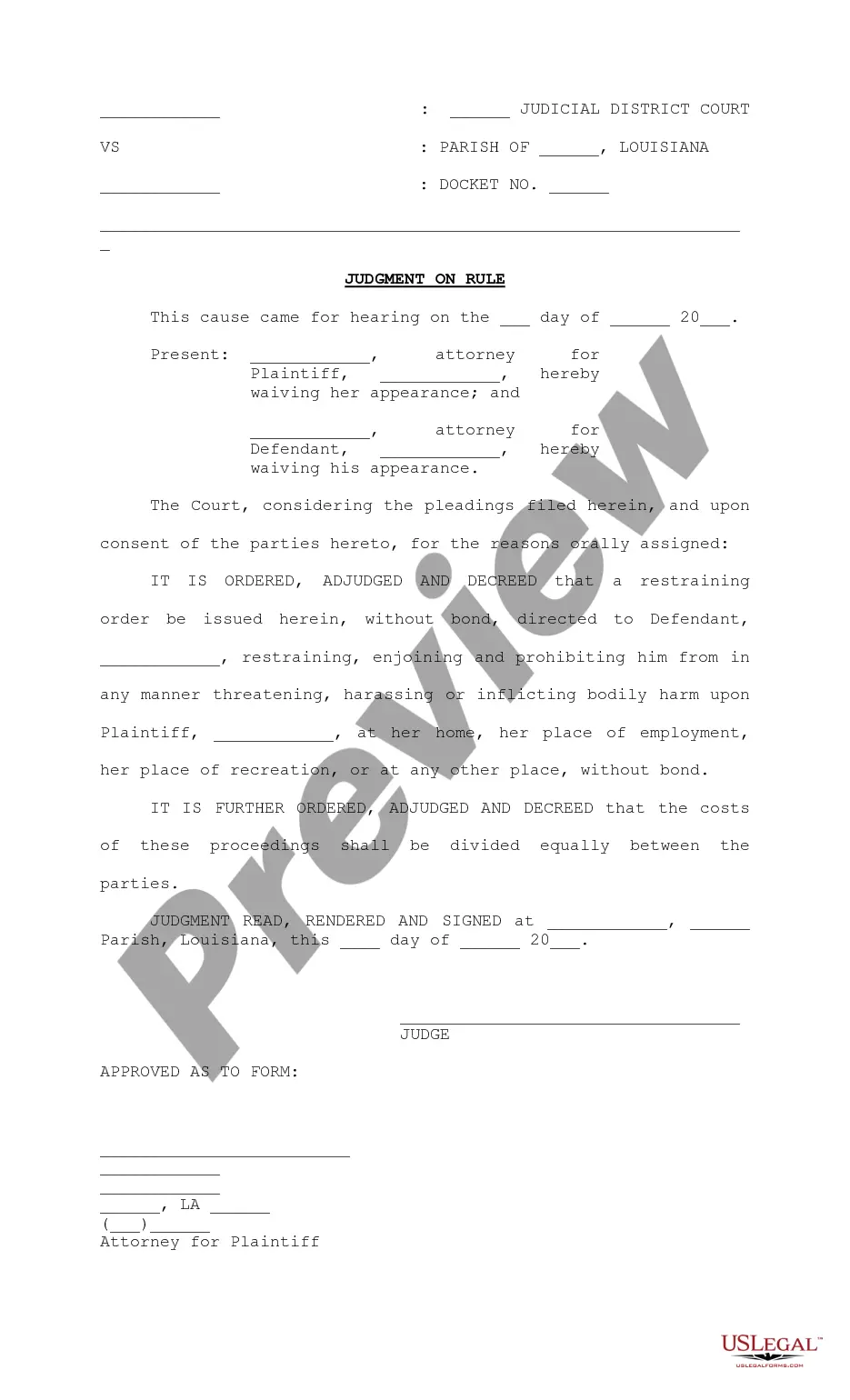
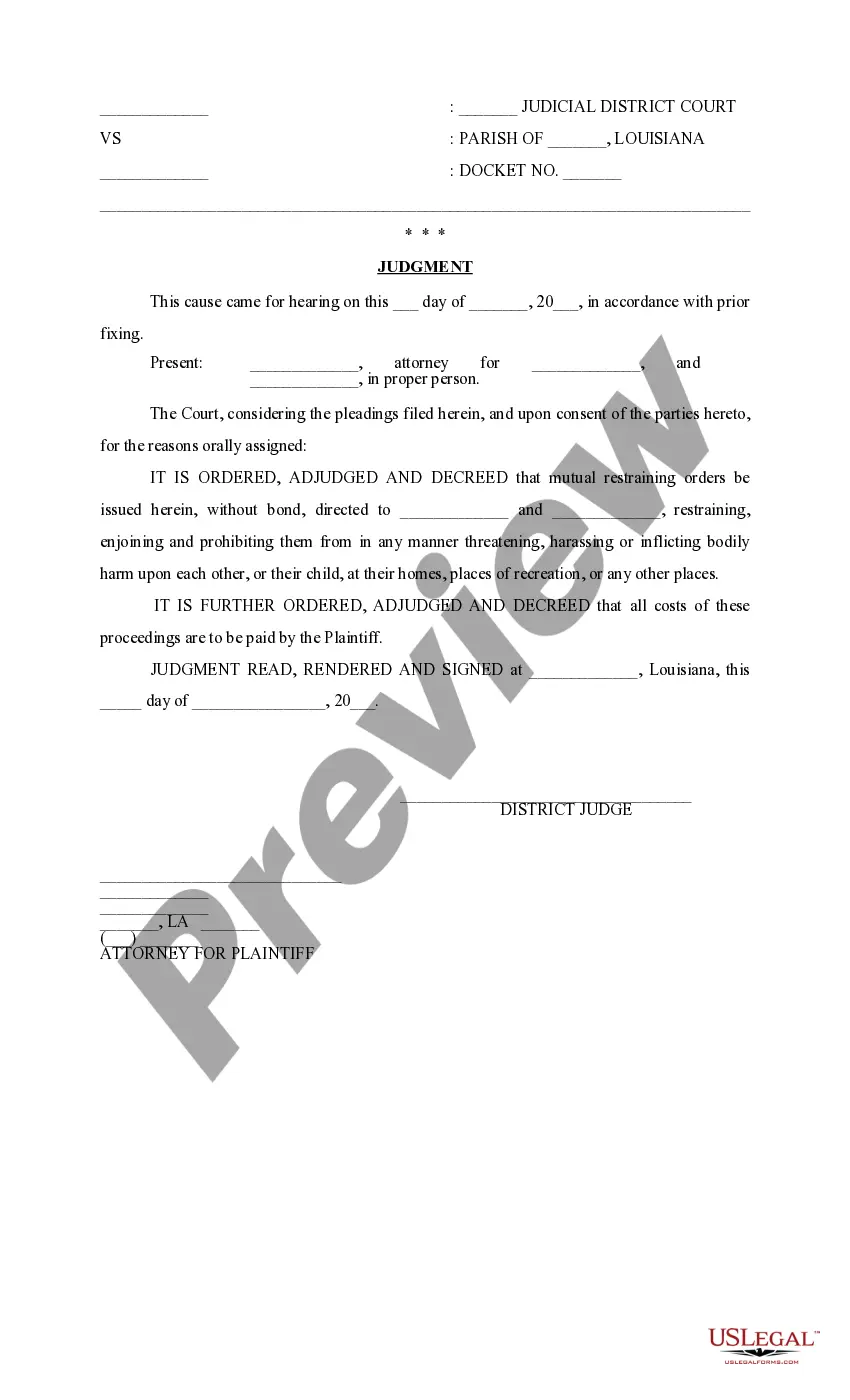
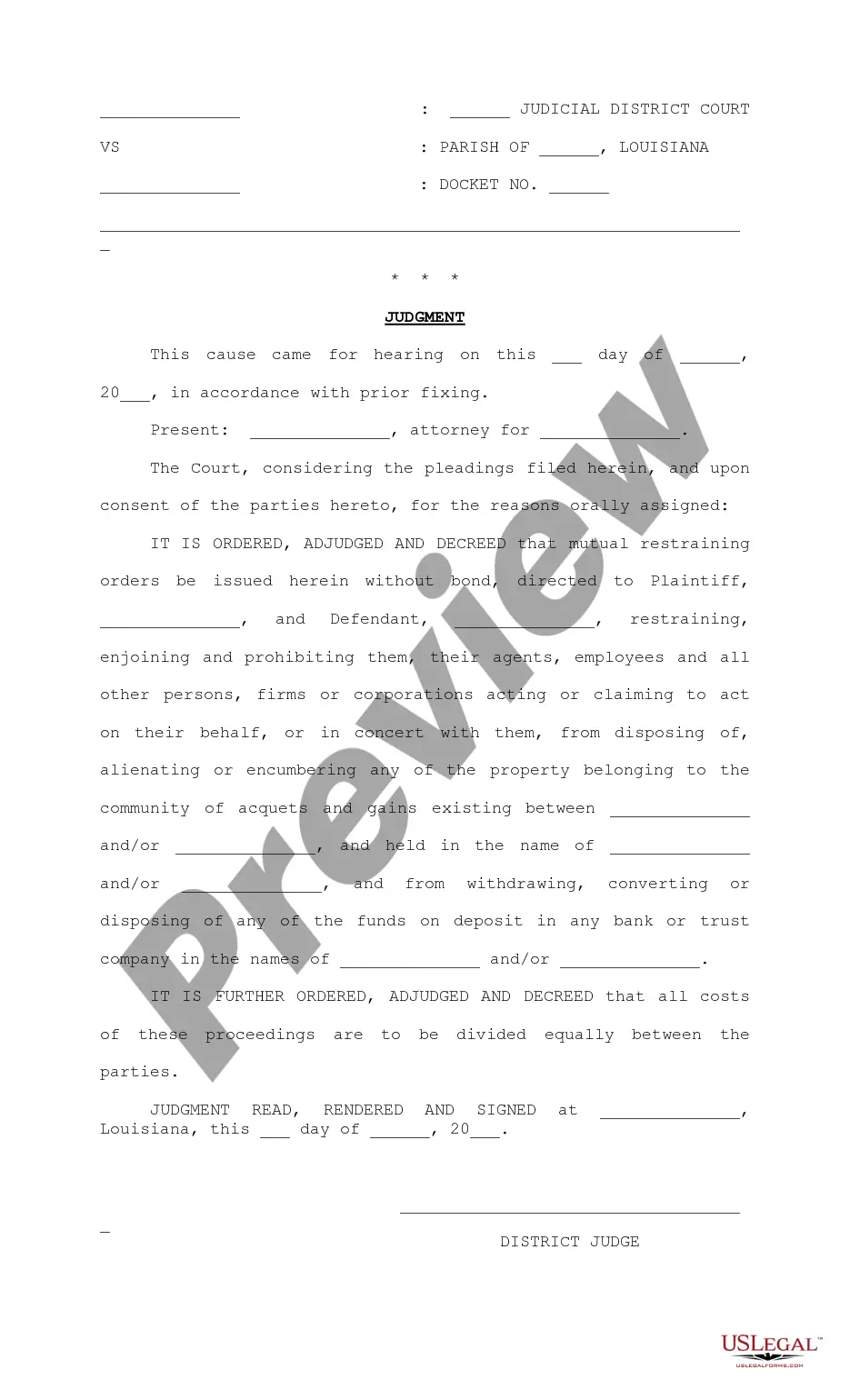
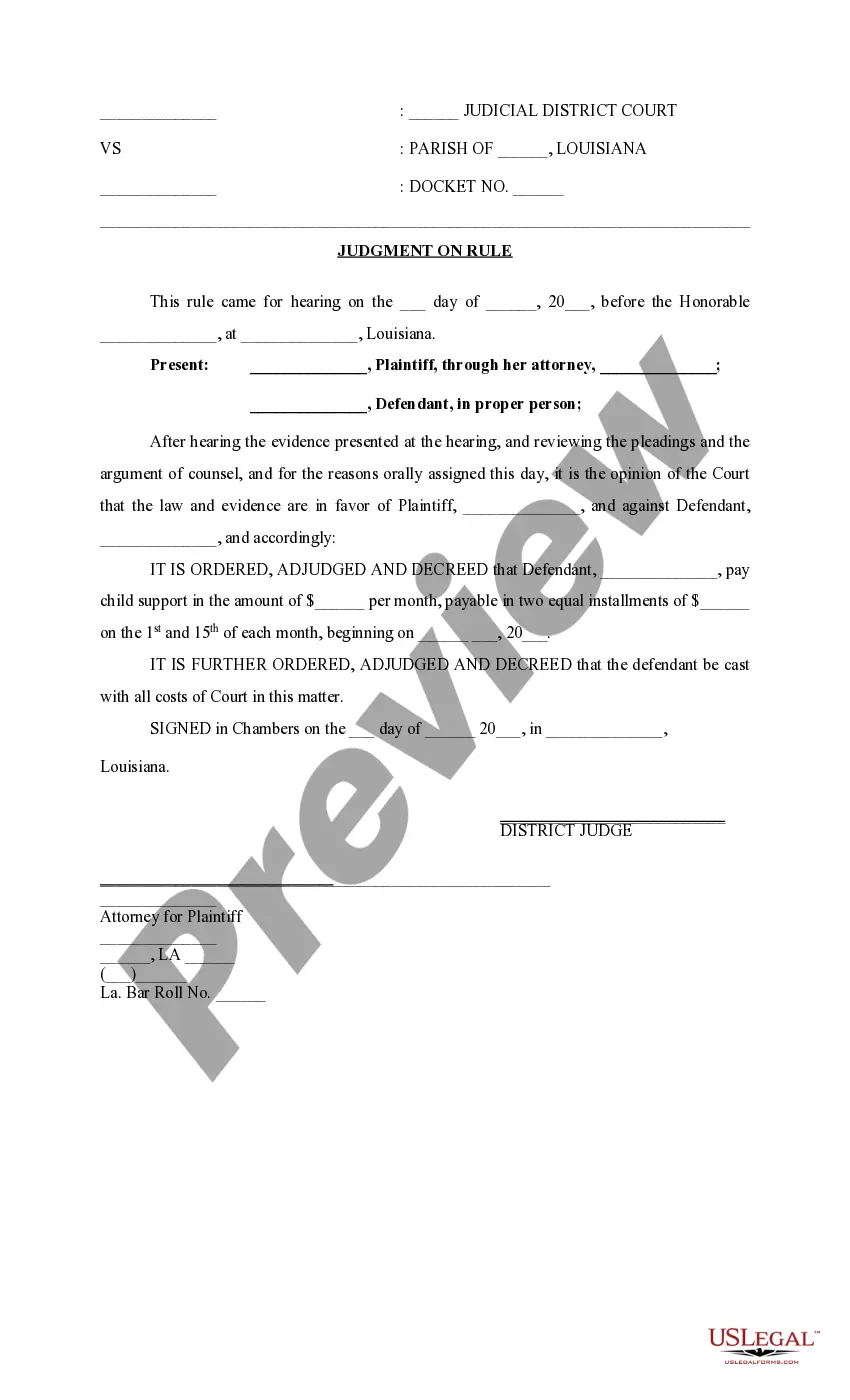
The Judgment on Rule on Restraining Order is a legal document issued by a court that grants a restraining order to the plaintiff without requiring the posting of a bond. This order protects the plaintiff from threats, harassment, or physical harm by the defendant in specified locations, such as the plaintiff's home or workplace. This form differs from other restraining orders as it is specifically a judgment issued after a court hearing, making it enforceable and binding.
What’s included in this form
- Case information including parish, docket number, and date of hearing.
- The names of the parties involved along with their representatives.
- Judgment details outlining the specific prohibitions against the defendant.
- Division of court costs between the parties.
- Signature lines for the judge and attorneys representing each party.
Common use cases
This form should be used when a plaintiff needs legal protection from a defendant who has threatened or harmed them. It is appropriate in situations where immediate action is required to prevent further harassment or violence, especially when the plaintiff feels unsafe in their home, workplace, or other frequent locations. The form applies after a court hearing has determined that a restraining order is warranted.
Who needs this form
- Individuals who have experienced threats or harassment from another party.
- Victims seeking legal recourse to ensure their safety.
- Parties involved in a court case where a restraining order has been discussed or is necessary.
Instructions for completing this form
- Identify the parties involved, including the plaintiff and defendant's names and addresses.
- Fill in the case details, including the parish and docket number.
- Enter the date of the hearing and any relevant attorney information.
- Clearly state the details of the restraining order, specifying prohibited actions and locations.
- Sign and date the form, ensuring it is filed with the appropriate court.
Does this document require notarization?
In most cases, this form does not require notarization. However, some jurisdictions or signing circumstances might. US Legal Forms offers online notarization powered by Notarize, accessible 24/7 for a quick, remote process.
Get your form ready online
Our built-in tools help you complete, sign, share, and store your documents in one place.
Make edits, fill in missing information, and update formatting in US Legal Forms—just like you would in MS Word.
Download a copy, print it, send it by email, or mail it via USPS—whatever works best for your next step.
Sign and collect signatures with our SignNow integration. Send to multiple recipients, set reminders, and more. Go Premium to unlock E-Sign.
If this form requires notarization, complete it online through a secure video call—no need to meet a notary in person or wait for an appointment.
We protect your documents and personal data by following strict security and privacy standards.

Make edits, fill in missing information, and update formatting in US Legal Forms—just like you would in MS Word.

Download a copy, print it, send it by email, or mail it via USPS—whatever works best for your next step.

Sign and collect signatures with our SignNow integration. Send to multiple recipients, set reminders, and more. Go Premium to unlock E-Sign.

If this form requires notarization, complete it online through a secure video call—no need to meet a notary in person or wait for an appointment.

We protect your documents and personal data by following strict security and privacy standards.
Typical mistakes to avoid
- Failing to include all parties' names and contact information.
- Not clearly specifying the actions that are prohibited.
- Omitting the date of the hearing or other critical court details.
- Inaccurate completion of signature lines, leading to filing issues.
Benefits of using this form online
- Convenient access to the form from anywhere at any time.
- Easily editable to ensure all information is accurate before filing.
- Reliable templates created by licensed attorneys, minimizing legal errors.
Legal use & context
- This judgment is legally binding once entered by the court.
- The restraining order aims to provide immediate protection to the plaintiff.
- Violating the order can result in serious legal consequences for the defendant.
Looking for another form?

Form popularity
FAQ
Give the protected person the orders he or she asked for. Give the protected person some of the orders he or she asked for and not others. Not give the protected person any of the orders he or she asked for. Postpone your case and give you a new court date.
Emergency Temporary Restraining Orders: If you are in need of emergency protection outside of regular court hours, the court may grant you an emergency temporary restraining order if there is an immediate and present danger of abuse. The judge must consider any and all past history of abuse, or threats of abuse, in
A violation of a restraining order will often result in arrest, and is a criminal offense.If there is a restraining order against you, but the person who filed the order repeatedly tries to have contact with you, you may go to court to ask the judge to vacate the restraining order.
If a Judge hears from an individual about past cases of physical or emotional abuse without a good explanation from the other side, a restraining order can be granted.If the connection between the parties is something else, like neighbors, then the restraining order is a civil one, not domestic violence.
You cannot drop the charges, but as long as the judge believes that you are not being forced or coerced into dropping the No Contact order, he/she should drop it. Just go to the court that put the order in effect and ask the Clerk's office to pull the case and tell them what it is that you are seeking.
There are typically two reasons for a denied restraining order petition: Petitioner did not establish a claim for relief. Petitioner did not appear at the time set for the ex parte hearing on the petition.
In situations where a court issued a restraining order that lack jurisdiction, that order is also invalidated. If this is proven during the trial, you are not bound by such an order. Falsely accused. In case you are falsely accused of violating a restraining order, a defense attorney can clear you of all the charges.
You can fill out and file a Response to Request for Civil Harassment Restraining Orders (Form CH-120. ) where you tell the judge your side of the story about what happened. Even if you do not file a Response, GO TO YOUR HEARING!