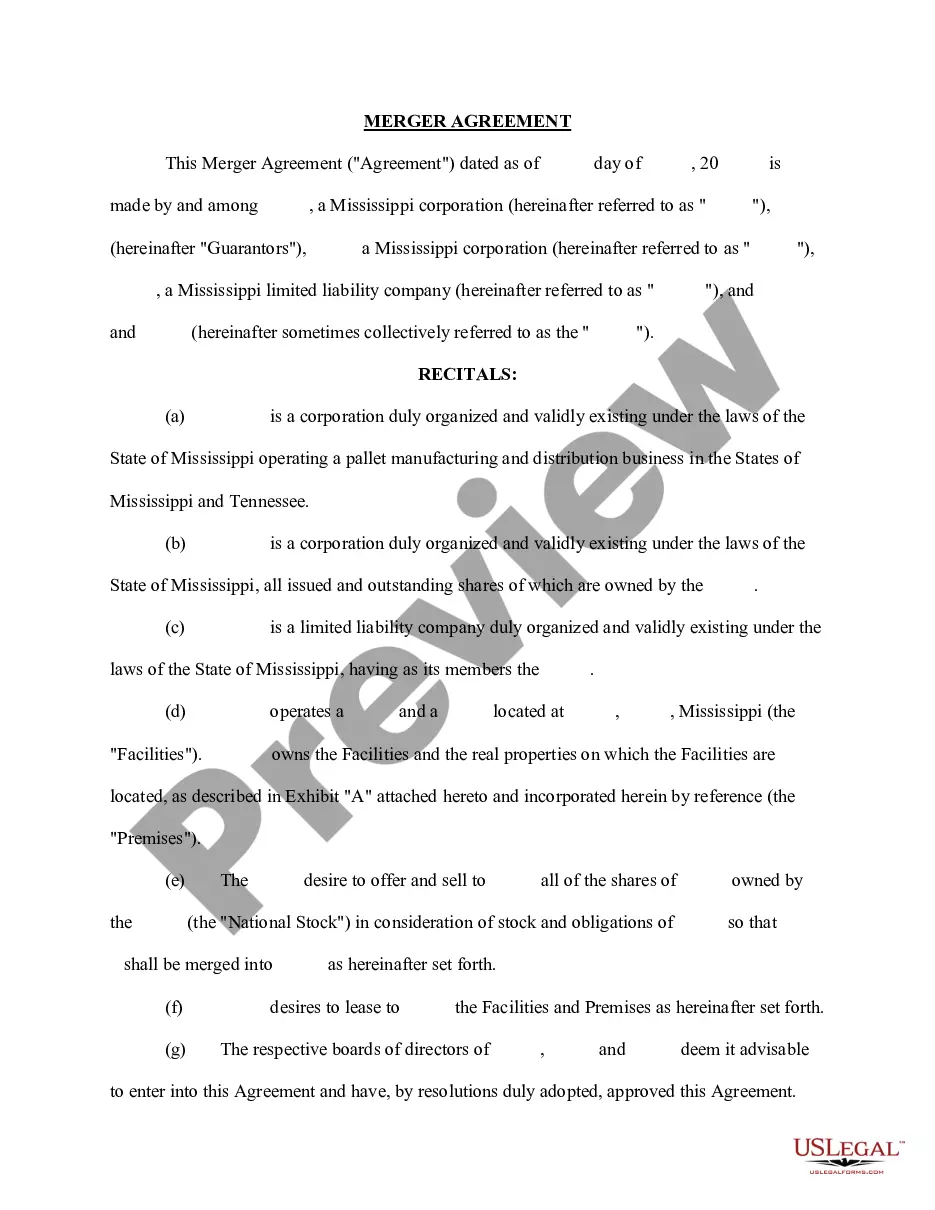
Louisiana Last Will and Testament - Testator Illiterate - Widow, No Children
Overview of this form
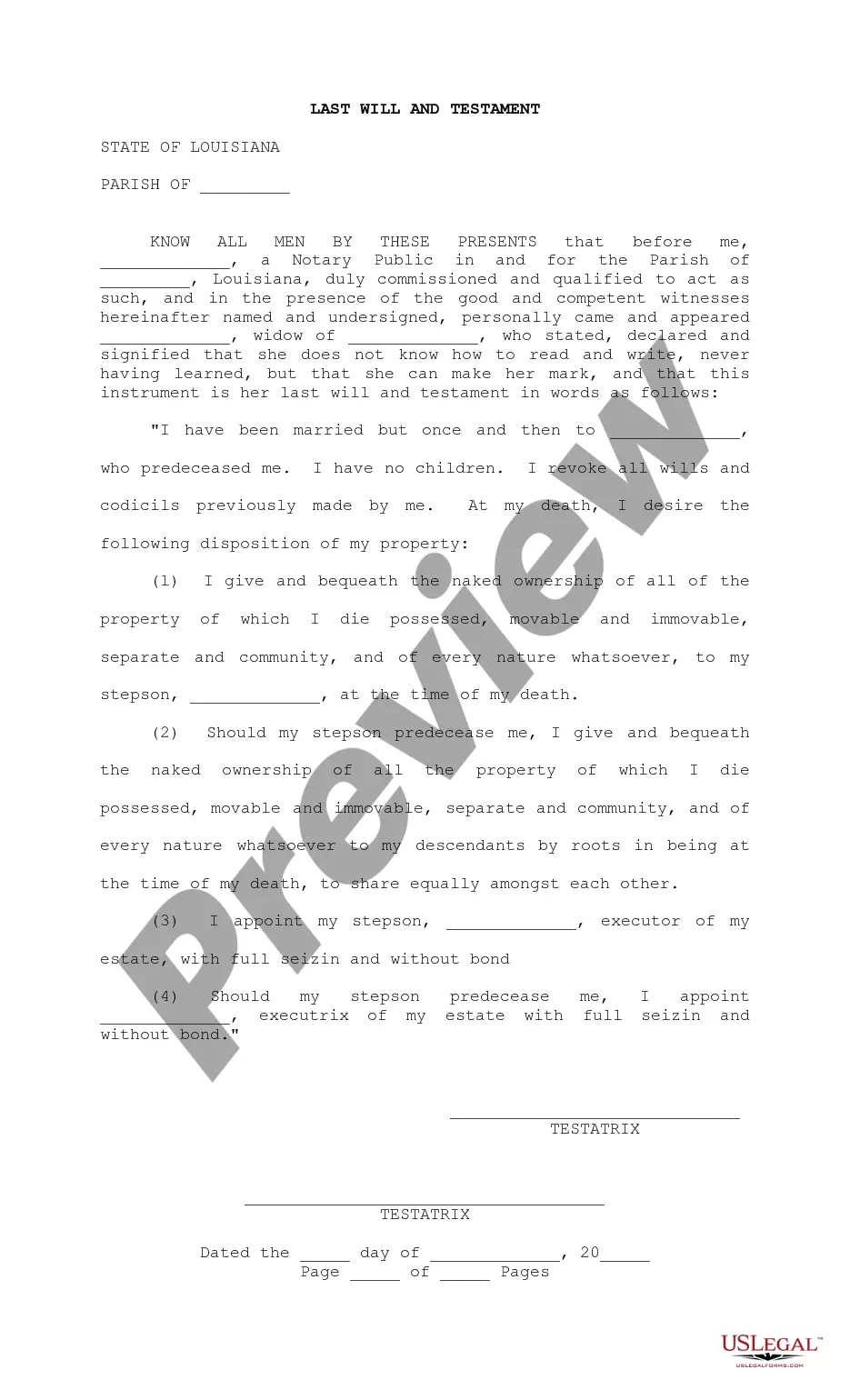
The Last Will and Testament - Testator Illiterate - Widow, No Children is a legal document that outlines the wishes of an individual who cannot read or write, regarding the distribution of their estate after their death. This specific form is tailored for a widow with no natural children, allowing her to designate her stepson as the recipient of her assets and as the executor of her estate. It is designed to comply with legal requirements for testators who are illiterate, ensuring the document is valid and enforceable.
Main sections of this form
- Identification of the Testatrix, including marital status and literacy.
- Revocation of any previously made wills and codicils.
- Specific bequests, assigning property to the stepson and provisions for descendants.
- Appointment of the stepson as executor, with an alternate executor named.
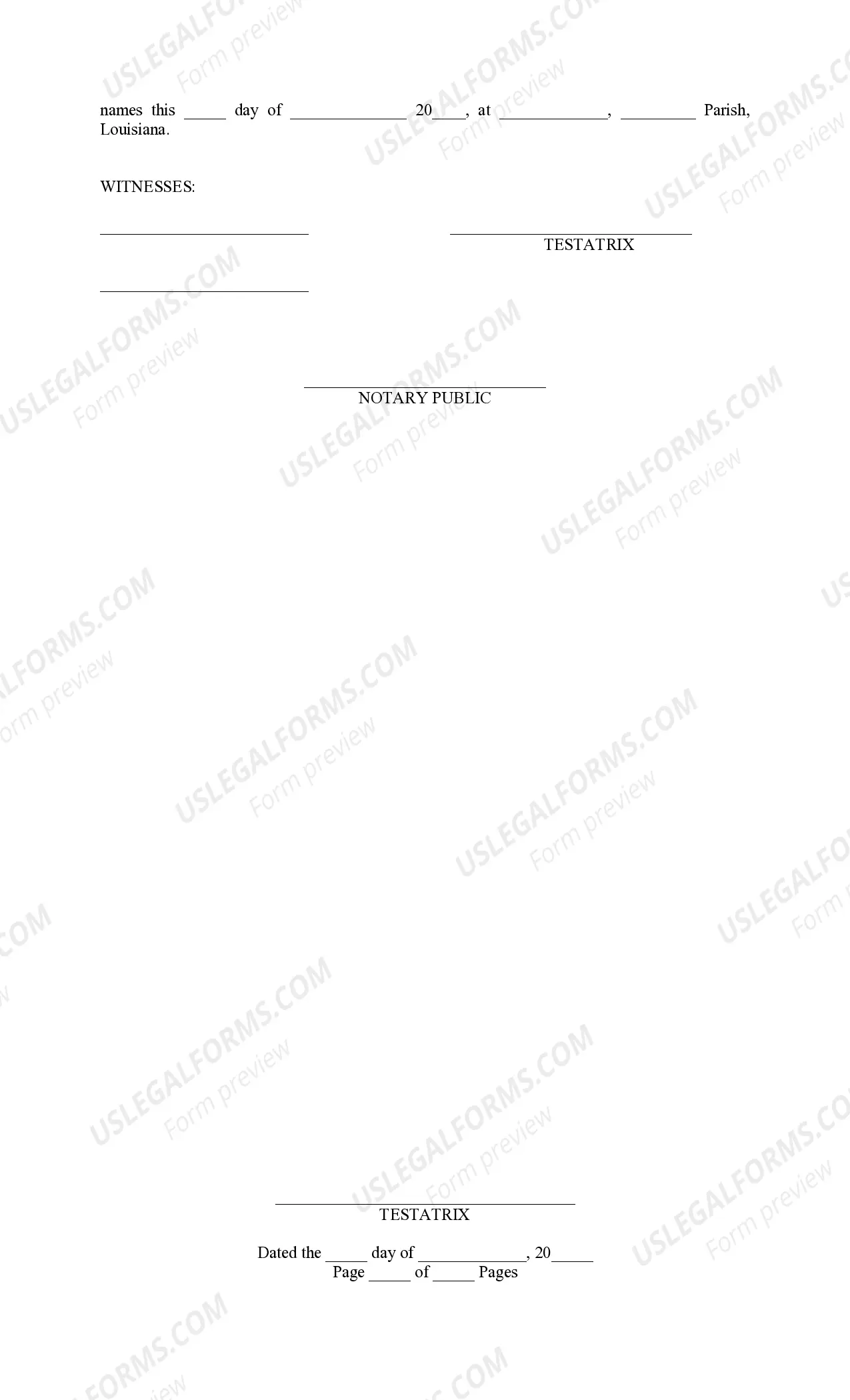
- Witnesses and notarization details to validate the will.




When to use this form
This form should be used when a person who is unable to read or write wishes to create a legally binding will. It is specifically intended for widows without children who want to ensure their estate is passed on to their stepson or, in his absence, to their descendants. This will clearly outline their wishes and appoint executors to manage the estate, protecting the Testatrix's intentions after her passing.
Who this form is for
- Individuals who are illiterate and cannot read or write.
- Widows or widowers with no natural children but with stepchildren.
- Persons wanting to appoint a particular individual as their estate executor.
- Individuals seeking to revoke any previous wills.
Instructions for completing this form
- Identify the Testatrix and provide her marital status and the fact that she is illiterate.
- State the revocation of all previous wills.
- Clearly specify the bequests of property to the stepson and outline provisions for descendants if necessary.
- Appoint the stepson as the executor and an alternate executor if he predeceases the Testatrix.
- Have the will read aloud by a notary and obtain signatures from witnesses.
Notarization guidance
Notarization is required for this form to take effect. Our online notarization service, powered by Notarize, lets you verify and sign documents remotely through an encrypted video session, available 24/7.
Get your form ready online
Our built-in tools help you complete, sign, share, and store your documents in one place.
Make edits, fill in missing information, and update formatting in US Legal Forms—just like you would in MS Word.
Download a copy, print it, send it by email, or mail it via USPS—whatever works best for your next step.
Sign and collect signatures with our SignNow integration. Send to multiple recipients, set reminders, and more. Go Premium to unlock E-Sign.
If this form requires notarization, complete it online through a secure video call—no need to meet a notary in person or wait for an appointment.
We protect your documents and personal data by following strict security and privacy standards.

Make edits, fill in missing information, and update formatting in US Legal Forms—just like you would in MS Word.

Download a copy, print it, send it by email, or mail it via USPS—whatever works best for your next step.

Sign and collect signatures with our SignNow integration. Send to multiple recipients, set reminders, and more. Go Premium to unlock E-Sign.

If this form requires notarization, complete it online through a secure video call—no need to meet a notary in person or wait for an appointment.

We protect your documents and personal data by following strict security and privacy standards.
Avoid these common issues
- Failing to have the will read aloud by a notary, which is crucial for validity.
- Not naming an alternate executor, which can complicate estate management.
- Omitting signatures from witnesses, which can lead to challenges in enforceability.
- Assuming previous wills are automatically revoked without explicit mention.
Benefits of completing this form online
- Convenience of downloading and completing the form at your own pace.
- Editability allows for personal tailoring to suit individual needs.
- Reliable templates drafted by licensed attorneys ensure legal compliance.
- Immediate access to necessary legal documentation without visiting an office.
Quick recap
- This Last Will and Testament is for individuals who cannot read or write.
- It ensures that the testator's wishes are legally documented and enforced.
- Notarization is required for validation in Louisiana.
- Proper completion and witnessing are crucial to avoid legal issues later.
Looking for another form?

Form popularity
FAQ
Form a Last Will in Louisiana Witnesses: At least two people must sign a declaration signifying that they have witnessed the testator signing the will or declaring the document to be his will. This must be done in the presence of a notary. Writing: A Louisiana will must be in writing to be valid.
Create the initial document. Start by titling the document Last Will and Testament" and including your full legal name and address. Designate an executor. Appoint a guardian. Name the beneficiaries. Designate the assets. Ask witnesses to sign your will. Store your will in a safe place.
In order to satisfy legal requirements in Louisiana, a will must be signed by two (2) witnesses who have attested the testator's signature. In addition, a will must be notarized by a state-authorized individual and registered with the Secretary of State's Office.
In order to satisfy legal requirements in Louisiana, a will must be signed by two (2) witnesses who have attested the testator's signature. In addition, a will must be notarized by a state-authorized individual and registered with the Secretary of State's Office.
Although a last will and testament is not legally required, without a will, state laws (called laws of intestacy) will determine the distribution of the deceased's assets.In Louisiana, a Petition for Probate of Testament must be filed with the court to request the recognition of the will as valid.
To formally contest the will, you must file a Petition of Objection in the court where the will is filed for probate. Once your petition is filed and the court determines you have standing, you will be allowed to enter evidence and argue your case.
The general requirements for a valid Will are usually as follows: (a) the document must be written (meaning typed or printed), (b) signed by the person making the Will (usually called the testator or testatrix, and (c) signed by two witnesses who were present to witness the execution of the document by the maker
A. You don't have to have a lawyer to create a basic will you can prepare one yourself. It must meet your state's legal requirements and should be notarized.A do-it-yourself will that's poorly drafted can save you money but create a mess for your heirs when you're gone.