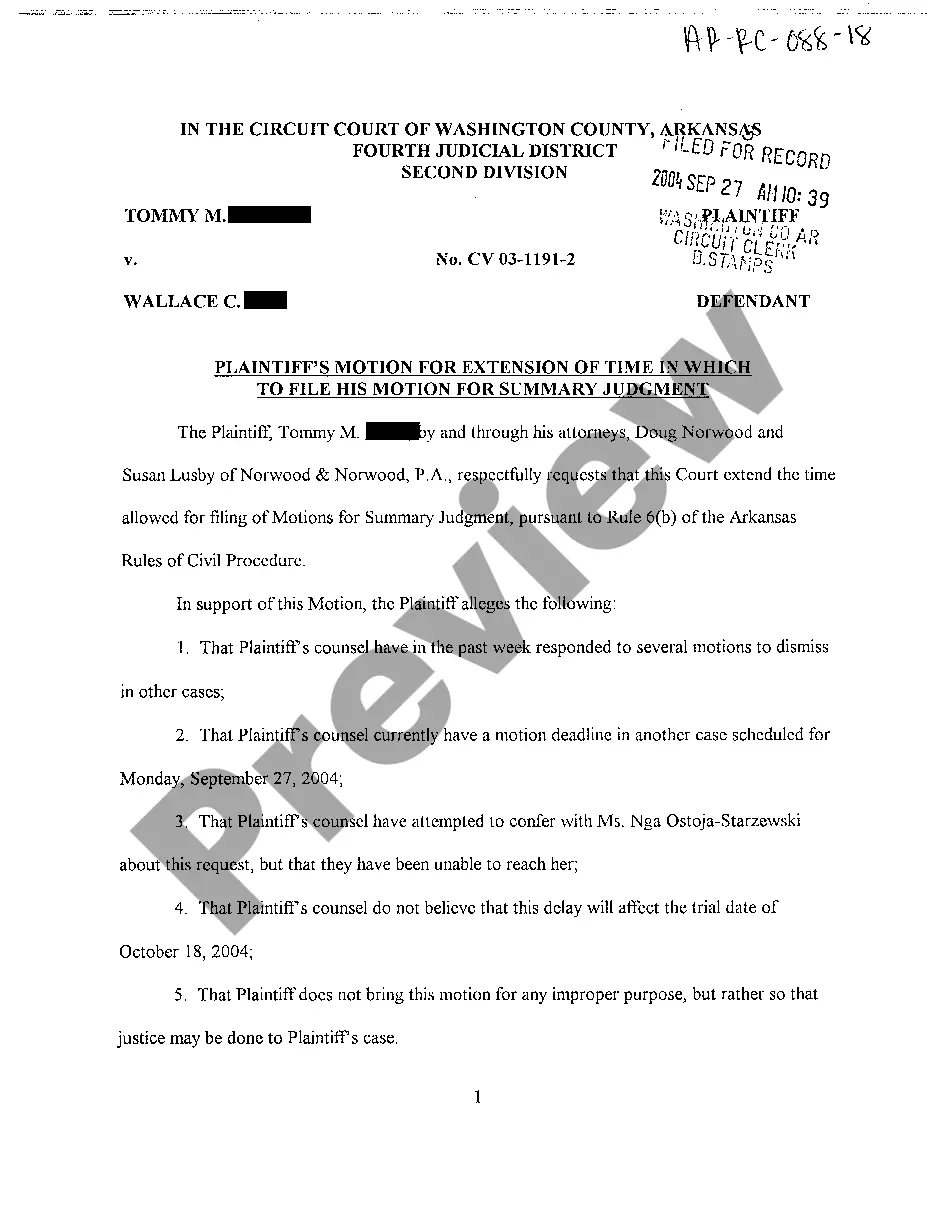
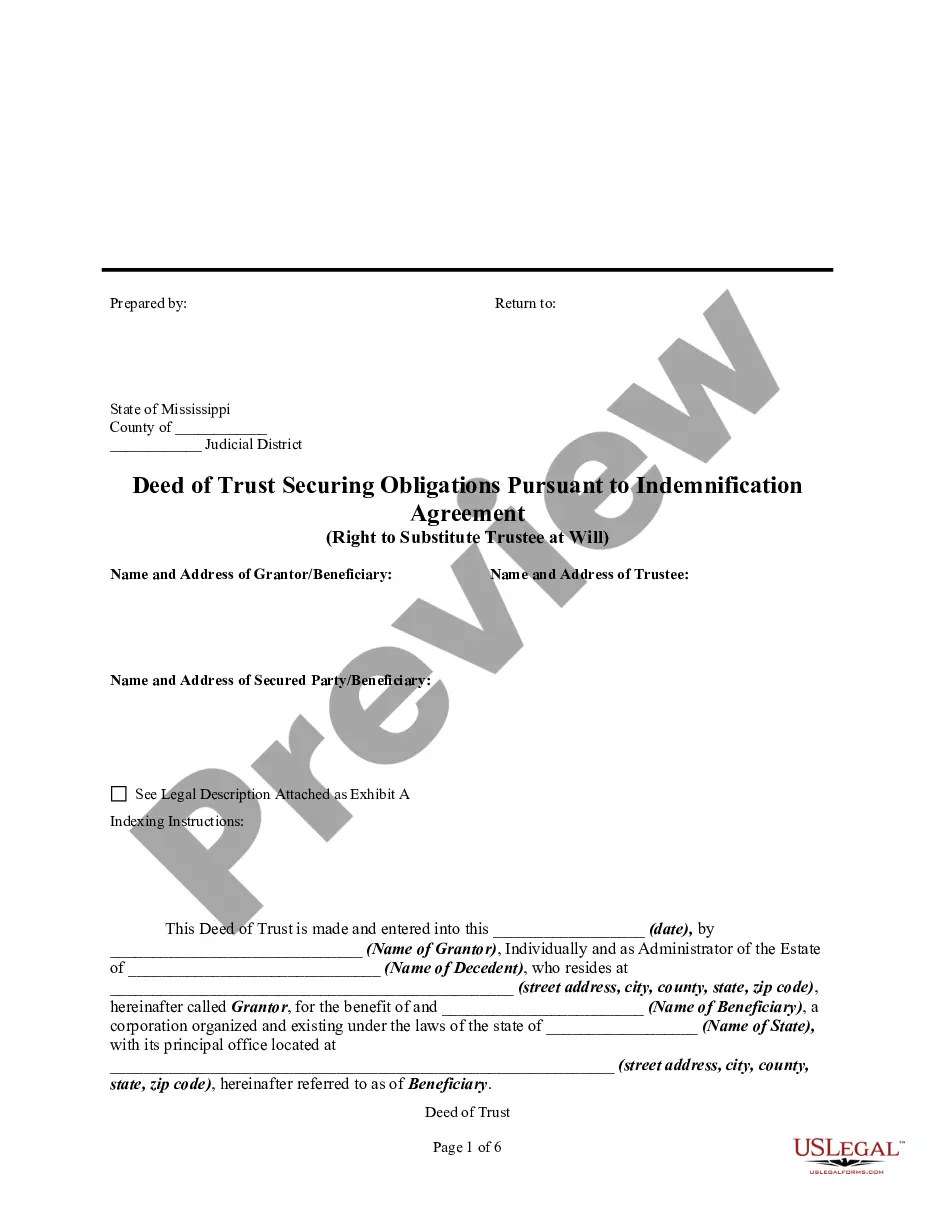
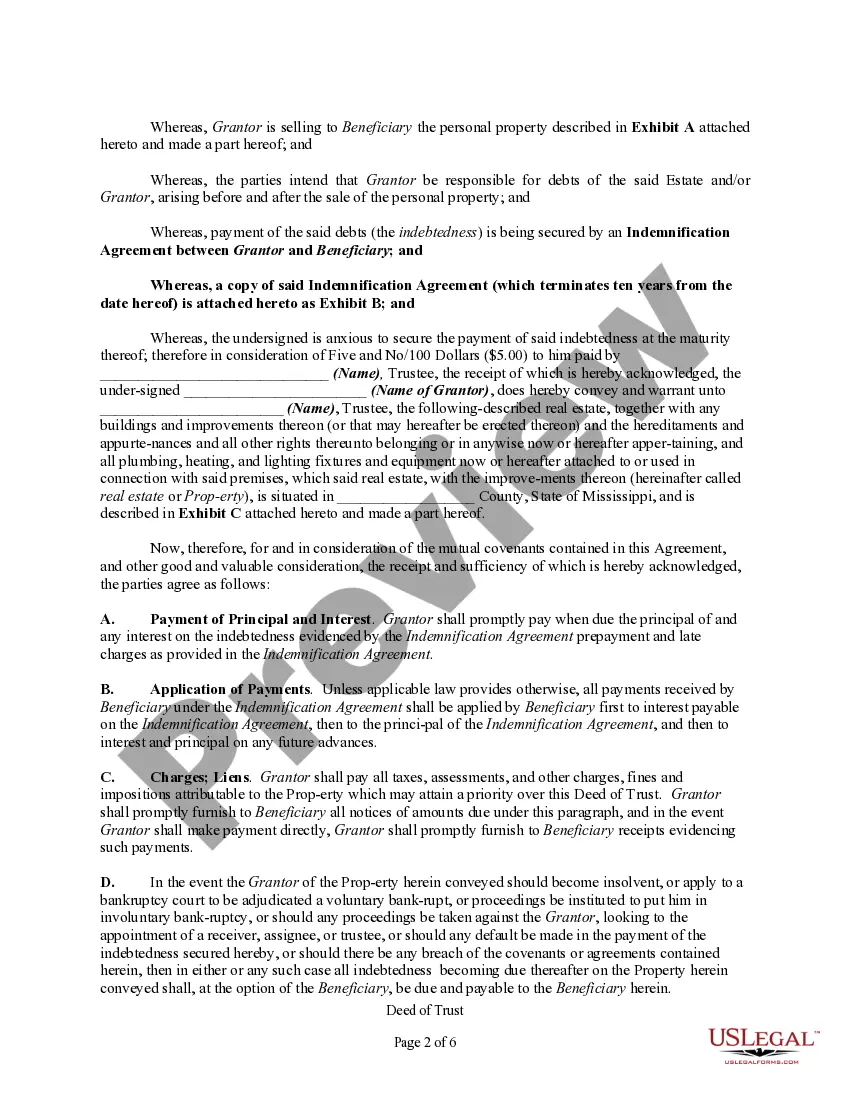
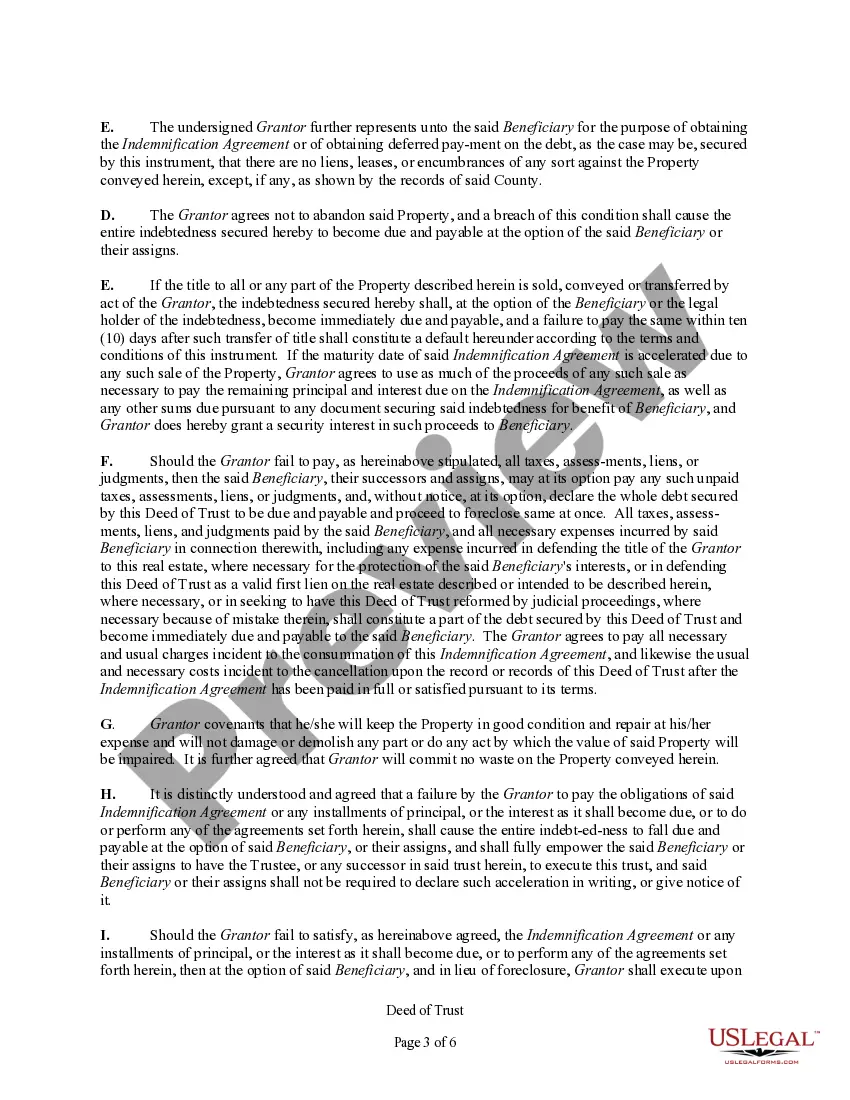
Mississippi Deed of Trust Securing Obligations Pursuant to Indemnification Agreement
What is this form?
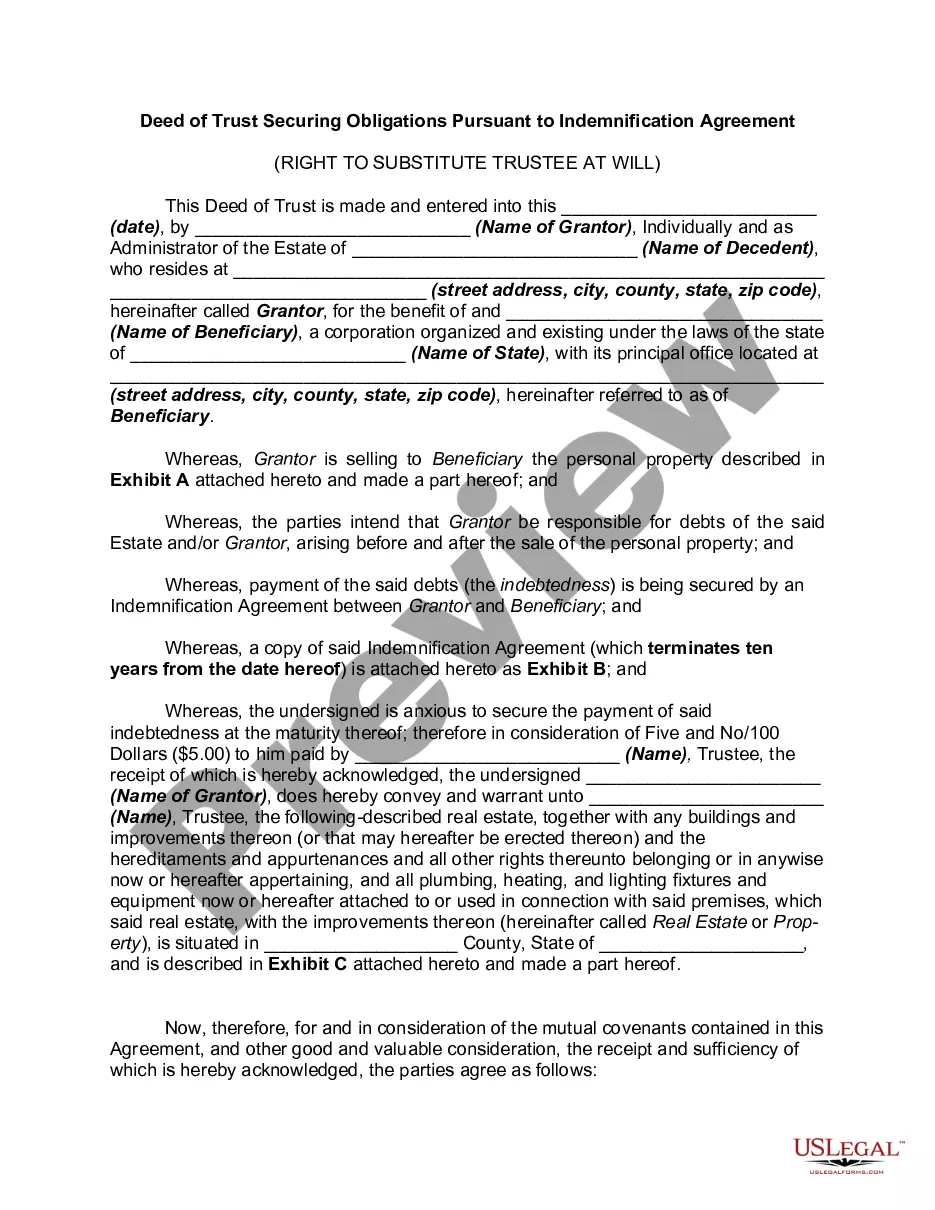
The deed of trust securing obligations pursuant to an indemnification agreement is a legal document that secures the obligations of the parties involved rather than the payment of a promissory note. This form provides a structured way for a grantor to transfer property to a trustee on behalf of a beneficiary, ensuring that financial obligations outlined in the indemnification agreement are met. This differs from a traditional deed of trust, which typically secures loan repayment.
Main sections of this form
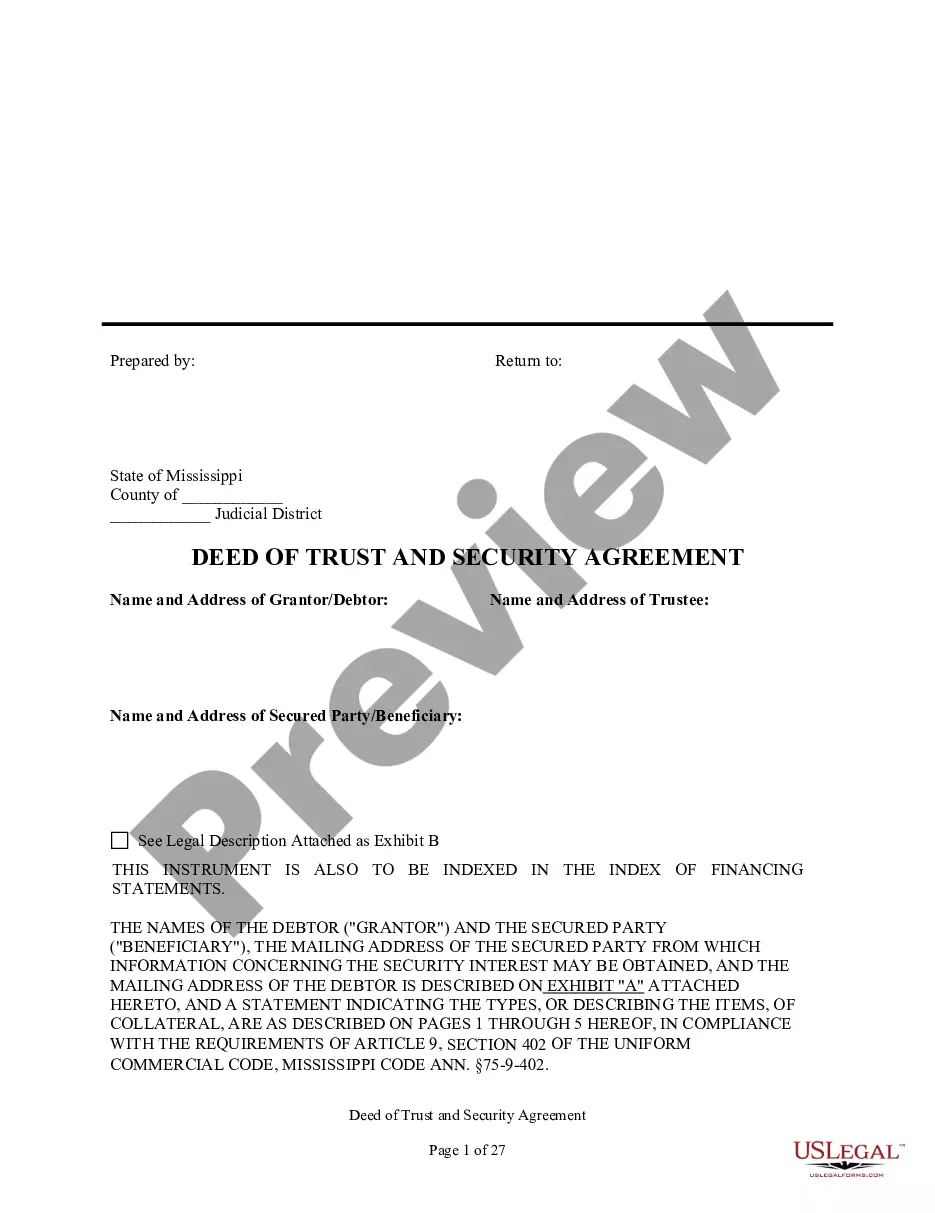
- Identification of the Grantor, Trustee, and Beneficiary involved in the agreement.
- Description of the property being secured and its inclusion in exhibits.
- Terms of payment for the principal and interest as per the indemnification agreement.
- Conditions under which the indebtedness becomes due and payable.
- Requirements for the maintenance and improvement of the property.
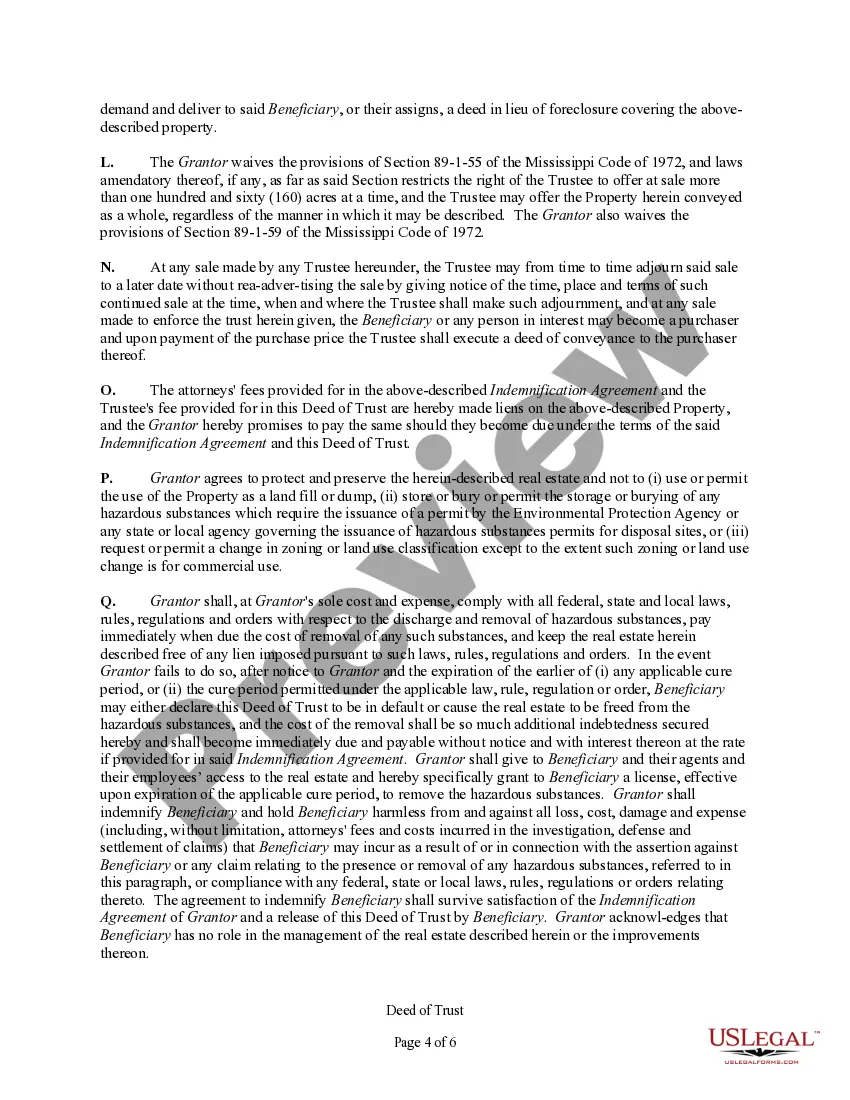
- Provisions related to compliance with environmental laws and regulations.
Situations where this form applies
This form is typically used when a grantor needs to secure the obligations arising from an indemnification agreement, particularly in a real estate context. It is relevant when a party is transferring property while wanting to ensure that any debts or obligations incurred either before or after the transfer are legally supported by the deed of trust. This form can protect the interests of the beneficiary in fulfilling any responsibilities outlined in the indemnification agreement.
Who needs this form
- Grantors who are transferring property and want to secure their obligations.
- Beneficiaries needing assurance that debts related to the property are met.
- Trustees appointed to oversee and manage the terms of the trust.
- Individuals involved in real estate transactions where indemnification agreements are present.
Completing this form step by step
- Identify all parties involved: the grantor, the trustee, and the beneficiary.
- Provide a clear description of the property being secured, including address and legal description.
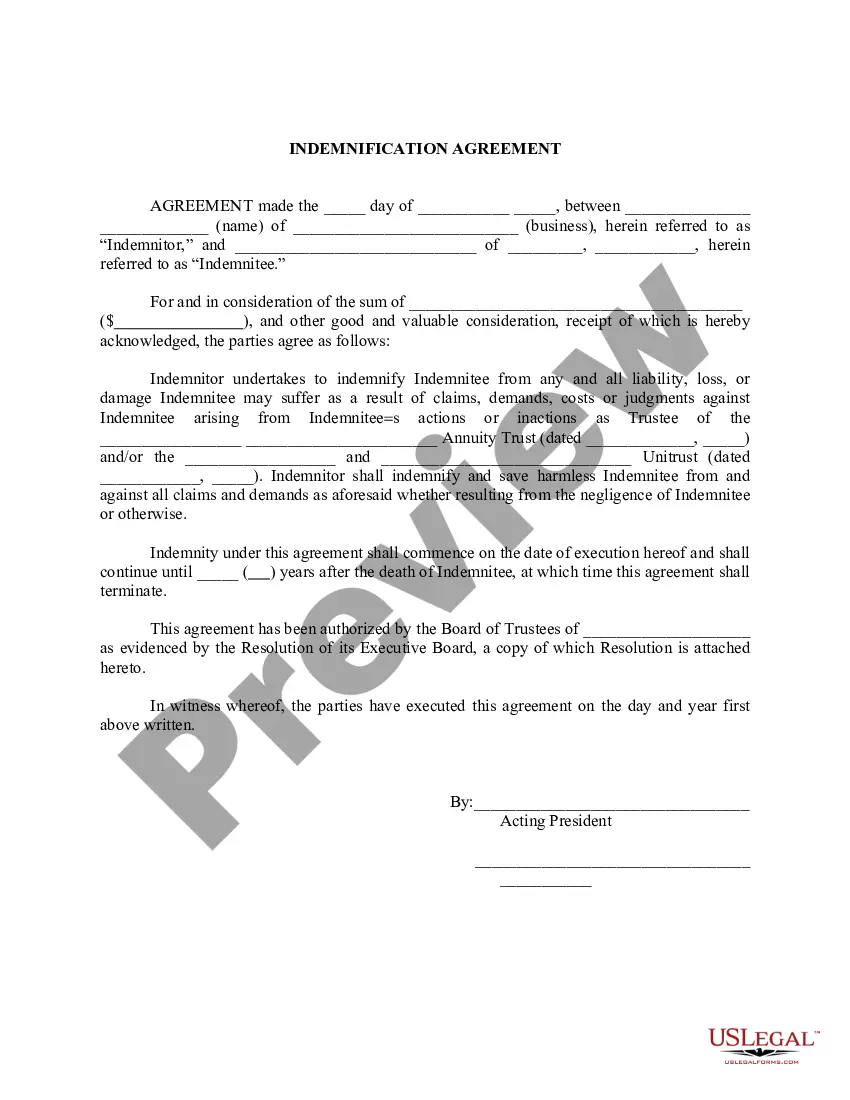
- Detail the specific obligations or debts covered under the indemnification agreement.
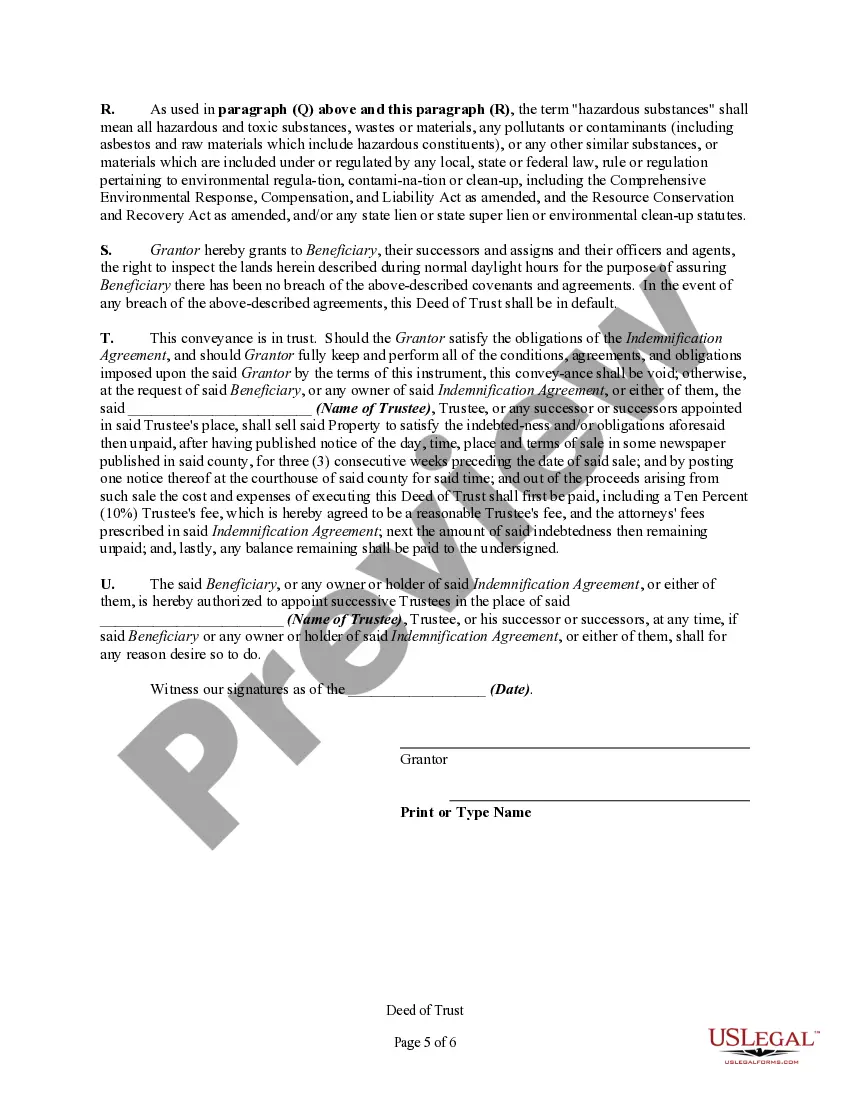
- Sign and date the document in the presence of a notary public, if required.
- Attach necessary exhibits, including the indemnification agreement and any relevant property descriptions.
Is notarization required?
This form must be notarized to be legally valid. Using US Legal Forms, you can enjoy integrated online notarization services that provide 24/7 availability, allowing you to complete the process via secure video calls without needing to travel.
Get your form ready online
Our built-in tools help you complete, sign, share, and store your documents in one place.
Make edits, fill in missing information, and update formatting in US Legal Forms—just like you would in MS Word.
Download a copy, print it, send it by email, or mail it via USPS—whatever works best for your next step.
Sign and collect signatures with our SignNow integration. Send to multiple recipients, set reminders, and more. Go Premium to unlock E-Sign.
If this form requires notarization, complete it online through a secure video call—no need to meet a notary in person or wait for an appointment.
We protect your documents and personal data by following strict security and privacy standards.

Make edits, fill in missing information, and update formatting in US Legal Forms—just like you would in MS Word.

Download a copy, print it, send it by email, or mail it via USPS—whatever works best for your next step.

Sign and collect signatures with our SignNow integration. Send to multiple recipients, set reminders, and more. Go Premium to unlock E-Sign.

If this form requires notarization, complete it online through a secure video call—no need to meet a notary in person or wait for an appointment.

We protect your documents and personal data by following strict security and privacy standards.
Common mistakes
- Failing to clearly identify all parties involved in the deed of trust.
- Not providing an accurate description of the property.
- Omitting necessary exhibits or appendices that support the agreement.
- Inadequately stating the terms of the obligations being secured.
- Not having the document notarized if required by local law.
Benefits of using this form online
- Convenience of accessing and completing forms from any location.
- Ease of editing sections to suit specific needs without hassle.
- Immediate availability of attorney-drafted forms ensures legal accuracy.
- Reduction of paperwork errors through guided instructions and checklists.
- Secure storage options for completed documents.
Quick recap
- The deed of trust secures obligations under an indemnification agreement, distinct from traditional promissory notes.
- Proper completion ensures legal validity, including property description and signatures.
- Compliance with state-specific laws is essential, particularly in Mississippi.
- Notarization is necessary for legal enforceability.
Looking for another form?
Form popularity
FAQ
In a deed of trust, the borrower is called the trustor and the lender is the beneficiary. The trustee holds title to the property until the trustor has fully repaid the loan to the beneficiary, at which time the lender notifies the trustee, who then transfers full title of the property to the trustor.
Party information: names and addresses of the trustor(s), trustee(s), beneficiary(ies), and guarantor(s) (if applicable) Property details: full address of the property and its legal description (which can be obtained from the County Recorder's Office)
Whether you have a deed of trust or a mortgage, they both serve to assure that a loan is repaid, either to a lender or an individual person. A mortgage only involves two parties the borrower and the lender. A deed of trust adds an additional party, a trustee, who holds the home's title until the loan is repaid.
Yes, there are key differences between the two. With a deed, you transfer the ownership of the property to one party. In contrast, a deed of trust does not mean the holder owns the property. In an arrangement involving a deed of trust, the borrower signs a contract with the lender with details regarding the loan.
A deed of indemnity is a contractual agreement between a company and a company director. A deed of indemnity can help to indemnify a director against liabilities or legal costs incurred in his or her professional capacity as a director of the company.
The trustee's primary function is to hold and maintain a property title for the borrower and the lender for the duration of the loan. Therefore, it is the trustee who retains factual ownership and control of the property in question, not the lender.
A point is 1% of the purchase price of the property being offered as security for the loan. In the event of a borrower's default, a subordination clause makes foreclosure easier by giving a lender the right to declare the entire debt due and payable.
Indemnity clauses in trust deeds However, a trustee has a right of indemnity out of the trust fund, which is recognised by law subject to the condition that the liability is incurred in proper execution of trust duties.
Giving the wrong legal address for the property or the wrong amount of the debt can render the deed unenforceable. In some cases, the error is easy to fix, and the court will rule the deed is enforceable.