Runner Agreement - Self-Employed Independent Contractor
Overview of this form
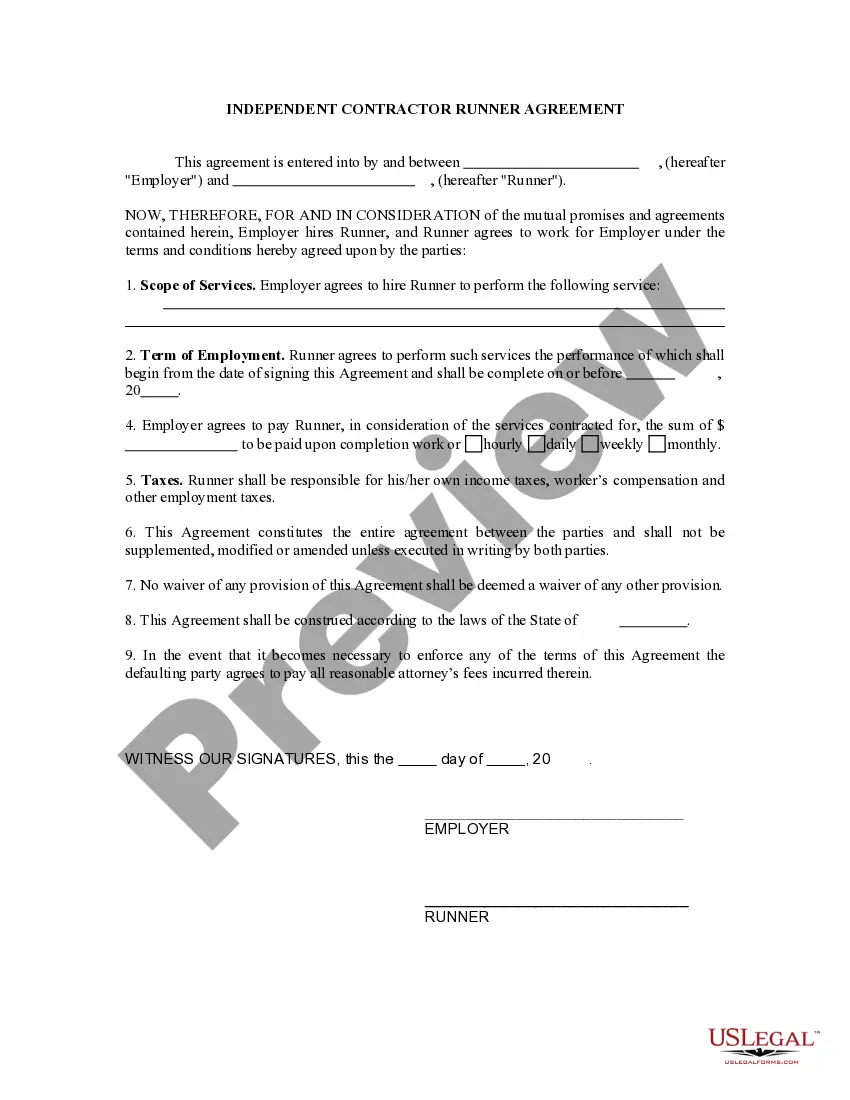
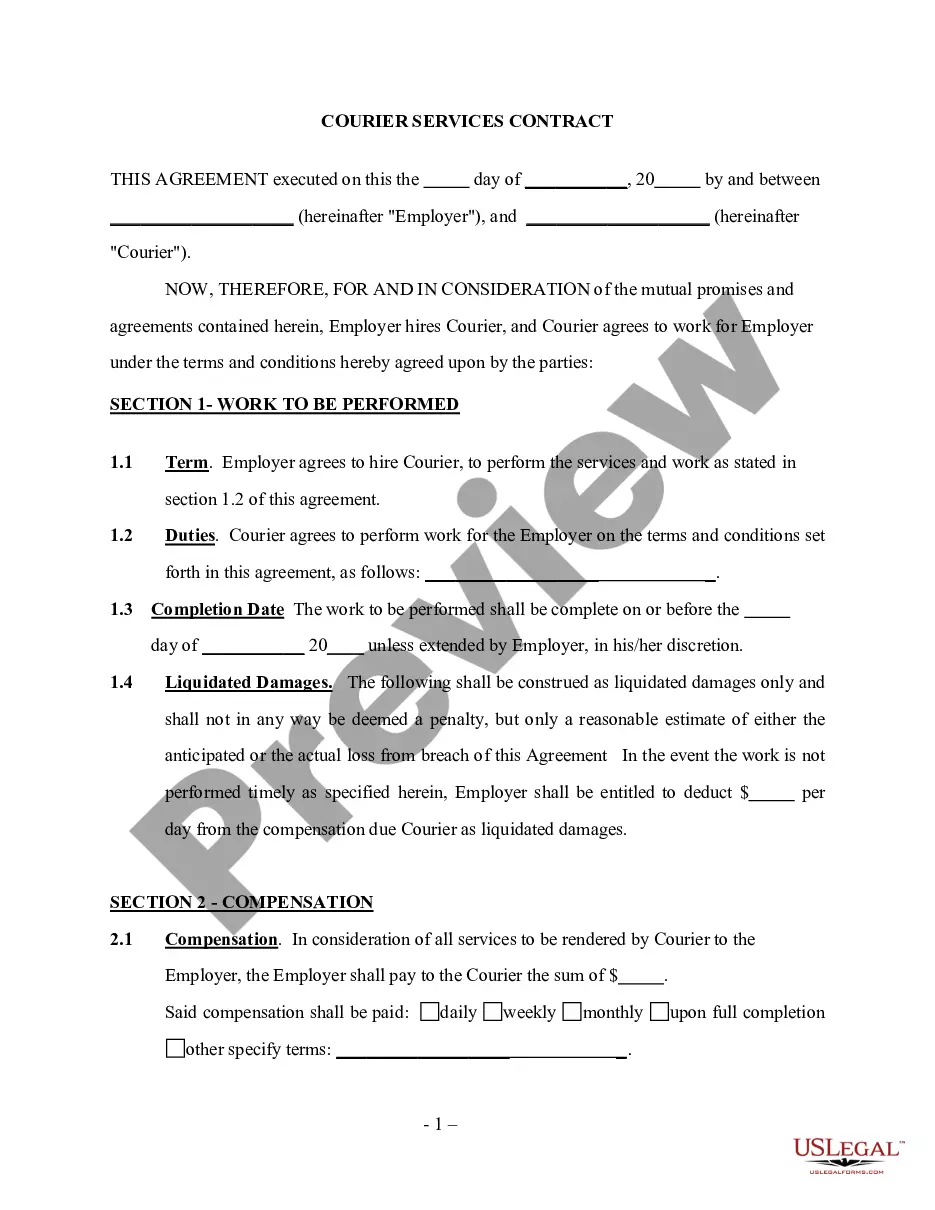
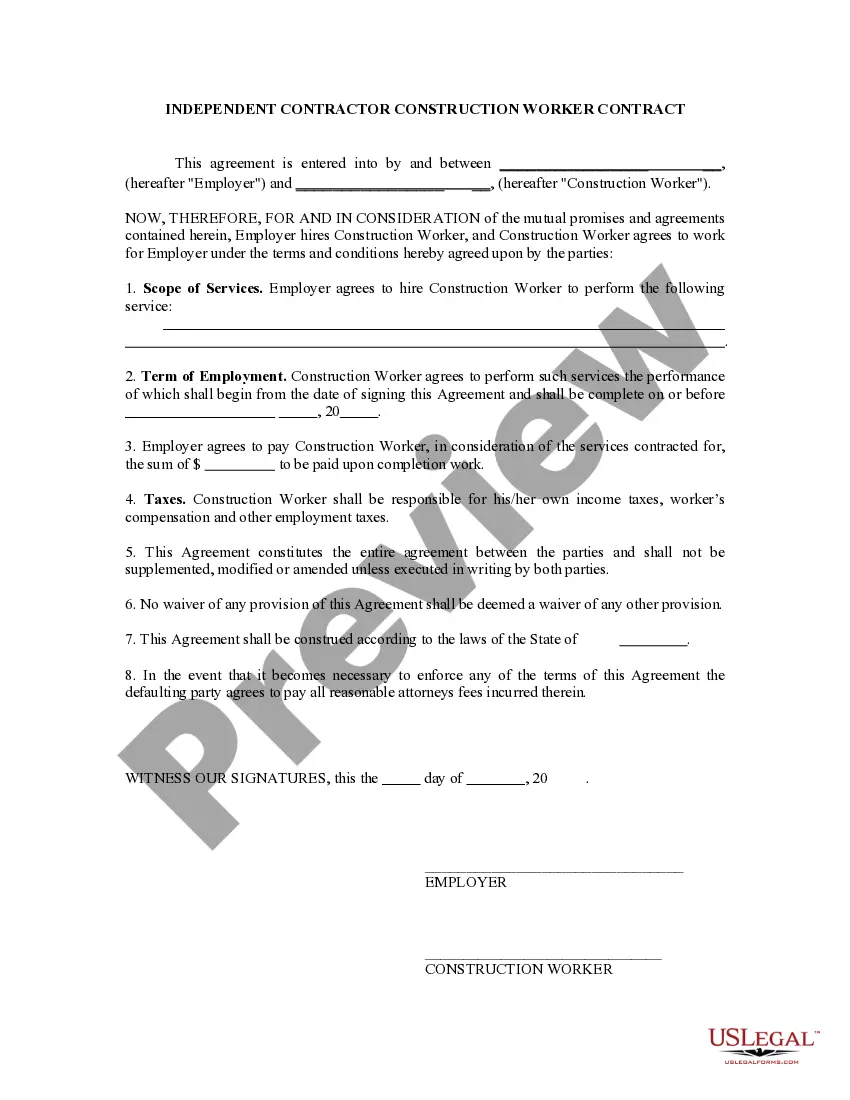
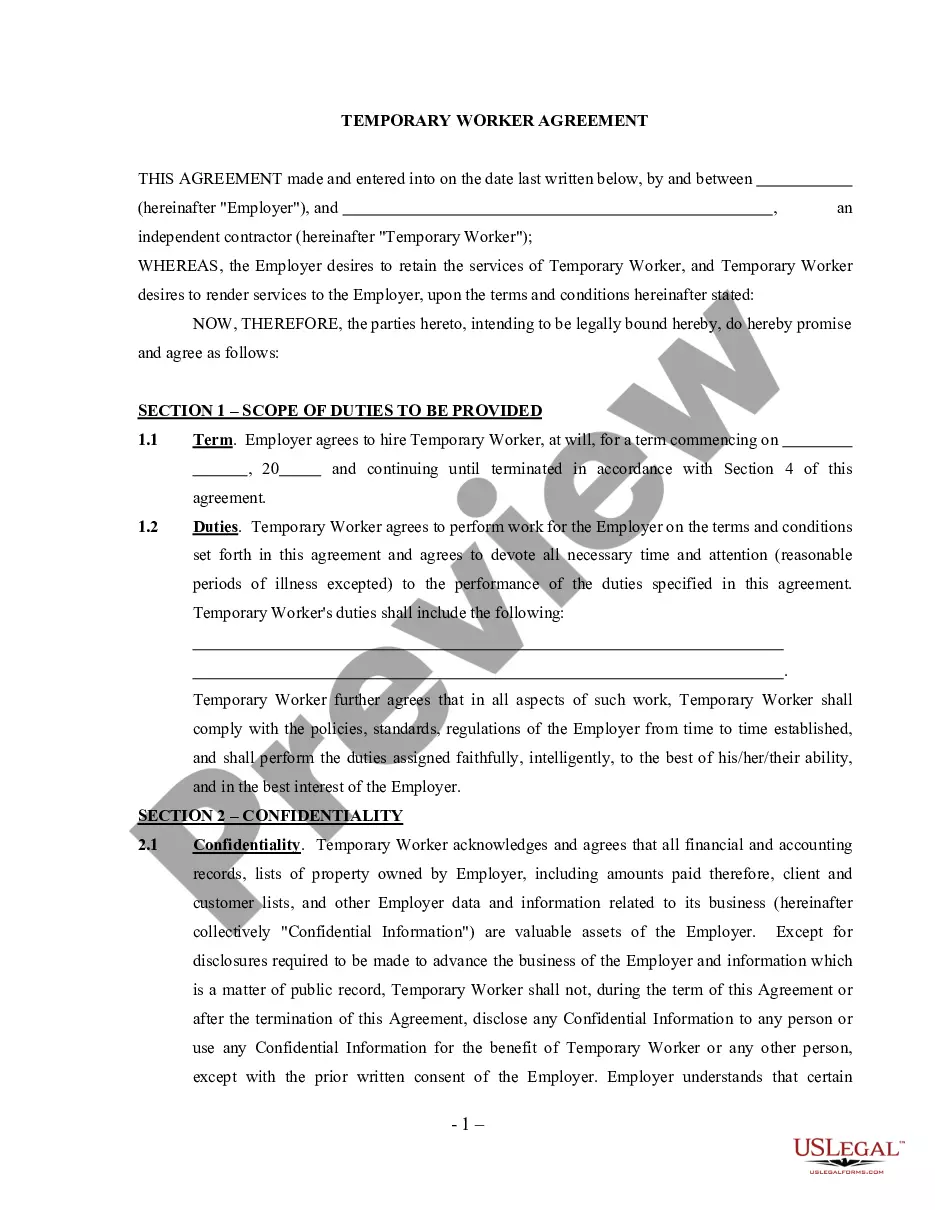
The Runner Agreement - Self-Employed Independent Contractor is a legal contract that formalizes the relationship between an employer and a runner. It stipulates the terms under which a runner is hired as an independent contractor, ensuring clear expectations and responsibilities. This agreement is distinct from traditional employment contracts, as it highlights the independent nature of the contractor's role and the flexibility that comes with it.
Form components explained
- Scope of Services: Details the specific activities the runner will perform.
- Compensation: Outlines how and when the runner will be paid.
- Term of Agreement: Specifies the duration this contract is effective.
- Indemnification: Clarifies liability and risk management between parties.
- Termination: Describes the conditions under which the agreement can be ended.

When to use this document
This agreement is essential when an employer wishes to hire a runner for tasks such as deliveries, errands, or other specified services on a contract basis. It is particularly useful in situations where the employer needs flexibility and does not wish to establish a traditional employer-employee relationship.
Who this form is for
- Employers looking to hire a runner as an independent contractor.
- Individuals or businesses needing a clear contract to outline service expectations.
- Entrepreneurs and small business owners who require assistance with non-core activities.
Completing this form step by step
- Identify the parties involved: Clearly state the names and contact information of the employer and the runner.
- Define the scope of services: Specify the tasks the runner is expected to perform.
- Enter the compensation details: Outline the payment structure, including any applicable rates.
- Set the term of the agreement: Indicate how long the contract will be in effect.
- Include the termination clause: Describe the conditions under which either party can end the agreement.
Notarization guidance
This form does not typically require notarization to be legally valid. However, some jurisdictions or document types may still require it. US Legal Forms provides secure online notarization powered by Notarize, available 24/7 for added convenience.
Get your form ready online
Our built-in tools help you complete, sign, share, and store your documents in one place.
Make edits, fill in missing information, and update formatting in US Legal Forms—just like you would in MS Word.
Download a copy, print it, send it by email, or mail it via USPS—whatever works best for your next step.
Sign and collect signatures with our SignNow integration. Send to multiple recipients, set reminders, and more. Go Premium to unlock E-Sign.
If this form requires notarization, complete it online through a secure video call—no need to meet a notary in person or wait for an appointment.
We protect your documents and personal data by following strict security and privacy standards.

Make edits, fill in missing information, and update formatting in US Legal Forms—just like you would in MS Word.

Download a copy, print it, send it by email, or mail it via USPS—whatever works best for your next step.

Sign and collect signatures with our SignNow integration. Send to multiple recipients, set reminders, and more. Go Premium to unlock E-Sign.

If this form requires notarization, complete it online through a secure video call—no need to meet a notary in person or wait for an appointment.

We protect your documents and personal data by following strict security and privacy standards.
Avoid these common issues
- Not clearly defining the scope of services, leading to misunderstandings.
- Failing to outline payment terms, which can create disputes later.
- Ignoring local laws that may impact independent contractor agreements.
Benefits of completing this form online
- Convenience of accessing and downloading the agreement anytime.
- Editable templates that allow you to customize the form easily.
- Access to legally compliant documents drafted by licensed attorneys.
What to keep in mind
- The Runner Agreement clearly outlines the working relationship between an employer and a self-employed contractor.
- It's essential to detail the scope of services and payment terms to prevent disputes.
- This form can be used across multiple states, but it's important to check local laws regarding independent contractors.
Looking for another form?
Form popularity
FAQ
The earnings of a person who is working as an independent contractor are subject to Self-Employment Tax. If you are an independent contractor, you are self-employed. To find out what your tax obligations are, visit the Self-Employed Tax Center.
Protect your social security number. Have a clearly defined scope of work and contract in place with clients. Get general/professional liability insurance. Consider incorporating or creating a limited liability company (LLC).
A: It is possible to transition an employee to a contactor if the worker truly meets the legal tests for independent contractor status.If the work is a core service of the nonprofit, it is less likely that the worker would have sufficient control over the work product to establish independent contractor status.
An Independent Contractor Agreement should contain all of these basic terms: Description of the services to be provided.Explanation of what the hiring party will provide or not provide, such as equipment, for the independent contractor to use. Ownership of work product if that is relevant to the work being performed.
The consequences of misclassification can be grave. Besides owing back taxes to the feds, the business will also owe state unemployment taxes and unpaid worker's compensation premiums, and may owe unpaid overtime or minimum wages, medical expenses and unpaid vacation and sick pay.
Criminal penalties of up to $1,000 per misclassified worker and one year in prison can be imposed as well. In addition, the person responsible for withholding taxes could also be held personally liable for any uncollected tax.
File Your Tax Return with IRS Form 8919.If you think you've been misclassified as a contractor, you can avoid having to pay more than half of these taxes yourself by filing IRS Form 8919, Uncollected Social Security and Medicare Tax on Wages.You filed a Form SS-8 and the IRS has determined that you are an employee.
Simply put, being an independent contractor is one way to be self-employed. Being self-employed means that you earn money but don't work as an employee for someone else.An independent contractor is someone who provides a service on a contractual basis.
When you have mistakenly marked someone as an independent contractor, you don't pay social security, Medicare, and other employment taxes on behalf of that individual. This results in a major loss for the government which makes taxpayers suffer and hurts the economy.