Warehouse Receipt for Grain
What is this form?
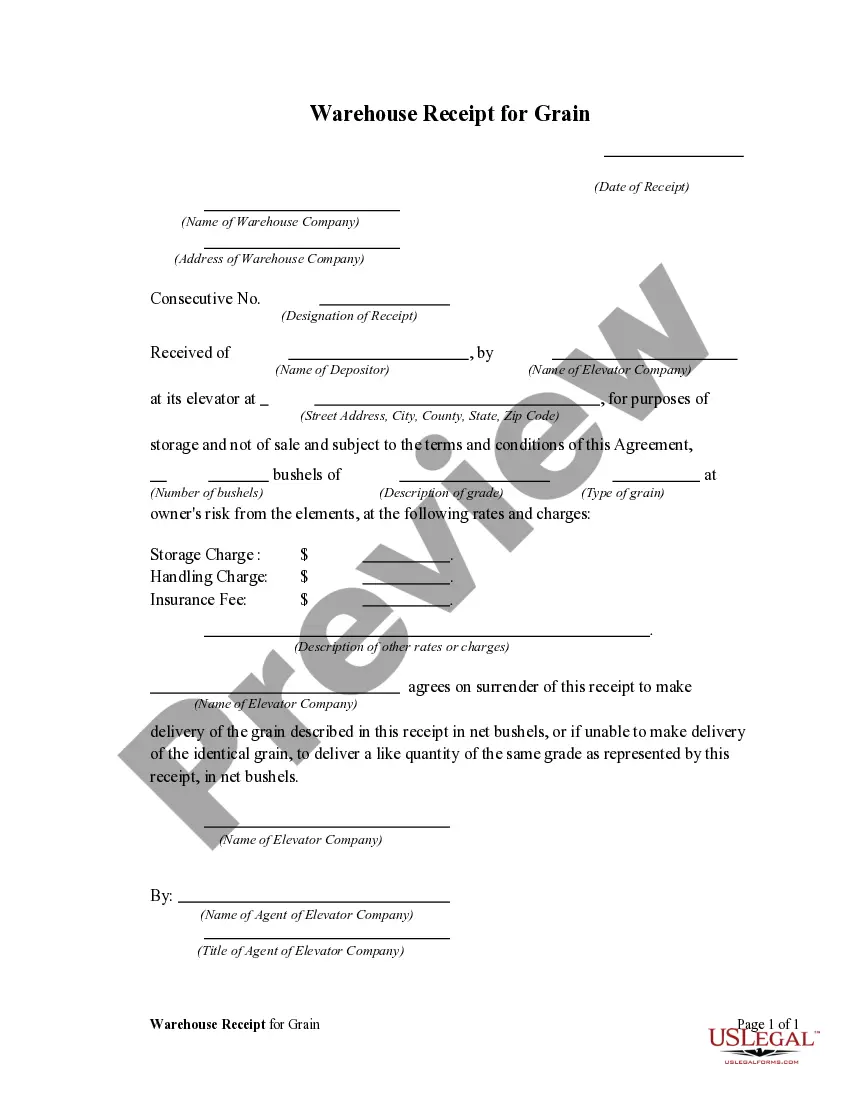
A Warehouse Receipt for Grain is a legal document that serves as proof of ownership for grains stored in a warehouse. It formalizes the relationship between the grain owner and the warehouse, distinguishing itself from similar documents by specifying the type of commodity and the conditions under which it is stored. This type of receipt can be negotiable, allowing for the easy transfer of ownership, or non-negotiable, requiring endorsement for transfer.
Form components explained
- Identification of the warehouse and storage location.
- Description of the grain, including type and quantity.
- Terms governing the storage, such as duration and fees.
- Details on ownership transfer rights (negotiable vs. non-negotiable).
- Signatures of authorized parties, typically the warehouse operator and the grain owner.

Situations where this form applies
You should use the Warehouse Receipt for Grain when you need to store grain in a warehouse and require formal documentation of ownership. This form is essential when seeking financing against the stored grain, as it can serve as collateral for loans. Additionally, it is useful if you plan to transfer ownership to another party without the need for physical movement of the grain.
Who this form is for
- Farmers and grain producers needing to document ownership of stored grain.
- Warehouse operators who must provide receipts for commodities stored.
- Individuals or businesses that intend to use the grain as collateral for loans.
Instructions for completing this form
- Identify the warehouse and its location.
- Describe the type and quantity of grain being stored.
- Include terms of storage, including any applicable fees.
- Indicate whether the receipt is negotiable or non-negotiable.
- Obtain the signatures of the warehouse operator and the grain owner.
Notarization guidance
Notarization is generally not required for this form. However, certain states or situations might demand it. You can complete notarization online through US Legal Forms, powered by Notarize, using a verified video call available anytime.
Get your form ready online
Our built-in tools help you complete, sign, share, and store your documents in one place.
Make edits, fill in missing information, and update formatting in US Legal Forms—just like you would in MS Word.
Download a copy, print it, send it by email, or mail it via USPS—whatever works best for your next step.
Sign and collect signatures with our SignNow integration. Send to multiple recipients, set reminders, and more. Go Premium to unlock E-Sign.
If this form requires notarization, complete it online through a secure video call—no need to meet a notary in person or wait for an appointment.
We protect your documents and personal data by following strict security and privacy standards.

Make edits, fill in missing information, and update formatting in US Legal Forms—just like you would in MS Word.

Download a copy, print it, send it by email, or mail it via USPS—whatever works best for your next step.

Sign and collect signatures with our SignNow integration. Send to multiple recipients, set reminders, and more. Go Premium to unlock E-Sign.

If this form requires notarization, complete it online through a secure video call—no need to meet a notary in person or wait for an appointment.

We protect your documents and personal data by following strict security and privacy standards.
Common mistakes
- Failing to accurately describe the type and quantity of grain.
- Not specifying terms related to transfer of ownership.
- Omitting signatures or dates, which can render the receipt invalid.
- Incorrectly choosing between a negotiable and non-negotiable receipt.
Why use this form online
- Convenient access allows for quick completion and download.
- Forms are prepared with legal expertise to ensure compliance.
- Editable fields let you customize the document to your needs.
- Availability of templates for various states saves time and effort.
Looking for another form?


Form popularity
FAQ
Any written instrument, such as a bill of lading, a warehouse receipt, or an order for the delivery of goods, that in the usual course of business or financing is considered sufficient proof that the person who possesses it is entitled to receive, hold, and dispose of the instrument and the goods that it covers.
Warehouse receipt. Receipt of goods or materials left for safekeeping in a warehouse. It is a non-negotiable instrument if it permits delivery only to a named entity; a negotiable instrument when bearer or made out to the order of the holder.
Term. Whiskey warehouse receipts. Definition. Security: Represent a share in a quantity of whiskey being aged for future sales.
Negotiable warehouse receipt, which was launched in 2011, allows transfer of ownership of that commodity stored in a warehouse without having to deliver the physical commodity. These receipts are issued in negotiable form, making them eligible as collateral for loans.
A warehouse receipt system (WRS) enables farmers to deposit storable goods (usually grains or coffee) in exchange for a warehouse receipt (WR). A WR is a document issued by warehouse operators as evidence that specified commodities of stated quantity and quality have been deposited at a particular location.
A warehouse receipt provides the exchange with documentation that the goods authorized for sale are available and ready for transfer to a buyer. The entity selling their inventory will write a futures contract to sell at a specified price.