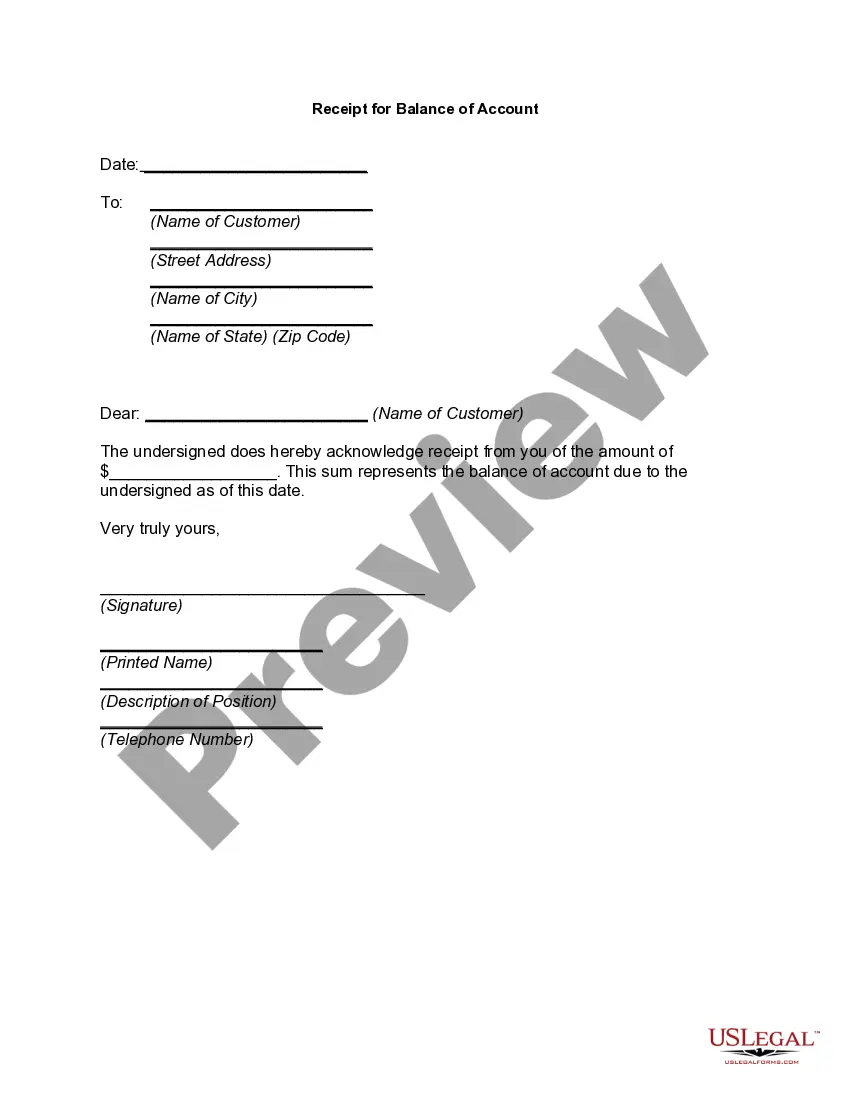
Receipt for Balance of Account
About this form
The Receipt for Balance of Account is a formal document used to acknowledge the receipt of the final payment owed on an account. This form differs from other payment acknowledgment forms in that it specifically confirms that the full balance has been settled, protecting both the payer and the recipient by providing clear documentation of the transaction. It serves as evidence that no further payments are due, ensuring all parties have clarity on the account's status.
Main sections of this form
- Date of receipt
- Name and address of the customer
- Amount received
- Signature of the recipient
- Printed name and position of the recipient
- Recipient's telephone number
Common use cases
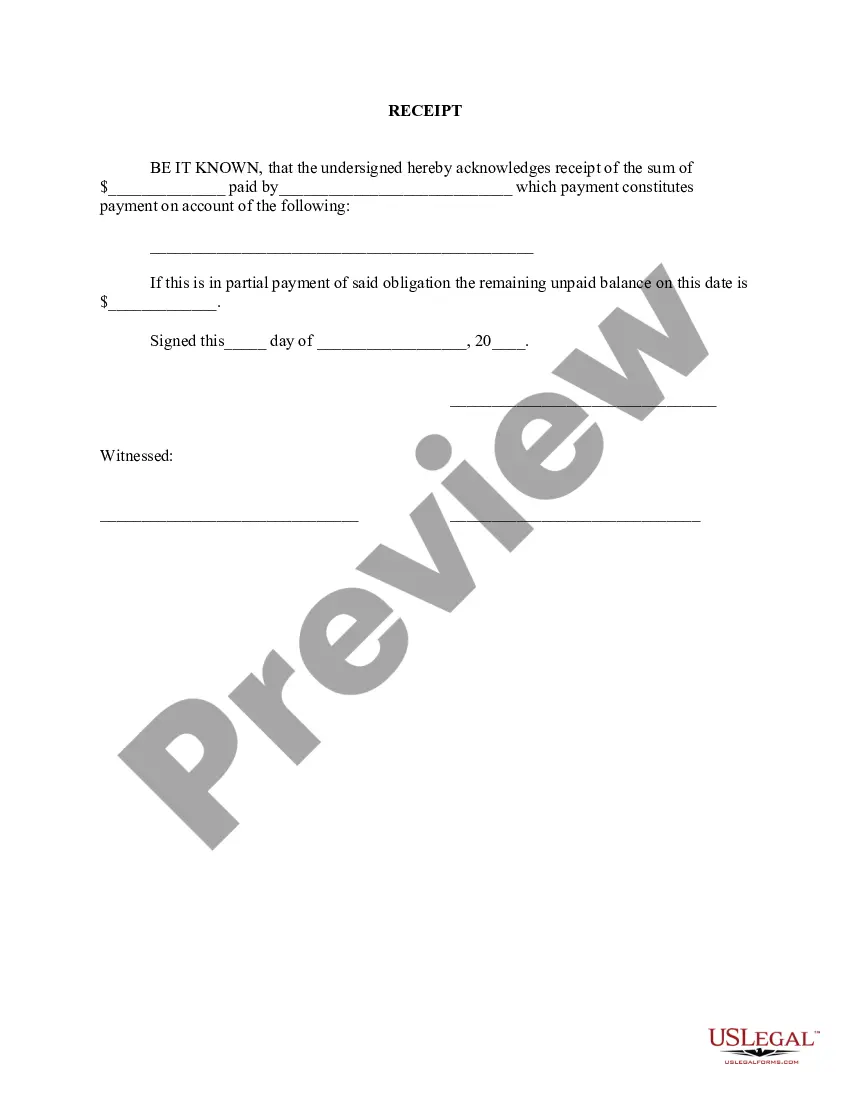
This form should be used when a customer has made their final payment on an account. It is typically utilized in situations such as the closing of a service agreement, settling payment for a loan, or finalizing a sale where the customer has cleared any dues. By issuing this receipt, the seller or service provider ensures documentation of payment and account closure.
Who can use this document
- Businesses that provide goods or services and require proof of final payment
- Individuals receiving payments for loans, installments, or services rendered
- Accountants or financial professionals managing client accounts
Steps to complete this form
- Enter the date on which payment was received.
- Fill in the name and address of the customer.
- Specify the amount received, which should represent the final balance due.
- Provide the signature of the recipient acknowledging receipt.
- Print the name and position of the signatory.
- Include a telephone number for any follow-up questions.
Notarization guidance
This form does not typically require notarization unless specified by local law. However, it is often advisable to keep thorough records of transactions.
Get your form ready online
Our built-in tools help you complete, sign, share, and store your documents in one place.
Make edits, fill in missing information, and update formatting in US Legal Forms—just like you would in MS Word.
Download a copy, print it, send it by email, or mail it via USPS—whatever works best for your next step.
Sign and collect signatures with our SignNow integration. Send to multiple recipients, set reminders, and more. Go Premium to unlock E-Sign.
If this form requires notarization, complete it online through a secure video call—no need to meet a notary in person or wait for an appointment.
We protect your documents and personal data by following strict security and privacy standards.

Make edits, fill in missing information, and update formatting in US Legal Forms—just like you would in MS Word.

Download a copy, print it, send it by email, or mail it via USPS—whatever works best for your next step.

Sign and collect signatures with our SignNow integration. Send to multiple recipients, set reminders, and more. Go Premium to unlock E-Sign.

If this form requires notarization, complete it online through a secure video call—no need to meet a notary in person or wait for an appointment.

We protect your documents and personal data by following strict security and privacy standards.
Common mistakes to avoid
- Failing to include the date of payment.
- Not specifying the amount received clearly.
- Omitting the signature of the recipient.
- Providing incorrect customer details.
Advantages of online completion
- Convenient access and easy downloading.
- Editability to customize for specific transactions.
- Reliability as it is drafted by licensed attorneys.
Looking for another form?
Form popularity
FAQ
You can enter two types of receipts in Receivables: Standard receipts: Payment (such as cash or a check) that you receive from your customers for goods or services. Also known as cash receipts. Miscellaneous receipts: Revenue earned from investments, interest, refunds, stock sales, and other nonstandard items.
It is the sum of the balance of trade (net earnings on exports minus payments for imports), factor income (earnings on foreign investments minus payments made to foreign investors) and unilateral transfers.
Accounts Receivable receipts are moneys owed to the State by a customer and are posted as a Worksheet Payment within the AR module. These receipts are applied against an agency receivable item (invoice) in SFS. As a general rule, each deposit should contain only one payment sequence.
Current account = change in net foreign assets. If an economy is running a current account deficit, it is absorbing (absorption = domestic consumption + investment + government spending) more than that it is producing.
Combination of cash and creditRecord any cash payments as a debit in your cash receipts journal like usual. Then, debit the customer's accounts receivable account for any purchase made on credit. In your sales journal, record the total credit entry.
Write down the total dollar value of goods exported by the country. You can use the total for all goods, or you can focus on a specific product. Write down the total value of goods imported by the country. Subtract the imports from the exports.
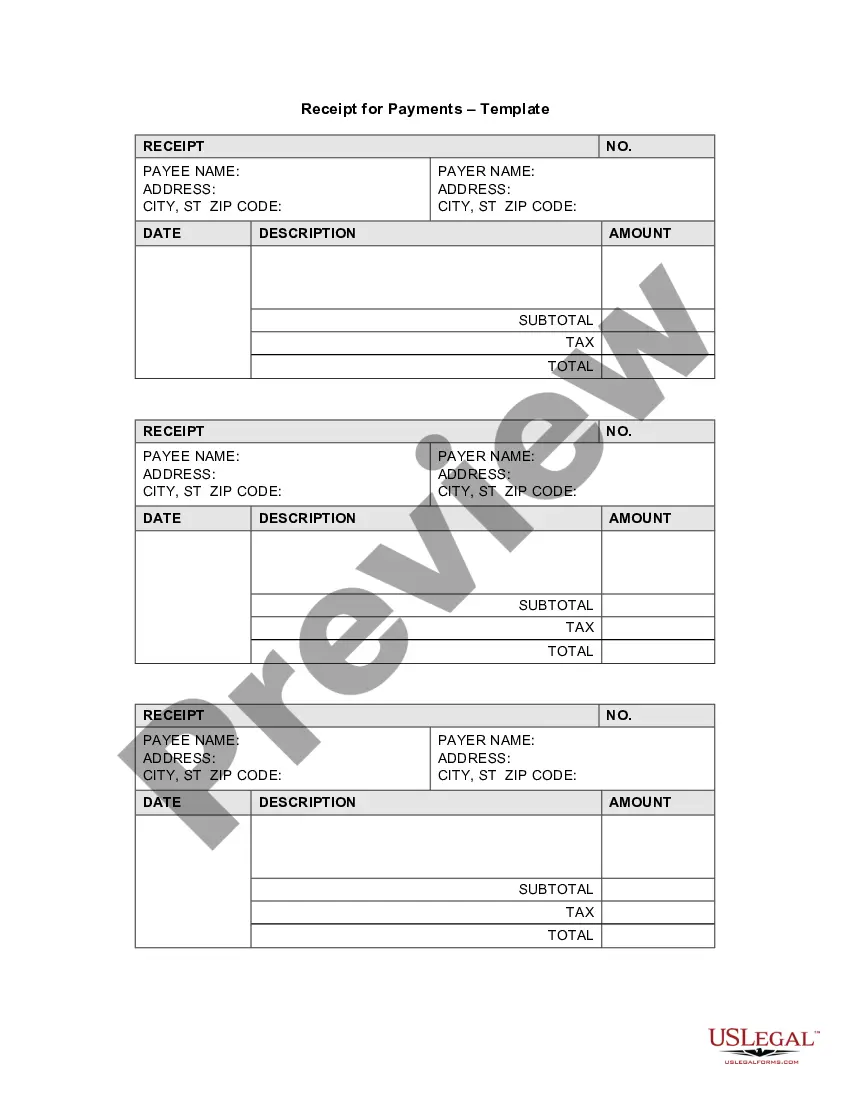
Receipts are the amount of cash a business takes in during any one accounting period, regardless of whether the money came from a sale or other source, according to IRS rules. Receipts are cash sales, as well as money received in a customer's account.
Whenever a country has an outflow of funds, it is recorded as a debit on the balance of payments.BOP=Current Account+Financial Account+ Capital Account+Balancing Item. The current account records the flow of income from one country to another.
Balance of current account = Exports of goods + Imports of goods + Exports of services + Imports of services. = $3,50,000 + (-$4,00,000) + $1,75,000 + (-$1,95,000) = -$70,000 i.e. current account is in deficit.