Mississippi Receipt of probated claim
What is this form?
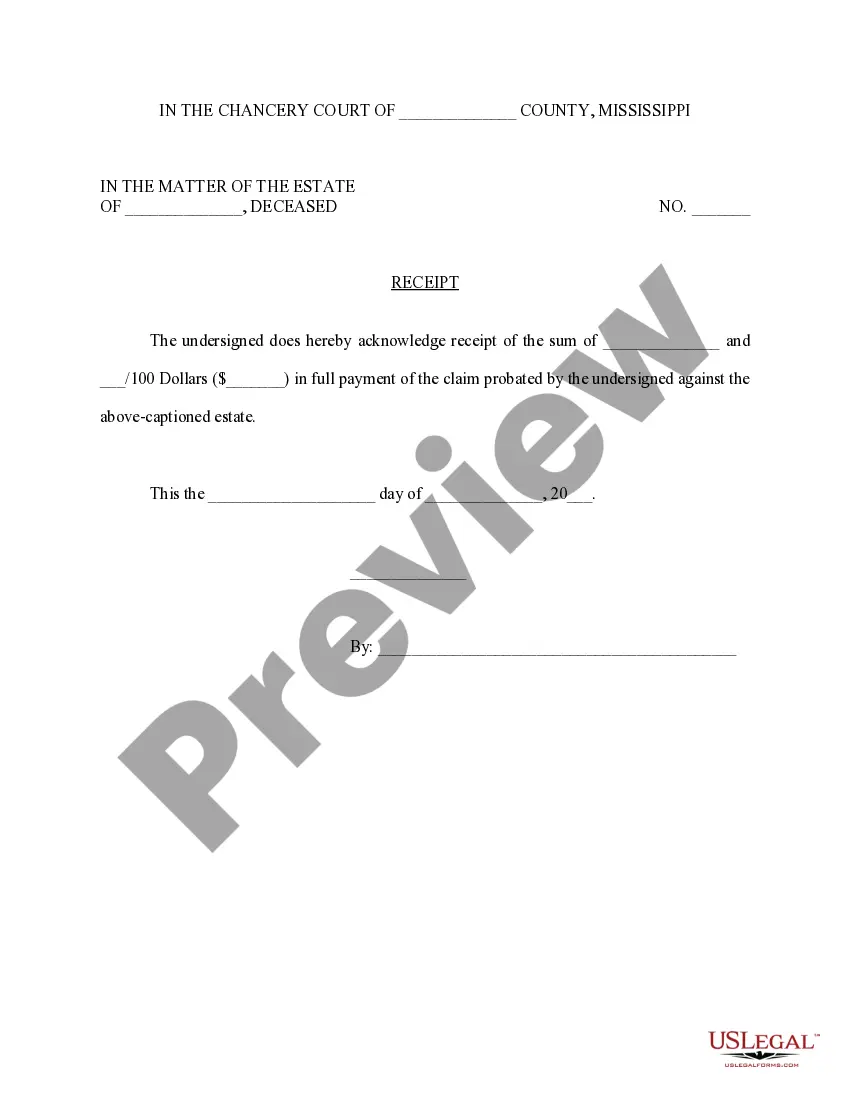
The receipt of probated claim is a legal document used in Mississippi to confirm the receipt of payment stemming from a probated claim against an estate. This form serves as verification for the claimant that they have received the stipulated amount as full payment for their claim, distinguishing it from other form types that may require additional documentation or legal proceedings. It is a simple yet essential document in the probate process.
Key components of this form
- Identification of the estate name and case number.
- Declaration of the amount received in full payment.
- Date of acknowledgement of payment.
- Signature of the claimant confirming receipt.
Common use cases
This form is needed when a claimant has had a financial claim against an estate that has been probated and they have received payment. It is an important step in the finalization of claims against an estate, ensuring that all parties have a written record of payments made and received.
Intended users of this form
- Individuals or entities who have filed a claim against an estate in Mississippi.
- Claimants who have received payment for their probated claims.
- Executors or administrators of estates who need to confirm payments made to claimants.
Steps to complete this form
- Enter the name of the deceased and the case number at the top of the form.
- Fill in the total amount received, including the dollar and cents portions.
- Specify the date on which the payment was received.
- Sign the form in the space provided to acknowledge receipt of payment.
Does this document require notarization?
Notarization is required for this form to take effect. Our online notarization service, powered by Notarize, lets you verify and sign documents remotely through an encrypted video session, available 24/7.
Get your form ready online
Our built-in tools help you complete, sign, share, and store your documents in one place.
Make edits, fill in missing information, and update formatting in US Legal Forms—just like you would in MS Word.
Download a copy, print it, send it by email, or mail it via USPS—whatever works best for your next step.
Sign and collect signatures with our SignNow integration. Send to multiple recipients, set reminders, and more. Go Premium to unlock E-Sign.
If this form requires notarization, complete it online through a secure video call—no need to meet a notary in person or wait for an appointment.
We protect your documents and personal data by following strict security and privacy standards.

Make edits, fill in missing information, and update formatting in US Legal Forms—just like you would in MS Word.

Download a copy, print it, send it by email, or mail it via USPS—whatever works best for your next step.

Sign and collect signatures with our SignNow integration. Send to multiple recipients, set reminders, and more. Go Premium to unlock E-Sign.

If this form requires notarization, complete it online through a secure video call—no need to meet a notary in person or wait for an appointment.

We protect your documents and personal data by following strict security and privacy standards.
Mistakes to watch out for
- Not accurately stating the amount received.
- Failure to include the case number or estate name.
- Omitting the date of receipt.
- Not signing the form.
Benefits of using this form online
- Convenient access to the form from anywhere, anytime.
- The ability to edit the form before downloading, ensuring accuracy.
- Trustworthy templates drafted by licensed attorneys.
Looking for another form?
Form popularity
FAQ
Explanation of the Mississippi Muniment of Title Procedure A muniment of title is an alternative to probate that allows a judge to recognize a will as valid for the sole purpose of transferring title to real estate. Creditors are not notified no executor or executrix is appointed.
All taxes and liabilities paid from the estate, including medical expenses, attorney fees, burial or cremation expenses, estate sale costs, appraisal expenses, and more. The executor should keep all receipts for any services or transactions needed to liquidate the assets of the deceased.
Before distributing assets to beneficiaries, the executor must pay valid debts and expenses, subject to any exclusions provided under state probate laws.The executor must maintain receipts and related documents and provide a detailed accounting to estate beneficiaries.
An inventory and appraisal is a required filing in California probate. The inventory and appraisal is a single document that (1) inventories the property in the decedent's estate and (2) contains an appraisal of the property in the inventory. California Probate Code § 8800(a).
Your inventory should include the number of shares of each type of stock, the name of the corporation, and the name of the exchange on which the stock is traded. Meanwhile, you should note the total gross amount of a bond, the name of the entity that issued it, the interest rate on the bond, and its maturity date.
When calculating the value of an estate, the gross value is the sum of all asset values, and the net value is the gross value minus any debts: in other words, the actual worth of the estate.
Determine Your State's Laws Regarding Inventory Forms. Review the Instructions Provided. Identify Real Property. Identify Personal Property. Identify Bank Accounts. Identify Retirement Accounts. Identify Non-Probate Assets. File the Form With the Court.
The first step in probating an estate is to locate all of the decedent's estate planning documents and other important papers, even before being appointed to serve as the personal representative or executor.
A letter of probate is a legal document that gives the executor the right to control the assets of a deceased persons estate.If a deceased person did not leave a will, a qualified candidate would also have to apply for a letter of probate to control the assets of the estate.