Mississippi Receipt
Understanding this form
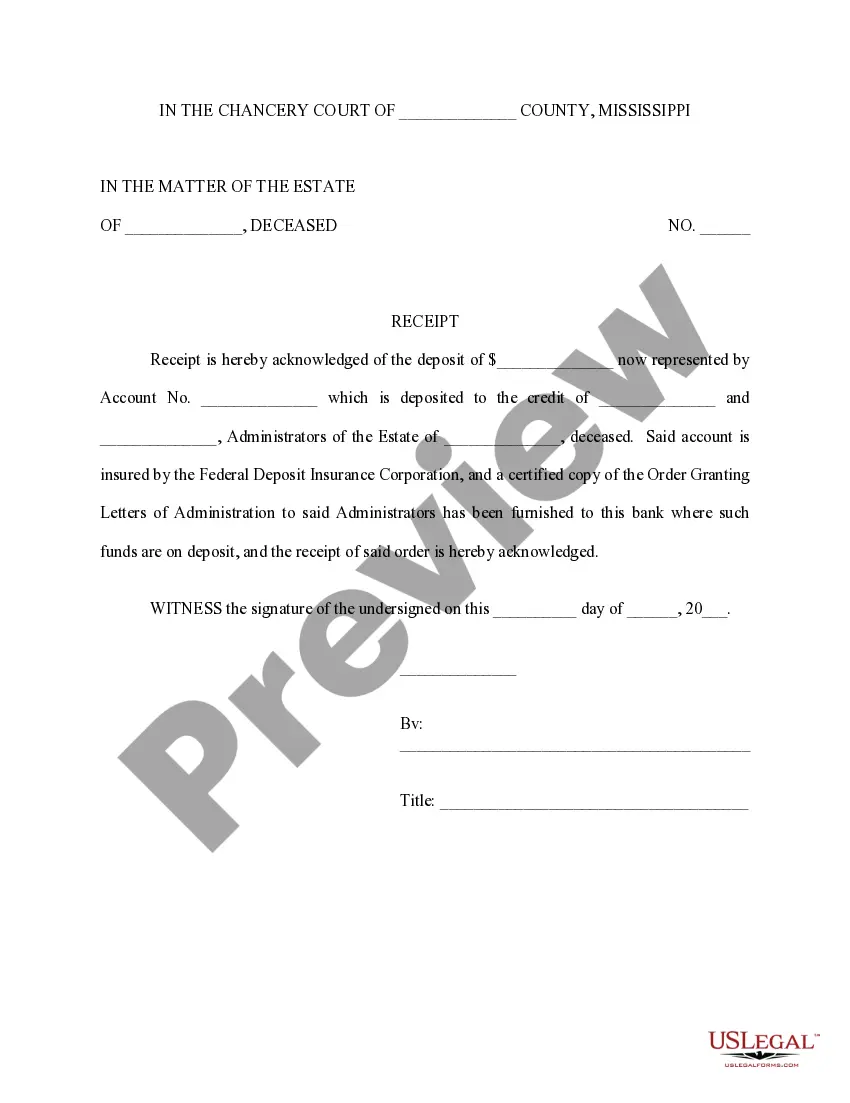
The Receipt form is a legal document used in Mississippi that provides official acknowledgment of funds deposited into an Administrator's account from an estate. This form recognizes the full satisfaction of the Administrator's interest in the estate and discharges them from any liability related to it. Unlike other estate forms, this Receipt is specifically tailored to confirm that financial obligations have been met and documented appropriately.
Key components of this form
- Identification of the estate, including the deceased's name and case number.
- Acknowledgment of the amount deposited and the specific account number.
- Names of the Administrators responsible for the estate management.
- Verification of the account's insurance under the Federal Deposit Insurance Corporation.
- Signatures of the Administrators and other relevant parties to validate the receipt.
When this form is needed
This form is typically used when an estate's funds have been deposited in a financial institution, and the Administrators need to officially confirm receipt of those funds. It is essential during the estate settlement process to ensure all parties acknowledge the financial transactions involved.
Who this form is for
- Administrators or executors of an estate who have received funds for distribution.
- Estate attorneys involved in the management of an estate's financial matters.
- Beneficiaries seeking confirmation of funds received in relation to their inheritance.
Completing this form step by step
- Identify the estate by entering the deceased's name and case number at the top of the form.
- Specify the amount deposited and provide the account number for reference.
- List the names of the Administrators responsible for handling the estate funds.
- Ensure that the form includes a certification reference for the Order Granting Letters of Administration.
- Have the responsible Administrators sign and date the form to validate the receipt.
Does this form need to be notarized?
This form does not typically require notarization unless specified by local law. However, it is recommended to check with legal counsel to ensure it meets the specific requirements for your situation.
Get your form ready online
Our built-in tools help you complete, sign, share, and store your documents in one place.
Make edits, fill in missing information, and update formatting in US Legal Forms—just like you would in MS Word.
Download a copy, print it, send it by email, or mail it via USPS—whatever works best for your next step.
Sign and collect signatures with our SignNow integration. Send to multiple recipients, set reminders, and more. Go Premium to unlock E-Sign.
If this form requires notarization, complete it online through a secure video call—no need to meet a notary in person or wait for an appointment.
We protect your documents and personal data by following strict security and privacy standards.

Make edits, fill in missing information, and update formatting in US Legal Forms—just like you would in MS Word.

Download a copy, print it, send it by email, or mail it via USPS—whatever works best for your next step.

Sign and collect signatures with our SignNow integration. Send to multiple recipients, set reminders, and more. Go Premium to unlock E-Sign.

If this form requires notarization, complete it online through a secure video call—no need to meet a notary in person or wait for an appointment.

We protect your documents and personal data by following strict security and privacy standards.
Mistakes to watch out for
- Failing to include the case number or correct account details.
- Not having all required signatures from the Administrators.
- Forgetting to date the form accurately before submission.
Why use this form online
- Convenience of completing the form at any time without the need for in-person visits.
- Editable fields allow for quick adjustments and accuracy.
- Reliable access to up-to-date legal templates drafted by licensed attorneys.
Looking for another form?
Form popularity
FAQ
The Mississippi small estate affidavit may be used by an heir or successor when the decedent's estate (the person who died) left $75,000 or less in probate-able personal property.
Applying for probate in New South Wales All applications must be filed at the Supreme Court of New South Wales Registry, either in person or by post. The application must be accompanied by supporting documents including the will and death certificate, as well as an application fee.
Mississippi has a simplified probate process for small estates. To use it, an executor files a written request with the local probate court asking to use the simplified procedure. The court may authorize the executor to distribute the assets without having to jump through the hoops of regular probate.
Net value of probate estate is $50,000 or less, or. Probate asset is bank account or accounts totaling no more than $12,500, or. Probate estate is $500 or less.
Is Probate Required in Mississippi? Most of the time, probate is required in Mississippi.However, for most instances, probate is necessary to distribute the assets of the estate and transfer ownership to the heirs.
In Mississippi, you can make a living trust to avoid probate for virtually any asset you ownreal estate, bank accounts, vehicles, and so on. You need to create a trust document (it's similar to a will), naming someone to take over as trustee after your death (called a successor trustee).
In the best of circumstances, the Mississippi probate process usually takes 4 to 6 months. This would only be possible if the estate was fairly simple, all interested parties are agreeable, and documents are signed and returned to the probate attorney in a timely manner.