Mississippi Receipt from a Beneficiary under the Last Will and Testament of a Decedent
Understanding this form
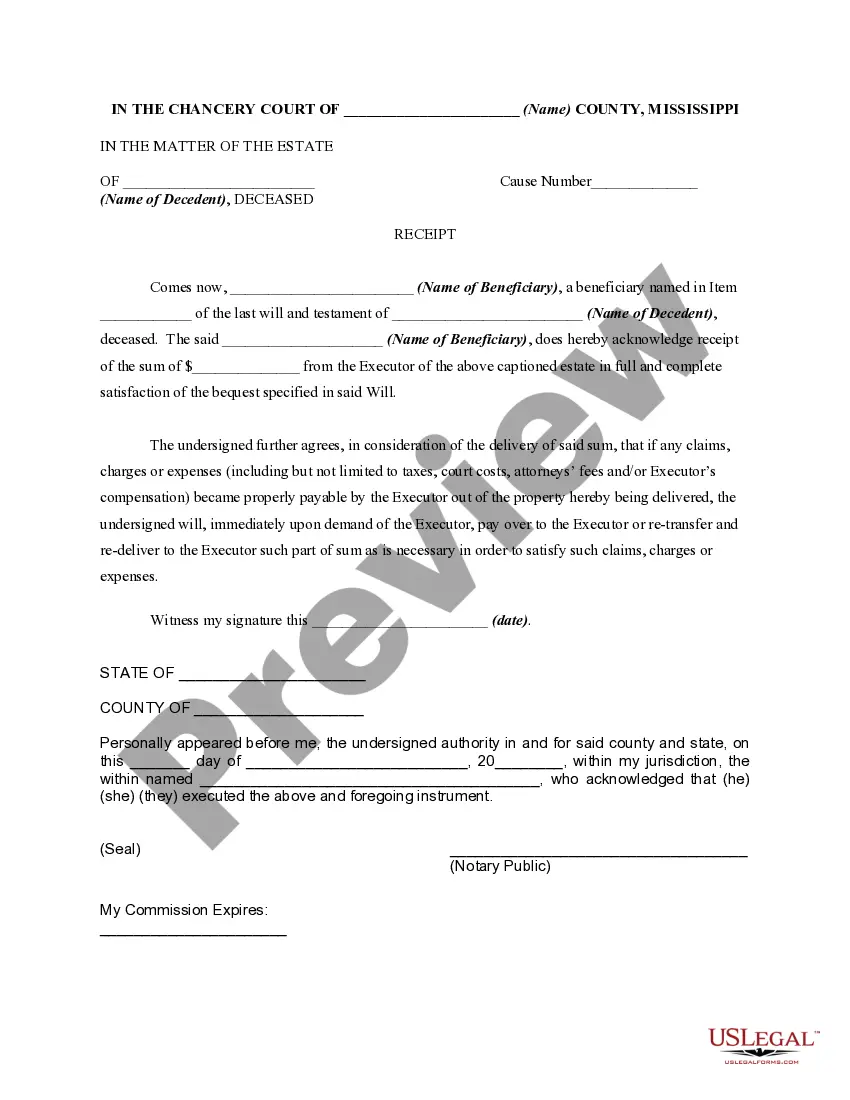
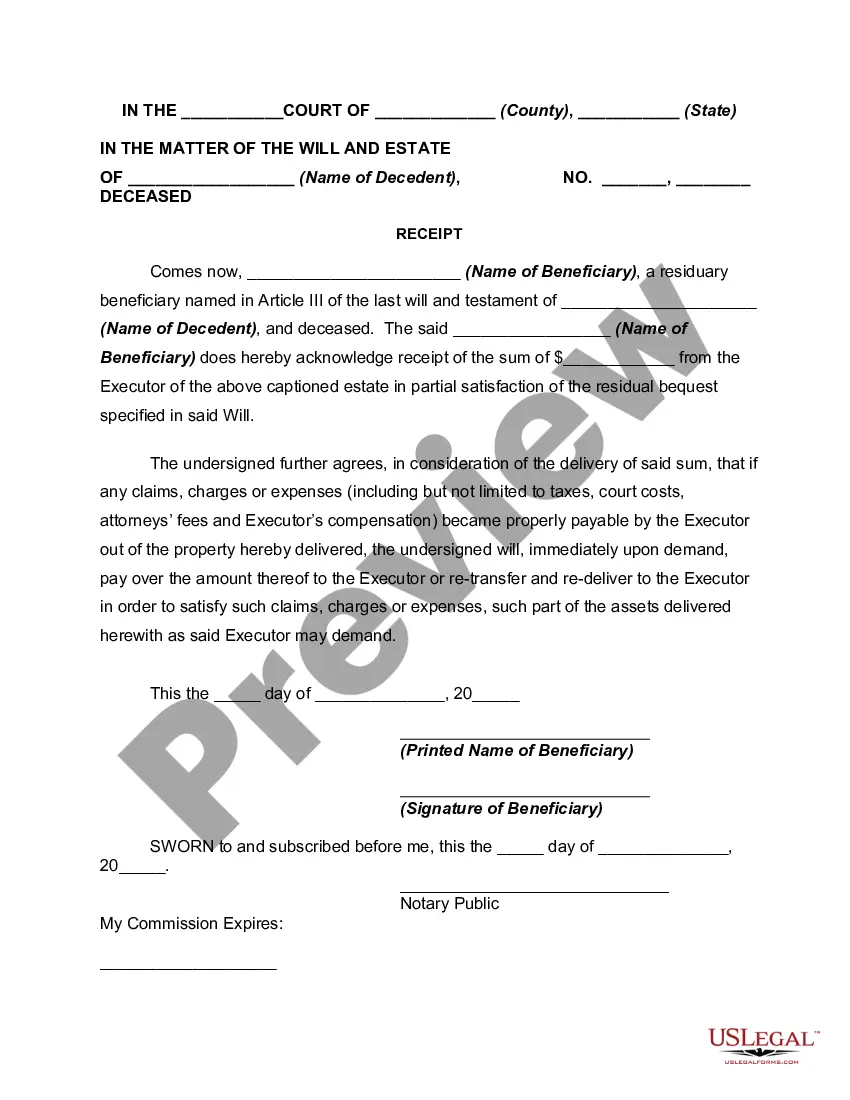
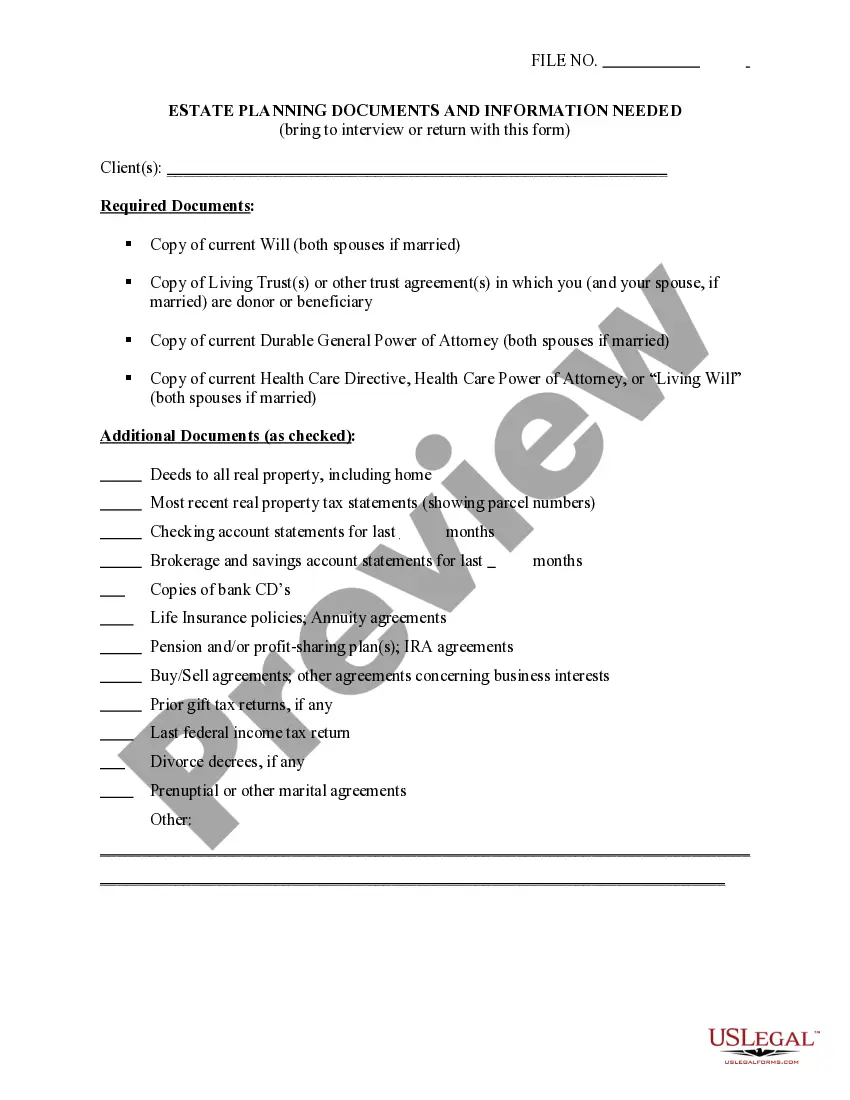
This form is a legally binding receipt that a beneficiary acknowledges upon receiving a bequest from the executor of a decedent's estate. It is used specifically under the Last Will and Testament, ensuring compliance with the will probated in the chancery court of Mississippi. This document helps clarify the beneficiary's acceptance of the funds and their responsibility regarding potential liabilities arising in the future.
Key parts of this document
- Identification of the estate and decedent's name.
- Name and relevant details of the beneficiary.
- Amount received as per the bequest from the executor.
- Agreement regarding liability for claims or expenses by the executor.
- Signature of the beneficiary and dating of the receipt.
- Notary acknowledgment confirming the beneficiary's signature.
Common use cases
This form should be used whenever a beneficiary receives a payment from an estate after the death of the decedent. It is essential in situations where an executor distributes assets granted in the Last Will and Testament. It helps protect the executor and the estate by documenting the transaction and ensuring the beneficiary acknowledges their acceptance of the bequest.
Who should use this form
- Beneficiaries named in a Last Will and Testament.
- Executors responsible for managing the distribution of an estate.
- Individuals involved in probate proceedings within Mississippi.
Completing this form step by step
- Enter the name of the decedent and the cause number of the estate.
- Fill in the name of the beneficiary receiving the bequest and the specific item number from the will.
- State the amount being received from the executor.
- Sign and date the form to acknowledge receipt of the funds.
- Have the form notarized to validate the signature.
Is notarization required?
Yes, this form must be notarized to be legally valid. This process ensures that the signature of the beneficiary is confirmed and that there is no coercion involved in signing the receipt. US Legal Forms provides integrated online notarization, allowing users to notarize documents through secure video calls, available 24/7.
Get your form ready online
Our built-in tools help you complete, sign, share, and store your documents in one place.
Make edits, fill in missing information, and update formatting in US Legal Forms—just like you would in MS Word.
Download a copy, print it, send it by email, or mail it via USPS—whatever works best for your next step.
Sign and collect signatures with our SignNow integration. Send to multiple recipients, set reminders, and more. Go Premium to unlock E-Sign.
If this form requires notarization, complete it online through a secure video call—no need to meet a notary in person or wait for an appointment.
We protect your documents and personal data by following strict security and privacy standards.

Make edits, fill in missing information, and update formatting in US Legal Forms—just like you would in MS Word.

Download a copy, print it, send it by email, or mail it via USPS—whatever works best for your next step.

Sign and collect signatures with our SignNow integration. Send to multiple recipients, set reminders, and more. Go Premium to unlock E-Sign.

If this form requires notarization, complete it online through a secure video call—no need to meet a notary in person or wait for an appointment.

We protect your documents and personal data by following strict security and privacy standards.
Common mistakes
- Failing to fill in all required fields accurately.
- Not obtaining a notarization, if required.
- Forgetting to date the receipt properly.
- Not reviewing state-specific requirements before submission.
Why complete this form online
- Convenient access to legal forms from any location, saving travel time.
- Editability allows for personalization and compliance with specific legal requirements.
- Reliable, attorney-drafted content ensures legal integrity.
Legal use & context
- This receipt is essential for documenting the transfer of bequests in accordance with estate laws.
- Proper use of this form helps prevent future disputes regarding payments made from the estate.
- Failure to document receipt may complicate the settlement of the estate and cause issues for both beneficiaries and executors.
Quick recap
- The Receipt from a Beneficiary is crucial for confirming the acceptance of a bequest.
- This form must be notarized to ensure its legal validity.
- Maintain clear documentation to avoid disputes regarding estate distributions.
Looking for another form?


Form popularity
FAQ
Paying any taxes that are due on the estate taking inventory of the property and belongings appraising and distributing the deceased person's assets settling any debts that are owed by the deceased inheriting assets named in a will if the first choice cannot acting on someone's behalf if he or she becomes sick or
If you are a named beneficiary in the will or a guardian of a minor child who is a beneficiary, you are likely permitted access to it by your state's laws. You should contact the executor to ask to see it. If you don't know who the executor is, obtain a copy of the death certificate through the county.
For a beneficiary to effectively monitor the administration of estate property it goes without saying the beneficiary needs information regarding the performance of the executor's duties and powers. To this end the law has imposed on executors and trustees a duty to account beneficiaries.
A Letter of Appointment of Executor helps prove you have been put in charge of someone's estate after they have passed away. As Executor, you've been given the duty to manage the estate and carry out the directions of the will; however, a court may require official documentation.
Before distributing assets to beneficiaries, the executor must pay valid debts and expenses, subject to any exclusions provided under state probate laws.The executor must maintain receipts and related documents and provide a detailed accounting to estate beneficiaries.
While an executor is obligated to notify beneficiaries and then move things along at a reasonable pace, he or she isn't required to distribute inheritances at the time of notification. In fact, beneficiaries might not receive anything until several months after they've been notified of their place in the will.
All taxes and liabilities paid from the estate, including medical expenses, attorney fees, burial or cremation expenses, estate sale costs, appraisal expenses, and more. The executor should keep all receipts for any services or transactions needed to liquidate the assets of the deceased.