Arkansas Seller's Disclosure of Forfeiture Rights for Contract for Deed

State:
Arkansas
Control #:
AR-00470-22
Format:
Word; 
Rich Text
Instant download

This form is part of a form package!

Get all related documents in one bundle, so you don’t have to search separately.

Understanding this form

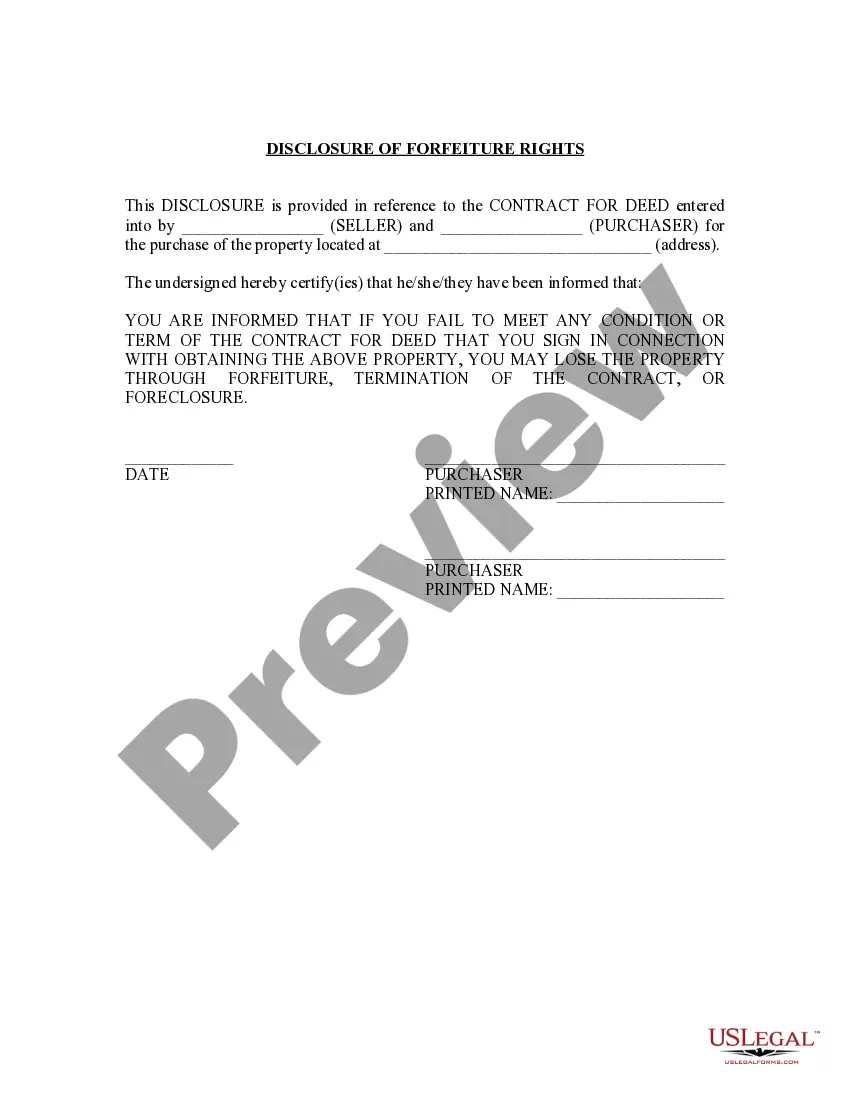
The Seller's Disclosure of Forfeiture Rights for Contract for Deed is a legal document provided by the seller to the purchaser at the time of signing the contract. This form informs the purchaser about the potential risks of forfeiture related to the property they are acquiring. By using this disclosure, both parties are clear about the consequences of defaulting on the contractual obligations, making it easier to resolve disputes should legal action become necessary.

Main sections of this form

  • Certification of understanding regarding forfeiture risks.
  • Statement outlining conditions that may lead to forfeiture or loss of property.
  • Identification of the parties involved (seller and purchaser).
  • Space for signatures to confirm mutual agreement.

When to use this form

This form should be used when a seller enters into a contract for deed with a purchaser. It is essential in transactions where the seller wishes to clearly communicate the potential consequences of defaulting on the terms of the contract. Utilizing this form can prevent misunderstandings and provide legal clarity for both parties involved.

Intended users of this form

  • Sellers of properties being sold under a contract for deed.
  • Purchasers who are entering a contract for deed arrangement.
  • Real estate professionals advising buyers and sellers in such transactions.

How to prepare this document

  • Identify and list the parties involved in the contract (seller and purchaser).
  • Clearly state the property being sold under the contract for deed.
  • Read and understand the forfeiture clauses outlined in the document.
  • Sign and date the form to confirm mutual understanding and agreement.

Is notarization required?

This form does not typically require notarization to be legally valid. However, some jurisdictions or document types may still require it. US Legal Forms provides secure online notarization powered by Notarize, available 24/7 for added convenience.

Get your form ready online

Our built-in tools help you complete, sign, share, and store your documents in one place.

Built-in online Word editor

Make edits, fill in missing information, and update formatting in US Legal Forms—just like you would in MS Word.

Export easily

Download a copy, print it, send it by email, or mail it via USPS—whatever works best for your next step.

E-sign your document

Sign and collect signatures with our SignNow integration. Send to multiple recipients, set reminders, and more. Go Premium to unlock E-Sign.

Notarize online 24/7

If this form requires notarization, complete it online through a secure video call—no need to meet a notary in person or wait for an appointment.

Store your document securely

We protect your documents and personal data by following strict security and privacy standards.

Form selector

Make edits, fill in missing information, and update formatting in US Legal Forms—just like you would in MS Word.

Form selector

Download a copy, print it, send it by email, or mail it via USPS—whatever works best for your next step.

Form selector

Sign and collect signatures with our SignNow integration. Send to multiple recipients, set reminders, and more. Go Premium to unlock E-Sign.

Form selector

If this form requires notarization, complete it online through a secure video call—no need to meet a notary in person or wait for an appointment.

Form selector

We protect your documents and personal data by following strict security and privacy standards.

Common mistakes

  • Failing to inform the purchaser about all terms related to forfeiture.
  • Leaving out critical information about the property or terms of the deal.
  • Not ensuring both parties sign the document, which may lead to disputes.

Advantages of online completion

  • Convenient access to legally vetted documents anytime, anywhere.
  • Easy to edit and customize for specific transactions.
  • Reliable and protects both parties by clarifying obligations.

Main things to remember

  • The form is crucial for contract for deed transactions to convey forfeiture risks.
  • It provides legal clarity, protecting both seller and purchaser rights.
  • Understanding and proper completion of the form can prevent future disputes.

Looking for another form?

This field is required
Virginia
Select state

Form popularity

FAQ

The Arkansas Seller's Disclosure of Forfeiture Rights for Contract for Deed is a disclosure provided by the seller to the purchaser at the signing of a contract for deed. It informs buyers about potential forfeiture risks and the consequences of default. The form includes sections for understanding forfeiture, conditions that may lead to loss, the parties involved, and signatures to confirm agreement.

If a party defaults on a land contract, this disclosure is intended to communicate the potential forfeiture risks and consequences of that default. It lists conditions that may lead to forfeiture or loss of the property and provides space for both seller and purchaser to acknowledge understanding. The disclosure helps clarify outcomes and support dispute resolution.

This form focuses on forfeiture rights disclosures in contract-for-deed transactions rather than establishing Arkansas-wide disclosure status. It is provided by the seller at signing and is meant to inform the purchaser of forfeiture risks. For broader Arkansas disclosure requirements, consult a licensed attorney or a real estate professional.

This form adds a specific forfeiture-rights disclosure to a contract-for-deed transaction, informing about conditions that may lead to forfeiture and consequences of default. It does not by itself cover every state-required disclosure, and other disclosures may apply. Always check with a licensed professional to ensure compliance with Arkansas law.

This form is a targeted disclosure used in contract-for-deed transactions to alert buyers about forfeiture risks. It does not state that Arkansas law requires a general seller disclosure in all real estate deals. Requirements may vary by transaction, so consult a licensed attorney or local real estate professional for guidance.

It differs by focusing specifically on forfeiture rights and default consequences in a contract-for-deed. The form emphasizes understanding of forfeiture risks, conditions that may lead to loss, and mutual signing, rather than broad disclosures of property condition or defects found in a general seller's disclosure.

Trusted and secure by over 3 million people of the world’s leading companies

Arkansas Seller's Disclosure of Forfeiture Rights for Contract for Deed