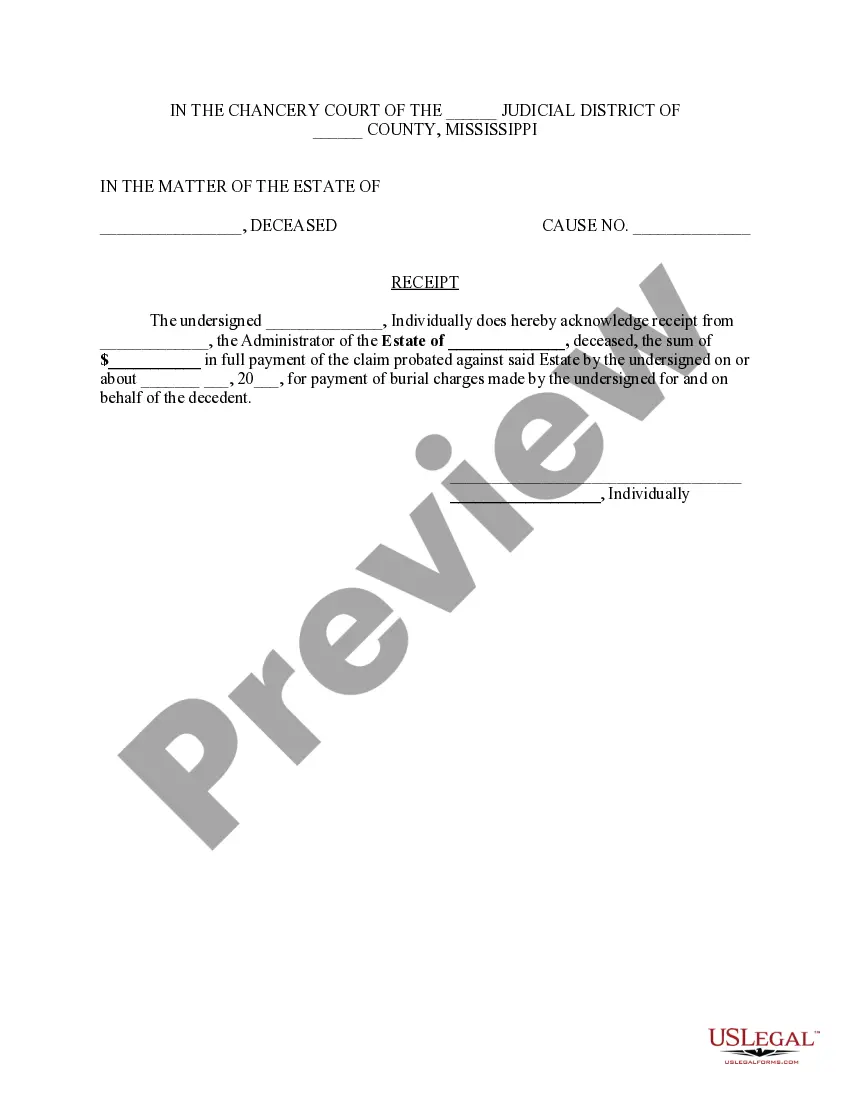
Mississippi Receipt for Distribution From Estate
Understanding this form
The Receipt for Distribution From Estate is a legal document that records the transfer of assets from an estate to a beneficiary. This form confirms that a beneficiary has received funds representing their claim against the decedent's estate, such as burial expenses. It serves a crucial role in documenting payments and protecting the executor from future claims regarding the distribution made to beneficiaries.
Key parts of this document
- Identifying information of the county and estate.
- Names of the parties involved, including the beneficiary and administrator.
- Sum of money received, indicating the total payment made.
- Date of claim probated against the estate.
- Signature of the beneficiary acknowledging receipt of funds.

Situations where this form applies
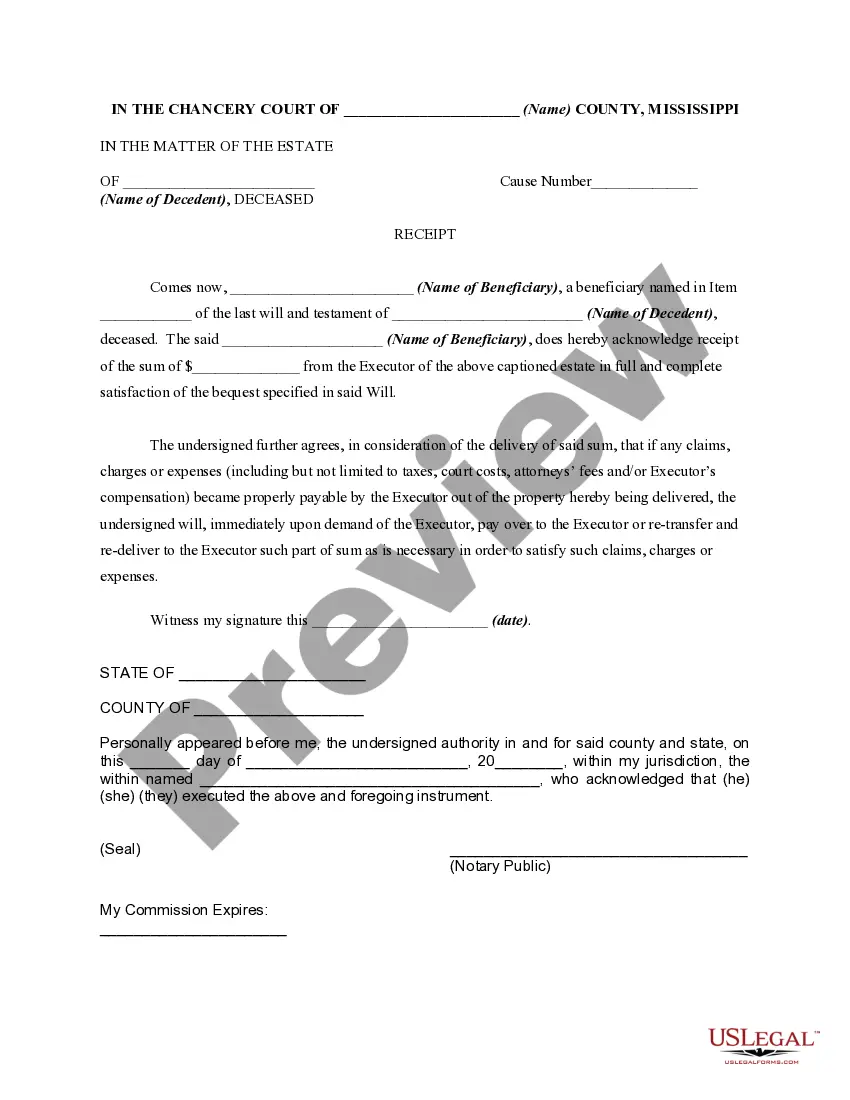
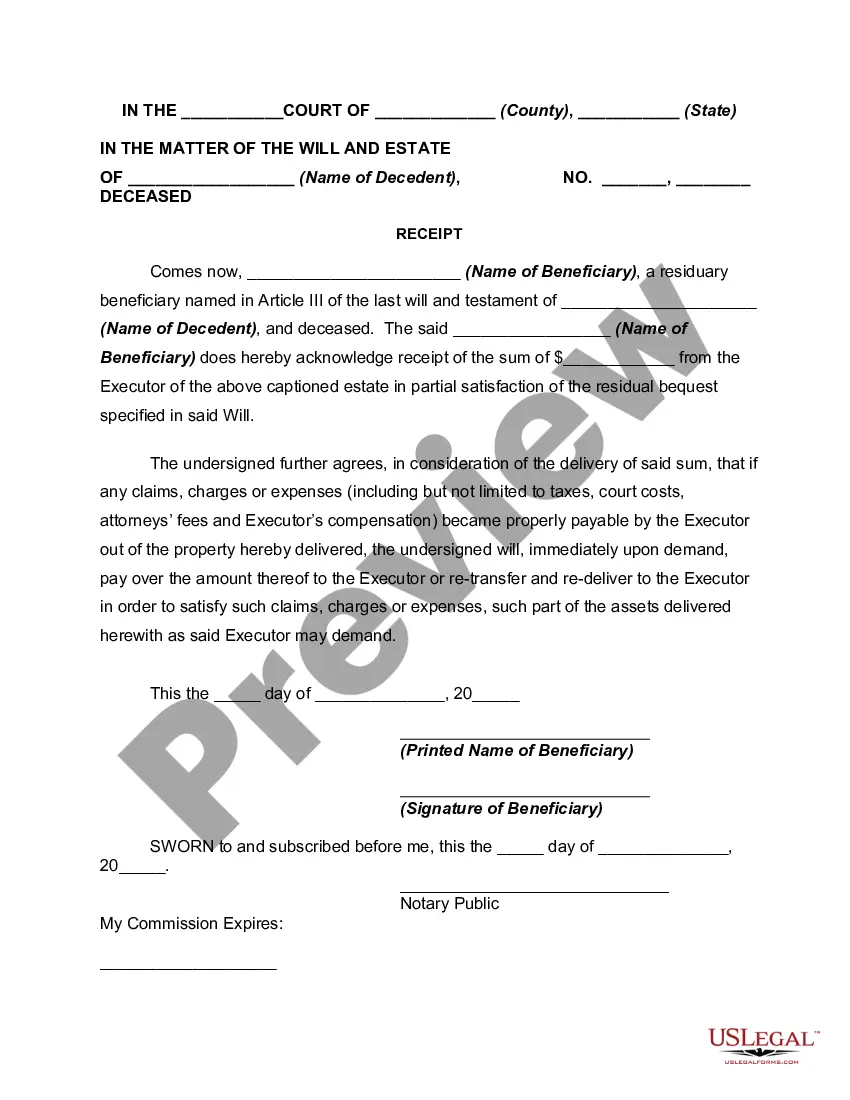
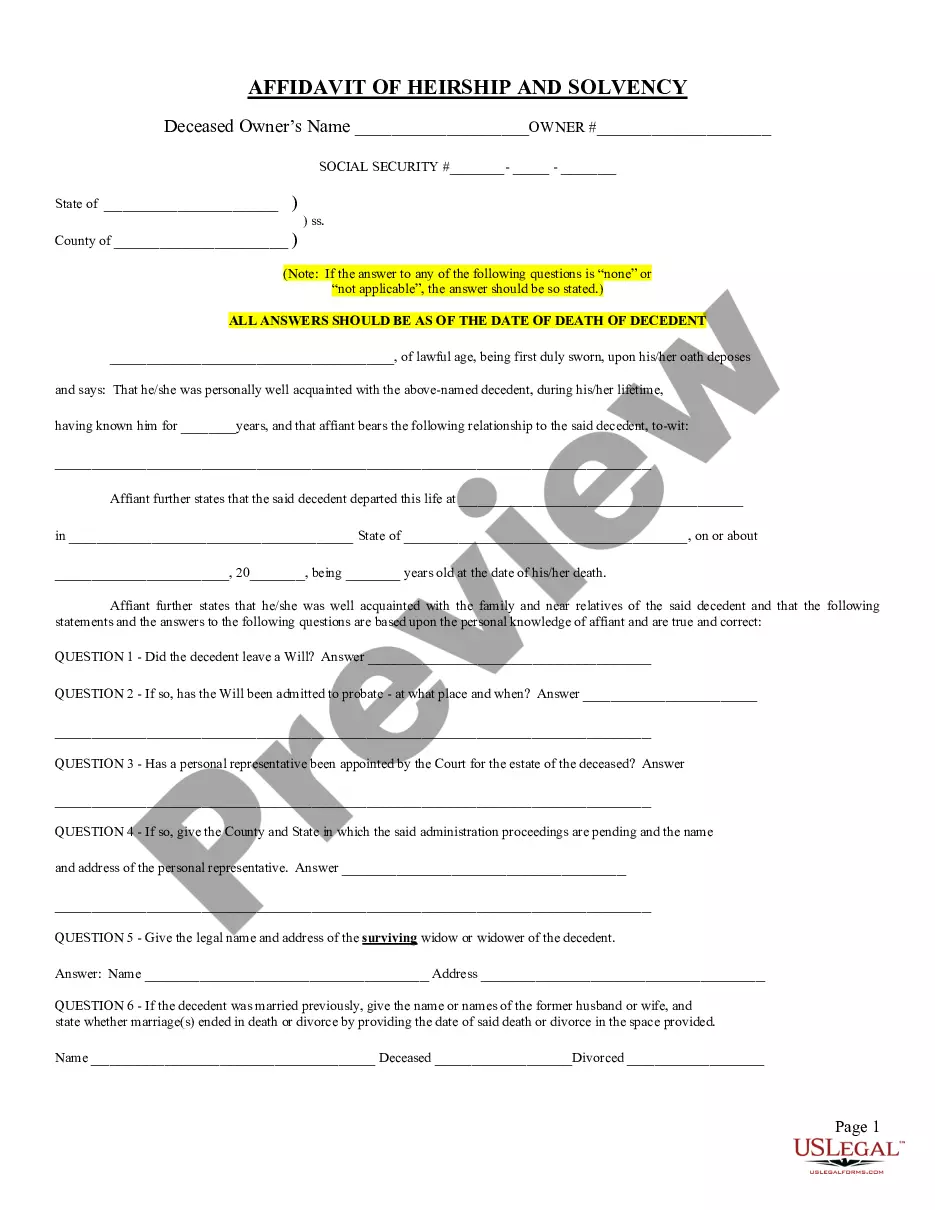
This form is typically used when a beneficiary has received a distribution from an estate, particularly after a claim has been probated. It is essential in cases where the beneficiary must prove they have received their entitled share, especially if burial or other costs were incurred on behalf of the deceased, ensuring proper legal documentation of transaction.
Intended users of this form
- Beneficiaries of an estate who have received funds.
- Executors of estates distributing assets to beneficiaries.
- Administrators managing the estate on behalf of the deceased.
How to complete this form
- Identify the county where the estate is probated.
- Insert the name of the deceased and the cause number.
- Clearly state the beneficiary's name in the acknowledgment section.
- Specify the amount received by the beneficiary.
- Include the date of the original claim against the estate.
- Have the beneficiary sign the form to officially acknowledge receipt.
Notarization guidance
This form does not typically require notarization unless specified by local law. However, you may consider having it notarized for added authenticity and to strengthen its legal standing.
Get your form ready online
Our built-in tools help you complete, sign, share, and store your documents in one place.
Make edits, fill in missing information, and update formatting in US Legal Forms—just like you would in MS Word.
Download a copy, print it, send it by email, or mail it via USPS—whatever works best for your next step.
Sign and collect signatures with our SignNow integration. Send to multiple recipients, set reminders, and more. Go Premium to unlock E-Sign.
If this form requires notarization, complete it online through a secure video call—no need to meet a notary in person or wait for an appointment.
We protect your documents and personal data by following strict security and privacy standards.

Make edits, fill in missing information, and update formatting in US Legal Forms—just like you would in MS Word.

Download a copy, print it, send it by email, or mail it via USPS—whatever works best for your next step.

Sign and collect signatures with our SignNow integration. Send to multiple recipients, set reminders, and more. Go Premium to unlock E-Sign.

If this form requires notarization, complete it online through a secure video call—no need to meet a notary in person or wait for an appointment.

We protect your documents and personal data by following strict security and privacy standards.
Common mistakes
- Failing to accurately fill in the total amount received.
- Neglecting to include the correct date of the claim.
- Omitting signatures from both the beneficiary and administrator.
- Using outdated versions of the form that may not comply with current laws.
Why use this form online
- Convenient and easy access to officially drafted legal documents.
- Editability allows users to fill in personalized information accurately.
- Reliable forms drafted by licensed attorneys tailored to your needs.
Main things to remember
- This form is crucial for confirming the distribution of estate funds to beneficiaries.
- Accurate completion helps avoid misunderstandings or disputes.
- Using the form online provides a simple and reliable way to manage estate documentation.
Looking for another form?

Form popularity
FAQ
It is also one the country's most tax-friendly states for retirees.Mississippi exempts all forms of retirement income from taxation, including Social Security benefits, income from an IRA, income from a 401(k) and any pension income. On top of that, the state has low property taxes and moderate sales taxes.
In Mississippi, you can make a living trust to avoid probate for virtually any asset you ownreal estate, bank accounts, vehicles, and so on. You need to create a trust document (it's similar to a will), naming someone to take over as trustee after your death (called a successor trustee).
Generally speaking, inheritance is not subject to tax in California. If you are a beneficiary, you will not have to pay tax on your inheritance.
The Mississippi small estate affidavit may be used by an heir or successor when the decedent's estate (the person who died) left $75,000 or less in probate-able personal property.
You won't have to report your inheritance on your state or federal income tax return because an inheritance is not considered taxable income. But the type of property you inherit might come with some built-in income tax consequences.
Unlike the federal estate tax, the beneficiary of the property is responsible for paying the tax, not the estate. However, as of 2020, only six states impose an inheritance tax. And even if you live in one of those states, many beneficiaries are exempt from paying it.
Mississippi probate is usually required if a deceased person died with Mississippi assets in his or her name and those assets do not pass automatically at the person's death.There are some alternatives to probate that may apply in limited circumstances.
Most estate disbursements are not subject to income tax, including cash provided it's bequeathed according to the terms of the decedent's will, through his probate estate. Cash received from a trust is income to the beneficiary, however.
Beneficiaries generally don't have to pay income tax on money or other property they inherit, with the common exception of money withdrawn from an inherited retirement account (IRA or 401(k) plan).The good news for people who inherit money or other property is that they usually don't have to pay income tax on it.