Louisiana Custody Agreement
Understanding this form
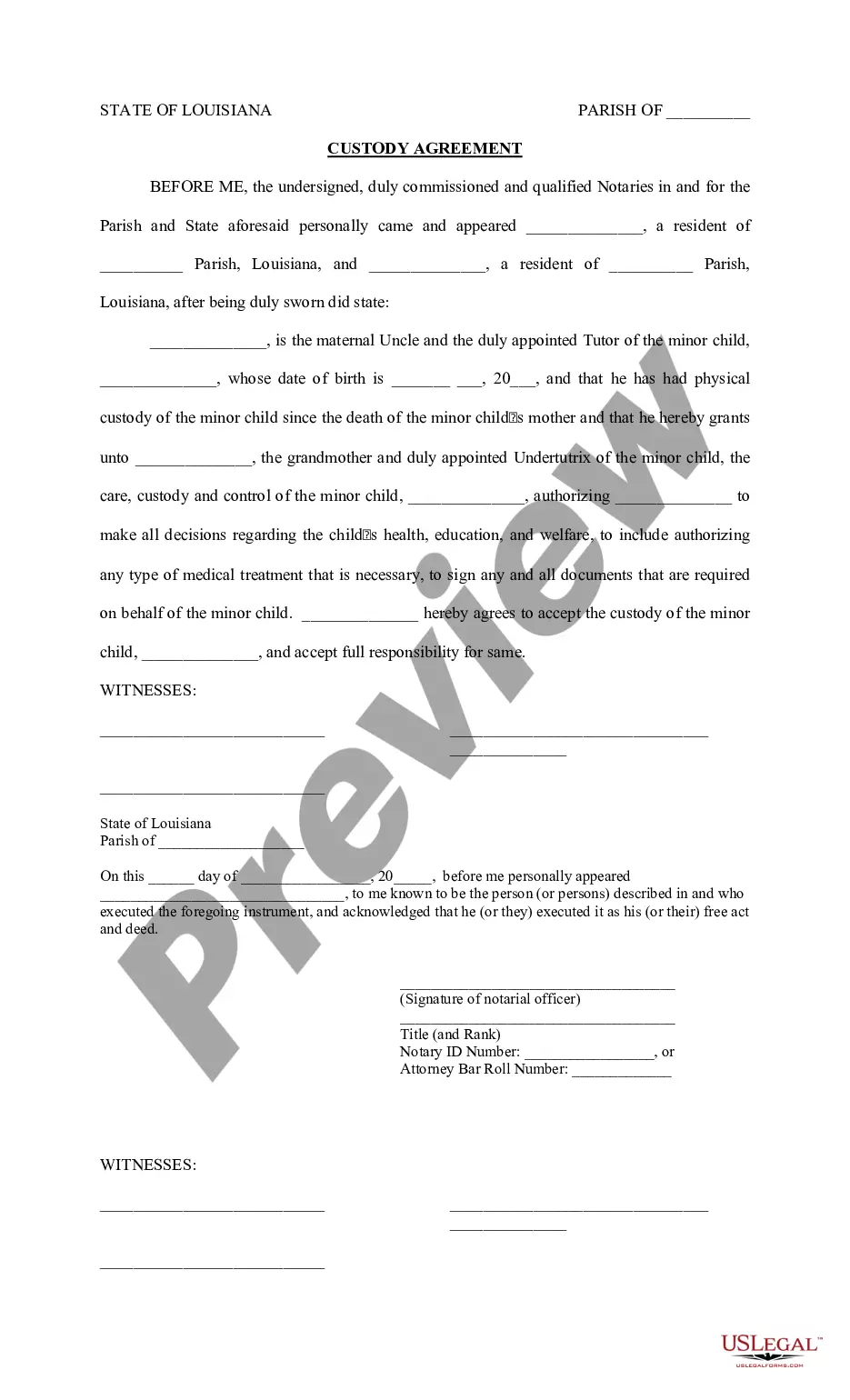
The Custody Agreement is a legal document that outlines the arrangement for the care and guardianship of a minor child. This agreement specifically pertains to situations where a guardian, such as an uncle, transfers custody to another family member, like a grandmother. By establishing clear responsibilities, this form helps prevent disputes and solidifies the custody arrangements within families, differing from other custody forms by focusing on the designated guardianship roles and responsibilities.
Main sections of this form
- Identification of the parties involved, including the guardian and the appointed guardian or undertutrix.
- Details about the minor child, including name and date of birth.
- Granting of care, custody, and control of the minor child from one guardian to another.
- Authority granted to the undertutrix to make decisions regarding health, education, and welfare.
- Signatures of both parties and witnesses, including notarization details.

When this form is needed
This Custody Agreement should be used in situations where a child is under the guardianship of a relative, such as an uncle, and that guardian wishes to delegate custody to another family member, like a grandmother. Common circumstances for its use include the death of a parent or when a parent is unable to provide care, ensuring the child's welfare is prioritized by legal representation of the family structure.
Who needs this form
This form is intended for:
- Uncles or aunts acting as guardians seeking to establish formal custody arrangements.
- Grandparents or other relatives who are appointed to take care of a minor child.
- Individuals wanting to ensure clarity in guardianship and custody rights within family dynamics.
How to prepare this document
- Identify all parties involved, including the current guardian and the new guardian.
- Fill in the minor child's name and date of birth accurately.
- Clearly state the transfer of custody and the responsibilities the undertutrix will take on.
- Sign the agreement in front of witnesses to validate the document.
- Ensure the form is notarized by a qualified notary public, if necessary.
Is notarization required?
To make this form legally binding, it must be notarized. Our online notarization service, powered by Notarize, lets you verify and sign documents remotely through an encrypted video session.
Get your form ready online
Our built-in tools help you complete, sign, share, and store your documents in one place.
Make edits, fill in missing information, and update formatting in US Legal Forms—just like you would in MS Word.
Download a copy, print it, send it by email, or mail it via USPS—whatever works best for your next step.
Sign and collect signatures with our SignNow integration. Send to multiple recipients, set reminders, and more. Go Premium to unlock E-Sign.
If this form requires notarization, complete it online through a secure video call—no need to meet a notary in person or wait for an appointment.
We protect your documents and personal data by following strict security and privacy standards.

Make edits, fill in missing information, and update formatting in US Legal Forms—just like you would in MS Word.

Download a copy, print it, send it by email, or mail it via USPS—whatever works best for your next step.

Sign and collect signatures with our SignNow integration. Send to multiple recipients, set reminders, and more. Go Premium to unlock E-Sign.

If this form requires notarization, complete it online through a secure video call—no need to meet a notary in person or wait for an appointment.

We protect your documents and personal data by following strict security and privacy standards.
Mistakes to watch out for
- Failing to properly identify all parties involved.
- Not including the child's full name and date of birth.
- Omitting witness signatures or notarization details.
- Not specifying the responsibilities and authority granted to the undertutrix.
Why complete this form online
- Immediate access to professionally drafted templates that are easy to understand and fill out.
- Ability to edit and customize the form to fit your specific situation without the need for legal assistance.
- Safe and secure downloading process with reliable quality assurance from licensed attorneys.
Legal use & context
- The custody agreement is legally binding once signed and notarized.
- It provides a formal record of custody arrangements, which is essential for legal clarity.
- Any disputes regarding custody could reference this document for resolution.
Quick recap
- A custody agreement formalizes the care and custody of a minor child.
- It's critical for outlining responsibilities and authorities of guardians.
- Notarization is required to ensure its legal standing.
Looking for another form?

Form popularity
FAQ
One of the biggest mistakes in a custody battle is failing to prioritize the child's best interests. Parents often become emotionally charged during disputes, leading to decisions that may not benefit the child. It's crucial to maintain a focus on communication, cooperation, and compromise when developing a Louisiana Custody Agreement. Utilizing resources like US Legal Forms can offer valuable insights and practical strategies to avoid common pitfalls in custody situations.
In Louisiana, the court begins it's custody evaluation by presuming that joint custody may be in the child's best interest. If parents submit a plan to the court for joint custody, it must include information about: where the child will live. the amount of child support each parent will pay.
In most cases, Louisiana courts prefer to grant joint custody to both co-parents.Louisiana child custody laws can apply joint custody to both physical and legal types of custody. A co-parent with physical custody acts as the primary residence for the child and handles the day-to-day care of the child.
Judges must decide custody based on the best interests of the child." The best interests of the child law requires courts to focus on the child's needs and not the parent's needs. The law requires courts to give custody to the parent who can meet the child's needs best .
The answer is usually no, a parent cannot stop a child from seeing the other parent unless a court order states otherwise.The parents have an existing court order, and a parent is violating the court order by interfering with the other parent's parenting time.
The relationship between the child and each parent. The relationship between the child and any siblings residing in the parents' households. Each parent's ability to care for the child. Each parent's ability to provide shelter, clothing, and food for the child.
The legal definition of an unfit parent is when the parent through their conduct fails to provide proper guidance, care, or support. Also, if there is abuse, neglect, or substance abuse issues, that parent will be deemed unfit.
You will not be able to file for sole custody of your child without the father knowing. I would highly recommend consulting with a local attorney prior to filing anything in this case.