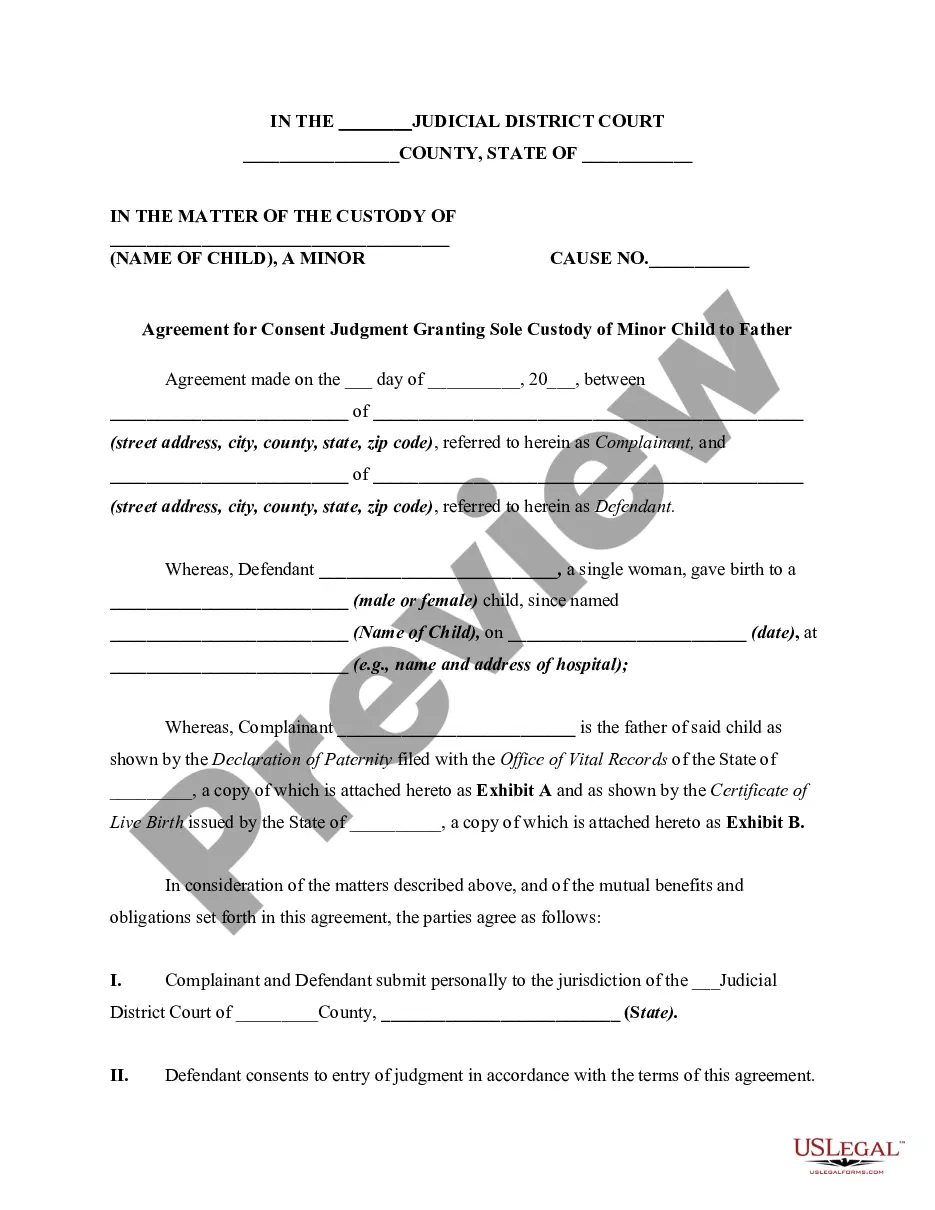
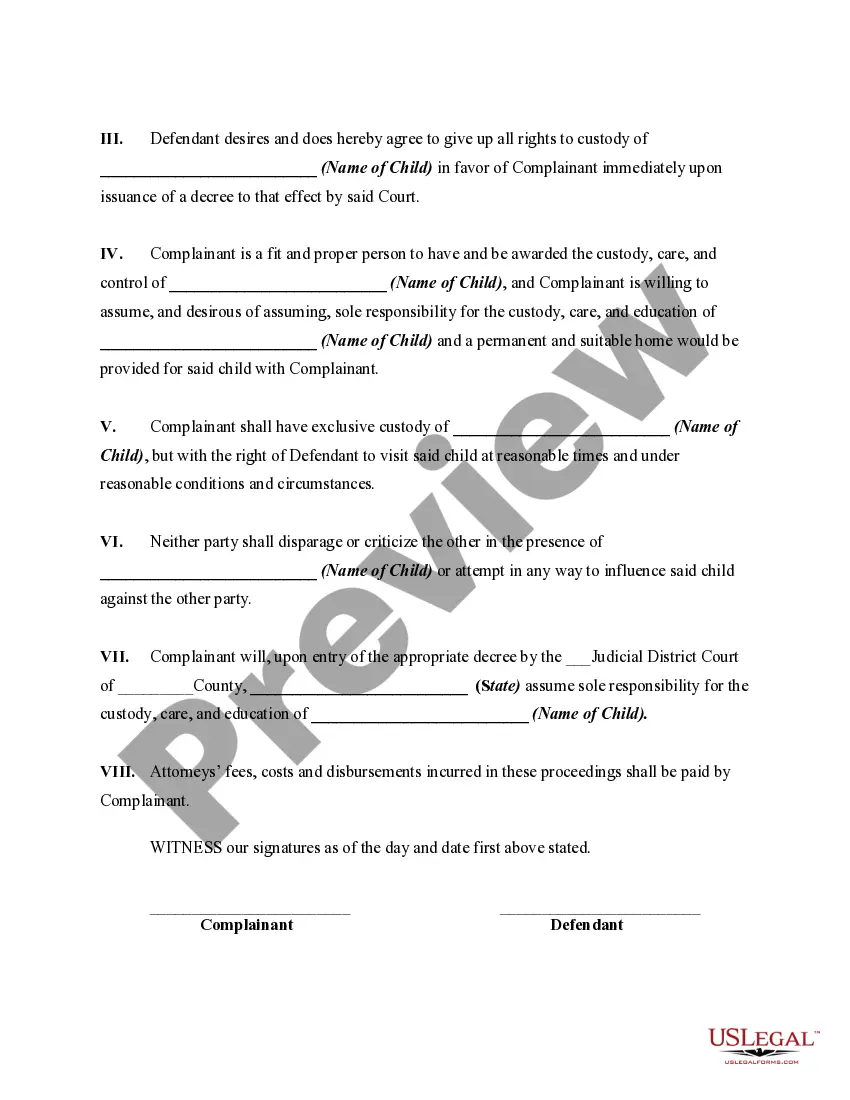
Agreement for Consent Judgment Granting Sole Custody of Minor Child to Father
Understanding this form
The Agreement for Consent Judgment Granting Sole Custody of Minor Child to Father is a legal document used by unmarried parents to formalize an agreement regarding child custody and support at the time of their breakup. This form specifically grants sole custody of a minor child to the father while allowing visitation rights to the mother. Unlike standard custody agreements, this consent judgment provides a judicial endorsement, making it enforceable by law unless modified.
Key parts of this document
- Jurisdiction: Identifies the court where the custody agreement is filed.
- Parental information: Details the Complainant (father) and Defendant (mother) including their names and addresses.
- Childâs details: Provides the name, date of birth, and hospital of the child.
- Custody arrangement: Outlines the fatherâs sole custody rights and motherâs visitation permissions.
- Mutual agreement: Affirms that both parents consent to the terms of the custody agreement.
- Judicial acknowledgment: Requires a judge's approval, making the agreement legally binding.

When this form is needed
This form is appropriate when unmarried parents are separating and wish to establish custody terms regarding their minor child. It is specifically useful for situations in which the father is seeking sole custody and the mother is agreeable to this arrangement. Using this consent judgment can help prevent future disputes and clarify parental rights and responsibilities.
Who should use this form
- Unmarried parents seeking to formalize custody agreements.
- Fathers who wish to gain sole custody of their child.
- Mothers consenting to the fatherâs sole custody but wishing to retain visitation rights.
- Those looking for a legally binding agreement that clarifies custody and support expectations.
Instructions for completing this form
- Identify the parties: Fill in the names and addresses of both the Complainant (father) and Defendant (mother).
- Enter child details: Provide the child's name, date of birth, and the location of birth.
- Specify custody terms: Clearly outline the custody and visitation rights as agreed upon.
- Sign the agreement: Both parties must sign the document in front of a judge.
- File with the court: Submit the completed form to the appropriate court for approval.
Is notarization required?
This form does not typically require notarization unless specified by local law. However, ensure that both parties sign in the presence of a judge as acknowledgment of the agreementâs terms. US Legal Forms provides integrated online notarization services for those who need it.
Get your form ready online
Our built-in tools help you complete, sign, share, and store your documents in one place.
Make edits, fill in missing information, and update formatting in US Legal Forms—just like you would in MS Word.
Download a copy, print it, send it by email, or mail it via USPS—whatever works best for your next step.
Sign and collect signatures with our SignNow integration. Send to multiple recipients, set reminders, and more. Go Premium to unlock E-Sign.
If this form requires notarization, complete it online through a secure video call—no need to meet a notary in person or wait for an appointment.
We protect your documents and personal data by following strict security and privacy standards.

Make edits, fill in missing information, and update formatting in US Legal Forms—just like you would in MS Word.

Download a copy, print it, send it by email, or mail it via USPS—whatever works best for your next step.

Sign and collect signatures with our SignNow integration. Send to multiple recipients, set reminders, and more. Go Premium to unlock E-Sign.

If this form requires notarization, complete it online through a secure video call—no need to meet a notary in person or wait for an appointment.

We protect your documents and personal data by following strict security and privacy standards.
Avoid these common issues
- Failing to provide complete and accurate details of both parents and the child.
- Not specifying the terms of visitation for the non-custodial parent.
- Overlooking the need for a judgeâs signature for the agreement to be enforceable.
- Neglecting to review state-specific custody laws that could impact the agreement.
Benefits of completing this form online
- Convenience: Downloadable and editable from the comfort of home.
- Reliability: Created by licensed attorneys to ensure legal soundness.
- Time-saving: Quickly fill out and submit without needing to draft a document from scratch.
Legal use & context
- The agreement is enforceable in court once approved by a judge.
- Both parties must mutually agree to the terms for the consent judgment to be valid.
- Noncompliance by either party can result in legal repercussions, including modification of custody arrangements.
Quick recap
- This form is essential for unmarried parents who need to formalize custody arrangements.
- Both parents must agree to the terms for the custody judgment to be legally binding.
- Fill out the agreement completely and ensure it complies with local laws to avoid complications.
Looking for another form?

Form popularity
FAQ
If you and the other parent agree on sole custody, the judge will typically approve your agreement. If the other parent does not contest your request for sole custody, the lack of interest will typically compel a judge to award sole custody.
Sole legal custody (also called sole parental responsibility) is when one parent has full responsibility to make major decisions for the child. The other parent doesn't have a say, but often has visitation rights and the responsibility to pay child support.
It's hard to get sole legal custody if there are no significant issues with the other parent and the other parent can effectively be involved in major decisions for the child. And it's hard to get sole physical custody if it's in the best interest of the child to spend at least half the time with the other parent.
When a parent is awarded full custody, they are the only parent entrusted with both legal and physical custody.Sole custody generally means that the non custodial parent was not awarded any visitation or custody rights.
Sole legal custody (also called sole parental responsibility) is when one parent has full responsibility to make major decisions for the child. The other parent doesn't have a say, but often has visitation rights and the responsibility to pay child support.
Write clearly, and use your own words. Use bulleted lists for your major points. Don't insult or bash your ex. Attach evidence such as pay stubs or bank statements, but redact SSN and account numbers. Affirm that you are making your statement under oath, and under penalty of perjury.
Drug or alcohol abuse. Physical abuse or neglect. Mental health issues. Money issues. Stability of the home.
The clearest reason to ask for sole custody is to protect your child from physical harm, especially if the other parent has a history of any of the following issues: ABUSE: If a parent has assaulted or sexually abused the other parent or any child, this presents an obvious danger to their child.
In writing your own custody and support agreement, you should use language that reflects your willingness to cooperate with the other parent. The tone should be positive and indicate that both parties are willing to comply with the terms of the document. If written this way, a judge is more likely to approve its terms.