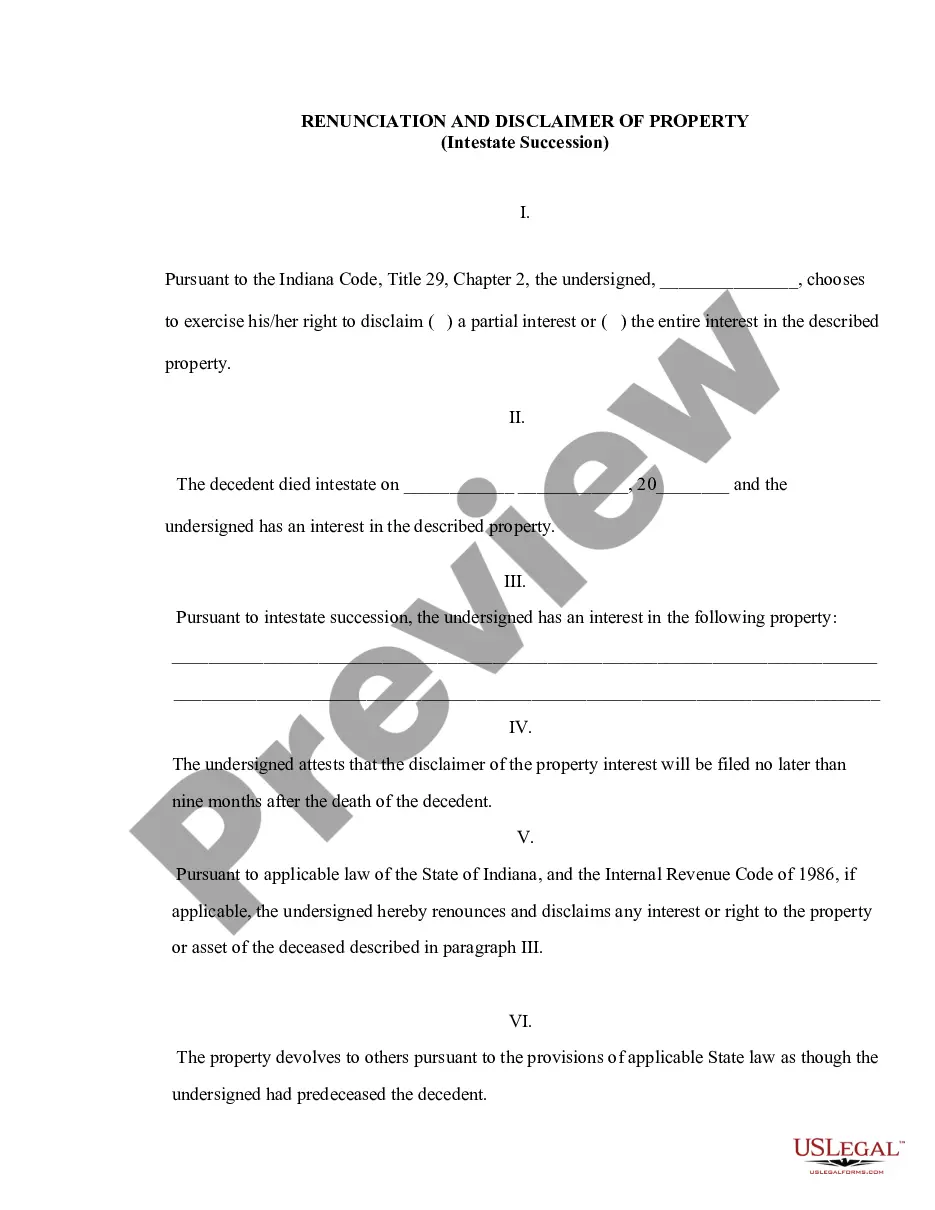
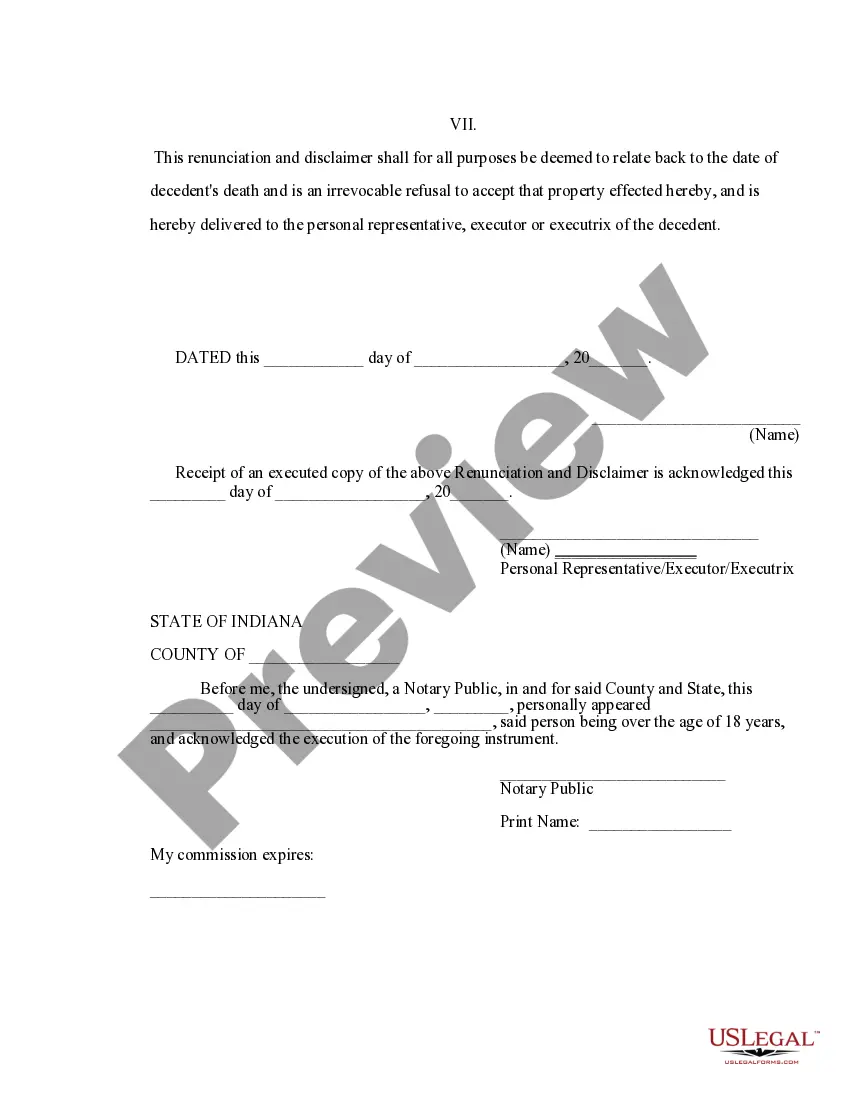
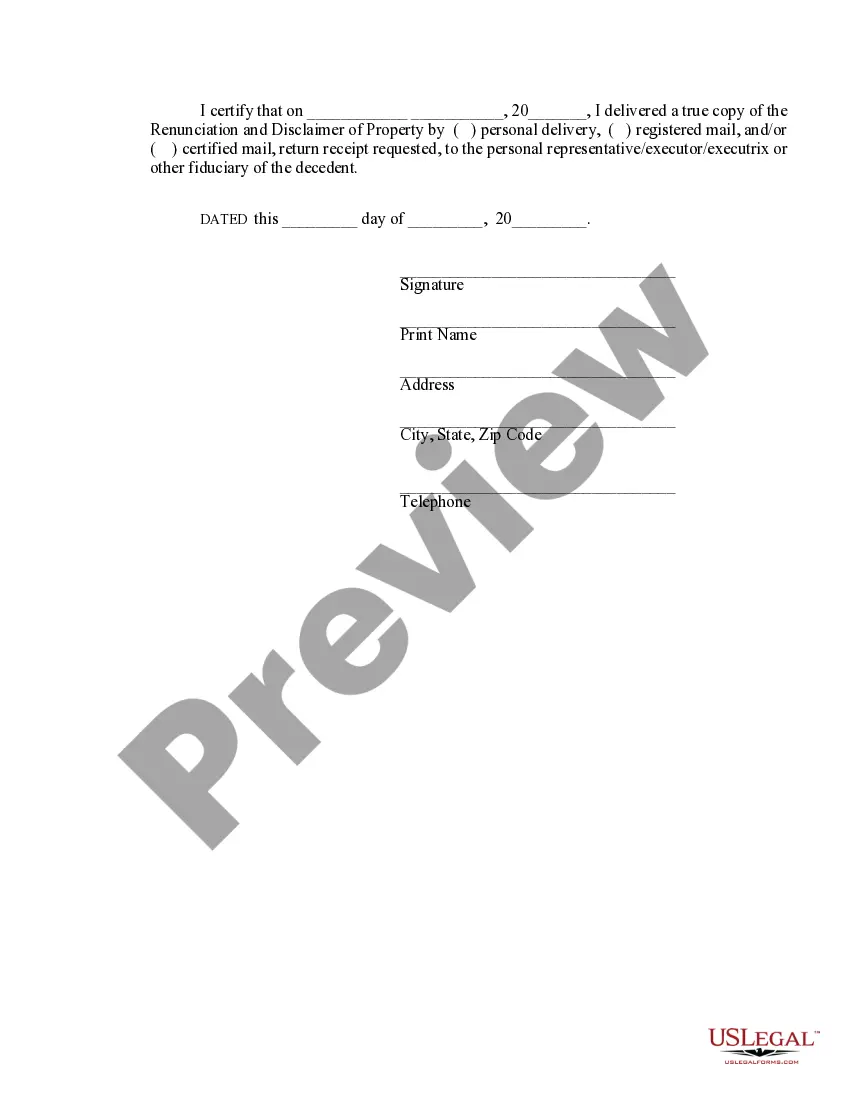
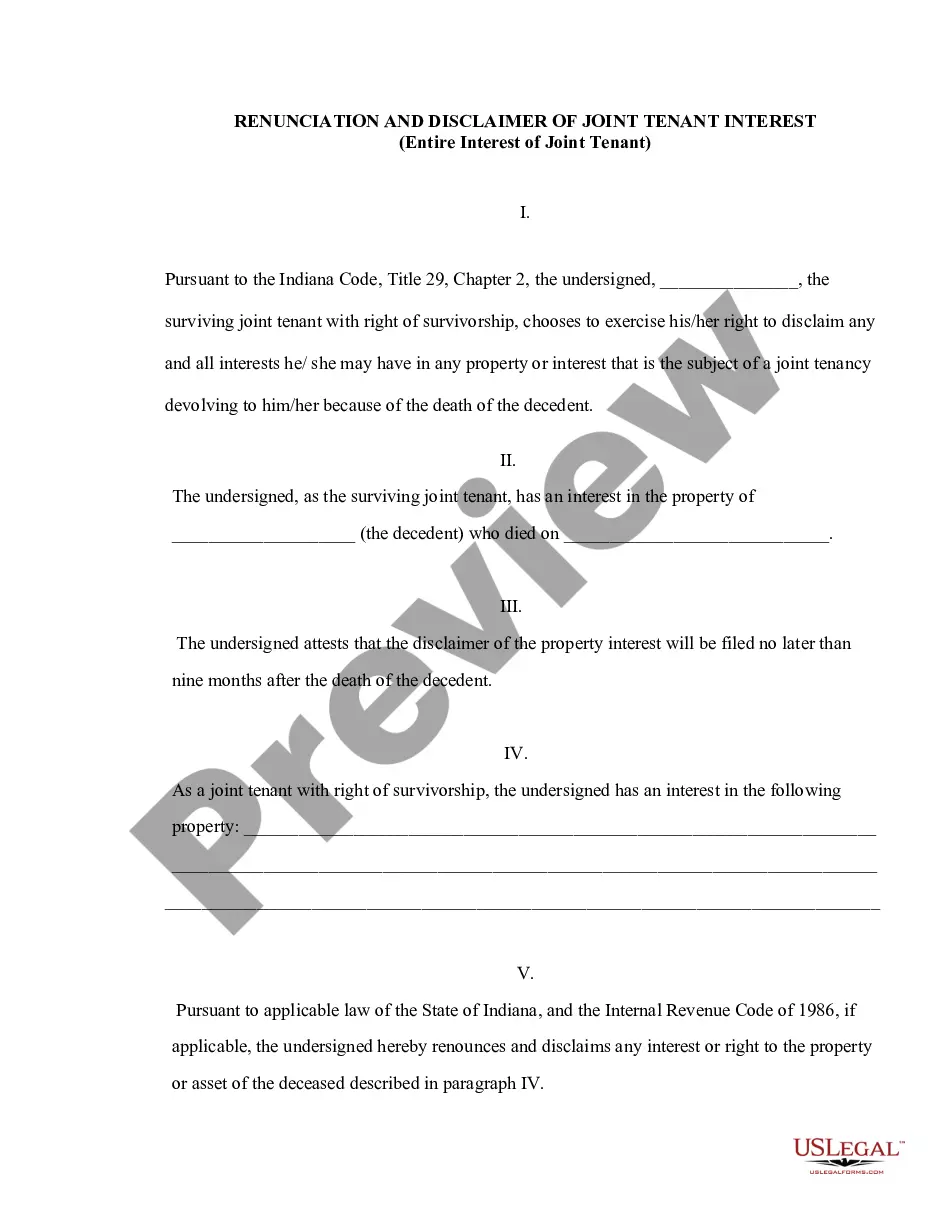
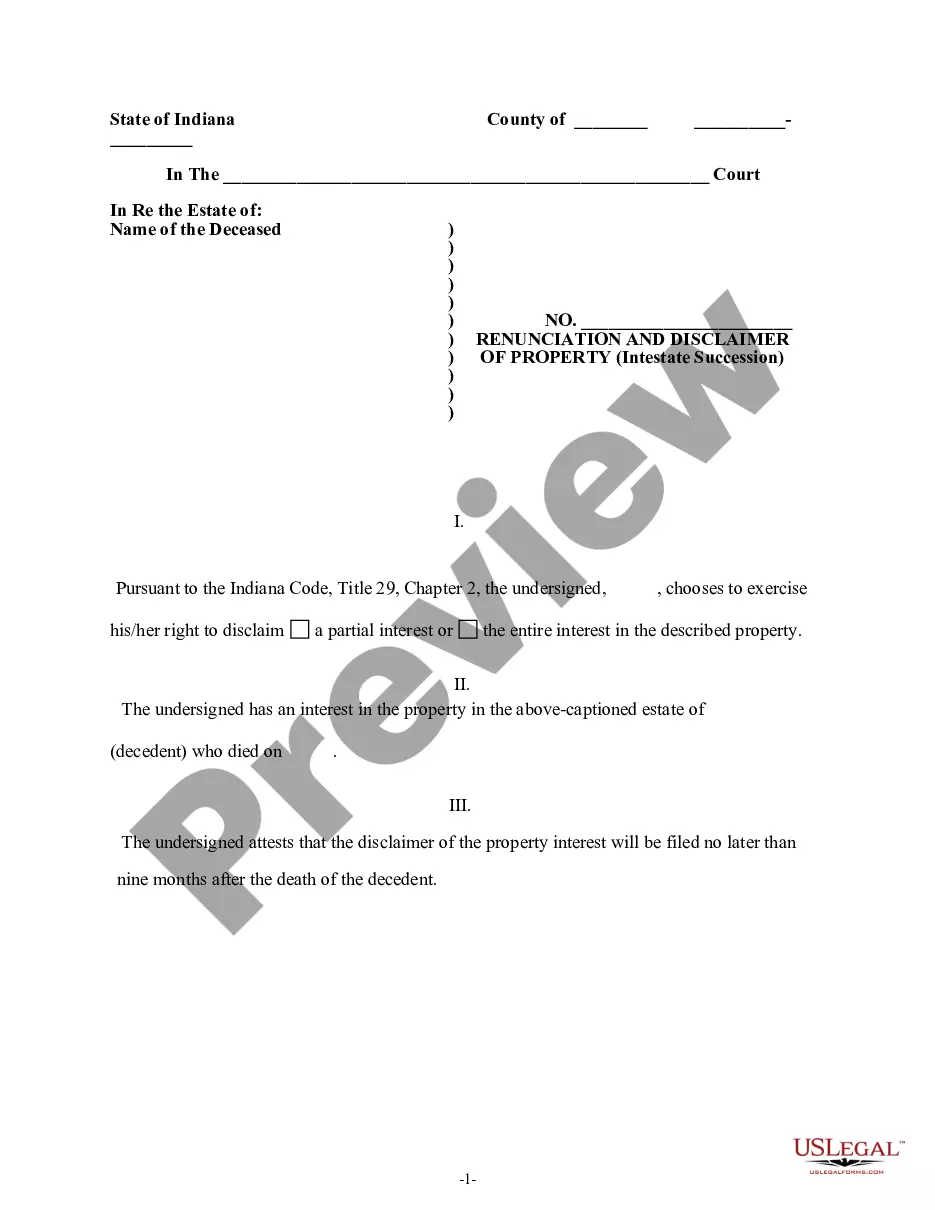
This form is a Renunciation and Disclaimer of Property acquired by the beneficiary through intestate succession. The decedent died intestate and the beneficiary gained an interest in the described property of the decedent. However, pursuant to the Indiana Code, Title 29, Chapter 2, the beneficiary wishes to disclaim a portion of or the entire interest in the property. The beneficiary attests that the disclaimer will be filed no later than nine months after the death of the decedent. The form also contains a state specific acknowledgment and a certificate to verify delivery.
Indiana Renunciation and Disclaimer of Property received by Intestate Succession
State:
Indiana
Control #:
IN-01-03
Format:
Word;
Rich Text
Instant download
Description
Free preview
How to fill out Indiana Renunciation And Disclaimer Of Property Received By Intestate Succession?
Searching for Indiana Renunciation and Disclaimer of Property acquired through Intestate Succession templates and completing them can be rather difficult.
To conserve time, expenses, and effort, utilize US Legal Forms and select the proper sample specifically for your state within a few clicks.
Our attorneys prepare every single document, so you simply need to complete them. It's genuinely that simple.
Hit the Buy Now button if you found what you're seeking. Select your plan on the pricing page and create your account. Indicate if you want to pay via card or PayPal. Download the form in your preferred file format. You can print the Indiana Renunciation and Disclaimer of Property received by Intestate Succession template or complete it using any online editor. Don’t worry about making typing errors because your form can be utilized, sent, and printed as many times as you desire. Explore US Legal Forms and gain access to over 85,000 state-specific legal and tax documents.
- Log in to your account and navigate back to the form's webpage and store the sample.
- Your downloaded templates are kept in My documents and are available at any time for further use later.
- If you haven’t signed up yet, you ought to register.
- Check out our comprehensive instructions on how to obtain your Indiana Renunciation and Disclaimer of Property received by Intestate Succession template in just a few moments.
- To acquire a qualified form, verify its applicability for your state.
- Examine the form using the Preview option (if available).
- If there's a description, read through it to understand the key details.
Form popularity
FAQ
Disclaim the asset within nine months of the death of the assets' original owner (one exception: if a minor beneficiary wishes to disclaim, the disclaimer cannot take place until after the minor reaches the age of majority, at which time they will have nine months to disclaim the assets).
Disclaim, in a legal sense, refers to the renunciation of an interest in, or an acceptance of, inherited assets, such as property, by way of a legal instrument. A person disclaiming an interest, right, or obligation is known as a disclaimant.
In the law of inheritance, wills and trusts, a disclaimer of interest (also called a renunciation) is an attempt by a person to renounce their legal right to benefit from an inheritance (either under a will or through intestacy) or through a trust.A disclaimer of interest is irrevocable.
The answer is yes. The technical term is "disclaiming" it. If you are considering disclaiming an inheritance, you need to understand the effect of your refusalknown as the "disclaimer"and the procedure you must follow to ensure that it is considered qualified under federal and state law.
The beneficiary can disclaim only a portion of an inherited IRA or asset, allowing some to flow to the contingent beneficiary(s). Partial disclaiming is either a specific dollar or percentage amount as of the date of death.The balance will go to the next beneficiary(s).