Parent - Child Citizenship Contract
Overview of this form
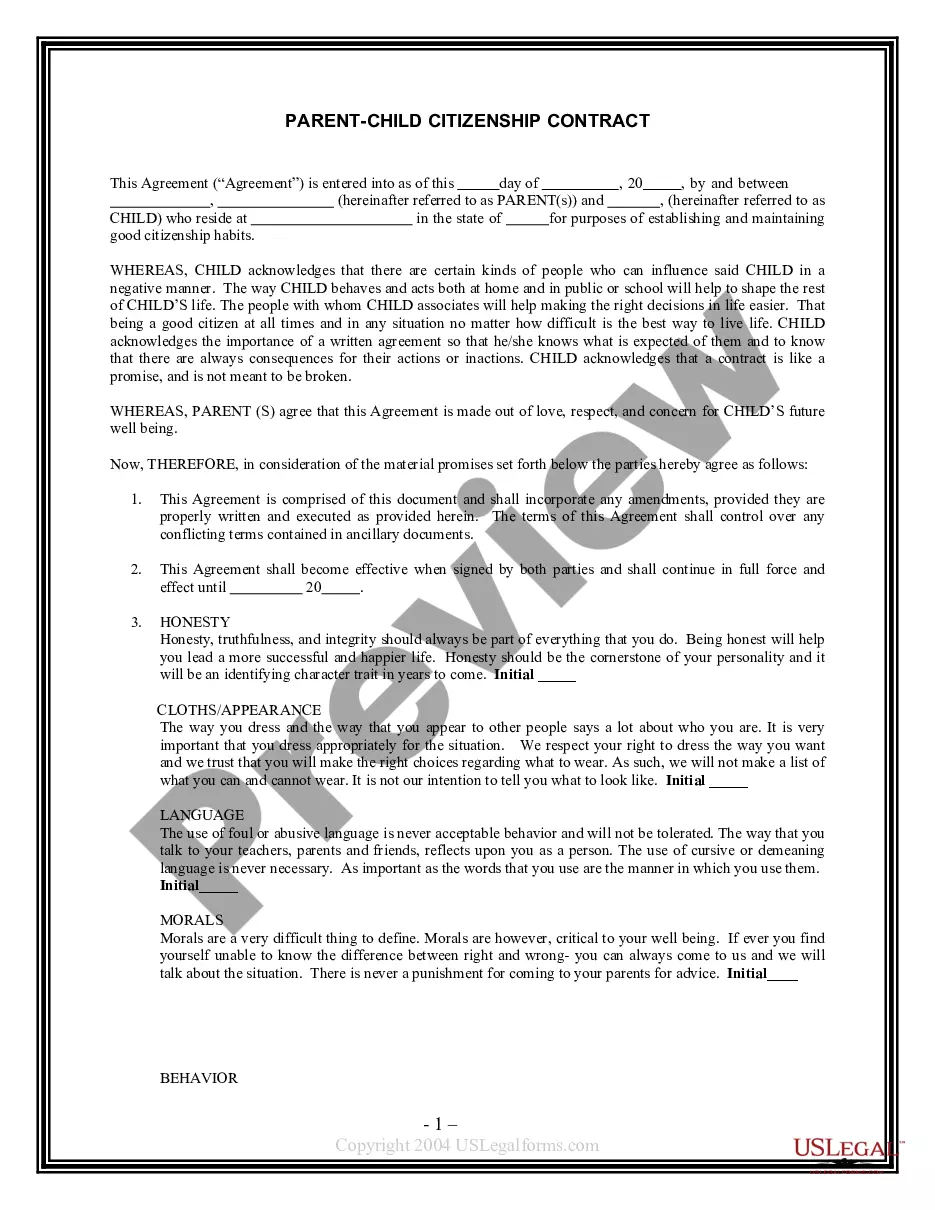
The Parent - Child Citizenship Contract is a legally binding agreement between parents and their child that outlines expected behaviors and responsibilities in daily life. This form focuses on establishing guidelines for conduct, language usage, and appearance, while also detailing a system of privileges based on compliance. Unlike other forms of contracts, this document is specifically tailored to promote ethical behavior and support the child's growth in a structured environment.
Form components explained
- Preamble stating the purpose and mutual commitment of the parent(s) and child.
- Dress code expectations regarding appropriateness and personal expression.
- Language guidelines that prohibit the use of foul or abusive language.
- Morality discussions encouraging open dialogue between parents and child.
- Behavior expectations emphasizing respect and the Golden Rule.
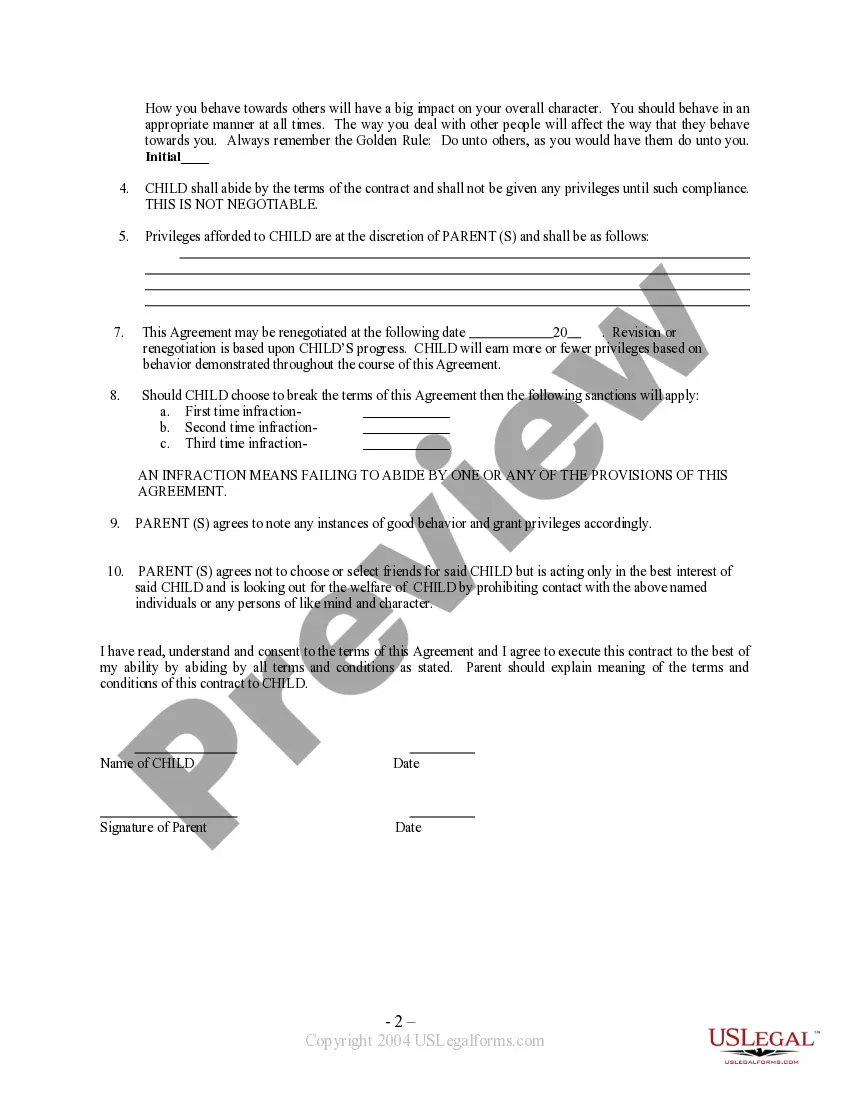
- Details concerning the granting or withdrawing of privileges based on behavior.
When to use this form
This contract is useful for parents who want to set clear boundaries and expectations for their child's behavior. It can help when instilling values, building accountability, and creating a structured environment that encourages good decision-making. Use this form if your child is struggling with behavior issues or if you want to proactively establish family guidelines.
Who can use this document
- Parents seeking to improve communication and behavior management with their children.
- Guardians wishing to establish clear expectations for minors in their care.
- Families looking for a structured approach to discipline and rewards.
Instructions for completing this form
- Identify the parties involved, including the parent(s) and child.
- Review and discuss the key behavioral expectations and values outlined in the contract.
- Have each party initial next to the defined sections to signify understanding and agreement.
- Complete any additional provisions regarding privileges and consequences for behavior.
- Sign and date the contract to make it effective.
Does this document require notarization?
This form does not typically require notarization unless specified by local law. It should be signed in presence of all parties involved to ensure mutual consent and understanding.
Get your form ready online
Our built-in tools help you complete, sign, share, and store your documents in one place.
Make edits, fill in missing information, and update formatting in US Legal Forms—just like you would in MS Word.
Download a copy, print it, send it by email, or mail it via USPS—whatever works best for your next step.
Sign and collect signatures with our SignNow integration. Send to multiple recipients, set reminders, and more. Go Premium to unlock E-Sign.
If this form requires notarization, complete it online through a secure video call—no need to meet a notary in person or wait for an appointment.
We protect your documents and personal data by following strict security and privacy standards.

Make edits, fill in missing information, and update formatting in US Legal Forms—just like you would in MS Word.

Download a copy, print it, send it by email, or mail it via USPS—whatever works best for your next step.

Sign and collect signatures with our SignNow integration. Send to multiple recipients, set reminders, and more. Go Premium to unlock E-Sign.

If this form requires notarization, complete it online through a secure video call—no need to meet a notary in person or wait for an appointment.

We protect your documents and personal data by following strict security and privacy standards.
Mistakes to watch out for
- Failing to review the terms with the child prior to signing.
- Not updating the contract as the child's behavior or needs change.
- Neglecting to clearly define privileges and consequences, leading to confusion.
Benefits of completing this form online
- Convenient access to legal templates that simplify the contract creation process.
- Editable format allows for customization to fit individual family dynamics.
- Reliability through professionally drafted content, ensuring legal soundness.
Summary of main points
- The Parent - Child Citizenship Contract sets clear expectations for a child's behavior.
- It is a tool for fostering open communication about morals and responsibilities.
- This contract allows for flexibility in modulating privileges based on behavior.
Looking for another form?
Form popularity
FAQ
If you are a U.S. citizen (or non-citizen national) and have a child overseas, you should report their birth at the nearest U.S. embassy or consulate as soon as possible so that a Consular Report of Birth Abroad (CRBA) can be issued as an official record of the child's claim to U.S. citizenship or nationality.
A child can also obtain U.S. citizenship through parents after his or her birth. Derivative citizenship may be established after birth but before the age of 18.At least one of the child's parents is a U.S. citizen by birth or naturalization; The child is a permanent resident under 18 years of age; and.
Applying for the Certificate of Citizenship (N-600) If you are the U.S. citizen parent of a minor child, you can help your child get a certificate of citizenship. You need to fill out and file Form N-600 Application for Certificate of Citizenship. If your child is over 18, they need to sign the form themselves.
Applying for the Certificate of Citizenship (N-600) If you are the U.S. citizen parent of a minor child, you can help your child get a certificate of citizenship. You need to fill out and file Form N-600 Application for Certificate of Citizenship. If your child is over 18, they need to sign the form themselves.
A child can also obtain U.S. citizenship through parents after his or her birth. Derivative citizenship may be established after birth but before the age of 18. If you have a parent that became a U.S. citizen after your birth and met a few other requirements, you could be a U.S. citizen automatically through this path.
A: To start the process to apply for parents to receive U.S. permanent residence (Green Card), you will need to fill out Form I-130, also called Petition for Alien Relative, issued by U.S. Citizenship and Immigration Services (USCIS). You need to prove your status as a U.S. citizen and the child-parent relationship.
Be under 18 years old when you become a citizen; Be a legal permanent resident (have a green card); Not be married; and. Live in the U.S. with you in your legal and physical custody.
A child can, under certain circumstances, acquire U.S. citizenship automatically through birth to U.S. citizen parents, no matter where the birth took place.A child who is born to U.S. citizen parents (or in some cases, to only one U.S. citizen parent) outside the U.S. may automatically become a U.S. citizen.
The child is legally present in the United States. The child is under 18 years of age. The child is in the legal and physical custody of the U.S. citizen parent; and. That U.S. citizen parent has been physically present in the U.S. for five years, two of which were after the parent turned 14 years of age.