Illinois Drainage Contractor Package
Understanding this form package
The Illinois Drainage Contractor Package is a comprehensive collection of legal forms designed specifically for drainage contractors. This package includes essential documentation for asserting legal rights and managing various legal aspects during construction projects, such as the installation of cesspools, septic tanks, and storm drains. Unlike other packages, this one focuses on state law compliance, ensuring that contractors operate within the legal framework established in Illinois.
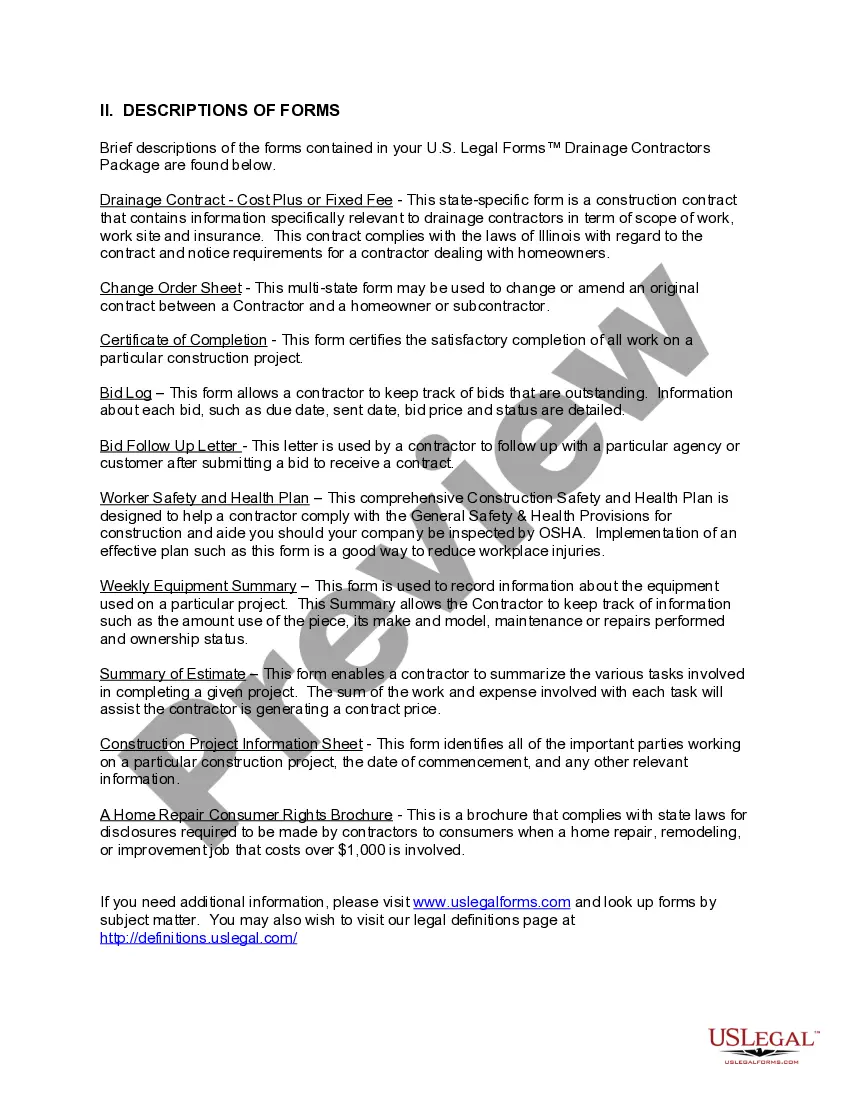
Documents contained in this package
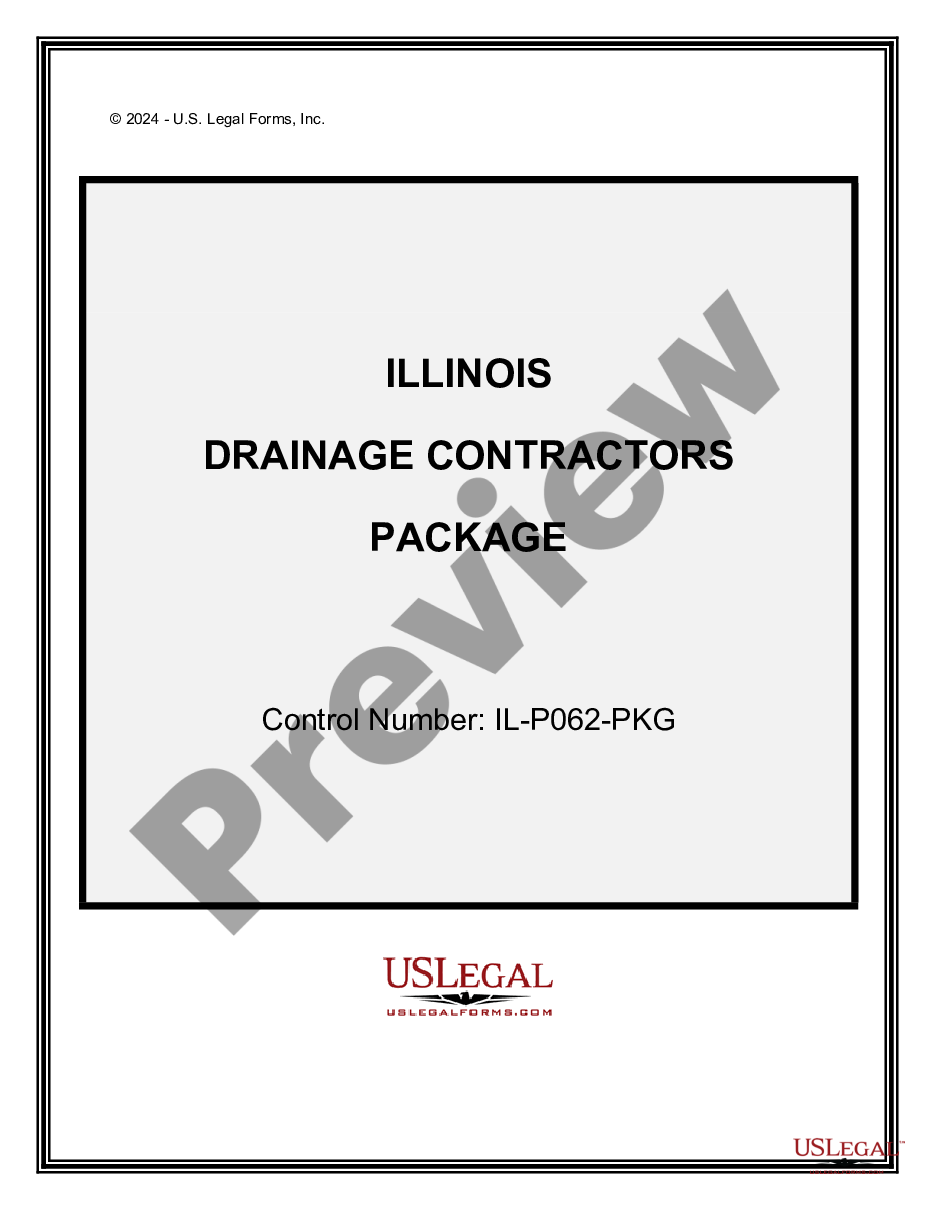
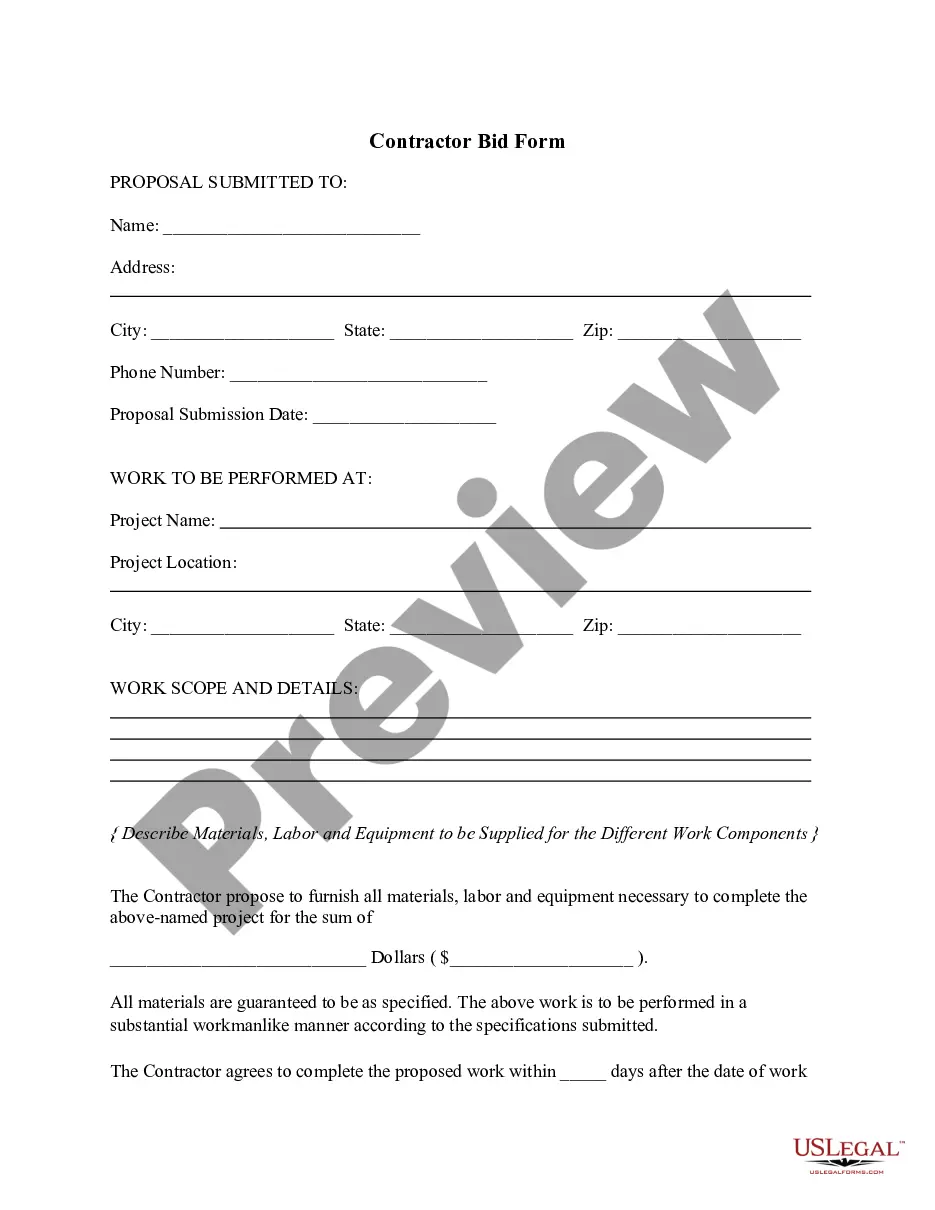
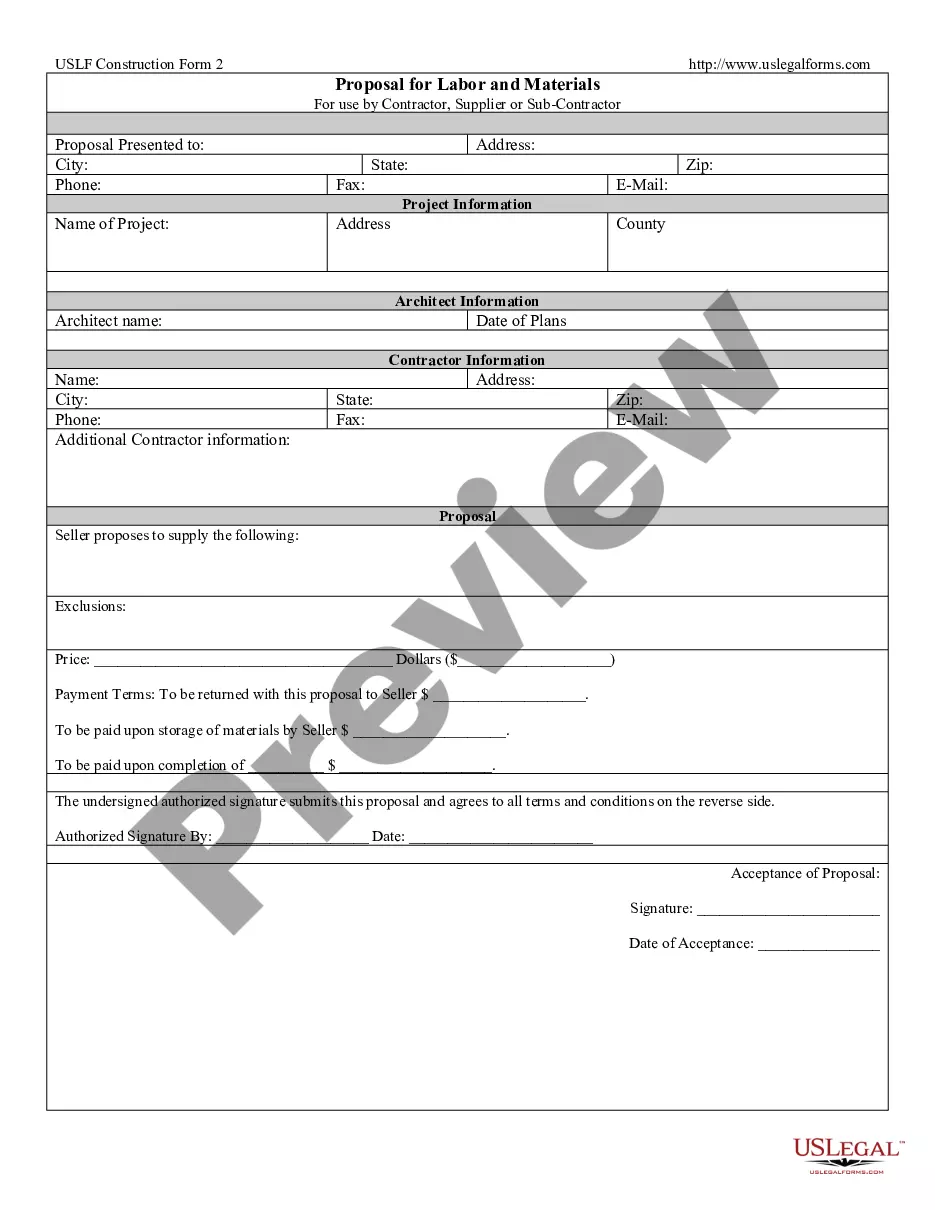
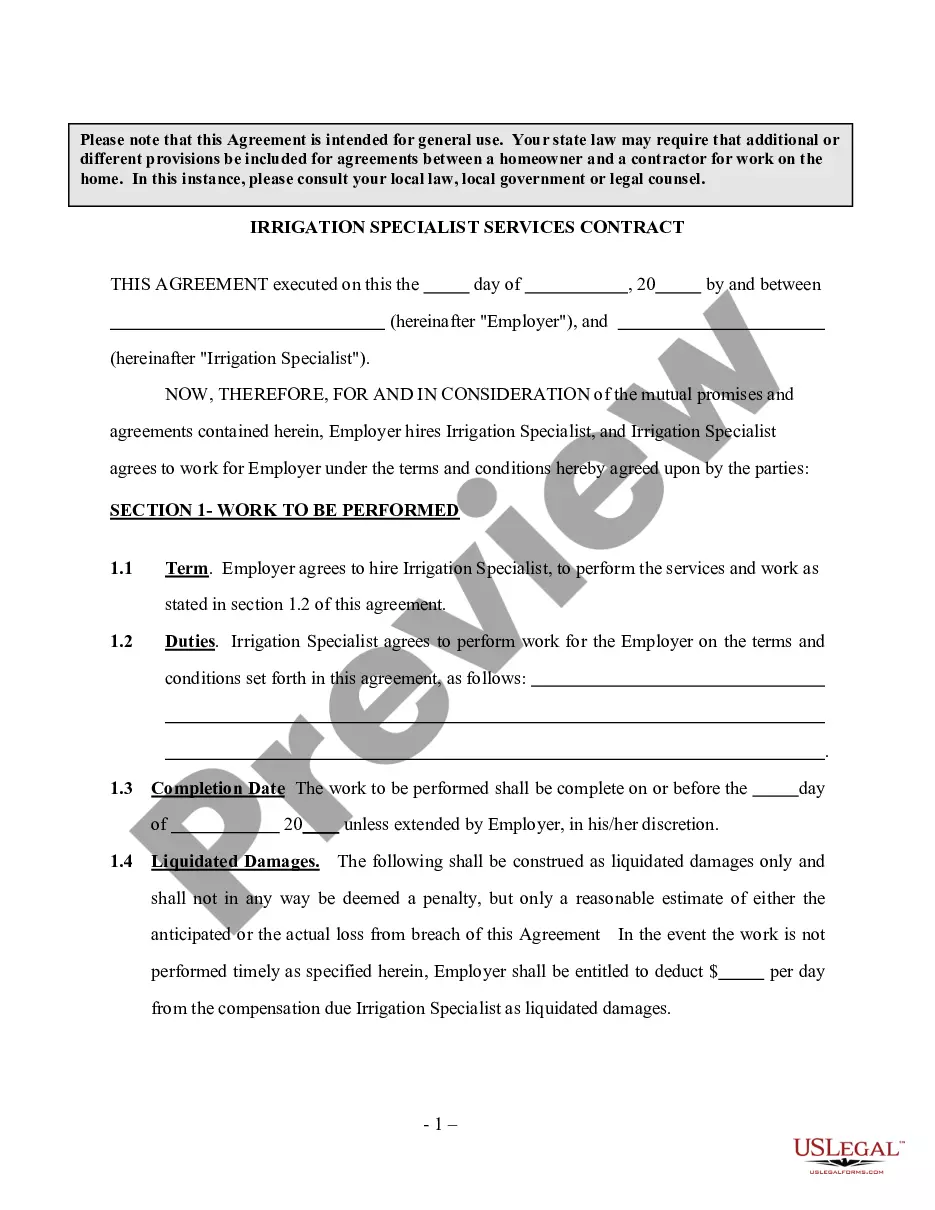
- Drainage Contract for Contractor
- Illinois Home Repair Consumer Rights Brochure
- Contractor's Weekly Equipment Summary
- Contractor's Bid Log
- Contractor's Bid Follow Up Letter
- Contractor's Summary of an Estimate
- Construction Safety and Health Plan
- Change Order for Construction or Repairs by Contractor
- Certification of Completion by Contractor
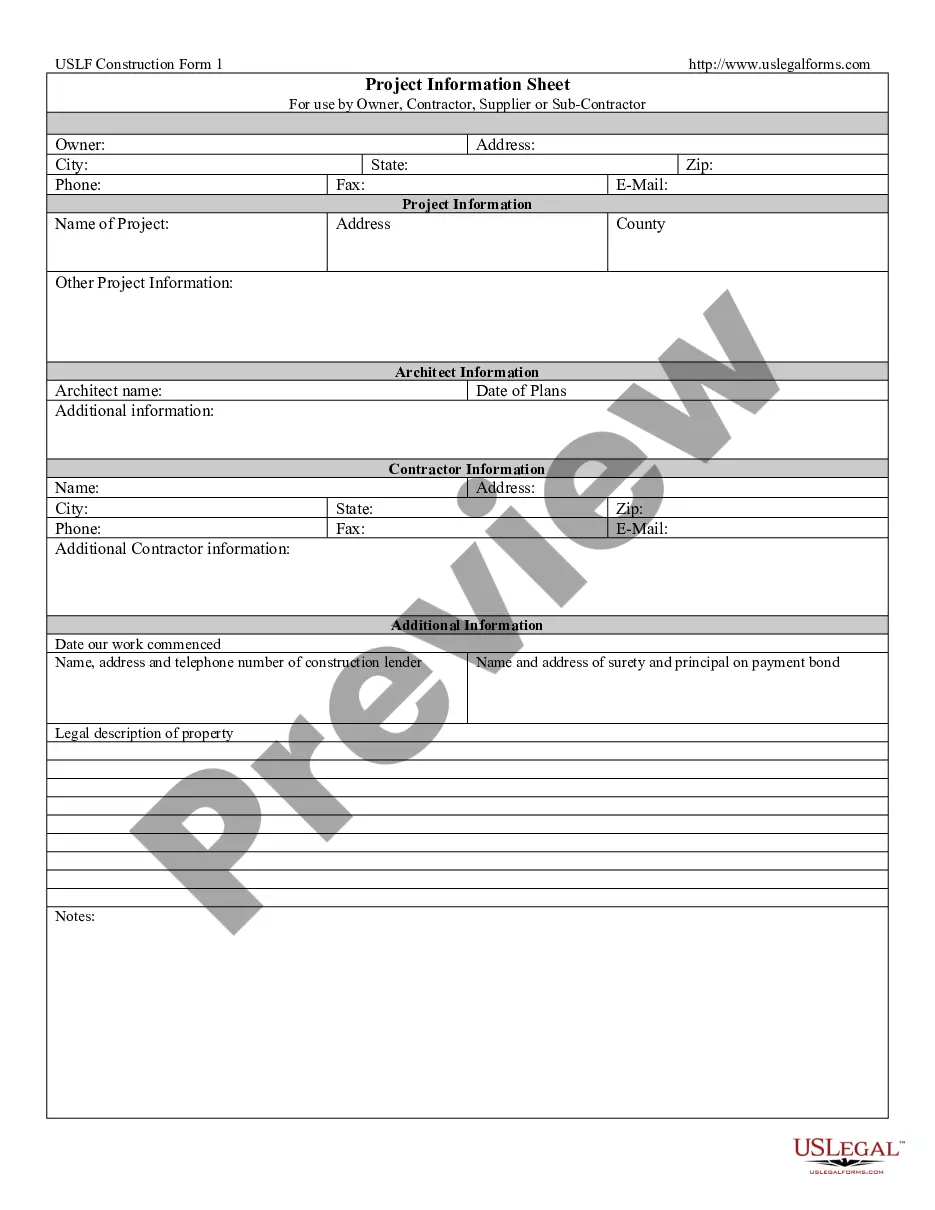
- Construction Project Information Sheet
Common use cases
You should consider using the Illinois Drainage Contractor Package when:
- You are entering into a contract for drainage services and need a legally binding document.
- You need to change or amend an existing contract for a project.
- You are tracking equipment usage and worker safety on a construction site.
- You are required to provide a certificate of completion upon finishing a project.
- You want to inform clients of their rights related to home repair and drainage work.
Intended users of this form package
- Drainage contractors working on residential or commercial projects.
- Subcontractors involved in drainage and plumbing work.
- Owners and suppliers related to drainage or sewage disposal services.
- Individuals navigating legal requirements for construction contracts and safety.
- Homeowners looking to understand their rights regarding drainage services.
Instructions for completing these forms
- Review the included forms thoroughly to understand their purpose.
- Identify all parties involved in the drainage project, including contractors, homeowners, and subcontractors.
- Fill in the required information, including dates, amounts, and signatures where indicated.
- Use the Construction Project Information Sheet to outline key project details.
- Complete the Weekly Equipment Summary and Worker Safety and Health Plan as required throughout the project.
Do forms in this package need to be notarized?
Notarization is not commonly needed for forms in this package. However, if your state’s laws require it, our notarization service, powered by Notarize, allows you to finalize documents online 24/7 without in-person visits.
Get your form ready online
Our built-in tools help you complete, sign, share, and store your documents in one place.
Make edits, fill in missing information, and update formatting in US Legal Forms—just like you would in MS Word.
Download a copy, print it, send it by email, or mail it via USPS—whatever works best for your next step.
Sign and collect signatures with our SignNow integration. Send to multiple recipients, set reminders, and more. Go Premium to unlock E-Sign.
If this form requires notarization, complete it online through a secure video call—no need to meet a notary in person or wait for an appointment.
We protect your documents and personal data by following strict security and privacy standards.

Make edits, fill in missing information, and update formatting in US Legal Forms—just like you would in MS Word.

Download a copy, print it, send it by email, or mail it via USPS—whatever works best for your next step.

Sign and collect signatures with our SignNow integration. Send to multiple recipients, set reminders, and more. Go Premium to unlock E-Sign.

If this form requires notarization, complete it online through a secure video call—no need to meet a notary in person or wait for an appointment.

We protect your documents and personal data by following strict security and privacy standards.
Common mistakes
- Failing to include all relevant parties in the Drainage Contract.
- Overlooking required signatures on critical documents like the Certificate of Completion.
- Not keeping accurate records in the Bid Log or Weekly Equipment Summary.
- Neglecting to update the Change Order Sheet when modifications are made to the project plans.
Advantages of online completion
- Instant access to all necessary legal forms tailored for drainage contractors.
- Forms are easy to download and complete electronically for convenience.
- Reduces costs by providing a comprehensive package that saves over 50% compared to purchasing forms separately.
- Forms are reviewed by licensed attorneys for reliability and legal accuracy.
Looking for another form?
Form popularity
FAQ
Your local authority is only responsible for the drain gullies on highways. Private land, or the land for which you are responsible, usually extends to the boundary of your garden or driveway. If you are based on a country road, any leaks on the road itself and road drains are the responsibility of the local authority.
Contact Your Local CouncilYour local council will likely have some sort of copy of the drainage plans for your property that can be obtained for a small fee.
The highest point of a manhole (or other access chamber) is the cover level (CL), which is the height of the cover above a benchmark level, and the difference between Cover Level (CL) and Invert level (IL) is the overall depth of the chamber.
Generally speaking, you're usually responsible for drains inside the boundaries of your property, while the sewerage company is responsible for lateral drains, which are usually outside of property boundaries, and sewers.
Municipal drainage plans provide details of legal points of discharge for stormwater drainage. They may also provide surface levels. Water authority documentation such as a sewer plan provides details of plumbing fixtures, drainage lines and points of attachment to existing building(s) on a site.
A highway drain is the pipe connecting the highway gully to the surface water sewer. In some circumstances the highway drain may outfall into rivers, ponds, soakaway etc.
The Council may hold your drainage plans. Ask for drainage plans from the previous owner. Ask your neighbours for drainage plans. You have no obligation to submit your drainage plan to authorities.
If each party is found to be reasonable in the use of the land, the upper owner will ultimately be responsible for any damages to the lower owner caused by the runoff. If the lower owner is shown to have acted unreasonably, the upper owner can be protected from liability.
Depending on when a road was built or the type of thoroughfare, ditches are public property either by right-of-way or deed.Ditches are built to maintain roads, keeping water from washing them out or eroding them away, contrary to some in the county who wrongly believe they exist to serve their needs, he said.