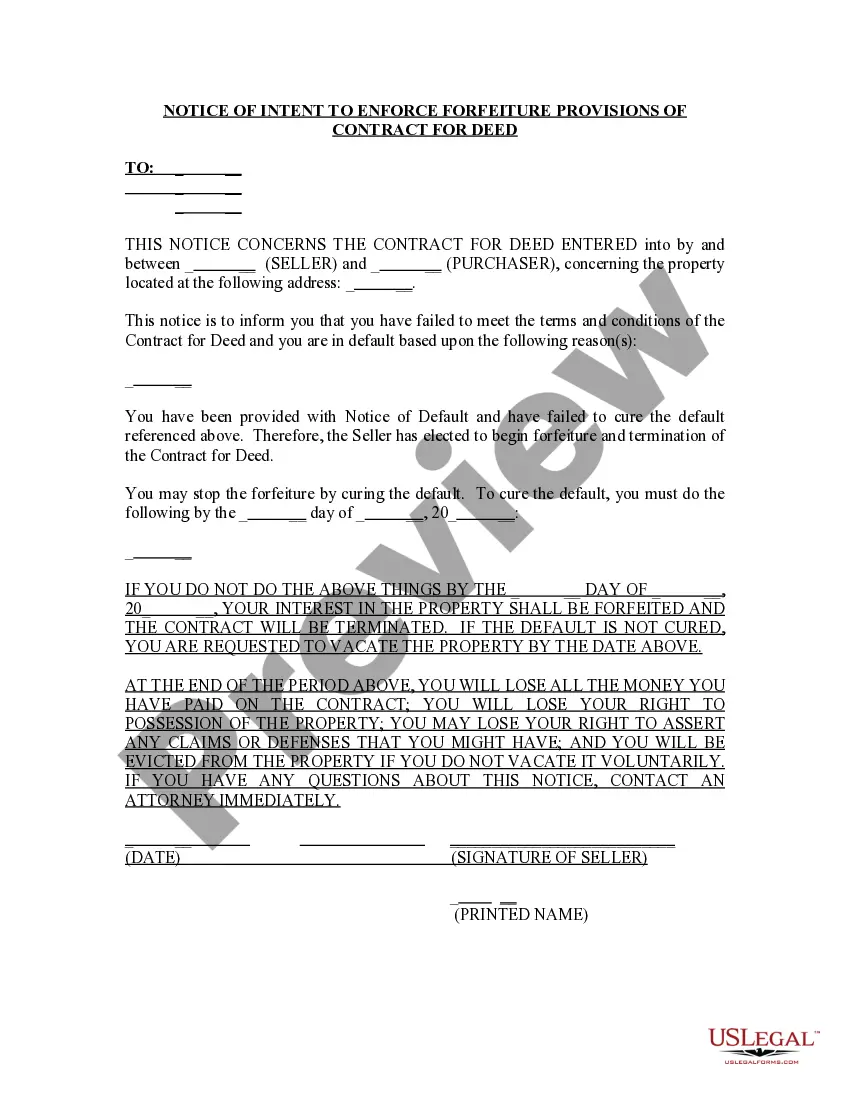
This Notice of Intent to Enforce Forfeiture Provisions of Contract for Deed is an initial notice of Seller's intent to enforce the forfeiture remedy of contract for deed if nonpayment or other breach is not cured. It is used specifically to inform the buyer that he/she has failed to meet the terms and conditions of the Contract for Deed and as a result, are in default based upon the reasons specified.
Arizona Notice of Intent to Enforce Forfeiture Provisions of Contact for Deed
State:
Arizona
Control #:
AZ-00470-11
Format:
Word;
Rich Text
Instant download
Description
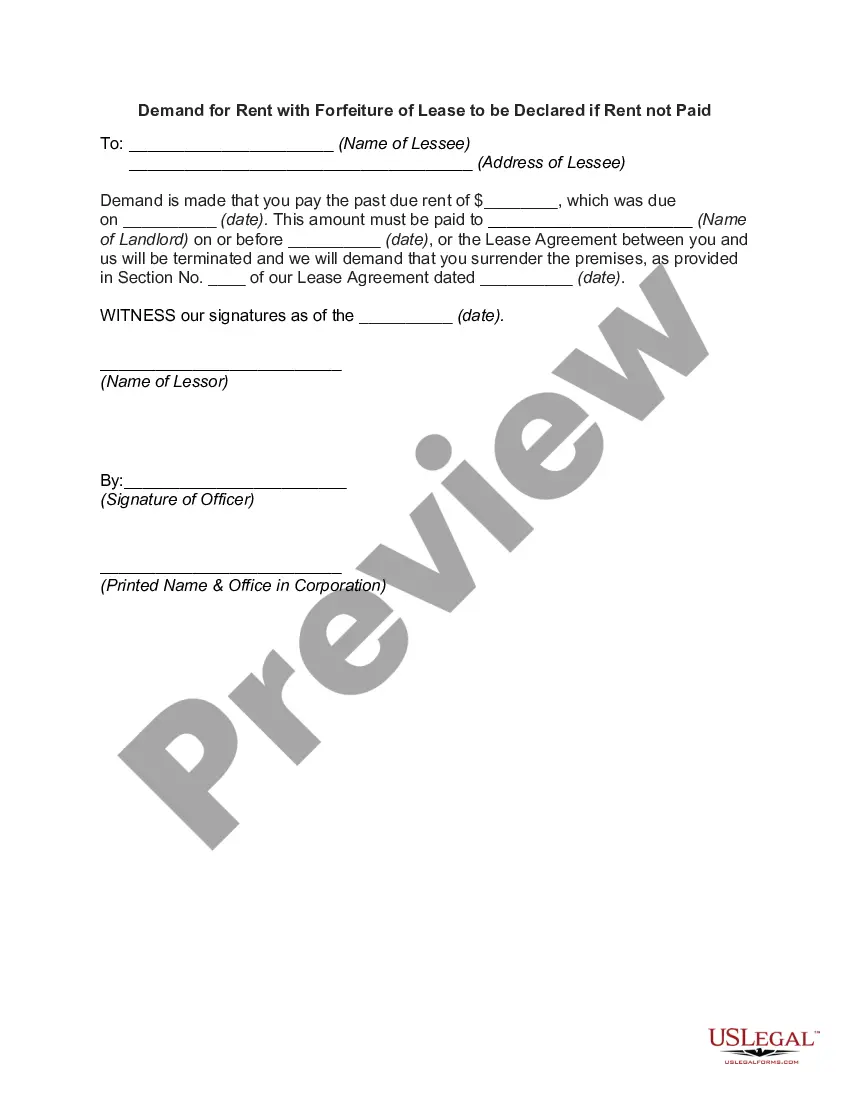
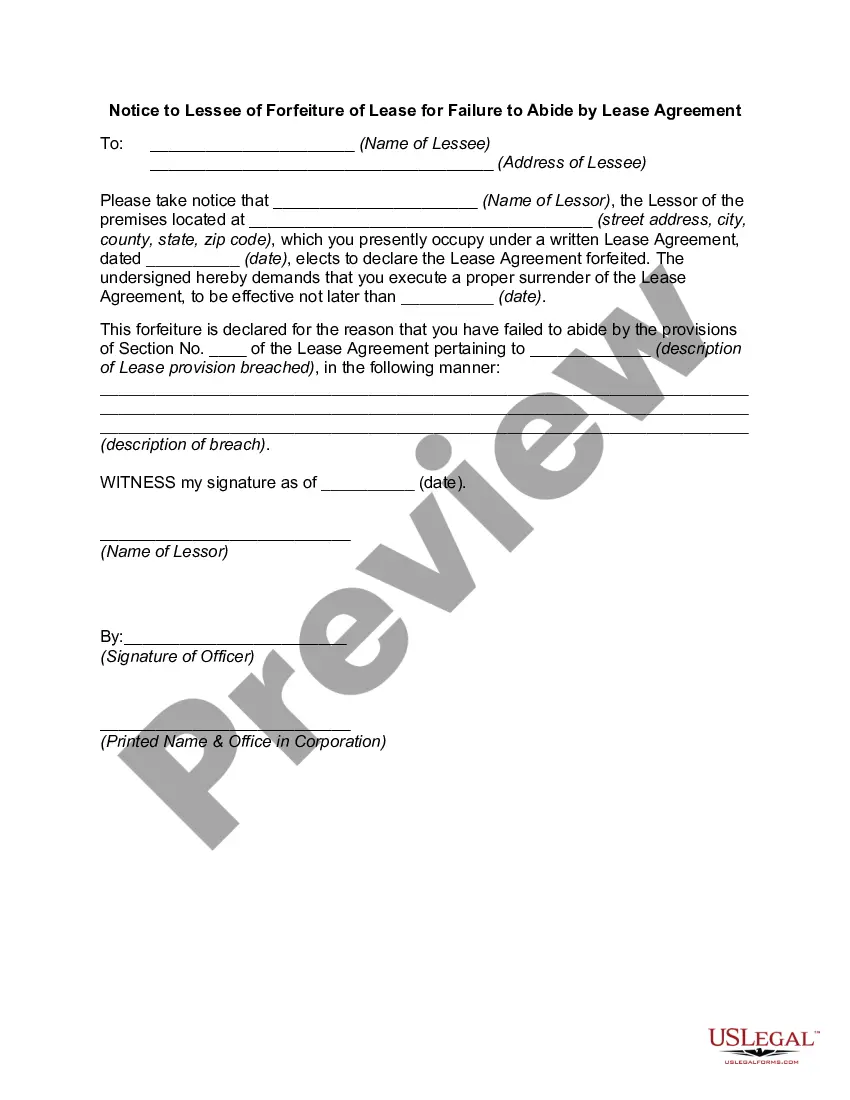




How to fill out Arizona Notice Of Intent To Enforce Forfeiture Provisions Of Contact For Deed?
Utilize US Legal Forms to acquire a printable Arizona Notice of Intent to Enforce Forfeiture Clauses of Contract for Deed.
Our legally admissible forms are composed and frequently revised by experienced attorneys.
Ours is the most extensive Forms collection on the internet and provides cost-effective and precise templates for clients, lawyers, and small to medium-sized businesses.
Press Buy Now if it's the template you require. Set up your account and make payment via PayPal or credit card. Download the template to your device and feel free to reuse it numerous times. Employ the search feature if you need to locate another document template. US Legal Forms offers a vast assortment of legal and tax samples and packages for business and individual needs, including Arizona Notice of Intent to Enforce Forfeiture Clauses of Contract for Deed. Over three million users have successfully utilized our service. Select your subscription plan and obtain high-quality documents in a few clicks.
- The templates are organized into state-specific categories, and several can be previewed prior to downloading.
- To download samples, users must possess a subscription and Log In to their account.
- Click Download next to any template required and locate it in My documents.
- For those lacking a subscription, adhere to the following suggestions to swiftly locate and download Arizona Notice of Intent to Enforce Forfeiture Clauses of Contract for Deed.
- Ensure you have the accurate form pertaining to the state in which it is needed.
- Examine the document by reading the description and utilizing the Preview feature.
Form popularity
FAQ
In Arizona, real estate contracts are generally assignable unless specified otherwise within the agreement. This assignability can be advantageous for parties seeking to transfer their obligations and rights. Always consider consulting resources on the Arizona Notice of Intent to Enforce Forfeiture Provisions of Contract for Deed to ensure compliance with relevant laws.
A contract may be signed as a deed to provide additional legal strength and enforceability. Signing a contract in this manner often implies a higher level of formality and commitment from the parties involved. When navigating situations like the Arizona Notice of Intent to Enforce Forfeiture Provisions of Contract for Deed, understanding this distinction can help clarify your legal standing.
Yes, contracts for deed are legal in Arizona and can be a beneficial option for certain buyers and sellers. These agreements allow buyers to make payments while retaining possession of the property, which can be compelling. However, knowing about the Arizona Notice of Intent to Enforce Forfeiture Provisions of Contract for Deed is vital to protect your interests.
Yes, Arizona is a deed state, meaning that property transfers generally utilize a deed. However, contracts for deed can also play a significant role in real estate transactions. Knowledge of the Arizona Notice of Intent to Enforce Forfeiture Provisions of Contract for Deed is crucial for anyone involved in these agreements.
A notice of termination of contract for deed formally informs the parties that the contract has been terminated. This notice is often linked to breaches or failure to comply with terms. Understanding your rights under the Arizona Notice of Intent to Enforce Forfeiture Provisions of Contract for Deed can significantly impact your position in such situations.
In Arizona, a valid contract requires an offer, acceptance, consideration, and mutual consent between the parties. Additionally, the contract must have a legal purpose and the parties involved must have the capacity to enter into the agreement. Understanding these elements is essential, especially in matters related to the Arizona Notice of Intent to Enforce Forfeiture Provisions of Contract for Deed.